

Dark inner thighs often come from friction and irritation: where skin rubs, sweats, or gets inflamed, it can make extra melanin, and melanin-rich skin does this easily. That color usually fades once the irritation stops. Darkening that feels velvety or thick, or appears suddenly, is different, and a doctor should see it first.
Written for Black and brown skin, this guide covers the causes, five questions to sort yours, honest fading times, and what spa care can and can't do.
What Causes Dark Inner Thighs?
Inner-thigh darkening happens when the skin there makes more melanin than the skin around it, in response to friction, irritation, hormones, medicines, or a medical condition.
Friction, sweat, and chafing
Harvard Health Publishing explains that post-inflammatory hyperpigmentation (PIH) shows up where skin rubs against skin, such as the inner thighs. With constant rubbing, the color can stay as long as the irritation continues. Once it stops, skin usually returns to its normal color, though that can take many months.
Irritation from hair removal and products
The American Academy of Dermatology (AAD) lists healing skin injuries and irritating skin or hair care products among the everyday triggers of dark spots in darker skin tones. It also names hormonal changes, such as pregnancy, and some medicines. Don't stop a prescription on your own; ask the doctor who prescribed it.
Hair removal adds its own irritation. The American College of Obstetricians and Gynecologists (ACOG) notes that shaving, waxing, or even friction can cause folliculitis, small bumps from infected hair follicles, on the outer vulva. If bumps are your pattern, see our guide to preventing ingrown hairs after waxing.
Acanthosis nigricans: one possible cause, not another name for it
You may read online that dark inner thighs are simply acanthosis nigricans by another name. They aren't. The AAD describes acanthosis nigricans (AN) as skin that darkens and thickens, often with a velvety feel. AN isn't contagious or harmful in itself, but it can be a sign of pre-diabetes, and vigorous scrubbing won't remove it.
The AAD's AN symptoms page says it can form in the groin area, especially in skin folds and creases, and is common in the armpits and the folds of the neck.
Dark Inner Thighs on Black Skin: What's Different
If you have Black or brown skin, three things change the picture.
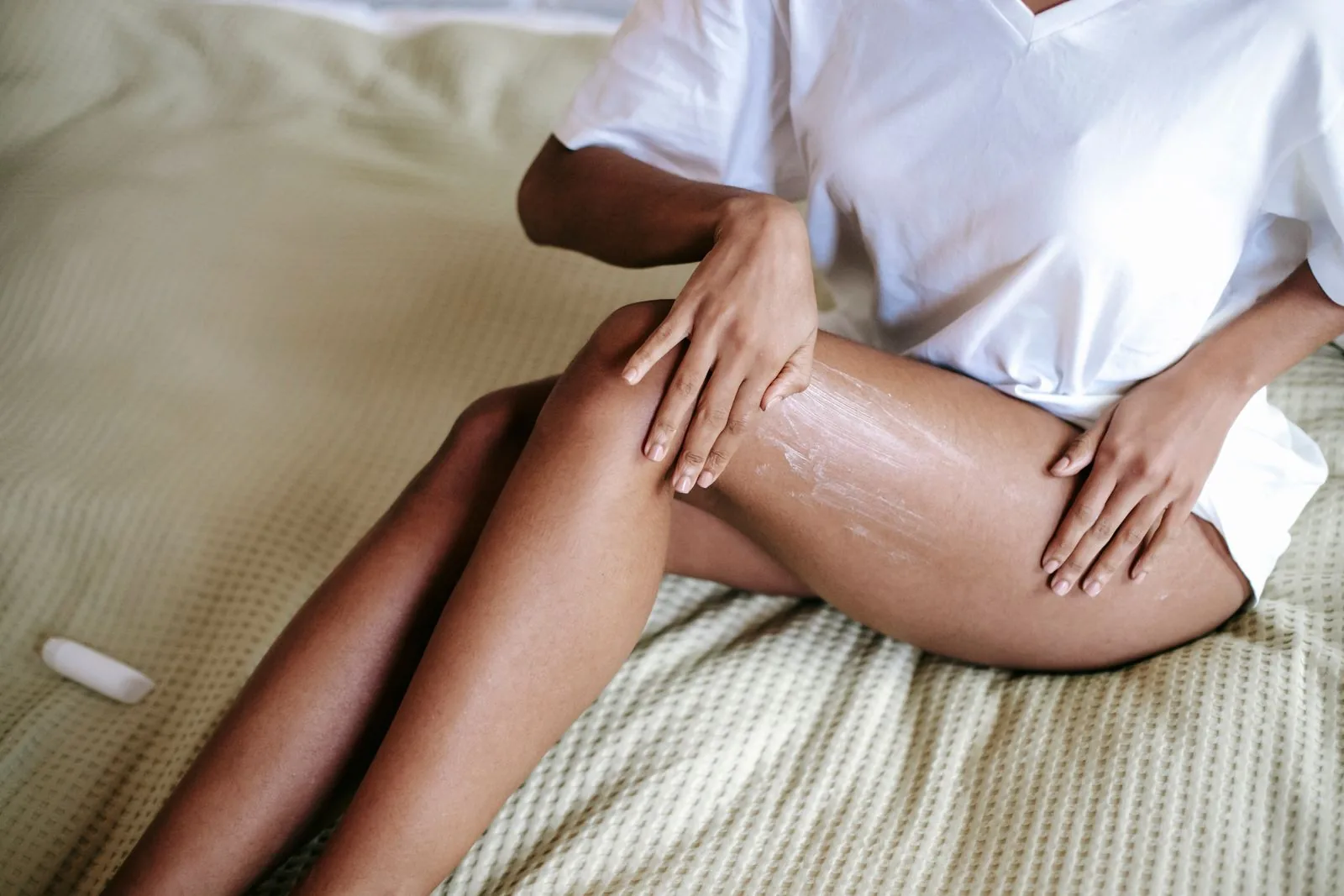
- Color is how your skin answers irritation. The AAD says dark spots and patches are one of the most common reasons people with darker skin tones see a dermatologist.
- AN risk runs higher in some groups. The AAD lists people of Native American, African, Caribbean, or Hispanic descent among those most likely to get it, along with people who are overweight or have a family history of it.
- Rashes can hide. The NHS notes that a fungal rash such as jock itch may look red or darker than the surrounding skin, and its color may be less noticeable on brown and black skin.
Other areas have their own guides: dark underarms, the bikini line and a vajacial, and dark spots on your face.
Your Shade, a Friction Mark, or a Medical Sign?
Answer these five questions before you buy a product or book anything. Start at question 1 and stop at your first yes. They're built from AAD, ACOG, NHS, and Harvard Health guidance, and they're not a diagnosis.
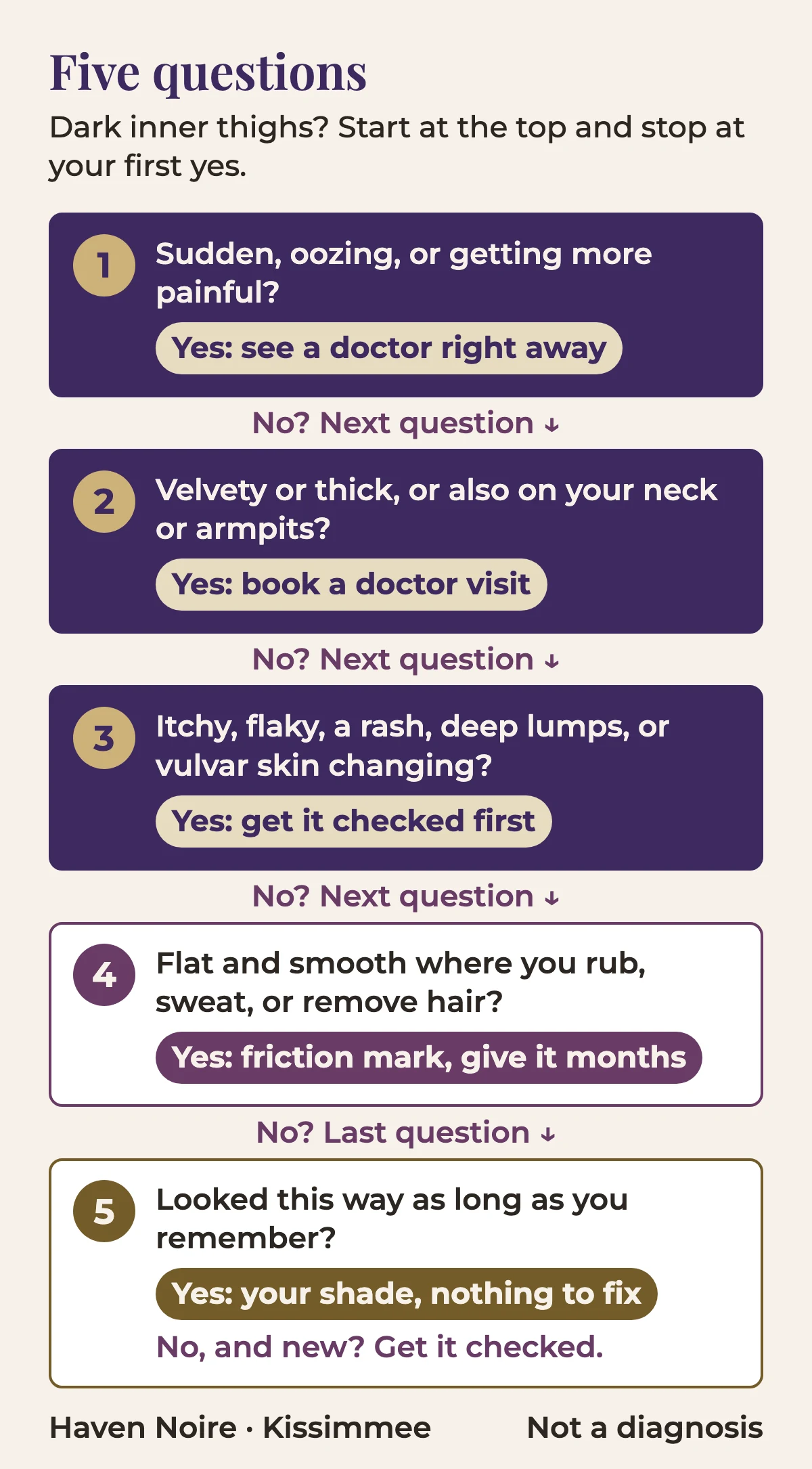
Question 1: Did it appear suddenly, or is it oozing or getting more painful?
Yes means make an appointment right away. The AAD says AN that appears suddenly calls for an immediate dermatologist appointment, because it can be a warning sign of cancer. For chafing blisters, the AAD says redness, pus, or increased pain or swelling mean seeing a doctor.
Question 2: Does it feel velvety or thick, or show up on your neck or armpits too?
Yes means book a dermatologist or primary care visit. Those are the hallmarks of AN, which the AAD links to pre-diabetes, reactions to medicines, and hormonal conditions such as polycystic ovarian syndrome (PCOS). A blood test may be part of the visit.
Question 3: Does it itch, flake, sting, form deep lumps, or change the skin of the vulva?
Yes means get it checked before you treat the color. The AAD says jock itch, a fungal infection, causes a scaly, very itchy rash that can develop on the inner thighs. A nonprescription treatment and keeping the area dry often clear it; if not, see a doctor. For skin changes, itching, burning, or pain on the vulva, ACOG says to contact your gynecologist. Deep, tender lumps belong with a dermatologist; see the list below.
Question 4: Is it flat and smooth, right where you rub, sweat, or remove hair?
Yes points to a friction or irritation mark, the pattern Harvard Health describes. This is where better habits and spa care help: take away the rubbing or the irritant, protect the skin, and give it months.
Question 5: Has it looked this way for as long as you remember?
Yes, with no earlier yes, means nothing on this check flags it. A shade you've always had isn't a problem to fix; evening it out is a cosmetic choice. If it's new and you can't explain it, get it checked anyway. The AAD notes that a small skin change can be an early warning sign.
When to See a Doctor About Dark Inner Thighs
The same advice, sorted by urgency. If you're unsure where you fit, choose the more urgent option.
Make an appointment right away
- Dark, velvety patches that appear suddenly, especially many at once. The AAD says to immediately book your dermatologist or primary care doctor.
- Chafed or blistered skin with pus, or pain or swelling that keeps increasing.
Book a visit with a dermatologist, primary care doctor, or gynecologist
- Darker skin that feels thick or velvety, especially with darkening on your neck or armpits, or skin tags in the area.
- A rash that doesn't clear with a nonprescription jock itch treatment.
- Deep, tender lumps in the groin or inner thigh, especially ones that clear and come back in the same area. The AAD describes these as possible signs of hidradenitis suppurativa (HS).
- Itching, burning, pain, or skin changes on the vulva.
What to tell your doctor or esthetician first
- When the darkening started, and whether it's changing or spreading.
- Every medicine you take. The AAD names birth control pills, strong corticosteroids like prednisone, and niacin as possible causes of AN.
- Everything you've put on the area, from lighteners and acids to home remedies.
- Any diagnosis such as diabetes, PCOS, or a thyroid condition, and whether you're pregnant.
This is general information, not medical advice. Your own doctor has the final word on your skin and your health.
How Long Do Dark Inner Thighs Take to Fade?
Months, not weeks, and only after the cause stops. The AAD says a spot a few shades darker than your natural color usually fades within 6 to 12 months once the cause is found and stopped. Color deep in the skin, often slate blue to gray or a brown much darker than your own, can take years.
| Cause | What has to stop first | What to expect |
|---|---|---|
| Friction and chafing | The rubbing | Can last as long as the rubbing does, then usually fades over many months |
| Irritating products or hair removal | The irritant or habit | A few shades darker: usually 6 to 12 months once it stops |
| Deep color (slate blue, gray, or very dark brown) | The cause | Can take years |
| Acanthosis nigricans | The underlying condition, with a doctor | Can clear as the cause is treated, but may not clear fully |
What can speed it up
The AAD says treatment can speed fading, starting with sunscreen. Once the cause is gone, it lists azelaic acid, glycolic acid, kojic acid, retinoids, and vitamin C as nonprescription ingredients that can fade dark spots. On skin that rubs all day, go slowly: if a product burns or stings, the AAD says stop using it. Pregnant? Ask your OB-GYN or midwife first.
If your skin feels velvety or thick (question 2), skip brighteners until a dermatologist weighs in. The AAD says bleaching creams and exfoliants rarely fade AN and can irritate it, making it worse.
Skin Lighteners to Skip
When darkening won't budge, lightening creams sold online look tempting. Here's why to pass.
The AAD warns that researchers have found steroids or mercury, not listed on the label, in skin care products imported from other countries. Used for a long time, hidden steroids can leave skin thin, fragile, or permanently discolored. And never put liquid bleach on your skin.
The U.S. Food and Drug Administration (FDA) advises consumers not to use over-the-counter skin lightening products and says none are FDA-approved or legally marketed. It has found mercury and hydroquinone in some, and has reports of rashes, facial swelling, and possibly permanent discoloration from hydroquinone lighteners. That warning covers products sold to lighten skin; the fade ingredients the AAD lists above are a different thing.
- Mercurous chloride, calomel, mercuric, mercurio, or mercury on the label: the FDA says stop using it immediately.
- No label, or a label only in a language other than English: the FDA says don't use it.
- Pregnant, or children at home: the FDA says both face heightened risks and should avoid mercury products.
If you've used one, the FDA suggests calling your health care professional or the Poison Center at 1-800-222-1222.
Keeping Inner Thighs Calm in Florida Heat
The next job is keeping the marks from coming back. In Central Florida, heat and humidity mean more sweat and rubbing for more of the year.

Cut the friction
- During workouts and long walks, wear loose, moisture-wicking clothes. The AAD advises skipping cotton then, because it soaks up sweat and moisture, which can lead to chafing.
- Apply powder or petroleum jelly where your thighs rub, or a securely applied soft bandage such as moleskin on problem spots. For a full plan for long, hot days, see our thigh chafing guide.
- Stop when your skin hurts or looks irritated. As the NHS notes, redness can be harder to see on brown and black skin, so go by feel too.
Keep it dry, fragrance-free, and protected
The AAD says the fungus behind jock itch thrives on warm, moist skin under tight clothing, so change out of sweaty leggings or a wet swimsuit soon. Damp leggings can set off bumps a little higher too; here's how to get rid of butt acne. ACOG notes that soaps, fabrics, and perfumes can irritate vulvar skin, and the AAD suggests products labeled fragrance-free or for sensitive skin.
Shorts and swimsuits leave inner thighs exposed. The AAD says sunscreen on all skin clothing won't cover can prevent new dark spots, and recommends a tinted, broad-spectrum, water-resistant sunscreen with iron oxide and SPF 30 or higher, reapplied every two hours and after swimming or sweating.
Spa or Dermatologist? How Haven Noire Fits
Spa care fits friction and irritation marks on otherwise healthy skin. We're licensed estheticians, not a medical clinic, so we don't diagnose skin conditions.
The Inner Thigh Facial
At Haven Noire in downtown Kissimmee, the Inner Thigh Facial is a mini facial for the inner thighs: a deep cleanse, exfoliation, and extractions where needed to help reduce ingrown hairs and even skin tone, finished with nourishing hydration. It's listed for all skin types, especially sensitive, congested, hyperpigmented, or ingrown-prone skin.
What it can't do: change your natural color, treat AN, or erase a mark in one visit. Afterward, avoid heat, friction, and sun for 24 to 48 hours, then exfoliate gently after a few days and keep the skin moisturized.
- Inner Thigh Facial: $40, about 20 minutes
- Brazilian Wax: $60, about 30 minutes, including up to a quarter of the inner thigh
Members get 10% off extra services, including body treatments. See our memberships, the full body treatment menu, and our waxing menu.
Thinking about laser?
Laser is a dermatologist's decision, and we don't offer it. For laser hair removal, the AAD warns that it can cause burns, permanent changes to skin color, and scars in inexperienced hands. It's an option for dark skin today, but the AAD says it must be performed very carefully, ideally by a board-certified dermatologist.
Who should wait before booking
- Anyone with a yes to questions 1 to 3: see a doctor first.
- Raw, broken, or blistered chafing: let it heal, keeping it clean and covered as the AAD advises.
- Pregnant, taking isotretinoin, or using a prescription cream on the area: ask your OB-GYN, midwife, or prescriber first, and tell us when you book.
We're at 231 Ruby Avenue, Unit E, in downtown Kissimmee, across from Lakefront Park, and we welcome clients from St. Cloud, Celebration, Poinciana, and the Orlando area. Our founder, Tiffany, is a Florida-licensed esthetician.
Frequently Asked Questions About Dark Inner Thighs
Is it normal to have dark inner thighs?
Often, yes. Skin that rubs, chafes, or gets irritated can make extra melanin, and Harvard Health names the inner thighs as a place this happens. See a doctor if the darker skin feels velvety or thick, appears suddenly, itches or flakes, or also shows up on your neck or armpits.
Can dark inner thighs be a sign of diabetes?
Sometimes. Darkening that feels velvety or thicker than the skin around it may be acanthosis nigricans, which the American Academy of Dermatology says can be a sign of pre-diabetes. Medicines and hormonal conditions can cause it too. Flat, smooth color right where your thighs rub fits the friction pattern instead.
How long does it take for inner thigh darkening to fade?
Usually months. The American Academy of Dermatology says a spot a few shades darker than your skin usually fades within 6 to 12 months once the cause stops, while color deep in the skin can take years. With ongoing friction, the color can stay as long as the rubbing continues.
How do Black women get rid of dark inner thighs?
If it's a friction mark, stop the cause first: less rubbing, moisture-wicking clothes during activity, fragrance-free products, and treatment for any rash. Then protect exposed skin with sunscreen and, if your skin tolerates it, add a gentle brightening product. Skip bleach and skin lighteners, and don't scrub harder, since irritation triggers extra color.
Can waxing or shaving make inner thighs darker?
It can contribute. Shaving and waxing can irritate skin and inflame hair follicles, and on deeper skin tones irritation can leave dark marks behind. Gentle technique, good aftercare, and light exfoliation help. If bumps keep coming back, hurt, or ooze, have a doctor look before you treat the color.
What is an inner thigh facial?
It's a 20-minute mini facial for the inner thighs. At Haven Noire in Kissimmee it costs $40 and includes a deep cleanse, exfoliation, and extractions where needed to help reduce ingrown hairs and even skin tone, then nourishing hydration. It can't change your natural color or treat a medical condition.
Keep exploring
More from the Journal

About the author
Tiffany · Licensed Esthetician · Licensed PMU Artist
Tiffany is a Florida-licensed esthetician and permanent makeup artist and the founder of Haven Noire. She specializes in customized facials, corrective skincare, and waxing for melanin-rich and all skin types, and is known for a calm, education-first approach that puts first-time clients instantly at ease.
Meet Tiffany →