

Many dark underarm marks clear once you find what's irritating the skin and stop it, whether that's razor burn, a deodorant that stings, or a harsh lightener. After that, the American Academy of Dermatology (AAD) says a spot a few shades darker usually fades within 6 to 12 months. Velvety, thick, or sudden darkening needs a dermatologist first.
This guide shows how to get rid of dark underarms on melanin-rich skin without making them worse: a four-step check for finding your trigger, the shave, wax, or laser question, which lighteners to skip, and what a spa in downtown Kissimmee can and can't do.
Why Do Underarms Get Dark?
Underarm darkening happens when something triggers the skin there to make extra melanin, the pigment that gives skin its color. In medium to dark skin tones, the AAD notes, many everyday things can set it off.
Irritation that leaves a mark
The AAD says dark spots often appear when a wound such as a cut heals, a pimple or psoriasis patch clears, you take certain medications, a skin or hair care product irritates, or hormones change, as in pregnancy. The medical name for one cause of these marks is post-inflammatory hyperpigmentation. Under the arms, start with what touches that skin daily: your razor, your deodorant, and anything you scrub on.
Acanthosis nigricans: the one that needs a doctor
Acanthosis nigricans (AN) is different. The AAD describes skin that's darker, velvety, and thicker than the skin around it, and names darker, velvety skin in an armpit as a common sign. It can also form on the neck, groin, elbows, knees, and knuckles. Darker knees, elbows, or knuckles have other causes too; see why knees and elbows get dark.
According to the AAD's page on who gets AN, it's more likely in people of African, Caribbean, Hispanic, or Native American descent. Obesity is the most common cause, but AN can also signal pre-diabetes, a reaction to a medicine such as birth control pills, or a hormonal condition such as polycystic ovary syndrome (PCOS) or thyroid disease.
The same triggers can darken skin between the legs; see our guide to dark inner thighs.
How to Get Rid of Dark Underarms Step by Step
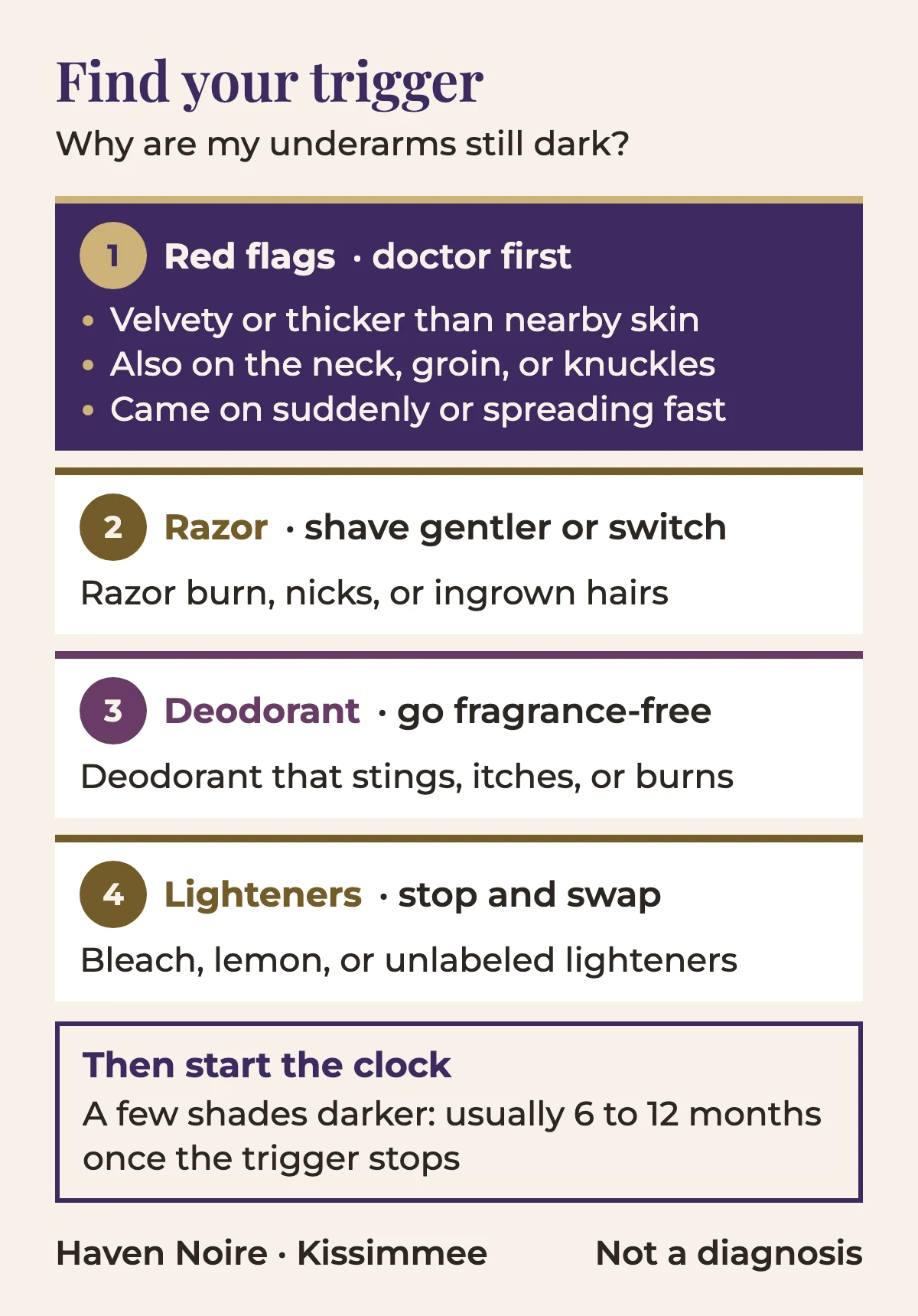
Use this check to find what's keeping your underarms dark. It's built from guidance by the AAD, the U.S. Food and Drug Administration (FDA), and the American College of Obstetricians and Gynecologists (ACOG), and it's not a diagnosis. Start with the red flags: they decide whether the rest apply.
Red flags (check these first)
Is the dark skin velvety or thicker than the skin around it? Is it also on your neck, groin, or knuckles? Did it appear suddenly or spread fast? Any yes means a dermatologist comes first, right away if it appeared suddenly. The AAD's self-care advice for AN says bleaching creams, exfoliants, and other skin care products rarely fade it and can irritate the skin, making it worse. A neck crease that fades when you lift your chin is a different thing; see tech neck lines.
Your razor
Did the darkening come with razor burn, nicks, or ingrown hairs? The AAD notes that frequent shaving can irritate skin, so test a gentler shave or a different method first.
Your deodorant
Deodorant and antiperspirant sit on underarm skin all day, and the AAD's page on treating excessive sweating says some people get irritated skin or underarm discoloration from antiperspirants. If yours stings or itches, try a gentler formula labeled fragrance-free or for sensitive skin.
Home remedies and lighteners
Lemon juice, bleach, gritty scrubs, and online lighteners belong here. The AAD's rule: if a product burns or stings when you apply it, stop using it. The FDA advises consumers not to use over-the-counter skin lighteners.
Then start the clock
Once the red flags are ruled out and the trigger is gone, time does much of the work to get rid of dark underarms. The AAD says a spot a few shades darker than your natural color usually fades within 6 to 12 months, while color deep in the skin, often slate blue to gray, can take years. A monthly photo in the same light shows slow change. For marks on your face, see how to fade hyperpigmentation on melanin-rich skin.
When to See a Doctor About Dark Underarms
Some changes need a doctor, not a new product or a spa visit.
Don't wait: contact a doctor right away
- Many dark, velvety patches appearing suddenly. The AAD says to make an appointment with your dermatologist or primary care doctor immediately, because this can be a sign of cancer.
- A lump that's very painful, hot, or swollen, or a bump with a high temperature or chills. The NHS lists these as signs of an infected ingrown hair.
Book an appointment with a dermatologist or your doctor
- Velvety or thick dark skin, even if it came on slowly. The AAD says AN can be a sign of pre-diabetes and advises finding out whether a medical condition is behind it.
- Darkening plus irregular periods, extra hair on your face or chest, or acne that won't clear with usual treatment. ACOG lists these, along with velvety, darkened skin, as common signs of PCOS. Talk with your OB-GYN.
- Deep, tender armpit lumps that clear and come back in the same spot. The AAD describes these as possible signs of hidradenitis suppurativa (HS) and says to see a board-certified dermatologist.
- Redness or swelling after waxing that lasts more than two days, which the AAD says calls for a board-certified dermatologist.
- Darkening that started after a new medicine. Don't stop it on your own; the AAD advises asking the prescribing doctor whether discolored skin is a possible side effect.
You may also see PCOS called PMOS (polyendocrine metabolic ovarian syndrome); an American Academy of Family Physicians blog post says international guidelines are expected to adopt it in 2028.
This is general information, not medical advice. Your own doctor has the final word on any skin condition, pregnancy, or medication.
Shaving, Waxing, or Laser on Deeper Skin?
Popular pages disagree: some say stop shaving and wax, others say shave more gently. The AAD's guide to six ways to remove unwanted hair doesn't rank them for underarm color. It does show that each method has its own skin risks, and on deeper skin, irritation is one of the triggers for extra pigment. Thinking about an epilator there? Read what plucking may mean for darker underarms. The best method is the one your skin tolerates. Leaning toward wax? Read what to check before you trade the razor.

| Shaving | Waxing | Laser | |
|---|---|---|---|
| How long it lasts | A day to a few days | A few weeks or longer | Permanent after 6 or more treatments, except on a woman's face |
| Irritation to watch for | Razor burn, nicks, ingrown hairs | Red, irritated skin for a short while; burns if the wax is too hot | Burns, blisters, infection, or dark spots if the provider is inexperienced |
| Who does it | You, at home | A salon or spa, or you at home | An experienced doctor |
Shaving more gently
If you keep shaving, the AAD's shaving tips are to shave right after a shower, use a shaving cream labeled for sensitive skin, shave in the direction the hair grows, rinse after every swipe, and toss disposable razors after 5 to 7 shaves.
Waxing: what to know first
Wax needs about a quarter inch of hair to grip, roughly two to three weeks of growth, so skip the razor before your appointment. The AAD says not to wax within six months of taking isotretinoin, or while using an antibiotic or applying tretinoin, since these thin the skin enough that it could tear. At any salon, it suggests checking that a fresh wooden stick goes into the wax every time. Our waxing in Kissimmee page lists our waxing services and prices. For what the appointment itself feels like, read what to expect from an underarm wax.
Laser: possible, with the right doctor
The AAD says people of all skin tones can safely have laser hair removal if the person doing it has experience with your skin tone, so always ask. In inexperienced hands it can cause burns, blisters, infection, or dark spots, and it takes about 6 treatments. Laser isn't on our menu; a board-certified dermatologist can tell you if you're a good candidate.
Underarm Lighteners: What's Safe and What to Skip
Lightening creams are where underarm care can turn harmful.
The FDA's warning on store-bought lighteners
The FDA advises consumers not to use over-the-counter skin lightening products, after its lab testing found high levels of mercury, hydroquinone, or both in some of them. It says no over-the-counter skin lightener is FDA-approved or legally marketed, and it has received reports of rashes, facial swelling, and possibly permanent discoloration (ochronosis) from hydroquinone products. That warning covers products sold to lighten skin; the fade ingredients the AAD lists below are a different thing.
Mercury carries its own risks. The FDA says it can be absorbed into the bloodstream and damage the kidneys and nervous system, that children and pregnant people face higher risks, and that family members can be exposed through vapors or shared towels.
How to read the label
- Stop using a product right away if its label lists mercurous chloride, calomel, mercuric, mercurio, or mercury (FDA).
- Skip any product with no ingredient list, or one labeled in another language without English labeling (FDA).
- Never put liquid bleach on your skin (AAD).
- Buy fade products made in the United States or recommended by your dermatologist; researchers have found unlisted steroids or mercury in some imported creams (AAD).
What dermatologists suggest instead
For marks left by irritation, the AAD says products with azelaic acid, glycolic acid, kojic acid, a retinoid, or vitamin C can fade dark spots, and tend to work better once the cause is gone. Lemon juice and turmeric aren't on that list. Prescription hydroquinone is a dermatologist's call, and if your darkening is AN, ask a dermatologist before using any fading product. Pregnant or breastfeeding? Check with your doctor first. For your face, see our hyperpigmentation and dark spots page.
What a Spa Can and Can't Do for Dark Underarms
A spa can't diagnose AN, prescribe a lightener, or promise to get rid of dark underarms. It can give you a gentler hair removal routine and calm, clean skin while the clock runs.
Underarm treatments at Haven Noire
- Underarm Wax + Detox: $35, about 30 minutes. Complete underarm hair removal paired with a clarifying treatment of antioxidant-rich masks and serums.
- Underarm Wax: $15, about 15 minutes, for hair removal on its own.
Despite the name, the Wax + Detox isn't a body detox. It's skin care for the surface of your underarms, following the steps our body treatments page lists: a consultation, waxing, a cleanse and exfoliation, a targeted mask, then final serums and aftercare guidance.
A licensed esthetician does every wax in a private, hygienic setting. First-time clients with sensitive skin can mention our waxing page for a complimentary skin patch test, and any of our memberships takes 10% off extra services, including waxing and body treatments.
Who should skip or postpone
- Isotretinoin in the last six months, or an antibiotic or tretinoin now: the AAD says not to wax.
- Sunburned or very sensitive underarm skin: the AAD says never to wax it.
- Any red flag above, an open cut, or a painful lump: see a doctor first.
- A prescription lightener, peel, or laser on the area: ask your clinician first.
- Pregnancy: ask your OB-GYN or midwife, and tell us when you book.
What to tell your esthetician first
Tell us your medications and skin products (especially retinoids, acids, or lighteners), when you last shaved, any diagnosis such as AN or HS, and whether your skin reacts easily.
We're at 231 Ruby Avenue, Unit E, in downtown Kissimmee, across from Lakefront Park, and we welcome clients from St. Cloud, Celebration, Poinciana, and the Orlando area.
Florida Sweat Without Restarting the Clock
Once you've found your trigger, the next problem is keeping it gone through a Central Florida summer of sweat, reapplying, and sleeveless tops.
Antiperspirant habits that go easier on skin
The AAD's routine for heavy sweating is a good model: apply antiperspirant to completely dry skin at bedtime and let it dry, since dry skin is less likely to get irritated. If a product irritates, it suggests more time between applications or a gel formula. Store-bought antiperspirants only help mild excess sweating; many people with heavy sweating need a prescription one from a dermatologist.

If your underarms see sun at the pool, the AAD's dark-spot advice applies: sunscreen on uncovered skin, reapplied every two hours and after swimming or sweating.
After an underarm wax
For 24 to 48 hours, skip heat, friction, sweat, and direct sun, so plan your wax around the gym and the pool. The AAD also suggests loose clothing, cold packs if you're sore, and no hot baths or showers. Ask us at your visit how long to wait before deodorant goes back on.
After a few days, exfoliate gently and keep the skin moisturized. Our guide to preventing ingrown hairs after waxing has the between-visit routine, and rebooking every 3 to 4 weeks gives the smoothest results.
Frequently Asked Questions About Dark Underarms
How long does it take to get rid of dark underarms?
Once the trigger stops, the American Academy of Dermatology says a spot a few shades darker than your skin usually fades within 6 to 12 months; deeper color can take years. For acanthosis nigricans, improving the medical condition behind it often helps, so see a dermatologist.
Does shaving make your underarms darker?
It can, when it irritates your skin. The American Academy of Dermatology notes that frequent shaving can irritate skin and that nicks, razor burn, and ingrown hairs happen. In medium to dark skin tones, irritation and injury can trigger extra pigment. Gentler technique or a different method may help.
Is waxing better than shaving for dark underarms?
Not automatically. The American Academy of Dermatology's hair removal guide doesn't rank either method for underarm color, and both can irritate. Shaving risks razor burn and nicks, while waxing can leave skin red for a short while. The better choice is the method your skin tolerates, done gently.
Can deodorant cause dark underarms?
It can for some people. The American Academy of Dermatology says a product that irritates your skin can cause dark spots, and that some people develop underarm discoloration from antiperspirants. If yours stings or itches, try a fragrance-free formula for sensitive skin, applied to completely dry skin.
Are dark underarms a sign of diabetes?
Sometimes. Velvety, thickened darkening can be acanthosis nigricans, which the American Academy of Dermatology says can be a sign of pre-diabetes or diabetes, a hormonal condition, or a reaction to a medicine. If your skin feels thick or velvety, see a dermatologist (right away if it appeared suddenly).
Can a spa treatment lighten dark underarms?
A spa can't diagnose or treat acanthosis nigricans or promise lighter skin, but it can make hair removal gentler and keep the skin clean and calm while marks fade. At Haven Noire, the Underarm Wax + Detox is $35 for about 30 minutes, and an Underarm Wax alone is $15.
More from the Journal

About the author
Tiffany · Licensed Esthetician · Licensed PMU Artist
Tiffany is a Florida-licensed esthetician and permanent makeup artist and the founder of Haven Noire. She specializes in customized facials, corrective skincare, and waxing for melanin-rich and all skin types, and is known for a calm, education-first approach that puts first-time clients instantly at ease.
Meet Tiffany →