

Thigh chafing is the sting, redness, or rawness that shows up when your inner thighs rub together or against fabric, and sweat makes it worse. Plenty of people call it chub rub. To prevent it, put a barrier between your thighs, wear fabric that sheds sweat, and take a break at the first sting. To soothe it, wash gently, smooth on a thin layer of petroleum jelly, and give the skin a few days away from the rub.
Thighs that touch are normal. Runners chafe, people who stand all day chafe, and a long, humid afternoon on your feet in Kissimmee can do it to anyone. It's a friction problem, not a body problem.
Below: what to do before, during, and after a long, hot day, rashes that look like chafing, how to time a thigh wax, and when to see a doctor.
What Is Thigh Chafing?
Thigh chafing is skin irritation on the inner thighs caused by friction: skin rubbing skin, or fabric rubbing skin. Sweat, heat, and humidity make it worse. Mild chafing stings, burns, or itches. Severe chafing can blister, crack, or bleed.
A Cleveland Clinic article on chafing puts it plainly: "Friction is always the root cause of chafing." The same article says moisture can make chafing much worse, that you sweat more when it's hot or humid, and that humidity itself can contribute.
Who gets it
Anyone whose skin rubs. The American Academy of Dermatology (AAD) notes that blisters can form anywhere body parts rub together or rub against clothing, and that preventing chafing prevents them. The Cleveland Clinic article lists activity, sweat, body shape, weight, poorly fitting clothes, rough fabrics, swimsuits, and hot or humid weather among the things that make chafing more likely.
What it feels like first
Go by feel as well as looks. The Cleveland Clinic article's mild symptoms include itching, a stinging or burning feeling, skin that feels warm to the touch, and tender skin. Its severe list includes blisters, cracking, tearing, and bleeding.
On brown and Black skin, go by feel
Redness is the sign most guides lead with, and on melanin-rich skin it may be harder to see. The NHS notes that heat rash, another hot-weather rash, may be harder to see or look grey or white on brown or black skin. Our advice: on deeper skin tones, trust the sting, heat, and tenderness as much as the color.
If chafed skin heals darker, our guide to dark inner thighs covers friction darkening and how long it takes to fade.
How to Prevent Thigh Chafing on a Long, Hot Day
Most chafing advice arrives as one long list. Here it's sorted by time of day, built on AAD and Cleveland Clinic guidance: protect your thighs before you go, keep sweat in check while you're out, and soothe your skin when you get home. Any step without a named source is our suggestion, not a medical rule.
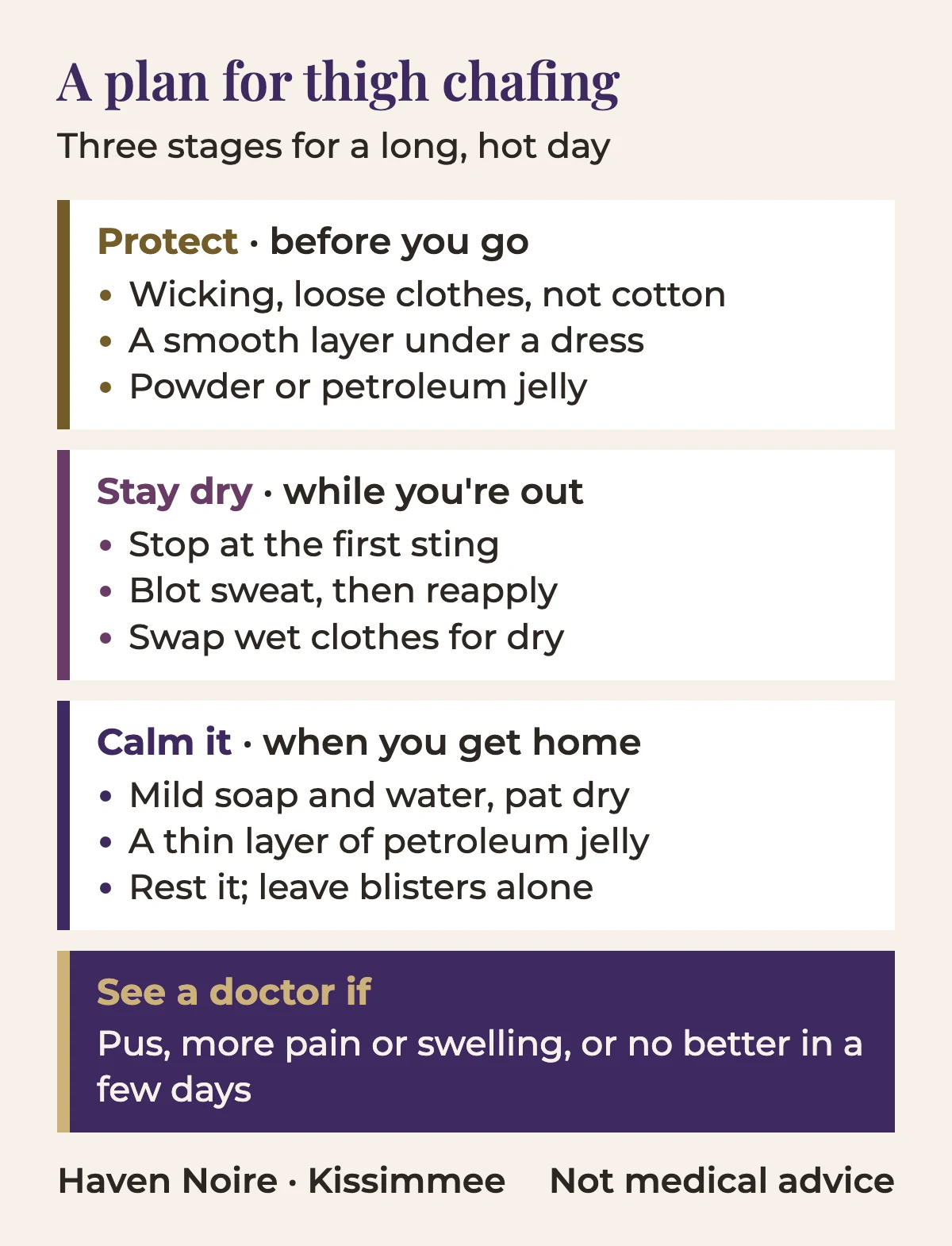
One honest note: we searched PubMed in November 2026 for trials comparing ways to prevent chafing and found none on the thighs. So we can't tell you that one balm, powder, or pair of shorts works better than another.
Before you leave the house
Put something between your thighs before the rubbing starts. On a long day, use both: a fabric layer and a glide or powder.
A fabric layer
- Wicking, not cotton, when you're active. The AAD recommends moisture-wicking, loose-fitting clothes during activity and says cotton soaks up sweat.
- A smooth layer under a dress. With slip shorts or bike shorts, fabric rubs fabric instead of skin.
- A fit that lies flat. The Cleveland Clinic article says tight or restrictive clothing causes chafing easily, and that tags and seams can chafe too.
- A soft bandage for one hot spot. For the thighs, the AAD suggests moleskin or another soft bandage, applied securely.
Cotton advice depends on the problem. For chafing, the AAD's no-cotton tip is about physical activity, and the Cleveland Clinic article also says to avoid cotton because it soaks up moisture and dries slowly. For heat rash, a different hot-weather rash, the NHS suggests loose cotton clothing to keep skin cool. Each source is answering its own question, so follow the advice for the problem you have.
A glide or powder
- Powder or petroleum jelly. The AAD suggests either one on problem areas to reduce friction when skin rubs together or against clothing.
- Anti-chafing balms and sticks. Cleveland Clinic suggests anti-chafing products and says to apply them before you're active.
- Something you've worn before. Try new products on an ordinary day at home, not before a big outing.
The fix can irritate, too. A 2023 case report in the journal Contact Dermatitis is titled "Occupational allergic contact dermatitis induced by adhesives used for prevention of chafing in the military forces." It's one report about one kind of product, not proof that anti-chafing products are risky. Our advice: if a tape, balm, or powder leaves you itchier than the chafing did, stop using it and tell your doctor.
While you're out
Sweat turns a little rubbing into raw skin, so midday is about moisture and the first sting.
- Stop at the first sting. The AAD says to stop your activity immediately if you feel pain or discomfort, or your skin turns red. On a park day, that means a shaded bench, not one more line.
- Blot, don't wipe. Press sweat away with a soft cloth or tissue so you aren't adding more friction.
- Reapply. No source we found sets a schedule. Our suggestion: at every long break and after a water ride or swim.
- Swap wet for dry. The Cleveland Clinic article says moisture can make chafing much worse and that swimsuits make it a lot more likely, so change out of a wet suit or sweat-soaked shorts when you can.
Pack a small kit: petroleum jelly or an anti-chafe stick, a little powder, a soft cloth, and spare shorts.
When you get home
- Wash gently. Cleveland Clinic suggests mild soap and water. Our advice: lukewarm water, no scrub or loofah, then pat dry.
- Smooth on a thin layer of petroleum jelly. Cleveland Clinic says aloe vera gel and a thin layer of petroleum jelly reduce friction, irritation, and pain.
- Rest the rub. Cleveland Clinic says you might need to avoid the activity that caused chafing while your skin heals. Dress loose and dry.
- Leave blisters alone. The AAD advises against popping or draining a blister, which could lead to infection, and suggests loosely covering it with a bandage.
Expect a few days. Cleveland Clinic says minor chafing usually clears up within a few days, and to talk to a healthcare provider if it takes longer.
Chafing in Central Florida Heat: Plan by the Day
In Central Florida, one day can stack heat, sweat, water, and miles of walking. So plan for the day you're about to have.

| Your day | What adds to the rub | What to plan |
|---|---|---|
| A theme park or festival day | Hours of walking in heat and sweat, plus water rides | A smooth layer and a glide before you go; reapply at breaks; dry off after rides; pack spare shorts |
| An outdoor workday | A full shift of sweat, with thick seams in work pants | A wicking layer underneath; powder or glide on the rub zone; dry clothes for the drive home |
| A pool, lake, or beach day | A wet swimsuit, sand, and sun | Change into dry clothes soon after you swim; rinse and pat dry |
| A wedding or party in a dress | Hours of standing and dancing with bare thighs | Slip shorts or a glide, plus a small tube in your bag |
| A run, walk, or gym class | Repeated motion and sweat | Loose-fitting, wicking clothes, no cotton; stop at the first sting |
After a day like that, a long, hot shower is tempting, but chafed skin does better with the lukewarm wash described above. Love a full shower routine? Our everything shower guide shows how to build one that's kind to your skin.
Chafing or a Look-Alike Rash?
Chafing should calm within a few days once the rubbing stops. When it doesn't, or the rash looks different, something else may be going on. We're estheticians, not doctors, so use this table to decide who to call, not to diagnose yourself.
| Could be | Clues | Next step |
|---|---|---|
| Chafing | Stinging, redness, or rawness right where skin rubs (Cleveland Clinic) | Rest from the rub; talk to a provider if it isn't better in a few days |
| Intertrigo | Inflammation of skin folds, with bright red, well-defined weeping patches; common in warm, moist climates (MedlinePlus) | Contact a provider if it doesn't go away with good home care or spreads beyond a skin fold |
| Yeast infection of the skin | Intense itching and a red, growing rash, most often in warm, moist creases such as the groin (MedlinePlus) | Contact your provider if you develop symptoms |
| Jock itch | A red, scaly, very itchy rash that can develop on the inner thighs (AAD) | The AAD says keeping the area dry and a non-prescription jock itch treatment can often clear it; if not, see a board-certified dermatologist or primary care doctor. With diabetes, the American Diabetes Association says to call your doctor |
| Heat rash | Small raised spots and a prickly feeling; may look grey or white on brown or black skin (NHS) | Keep skin cool; see a doctor if it doesn't improve after a few days |
| Folliculitis or ingrown hairs | Itchy pimples or pus bumps around hair follicles; rubbing from clothing or shaving can start folliculitis (MedlinePlus) | Contact a provider if the bumps come back often, get worse, or last longer than 2 or 3 days (MedlinePlus). Bumps after a wax? See our ingrown hair guide |
Two things raise the stakes. MedlinePlus says yeast infections of the skin are particularly common in people with diabetes, and that antibiotics and steroid therapy raise the risk. And the Cleveland Clinic article notes that chafing damages your skin, making it easier for germs to enter.
Breaking out where sweat sits, rather than stinging where you rub? That's a different problem, covered in our guide to sweat pimples.
Chafing and Hair Removal: Timing a Thigh Wax
Can a thigh wax prevent chafing? We searched PubMed in November 2026 for studies pairing chafing with shaving, waxing, or hair removal and found none, so we won't promise that waxing stops chafing. We can help you keep the two apart.
Don't wax chafed skin
The AAD's waxing guide says never to wax sunburned or very sensitive skin. Our rule of thumb: raw, broken, or blistered chafing counts, so reschedule until it heals. Under our cancellation policy, rescheduling at least 24 hours before your appointment gets a full deposit refund to your original payment method.
Book two days before a long walking day
Our waxing aftercare asks you to avoid heat, friction, sweat, and direct sun for 24 to 48 hours. A theme park day brings all four. Our advice: book a thigh wax at least two days before, then follow our waxing aftercare plan for the first 48 hours.
Medicines that change the answer
The AAD's page on ways to remove unwanted hair says waxing isn't recommended if you're applying tretinoin, using an antibiotic, or have taken isotretinoin in the past six months, because these medicines thin your skin and it could tear. Its waxing guide repeats the isotretinoin rule. Pregnant, or using another prescription skin medicine? Ask your doctor or dermatologist before you book, and tell us what you use.
Thigh services on our menu
At Haven Noire in downtown Kissimmee, an Upper Legs Wax is $40 for about 30 minutes, from the knee to the thigh. A Full Legs Wax is $80 for about 45 minutes, and a Brazilian Wax ($60) includes up to a quarter of the inner thigh. See the full waxing menu. A 10% deposit is required when you book.
The Inner Thigh Facial ($40, about 20 minutes) is listed for all skin types, especially sensitive, congested, hyperpigmented, or ingrown-prone skin. It doesn't prevent or treat chafing.
Comparing methods first? See epilator vs waxing. Planning to do it yourself? Read how to wax at home before you start.
When to See a Doctor About Thigh Chafing
Haven Noire is an esthetics spa, not a medical office. We can't diagnose a rash, and nothing on our menu treats one. Not sure who to call? Our guide to esthetician vs dermatologist explains who does what.
Make an appointment soon
- Signs of infection around a healing blister: redness, pus, or increased pain or swelling. The AAD says to make an appointment with your doctor or a board-certified dermatologist.
- Chafing that gets worse, with cracking, bleeding, or open sores. Cleveland Clinic lists these among the more serious symptoms and says to call your healthcare provider if chafing gets worse.
Book a visit
- Chafing that isn't better in a few days. Cleveland Clinic says to talk to a healthcare provider if it takes longer.
- A rash that spreads beyond a skin fold, won't clear with home care or a jock itch treatment, or itches intensely, as the look-alike table above describes.
Check with your doctor first
- You have diabetes. The American Diabetes Association says people with diabetes get bacterial and fungal infections more easily, and to call your doctor if you think you have a yeast or fungal infection.
- You're pregnant, or you use isotretinoin, tretinoin, or another prescription skin medicine, and you're about to try a new product on broken skin or book a wax.
- You have eczema, or skin that scars or forms keloids easily, and the chafed skin has broken open.
Frequently Asked Questions About Thigh Chafing
How long does thigh chafing take to heal?
Mild chafing usually clears up within a few days, according to Cleveland Clinic, as long as you stop the rubbing that caused it. Keep the area clean, dry, and lightly coated with petroleum jelly. If it isn't better in a few days or gets worse, Cleveland Clinic says to call your healthcare provider.
What is the fastest way to soothe chub rub?
Wash the area with mild soap and water, pat it dry, and smooth on a thin layer of petroleum jelly, which Cleveland Clinic says reduces friction, irritation, and pain. Then rest from the activity that caused it, wear loose, dry clothes, and leave any blister unpopped, as the American Academy of Dermatology advises.
Is powder or petroleum jelly better for chafing?
Both are on the American Academy of Dermatology's list for problem areas, and our November 2026 PubMed search found no trial comparing them on thighs. Our suggestion: if your skin mostly gets damp, start with powder. If it mostly rubs, start with a glide such as petroleum jelly. On a long, hot day, you can use both.
Do bike shorts stop your thighs from chafing?
They can help by putting smooth fabric between your thighs, so fabric rubs fabric instead of skin. That's our judgment, not a tested result. Choose a pair that lies flat without digging in, since Cleveland Clinic says tight clothing chafes easily, and pick moisture-wicking fabric over cotton on active days.
Why do my thighs chafe more in the summer?
Heat and humidity add moisture to your skin. Cleveland Clinic says you sweat more when it's hot or humid, that moisture can make chafing much worse, and that humidity itself can contribute. In Central Florida, that season runs long, so it helps to keep a small chafing kit in your bag most of the year.
Can you get your thighs waxed if they're chafed?
Wait until the skin heals. The American Academy of Dermatology says never to wax sunburned or very sensitive skin, and in our judgment raw or blistered chafing counts. Reschedule at least 24 hours before your appointment for a full deposit refund. After any wax, avoid heat, friction, sweat, and direct sun for 24 to 48 hours.
Keep exploring
More from the Journal

About the author
Tiffany · Licensed Esthetician · Licensed PMU Artist
Tiffany is a Florida-licensed esthetician and permanent makeup artist and the founder of Haven Noire. She specializes in customized facials, corrective skincare, and waxing for melanin-rich and all skin types, and is known for a calm, education-first approach that puts first-time clients instantly at ease.
Meet Tiffany →