

Butt acne is the everyday name for red, pimple-like bumps on your buttocks. Despite the name, the bumps aren't always acne. The NHS says acne usually affects your face, chest, and back. Bumps lower down can be something else, such as folliculitis: irritated or infected hair follicles.
The short answer on how to get rid of butt acne: find what's irritating your hair follicles and stop it. The American Academy of Dermatology (AAD) says folliculitis tends to clear on its own when you have a healthy immune system and stop what caused it, and that warm compresses speed relief. Wear loose clothes, change out of sweaty ones soon after a workout, pause hair removal if it started the bumps, and keep your hands off. A boil with a fever, a deep lump that keeps coming back, or a sore lump at the top of the cleft needs a doctor.
Haven Noire is an esthetics spa in downtown Kissimmee, not a medical office, so this guide helps you sort and soothe. It doesn't diagnose.
What Is Butt Acne?
Butt acne is a common name for red, pimple-like bumps on the buttocks. The bumps can be true acne, or one of several look-alikes that also show up there, such as folliculitis, keratosis pilaris, or a boil. Soft dimples rather than bumps are a different thing; see what changes how cellulite looks.
Folliculitis: the acne look-alike
The AAD's folliculitis page has a blunt title: "Acne-like breakouts could be folliculitis." It calls folliculitis a common infection in the hair follicles that can appear anywhere except the palms and soles. Each spot may have a red ring around it, and the skin may itch, hurt, or feel like nothing at all.
Damaged follicles let germs such as Staph aureus inside, the AAD explains. Its common causes read like an ordinary week: shaving, plucking, or waxing, tight clothing or equipment, a poorly maintained hot tub, medication you apply or take, and weight gain.
Other bumps that show up on the buttocks
| What you notice | It may be | First move |
|---|---|---|
| Small red or pus-topped bumps that appear suddenly | Folliculitis | Find and stop the trigger |
| Rough, dry bumps that feel like sandpaper | Keratosis pilaris | Gentle care, no scrubbing |
| A hard, painful lump that fills with pus | A boil | Never squeeze; check the doctor section |
| A tender, deep lump that clears and returns in the same spot | Possibly hidradenitis suppurativa | See a dermatologist |
| A painful lump at the top of the cleft between your buttocks | Possibly a pilonidal sinus | See a doctor promptly |
| Blackheads and whiteheads among the bumps | Acne | Treat it as body acne |
Sources for the table: the AAD says most teens and adults with keratosis pilaris see bumps on the upper arms, front of the thighs, and buttocks, and that they can look brownish black on dark skin. MedlinePlus lists the buttocks among the most common places for boils. The AAD says hidradenitis suppurativa often starts as a painful lump that looks like a deep pimple or boil, and can appear on the buttocks. The NHS places a pilonidal sinus at the top of your bottom, between your buttocks.
Rough bumps rather than sore ones? Our strawberry legs guide sorts keratosis pilaris from folliculitis. One honest note: we searched PubMed in November 2026 for "butt acne," "buttock acne," and "gluteal acne" and found no study measuring how often these bumps are acne rather than another condition, so we won't give you a percentage.
Three Questions to Trace Your Butt Acne Trigger
Most guides hand you a body wash and a scrub. But the AAD's folliculitis advice is mostly subtraction: with a healthy immune system, the breakouts tend to go away on their own once you stop doing what caused them. So find the cause.
Three questions about your week, built on the AAD's list of causes, help with that search. They aren't a diagnosis, and anything not credited to a source is our advice, not a medical rule. First, check the stop signs: a boil with a fever, a deep lump that keeps returning, or a sore lump at the top of the cleft means a doctor first.
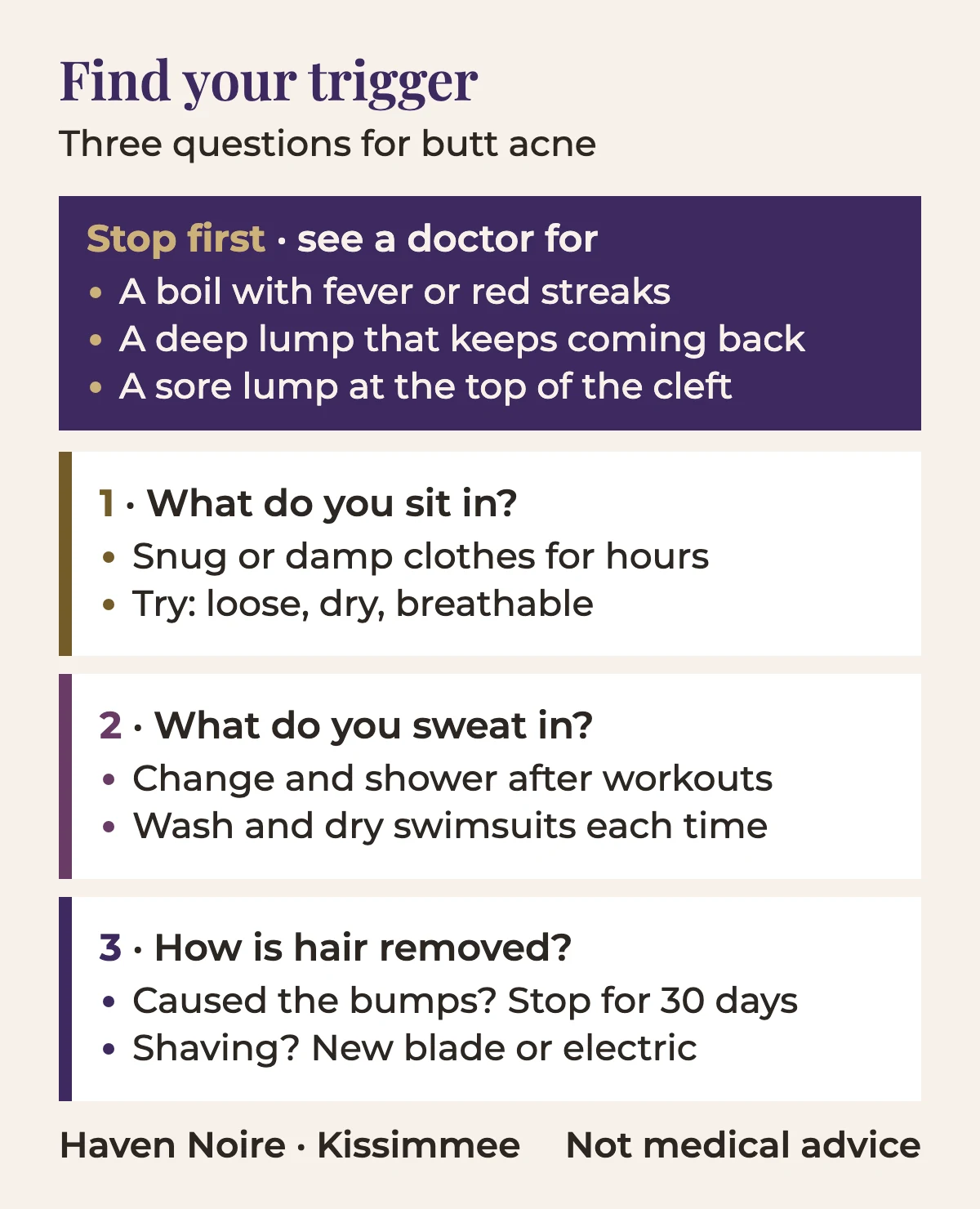
1. What are you sitting in, and for how long?
The AAD says rubbing, tight clothing, and skin rubbing against skin can damage hair follicles, and that damp, hot skin is easier to damage. A long sit can bring all of that: snug jeans through a workday, a commute in leggings, class right after a run.
Our advice: if bumps sit where your body meets the seat, start here. Wear looser, breathable clothes on long sitting days, get up when you can, and never sit in damp clothing. The AAD advises loose clothing when it's hot and humid, which describes many Central Florida days.
2. What do you sweat in, and how long do you stay in it?
Sweat keeps skin damp and hot. The AAD's prevention tips are specific:
- Change out of tight workout clothes immediately after working out, then shower.
- Wash your swimsuit after each use, and let it dry completely before wearing it again.
- Use well-maintained hot tubs. Hot tub breakouts tend to appear under your suit, about 12 to 48 hours later.
Our advice for Florida summers: the drive home in wet leggings or a damp swimsuit counts, so pack a change of clothes. Breakouts on your face, chest, or hairline in the heat? See our guide to sweat pimples.
3. How do you remove hair there?
Shaving, plucking, and waxing are all on the AAD's list. If hair removal set off the bumps, the AAD says to stop for 30 days. MedlinePlus adds: avoid shaving the area if possible, and if you must, use a clean, new razor blade or an electric razor each time.
Weighing methods? See waxing vs shaving. Bumps a few days after hair removal can also be trapped hairs; our between-wax care routine covers prevention.
| Question | Clues it's your trigger | What the source says | First change |
|---|---|---|---|
| What do you sit in? | Bumps where you sit; long days in snug or damp clothes | AAD: rubbing, tight clothes, damp heat | Looser clothes; never sit in damp ones |
| What do you sweat in? | Flares after workouts, pool days, or a hot tub | AAD: change and shower after workouts; dry swimsuits | Pack a change; shower soon |
| How do you remove hair? | Bumps within days of shaving, plucking, or waxing | AAD: stop hair removal for 30 days | Pause it, then rethink the method |
| None of these | Deep, painful, or returning lumps | AAD, MedlinePlus, NHS: see a doctor | Book a medical visit |
More than one yes? Start with the change you can keep, then watch whether new bumps stop.
How to Get Rid of Butt Acne, Step by Step
Once you know the trigger, the plan for pimples on your buttocks is simple and gentle:
- Stop the trigger. The AAD says folliculitis tends to clear on its own once you do, if your immune system is healthy.
- Use warm compresses: at least 3 to 4 times a day, for 15 to 20 minutes each time, as the AAD recommends.
- Wash gently with your fingertips. The AAD's acne tips say scrubbing with washcloths, sponges, and other tools can irritate your skin.
- Keep the area clean, and skip contaminated clothing and washcloths, as MedlinePlus advises.
- Wear loose, clean clothes, and change out of damp ones.
- Keep your hands off. Don't pick, pop, or squeeze.
- Watch the calendar. Bumps that come back often, get worse, or last longer than 2 or 3 days need your provider, says MedlinePlus.
Why popping makes it worse
The AAD says picking, popping, or squeezing acne makes it take longer to clear and raises your risk of scarring and dark spots. For boils, MedlinePlus is blunter: never squeeze one or cut it open at home, because that can spread the infection. Could a patch help you leave a spot alone? See what pimple patches can and can't do.
If some of the bumps are acne
Blackheads and whiteheads among red bumps point toward true acne. Our back acne guide covers the benzoyl peroxide wash the AAD describes for breakouts on the back. One AAD line matters here: benzoyl peroxide is known to bleach fabrics, so rinse it off to protect clothes, sheets, and towels.
What to skip
- Scrubs and rough loofahs on sore bumps. A dry brush belongs on that list too; see who should skip dry brushing.
- Astringents, toners, and exfoliants while bumps are angry. The AAD says these can dry your skin and make acne appear worse.
- Kitchen-cabinet remedies such as tea tree oil or vinegar baths. None of the AAD, NHS, or MedlinePlus pages we read for this guide in November 2026 recommends them, so we don't either.
- New acids or retinoids on sore folliculitis bumps (our own advice). True acne there? Follow the AAD plan in the back acne guide. Pregnant or on a prescription skin medicine? Read the note at the end of the doctor section first.
Once your skin is calm, our guide to how often you should exfoliate helps you set a gentle schedule.
Butt Acne on Brown and Black Skin: Preventing Dark Marks
On melanin-rich skin, the bump is only half the story. The AAD's guide to dark spots in darker skin tones says dark spots often appear when a pimple clears or when a cut, burn, or other injury heals.
Once the cause stops, the same guide says, a spot a few shades darker than your natural color usually fades within 6 to 12 months, and color deep in the skin can take years. The AAD's acne tips add that picking raises your risk of dark spots, so keeping your hands off lowers the odds of a mark you'd have to wait out.
- Don't re-injure the skin. The AAD says a dark spot from an injury will fade in time if you don't.
- Go gentle. The AAD points to products labeled "for sensitive skin" or "fragrance-free," and says to stop any product that burns or stings.
- Treat the cause first. When a skin condition such as acne causes the marks, the AAD says to treat the skin condition first.
Flat darkening where skin rubs all day is a friction pattern, covered in our guide to dark inner thighs. To fade marks once the bumps stop, read how to fade hyperpigmentation on melanin-rich skin.
Waxing Your Buttocks: When Smooth Skin Helps, and When to Wait
If a razor is your trigger, waxing takes it out of your routine. But waxing is on the AAD's folliculitis list too, so it's a trade, not a cure.
Wait to wax, or skip it, if
- Your bumps are active. Tell us when you book. If shaving, plucking, or waxing caused them, the AAD says to stop all three for 30 days.
- Your bumps are rough keratosis pilaris. The AAD's keratosis pilaris self-care page says shaving or waxing that skin can cause more bumps, so tell us before you book.
- You have a pilonidal sinus. The NHS says not to shave that area unless a GP advises it, so ask your doctor before any hair removal there.
- You're using an antibiotic, even one prescribed for these bumps, or applying tretinoin. The AAD's hair removal guide says these thin your skin, so it could tear when the wax comes off.
- You've taken isotretinoin in the last six months. Both AAD hair removal pages advise against waxing.
- Your skin is sunburned or very sensitive. The AAD's waxing guide says never to wax it. Its two-to-five-day retinol pause is written for the face; using retinol on your body? Tell us, and ask your dermatologist.
- You have hidradenitis suppurativa. Skip waxing altogether: the AAD says dermatologists generally recommend that people with it never wax, since waxing can irritate the skin and may cause more painful lumps.
When your skin is calm
Our Full Butt Wax is $30 and takes about 20 minutes: complete, careful waxing of the buttocks. Like everything on our waxing menu in Kissimmee, it's performed by a licensed esthetician in a private, hygienic setting. Come in with about a quarter inch of growth, roughly two to three weeks, and avoid shaving between waxes.
Afterward, avoid heat, friction, sweat, and direct sun for 24 to 48 hours, then exfoliate gently after a few days and keep moisturizing. Our waxing aftercare guide has the full plan. Rebook every 3 to 4 weeks.
Body Care at Haven Noire: What We Can and Can't Do
We're estheticians, not doctors. Tiffany, our founder, is a Florida-licensed esthetician, and we can't diagnose bumps or treat folliculitis, boils, or hidradenitis suppurativa. Here's what our body and waxing menus list:
- Firming Back + Booty: $135, 60 minutes, a treatment for the back, back of the legs, and booty with an enzyme polish and a peptide-rich firming mask. Wondering whether it's right for your skin right now? Ask us at your consultation.
- Full Butt Wax: $30, about 20 minutes, once bumps have settled.
- Members get 10% off extra services and in-spa products. See our monthly memberships.
Every body treatment starts with a consultation about your goals and your skin. See the full body treatments menu, or visit us at 231 Ruby Avenue, Unit E, across from Lakefront Park.
When to See a Doctor or Dermatologist About Butt Bumps
Some bumps need a medical visit, not a spa visit. If you're unsure which list fits, choose the more urgent one.
Get care promptly
- A boil with a fever, red streaks coming out from the sore, or a large build-up of fluid. MedlinePlus says to contact your provider.
- Skin around a boil that feels hot, painful, and swollen, or you feel hot, cold, or shivery. The NHS advises an urgent appointment with a GP (a family doctor).
- A boil when you have a weakened immune system, for example from steroid treatment or a condition like diabetes. The NHS advises an urgent GP appointment.
- A small lump at the top of the cleft between your buttocks that's painful, bleeding, or leaking pus. The NHS advises an urgent GP appointment for this too.
Book a doctor or dermatologist
- A tender, deep lump on your buttocks or inner thigh, especially one that clears and comes back in the same spot. The AAD says to see a board-certified dermatologist for a diagnosis.
- Bumps that come back often, get worse, or last longer than 2 or 3 days (MedlinePlus).
- A boil that causes pain or discomfort, doesn't heal with home treatment within 1 week, or comes back after treatment (MedlinePlus).
- Redness or swelling after a wax that lasts more than two days. The AAD's waxing guide says to see a board-certified dermatologist.
- You're not sure it's folliculitis. The AAD says a board-certified dermatologist can tell you.
- A dark mark that isn't fading. The AAD says to consider a dermatologist if your treatment isn't delivering.
Pregnant, taking isotretinoin, using tretinoin or another prescription skin medicine, or living with eczema or keloid-prone skin? Talk to your doctor or dermatologist before you treat bumps at home or book a wax. Not sure where you fit? Contact us first.
Frequently Asked Questions About Butt Acne
Why do I keep getting pimples on my buttocks?
Repeat bumps often point to a trigger still in your routine. The American Academy of Dermatology says tight clothing, skin rubbing against skin, shaving or waxing, and poorly kept hot tubs can all lead to folliculitis, and that damp, hot skin is easier to damage. If bumps keep coming back, MedlinePlus says to contact your provider.
Is butt acne actually acne?
Sometimes, but not always. The NHS says acne usually affects the face, chest, and back. Bumps on the buttocks can also be folliculitis, keratosis pilaris, a boil, or hidradenitis suppurativa. Blackheads and whiteheads point toward true acne. If you can't tell, the AAD says a board-certified dermatologist can tell you whether it's folliculitis.
How long do butt bumps take to go away?
It depends on the cause. The AAD says folliculitis tends to clear on its own once you stop the trigger. MedlinePlus says to contact your provider if symptoms last longer than 2 or 3 days, and that boils most often drain within 2 weeks. A mark a few shades darker than your skin usually fades in 6 to 12 months.
Can sitting all day cause pimples on your bottom?
It can add to them. The American Academy of Dermatology says rubbing and tight clothing can damage hair follicles, and that damp, hot skin is easier to damage. Long hours in a chair can bring all three. The NHS adds that long sitting can raise your chances of a pilonidal sinus, a different problem.
Can waxing cause bumps on your butt?
Yes, it can. The American Academy of Dermatology lists shaving, plucking, or waxing among common causes of folliculitis, and says to stop for 30 days if hair removal caused the infection. Wax only calm skin, and tell us about any bumps when you book. Afterward, avoid heat, friction, sweat, and direct sun for 24 to 48 hours.
Should you pop a pimple on your butt?
No. The American Academy of Dermatology says picking, popping, or squeezing acne makes it take longer to clear and raises your risk of scarring and dark spots. MedlinePlus says never to squeeze a boil or cut it open at home, because that can spread the infection. Use warm compresses instead, and keep your hands off.
How do you fade dark spots on your buttocks?
With time and gentle care. The AAD says a spot a few shades darker than your skin usually fades within 6 to 12 months once the cause stops, and that it fades if you don't re-injure your skin. Choose products labeled fragrance-free or for sensitive skin, stop anything that stings, and see a dermatologist if marks aren't fading.
How much is a butt wax in Kissimmee?
At Haven Noire in downtown Kissimmee, a Full Butt Wax is $30 and takes about 20 minutes. A 10% deposit is required when you book. Come in with about a quarter inch of growth, and rebook every 3 to 4 weeks. Members get 10% off extra services. Nervous? Read does waxing hurt.
More from the Journal

About the author
Tiffany · Licensed Esthetician · Licensed PMU Artist
Tiffany is a Florida-licensed esthetician and permanent makeup artist and the founder of Haven Noire. She specializes in customized facials, corrective skincare, and waxing for melanin-rich and all skin types, and is known for a calm, education-first approach that puts first-time clients instantly at ease.
Meet Tiffany →