

Dermaplaning at home means running a small, single-blade facial razor over clean skin to remove peach fuzz and some dull surface cells. Harvard Health Publishing says the technique is safe when done carefully, with one honest catch: every at-home gadget is essentially shaving the face.
So yes, women can shave their face, and no, the hair won't grow back thicker. The real risks are nicks, irritation, and, on brown and Black skin, a dark mark that can outlast the smoothness by months. Some faces shouldn't meet a blade at all: Harvard Health says people with sensitive skin, rosacea, eczema, or acne should avoid dermaplaning.
Below: a mirror check for whether a razor suits your hair and skin, then eight steps if it does, how to protect melanin-rich skin, and when to see a pro or a doctor. Prefer to leave the blade to us? See professional dermaplaning in Kissimmee.
What Is Dermaplaning at Home?
Dermaplaning at home is a do-it-yourself exfoliation. You hold a small facial blade at an angle and use short strokes to shave off vellus hair, the soft peach fuzz, along with loose dead skin cells. Tools come in manual and battery-operated versions.
Is it just shaving your face?
Mostly, yes. Harvard Health says all dermaplaning tools involve a type of razor or scalpel, and that done properly, dermaplaning can remove both pesky hairs and dead skin cells that can dull your complexion. That's the whole appeal: a smoother base for skin care and makeup.
It also means shaving's usual side effects come with it. The American Academy of Dermatology (AAD) says frequent shaving can irritate your skin, that cuts, nicks, and razor burns happen, and that some people who shave develop ingrown hairs.
At home vs. a professional dermaplaning facial
| At home | At Haven Noire | |
|---|---|---|
| The blade | A small razor or scalpel-style tool, manual or battery operated | A sterile, surgical-grade blade |
| Who checks your skin first | You, at the mirror | A licensed esthetician, during a skin analysis and consultation |
| What follows the blade | Your own moisturizer and sunscreen | A nano infusion step with serums, a hydrating masque, and SPF |
| How often | No more than once a week, a Cleveland Clinic dermatologist advises | Results typically last three to four weeks |
| Cost | A tool and replacement blades | $135 as a Corrective Facial, or $360 for a 3-pack |
In a February 2026 Consumer Reports review of seven at-home tools, dermatologist Jessie Cheung calls at-home dermaplaning very technique-dependent. A 2023 laboratory study in AAPS PharmSciTech, done on skin samples rather than people, agrees in its way: the blade removed the skin's outermost layer and some of the living layer beneath it, and results varied from one user to the next.
Evidence for the benefits is thin. We searched PubMed for "dermaplaning" in November 2026 and found nine records; none studied home use. The only review among them, a 2011 systematic review in Aesthetic Plastic Surgery, called the data on dermaplaning, oxygen therapy, and light therapy "scarce, anecdotal, and not well documented." Weighing professional options? Compare dermaplaning vs. microdermabrasion.
Women Shaving Their Face: Does Hair Grow Back Thicker?
No. In a Cleveland Clinic article on DIY dermaplaning, dermatologist Melissa Piliang, MD, says that "trimming off the hair above the surface of the skin has no effect on how the hair grows." Regrowth can feel coarser for a short while, the article explains, because the cut leaves a blunt tip, and it softens as it grows.
In other words, expect the same fuzz to come back. Our guide to waxing vs shaving traces the shaving myth back to a 1928 clinical trial.
Peach fuzz itself is common. The NHS says that lighter, finer hair on your face is probably not hirsutism, and that most women get more of it as they get older, particularly after menopause. Coarse, dark hair is a different story, and it changes which tool makes sense. That's the first thing to check in the mirror.
Is Dermaplaning at Home Right for Your Face?
This mirror check is built from Harvard Health, AAD, NHS, and Cleveland Clinic guidance. It's a tool, not a medical screening, and not medical rules. In good light, sort each area of your face into one of three groups. Your cheeks can have soft fuzz while your chin has coarse hairs. Irritated skin overrides everything.
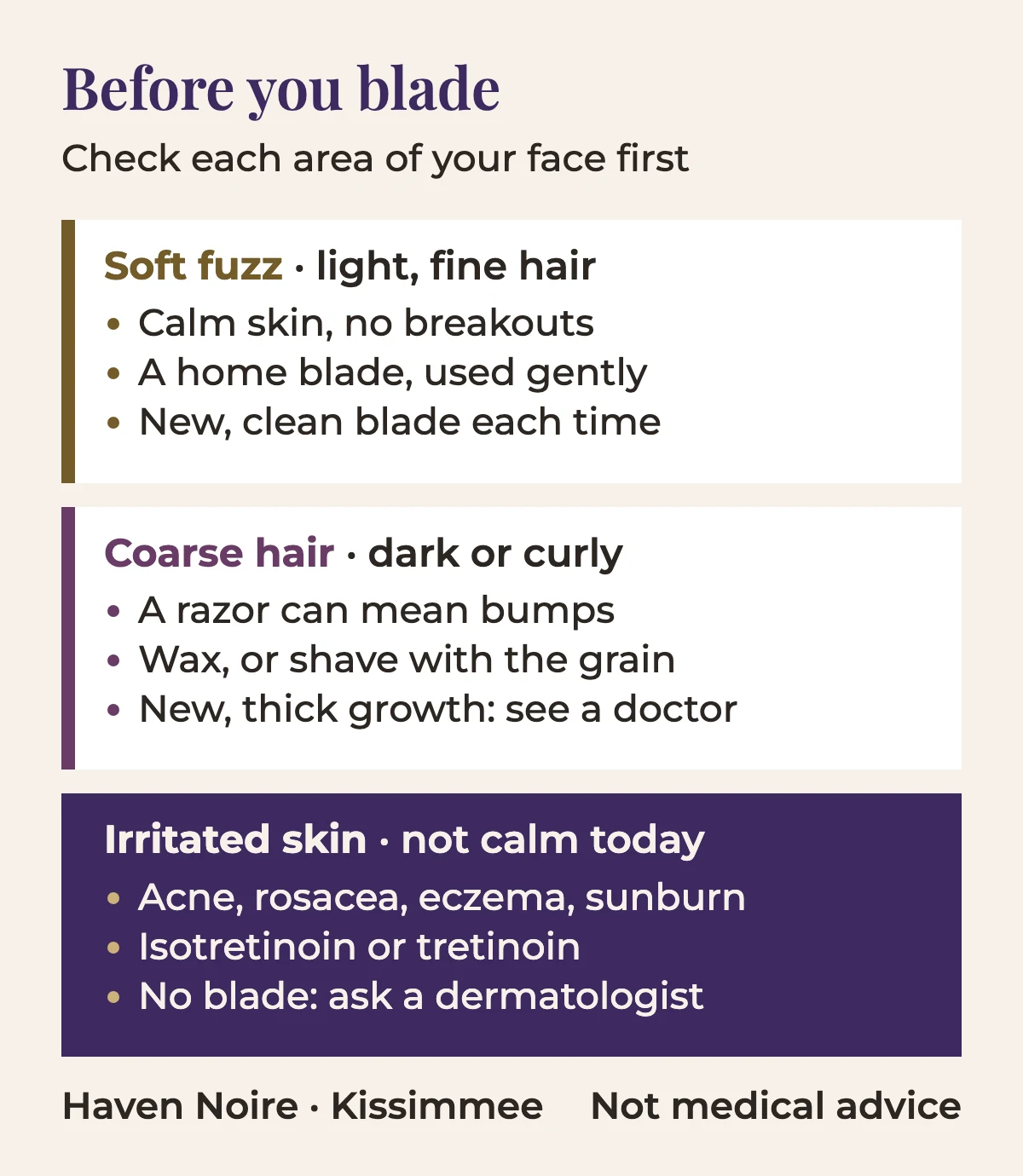
Soft, light hair on calm skin
Fine, light, short hair you notice mostly in side light or under foundation, on skin with no breakouts, rash, or stinging. This is the job at-home blades are made for. Go to the eight steps below.
Coarse, dark, or curly hairs
Thicker, darker hairs, often on the upper lip, chin, or jaw. The AAD's razor bump guide explains that bumps develop when a razor cuts hairs short and coarse, curly hairs curve back into the skin. That page is written for men with darker skin tones; our reading is that coarse, curly chin hair behaves the same on a woman.
Two better fits. Wax pulls hair from the root: on our waxing menu, a Lip Wax or Chin Wax is $10 and a Lip and Chin Wax is $20. Or shave carefully: the AAD's razor bump guide says to shave in the direction the hair grows, never to pull or stretch your skin or dry shave, and that a single-blade or electric razor is often recommended.
Planning a lip or chin wax? Retinol, prescription retinoids, antibiotics, and isotretinoin all change the rules, according to the AAD's waxing guide and its hair removal page, so run the check in our face waxing guide first. Hair that's new, thick, and dark? Read the doctor section below first.
Skin that shouldn't meet a blade today
Breakouts, a rash, an eczema or rosacea flare, a cut, a sunburn, or skin that stings. Harvard Health says people with sensitive skin or conditions such as rosacea, eczema, or acne should avoid dermaplaning. A Cleveland Clinic article says to skip it during an eczema flare-up or any other active skin issue. The AAD's shaving advice for acne is blunt: never try to shave off the acne.
Sensitive but calm today? That's a judgment call better made at a skin analysis than alone at a mirror. See how we approach sensitive and redness-prone skin.
Medicines, pregnancy, and scars: ask first
- Isotretinoin, now or in the last six months: no source we checked sets a dermaplaning rule, but the AAD says not to wax within six months, so ask your dermatologist first.
- Tretinoin or another prescription retinoid: the AAD says tretinoin thins your skin, so ask your prescriber first.
- Pregnant or nursing: ask your OB-GYN or midwife before you start, including about any serums you plan to use after.
- Keloid-prone skin: a nick is a wound, so our advice is to check with your dermatologist first.
| Type | What you see | Best tool | Based on |
|---|---|---|---|
| Soft fuzz | Soft, light, fine hair on calm skin | A home blade, used carefully | Harvard Health, NHS |
| Coarse hair | Coarse, dark, or curly hairs | Wax, or shave the AAD's way | AAD, NHS |
| Irritated skin | Breakouts, rash, flare, cut, sunburn, or a prescription retinoid | No blade for now; ask a dermatologist | Harvard Health, Cleveland Clinic, AAD |
How to Dermaplane at Home, Step by Step
These steps are for areas with soft fuzz only. They follow Harvard Health's technique, the AAD's shaving tips, and dermatologist advice reported by Cleveland Clinic and Consumer Reports. Where we add our own judgment, we say so.
- Start with a new, clean blade. Harvard Health says this lowers the odds of a nick.
- Wash your face and remove all makeup. Our dermaplaning page notes the blade needs a clean, product-free surface.
- Pull the skin taut with your free hand.
- Hold the blade at about 45 degrees and use short, light, downward strokes.
- Start near the top of your ear and work down. Skip your hairline, eyelids, and the sides of your nose.
- Go around any pimple, bump, or broken spot, never over it.
- Stop at the first redness or burning, as dermatologist Jessie Cheung advises in Consumer Reports.
- Rinse, then apply a gentle, fragrance-free moisturizer and sunscreen. Skip acid- or retinol-based products for a few days.
Steps 3 to 5 and the last line of step 8 are Harvard Health's; Dr. Cheung also warns against pressing too hard. Our advice: keep the blade off your brows too, since shaping them is a different job, covered in our guide to eyebrow shapes. For the days after, our dermaplaning aftercare plan maps makeup, actives, and Florida sun day by day.
Dry blade or shaving cream?
Here the sources disagree. Some at-home tool guides we read, and Consumer Reports' testers, start on a clean, dry face. The AAD's shaving tips, written for razors in general rather than facial blades, say to wet your skin and hair first, and to use a shaving cream labeled "sensitive skin" if your skin is very dry or sensitive. No source we found settles which applies to dermaplaning, and our November 2026 PubMed search turned up no study comparing them. Whichever method you use, stop at the first redness or stinging.
Keep the blade clean, dry, and yours
- Clean it before and after each use, as Cleveland Clinic advises.
- Let it dry completely between uses, and don't leave it in the shower, as the AAD advises.
- Replace it often: Harvard Health says a new blade each time; the AAD's rule for razors is 5 to 7 shaves.
- Don't share it. That one is our own advice.
How often to dermaplane at home
Less often than you might think. Dr. Piliang says she wouldn't do it more than once a week, so your skin can recover in between, and Dr. Cheung warns that overdoing it can make skin more sensitive or cause pigmentation problems. Our advice: don't blade before the fuzz is back, and count it as that week's exfoliation. Our guide to how often to exfoliate explains why we don't stack them.
Dermaplaning at Home on Melanin-Rich Skin
On brown and Black skin, the bigger worry isn't the shave. It's what a nick or irritation can leave behind.
The AAD's guide to dark spots in darker skin tones says spots often appear when a wound, such as a cut, heals, or when a skin or hair care product irritates your skin. A nick is a cut. Over-blading is irritation. The AAD adds that a spot a few shades darker than your natural color usually fades within 6 to 12 months, and deeper color can take years. A smooth cheek lasts weeks.
Three habits lower the odds:
- Blade less, not more. Dr. Cheung's warning about pigmentation problems is about overdoing it.
- Don't blade coarse, curly hairs. If a razor gives your chin bumps, change tools instead of blading over them.
- Wear tinted sunscreen every day. The AAD recommends iron oxide, SPF 30 or higher, and broad-spectrum protection.
Our guide to sunscreen for dark skin shows how to find iron oxide on the label. If a mark has already formed, start with how to fade hyperpigmentation on melanin-rich skin.
When to Leave Dermaplaning to a Professional
A home blade handles fuzz. In our view, a professional visit makes more sense when:
- You can't tell which group you're in, or your face sorts into all three.
- Your skin runs sensitive and you'd like someone to check whether a blade suits it at all.
- You want the exfoliation and the care that follows, not only smooth skin.
- A nick or a flare last time made you nervous to try again.
At Haven Noire, dermaplaning is the Dermaplane + Nano Infusion facial on our corrective facials menu: $135, or $360 for a 3-pack (save $45). Our dermaplaning page lays out the visit:
- Skin analysis and consultation, reviewing your concerns, goals, and anything that rules treatment out.
- Double cleanse and prep.
- Dermaplaning across the forehead, cheeks, chin, and upper lip.
- A nano infusion step that applies serums such as vitamin C, peptides, and hyaluronic acid.
- A hydrating masque, SPF, and home-care instructions.
Beforehand, our page asks you to skip retinoids, AHAs, BHAs, and other actives for 3 to 5 days, and not to wax or use hair removal creams on your face within a week. Used a home blade recently? Ask us how long to wait. Coming monthly? The Corrective Membership is $109.99 a month, with a three-month minimum.
Haven Noire is an esthetics spa, not a medical office, founded by Tiffany, a Florida-licensed esthetician. We're at 231 Ruby Avenue, Unit E, in downtown Kissimmee, across from Lakefront Park.
When to See a Dermatologist or Doctor Instead
We're estheticians, not doctors, and a facial blade doesn't treat a skin or hormone condition. These are medical questions.
Before you pick up a blade
- Active acne, an eczema flare, or any other active skin issue: Cleveland Clinic suggests seeing a dermatologist about professional options.
- Isotretinoin, tretinoin, or another prescription skin medicine: ask your prescriber first.
- Pregnancy or nursing: ask your OB-GYN or midwife first.
After blading
- A nick that turns painful, hot, and swollen: our aftercare guide lists the NHS signs that need a doctor today.
- Dark marks that keep appearing or won't fade: the AAD says a dermatologist can help when your treatment isn't working.
- Razor bumps that continue after you change your technique: that's the AAD's line for seeing a dermatologist.
When the hair itself is the question
The NHS describes hirsutism as thick, dark hair on a woman's face, neck, chest, tummy, lower back, buttocks, or thighs, and advises seeing a doctor if it's a problem for you, particularly with irregular periods. It advises an urgent appointment if new thick, dark hair suddenly starts growing on your face and body, your voice is getting lower, or your muscles are getting bigger.
The NHS lists shaving and waxing among the at-home ways a GP may suggest to remove the hair, but hair removal doesn't replace that visit. Not sure which question you have? Contact us before you book.
Frequently Asked Questions About Dermaplaning at Home
Is it bad for women to shave their face?
Not for most calm skin. Harvard Health says at-home dermaplaning, which is essentially shaving, is safe when done carefully. The catches are nicks and irritation, and people with sensitive skin, rosacea, eczema, or acne should skip it. Coarse, dark hairs may do better with wax, and sudden new growth is a question for your doctor.
Will peach fuzz grow back thicker after dermaplaning?
No. A Cleveland Clinic dermatologist explains that trimming hair above the skin's surface has no effect on how it grows. Regrowth can feel coarser for a short while because the cut leaves a blunt tip, and it softens as it grows. Expect the same soft fuzz to return on its usual schedule.
How often can you dermaplane your face at home?
No more than once a week, a Cleveland Clinic dermatologist advises, so your skin can recover in between. Our advice is gentler: wait until the fuzz is back. A dermatologist interviewed by Consumer Reports warns that overdoing it can make skin more sensitive or cause pigmentation problems.
Can you dermaplane at home if you have acne?
Not over active breakouts. Harvard Health says people with acne should avoid dermaplaning, and Cleveland Clinic says it can agitate existing acne. The AAD's shaving advice is never to shave off acne. See a dermatologist for breakouts that persist, and read the best facial for acne to see where facials fit.
Is dermaplaning safe for Black skin?
It can be, on calm skin with a careful hand. The risk is what a nick or irritation leaves behind. The AAD says cuts and irritating products often trigger dark spots in darker skin tones, and a spot a few shades darker usually takes 6 to 12 months to fade. Blade gently and rarely, and wear tinted sunscreen daily.
Should I dermaplane my upper lip and chin?
If the hair there is soft and light, the same steps apply. If it's coarse, dark, or curly, a razor cuts it short, and the AAD says that's how razor bumps start in curly hair. Waxing removes it from the root instead. At Haven Noire, a Lip Wax or a Chin Wax is $10, and both together are $20.
How much does professional dermaplaning cost in Kissimmee?
At Haven Noire, dermaplaning is the Dermaplane + Nano Infusion corrective facial: $135, or $360 for a 3-pack. The Corrective Membership is $109.99 a month for one corrective facial of your choice, with a three-month minimum. For how that compares across our menu, see what a facial costs in Kissimmee.
More from the Journal

About the author
Tiffany · Licensed Esthetician · Licensed PMU Artist
Tiffany is a Florida-licensed esthetician and permanent makeup artist and the founder of Haven Noire. She specializes in customized facials, corrective skincare, and waxing for melanin-rich and all skin types, and is known for a calm, education-first approach that puts first-time clients instantly at ease.
Meet Tiffany →