
Copper peptides are skin care ingredients that bind copper to a tiny protein fragment, and the best known is GHK-Cu. As of November 2026, they're one of skin care's loudest trends: in September 2026, NPR reported that people are smearing an electric-blue tincture on their faces or drawing it up in syringes.
The short version: GHK-Cu serums and creams have been tested on human skin in small trials, mostly funded by the cosmetic industry, and they point toward softer fine lines and firmer skin. The bigger promises come mostly from lab dishes and animals. Injections have no published human studies showing they're safe and effective.
Below: what the studies tested, a way to sort any claim, how to try a serum, what changes for melanin-rich skin, and when a doctor comes first.
What Are Copper Peptides?
Copper peptides are ingredients that attach copper to a short chain of amino acids. The best-studied one, GHK-Cu, links copper to glycine, histidine, and lysine. Ingredient lists usually call it GHK-Cu or copper tripeptide-1.
Your body makes GHK, too. NPR traces it to the early 1970s, when a chemist first isolated it while studying blood plasma from younger adults, and also found that levels decline as people age. That decline is the root of the anti-aging pitch: add back what young skin has more of. Our guide to preventing wrinkles ranks the everyday habits with more proof behind them, starting with daily sunscreen.
From Blue Serum to Syringes: The 2026 Trend
NPR says serums and creams have been sold for decades. What changed is the route: many people now inject GHK-Cu under the skin, sometimes "stacked" with other peptides promoted for tissue repair and anti-aging, often bought from gray-market sellers online. NPR also notes that GHK-Cu isn't an approved drug.
The Benefits of Copper Peptides: What Studies Actually Tested
In Lab Dishes and Animals
The big claims start here. NPR reports that in animal studies, GHK-Cu sped up wound healing and helped repair organs.
The clearest count we found is a 2026 systematic review in Aesthetic Surgery Journal. It searched three research databases for studies of GHK-Cu used on its own for aesthetic purposes and included 20. Eighteen were preclinical, meaning lab or animal work, and two were randomized controlled trials in people. In the preclinical work, GHK-Cu consistently boosted collagen production, promoted new blood vessel growth, and calmed inflammation.
On Human Skin: Small, Short, and Mostly Industry-Funded
The human studies exist, and they're small. NPR describes them as generally small trials funded by the cosmetic industry, showing that GHK-Cu creams and serums improve skin thickness and elasticity and decrease wrinkles.
A 2015 review in BioMed Research International describes three face and eye studies: 12-week facial cream studies in 71 women and in 67 women aged 50 to 59, and a 12-week eye cream study in 41 women. Its lead author is the chemist who first isolated GHK. All three authors list Skin Biology's research and development department as their affiliation, and the review cites the lead author's own copper peptide patents, though it declares no conflict of interest.
Other reviews read the record more cautiously. A 2024 review in BioImpacts called the absence of clinical studies on GHK-Cu in anti-wrinkle products surprising. A 2026 review in the journal Life found many peptide trials limited by small samples, short follow-up, industry sponsorship, or multi-ingredient formulas.
Two human trials outside face creams are worth knowing:
- After laser resurfacing: in a 2006 randomized trial that 13 patients completed, GHK-Cu skin care didn't speed the fading of redness, and objective measures found no difference in wrinkles between groups. Patients who used it did rate their skin quality higher.
- On leg ulcers: in a 1992 randomized trial of 86 people with venous leg ulcers, a 0.4% copper tripeptide cream did no better than a placebo.
Does It Even Get Into Your Skin?
A cosmetic dermatologist quoted by NPR says the molecule doesn't easily penetrate deeper into the skin when applied topically, and a 2025 review in Molecules describes limited permeation through the skin's outer layer. The 2015 review, by contrast, says enough appears to pass that layer to trigger repair. The same dermatologist still calls the science very solid, on par with vitamin C and antioxidant topicals.
Researchers are testing microneedles to push GHK-Cu past that layer, but a separate 2026 systematic review, in Archives of Internal Medicine Research, says that route hasn't been evaluated in a single registered, adequately powered human randomized trial. Microneedling isn't on our menu; our guide to types of facials lists it among the treatments we don't offer.
How to Sort the Copper Peptide Claims You See
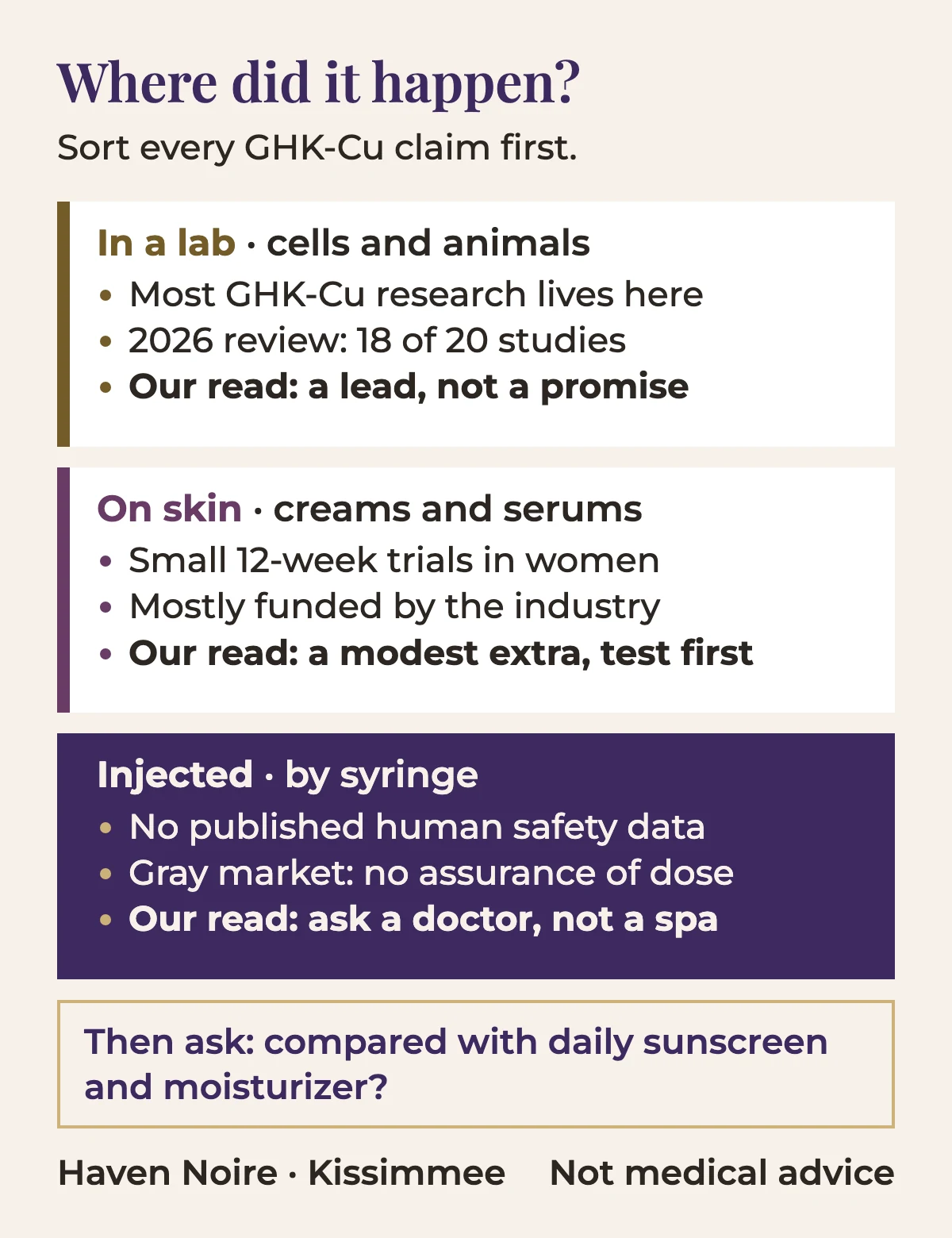
Labels, videos, and brand blogs blend three different bodies of evidence into one promise. To pull them apart, ask one question of every claim: where did that result happen? Most results come from one of three places.
Results in Cells and Animals
Collagen in a lab dish isn't collagen in your cheek. Treat a dish result as a reason for more research, not a reason to buy. In the 2026 review above, 18 of 20 studies were lab or animal work.
Results From Creams and Serums on People
These are the results that tell you about a serum. Expect slow, modest change. The AAD's tips for choosing anti-aging products say these products deliver modest results, and that you can't get the results of a facelift from a cream.
Results From Injections
A cream study can't vouch for a syringe. Injections are outside esthetics, and they get their own section below.
Then Ask: Compared With What?
The same AAD page says "clinically proven" means a product was given to consumers to try, not that it went through clinical trials and FDA approval. It also calls sunscreen and moisturizer the two most-effective anti-aging products you can buy. Measure every serum against those.
| Claim you'll see | Where the evidence comes from | Where it happened | Our read |
|---|---|---|---|
| Softens fine lines and wrinkles | Small 12-week cream trials in women; a 2026 review reports a trial with less wrinkle volume and depth than controls | On skin | Some support, small |
| Firmer, thicker skin | The same small cream trials | On skin | Some support, small |
| Fades dark spots | One cream study reported less mottled pigmentation; none we found in darker skin | On skin, barely | Thin |
| Heals skin faster | Animal studies; in people, the 1992 ulcer trial and 2006 laser trial found no edge over controls | Lab or animal | Not shown in those human trials |
| Slows aging beyond your skin | Lab and animal work, per NPR | Lab or animal | Not tested in people |
| Works better injected | No published human studies, per NPR | Injected | Unknown, and outside esthetics |
How to Use Copper Peptides for Skin Without Irritation
If a serum passes the sort, add it carefully and follow its directions. The AAD warns that some active ingredients cause problems if you apply more than directed.
- Read the label. Look for GHK-Cu or copper tripeptide-1 in the ingredient list.
- Test it first. The AAD's guide to testing skin care products suggests a quarter-sized spot, such as the underside of your arm, twice a day for seven to 10 days.
- Start nothing else new. The AAD's tips for anti-aging products say to start with one product, because several at once can irritate your skin.
- Wear sunscreen every morning. The same page says sun protection helps reduce signs of premature aging.
- Give it time. Most products take at least six weeks to work, the AAD says, and sometimes up to three months.
- Stop if it stings, burns, or tingles. The AAD says those sensations mean a product is irritating your skin.
If your test spot turns red, itchy, or swollen, the AAD's testing guide says to gently wash the product off and not use it again.
Can You Mix GHK-Cu With Vitamin C, Retinol, or Acids?
You'll find opposite answers online: some guides say to avoid using them at the same time, while brand blogs say it depends on the formulas. We searched PubMed in November 2026 for studies combining GHK-Cu with vitamin C, retinol, tretinoin, or glycolic acid and found no human study testing whether using them together helps, hurts, or irritates.
Our advice: never start two actives at once. If you use a retinoid, keep it at night, as a dermatologist in the AAD's retinoid guide advises, and try the copper serum in the morning so the two never go on together. If your skin already stings, follow our plan for a stressed skin barrier first.
Injected GHK-Cu: Why the Syringe Trend Is Outside Esthetics
This is where the trend stops being skin care. NPR's reporting raises three problems:
- No published human studies. NPR reports there is no data from published human studies showing injection is safe and effective.
- Unknown contents. Many people buy injectable versions from gray-market sellers, and a dermatologist told NPR that whether the product even is a copper peptide is always a concern.
- Real complications. A clinician who runs a Seattle-area wellness clinic told NPR he sees problems ranging from injection site irritation and infections to raised liver enzymes and copper levels in people injecting too much, though NPR notes it's unclear whether the peptide or impurities are to blame.
The rules are unsettled, too. NPR reports that U.S. compounding pharmacies aren't technically allowed to offer GHK-Cu for injection in humans, and that an FDA advisory panel planned to review it as an injectable in February.
One dermatologist told NPR injecting might add benefits, since the molecule doesn't easily penetrate, but he and other dermatologists are advising patients to hold off on injecting anything. Injectables aren't on our service menu, and we don't inject anything. Thinking about a peptide you'd inject or swallow? Talk with your doctor first. Already injected one and feel unwell, or see redness, swelling, or pain at the spot? Call your doctor.
Melanin-Rich Skin: Why Irritation Is the Real Risk
The Studies Say Little About Darker Skin
The study summaries we read describe participants by age and sun damage, not skin tone. We searched PubMed in November 2026 for GHK-Cu studies in skin of color, darker skin tones, hyperpigmentation, or melasma and found none that tested it in people with darker skin. That doesn't make it unsafe for you. It means the studies we found didn't report results on skin like yours.
Irritation Can Outlast the Product
The AAD's guide to fading dark spots lists a skin care product that irritates your skin among the triggers for dark spots in darker skin tones. Once the cause stops, it says, a spot a few shades darker than your skin usually fades within 6 to 12 months. So the test spot and the one-product rule matter more for you, not less.
For Dark Spots, Start Somewhere Else
Some guides pitch copper serums for uneven tone. The AAD's list of over-the-counter ingredients that can fade dark spots names azelaic acid, glycolic acid, kojic acid, a retinoid, and vitamin C. Copper peptides aren't on it. The same guide says effective treatment begins with sunscreen, ideally a tinted one with iron oxide.
For the full plan, read how to fade hyperpigmentation on melanin-rich skin and our guide to sunscreen for dark skin.
A Safer Path to Firmer-Looking Skin, and Where a Facial Fits
If the goal behind the blue serum is softer lines and firmer skin, sunscreen and moisturizer come first. After that:
- Consider a retinoid. The AAD's retinoid guide says dermatologists noticed that tretinoin, approved for acne in 1971, also reduces fine lines and wrinkles, and it calls a retinoid a good option for mild fine lines.
- Start it gently, and skip it if you're pregnant: the guide says retinoids should not be used during pregnancy. Our beginner's plan for using retinol walks you through the first weeks.
In our view, a copper serum comes after those: an extra to try only if your skin tolerates it.
Where Haven Noire Fits
We're estheticians, not doctors, and no facial replaces daily sunscreen. A facial adds a trained look at your skin and a plan. Our anti-aging facials page lists the signs those treatments are built for, from fine lines around the eyes and mouth to loss of firmness. Three options fit:
- Luxe Lift Anti-Aging, a 60-minute Corrective Facial with advanced peptides and collagen-stimulating actives targeting fine lines, wrinkles, and loss of tone: $135, or $360 for a 3-pack.
- The 90-minute Signature Facial, $110 or 3 for $285, with facial massage and an added eye treatment.
- The Corrective Membership, $109.99 a month with a three-month minimum: one Corrective Facial of your choice each month, Luxe Lift included.
Every Corrective Facial starts with a skin consultation and ends with serums, moisturizer, and SPF, plus a home-care plan. Wondering whether a copper serum belongs in it? Ask us, and see the professional skincare lines we work with.
Curious about other viral anti-aging trends? Read our guides to the salmon sperm facial and face taping.
When to See a Dermatologist or Doctor Instead
Haven Noire is an esthetics spa, not a medical office. Check with your doctor or a board-certified dermatologist before you try a copper serum, or after, if any of these apply:
- You're pregnant, planning a pregnancy, or breastfeeding. We searched PubMed in November 2026 and found no study of GHK-Cu skin products in pregnancy or breastfeeding. ACOG's guide to skin conditions during pregnancy lists a few over-the-counter acne ingredients that can be used and says to contact your ob-gyn about any ingredient not on its list.
- You take isotretinoin, use tretinoin or another prescription skin medicine, or have eczema, rosacea, or very sensitive skin. Ask your dermatologist before you add any new active.
- You have Wilson disease, which MedlinePlus describes as an inherited disorder with too much copper in the body's tissues. We searched PubMed in November 2026 and found no study of GHK-Cu skin products in people with it, so our advice is to ask your doctor first.
- Dark spots appear after a product irritates your skin and don't fade with gentler products and daily sunscreen. The AAD's dark spots guide says a dermatologist can help when your treatment isn't working, and some spots may need prescription-strength treatment.
- A reaction is severe. The AAD's testing guide says that if a reaction isn't relieved with cool compresses or petroleum jelly, you may need a dermatologist.
- You've followed the AAD's anti-aging tips without the results you want. The AAD suggests a board-certified dermatologist then.
If redness is what you notice most, see how we approach sensitive and redness-prone skin alongside your doctor's care.
Frequently Asked Questions About Copper Peptides
What do copper peptides do for your skin?
In small human trials, mostly funded by the cosmetic industry, GHK-Cu creams and serums improved skin thickness and elasticity and reduced wrinkles, NPR reports. The bigger claimed benefits, such as faster healing and slower aging, come mostly from lab and animal studies. Treat it as a modest extra next to sunscreen and moisturizer, not a replacement.
How long does it take for a GHK-Cu serum to work?
The cream studies we read ran for 12 weeks. The American Academy of Dermatology says most anti-aging products take at least six weeks to work, and sometimes up to three months. Give a new serum that long before you judge it, and stop sooner if it stings, burns, or tingles.
Can you use GHK-Cu with vitamin C or retinol?
We searched PubMed in November 2026 and found no human study testing those combinations. Our advice: start one active at a time, keep a retinoid at night as a dermatologist in the AAD's retinoid guide advises, and try the copper serum in the morning. If your skin stings, pause both and ask a dermatologist.
Is it safe to inject GHK-Cu for your skin?
No one can say yet. NPR reports there's no data from published human studies showing injected GHK-Cu is safe and effective, and many people buy it from gray-market sellers with no assurance of quality or dose. Dermatologists told NPR they advise holding off. Injections aren't on our menu, so talk with your doctor.
Is GHK-Cu safe for Black or brown skin?
Our November 2026 PubMed search found no study that tested it in people with darker skin, so we can't say either way. The AAD lists an irritating skin care product among the triggers for dark spots in darker skin tones, so test a small spot first, add one product at a time, and wear sunscreen daily.
Can you use a copper serum while pregnant?
Ask your ob-gyn first. We searched PubMed in November 2026 and found no study of GHK-Cu skin products in pregnancy. ACOG's pregnancy skin guide lists a few over-the-counter acne ingredients that can be used and says to contact your ob-gyn about any ingredient that isn't on its list.
Is GHK-Cu better than retinol?
That hasn't been shown. The AAD calls a retinoid a good option for mild fine lines and wrinkles. GHK-Cu's human trials are few and small; one pilot cited in the 2015 review found collagen gains in more women using GHK-Cu than retinoic acid, but measured thigh biopsies, not wrinkles. Retinoids can irritate and aren't for pregnancy, so ask a dermatologist.
Does Haven Noire use copper peptides in facials?
Our menu describes Luxe Lift Anti-Aging, a $135 Corrective Facial, as using advanced peptides and collagen-stimulating actives, but it doesn't name which peptides. Ask us at your consultation what's in your treatment, and tell us everything you use at home, including any copper serum, so we can plan around it.
More from the Journal

About the author
Tiffany · Licensed Esthetician · Licensed PMU Artist
Tiffany is a Florida-licensed esthetician and permanent makeup artist and the founder of Haven Noire. She specializes in customized facials, corrective skincare, and waxing for melanin-rich and all skin types, and is known for a calm, education-first approach that puts first-time clients instantly at ease.
Meet Tiffany →