

How often should you exfoliate? The American Academy of Dermatology (AAD) doesn't give one number. It says the more aggressive the exfoliation, the less often you need it. For most faces, we suggest starting at once a week, with something gentle. That number, like every number in this guide, is our starting point, not a medical rule.
For some people, the number is zero, because the AAD tells people with rosacea to stop exfoliating and lists exfoliants among the products to avoid while taking isotretinoin. For almost everyone else, the real question isn't how many days. It's how many exfoliants are already in your week.
How Often Should You Exfoliate Your Face? What Dermatologists Say
Exfoliation removes dead skin cells from the outer layer of your skin. You do it mechanically, with a tool or a scrub, or chemically, with acids that dissolve those cells. How often depends on your skin type and your method.
That last line comes straight from the AAD's guide to exfoliating safely at home. It says how often you exfoliate "depends on your skin type and exfoliation method," and that "the more aggressive the exfoliation, the less often it needs to be done." It never names a number of days. It also warns that exfoliation is "not for everyone," and that done badly, "it could do more harm than good."
So where do the popular "two to three times a week" rules come from? The top-ranking guides we read in November 2026 ranged from once a week to several times a week, and none cited a study that tested a schedule. We searched PubMed that month for trials comparing how often to exfoliate the face at home and found none. Any number you see, ours included, is a starting point, not a medical rule.
| Your skin | What the AAD says | Our starting point |
|---|---|---|
| Oily, thicker skin | May want stronger chemical treatments or mechanical exfoliation | Once a week; build to two or three times only if skin stays calm |
| Normal or combination | Choose a method that suits your skin type | Once a week; let the drier areas set the pace |
| Dry, sensitive, or acne-prone | A washcloth and a mild chemical exfoliator; mechanical may be too irritating | Once a week at most, or skip it |
| Darker skin tone, or dark spots after bites, burns, or acne | Avoid strong chemical or mechanical exfoliation | Gentle only, once a week at most |
| Rosacea | If you exfoliate, stop | Zero |
| Taking isotretinoin | Exfoliants are on the list of products to avoid | Zero, unless your dermatologist says otherwise |
| Using a retinoid, retinol, or benzoyl peroxide | Exfoliating on top may worsen dry skin or cause breakouts | Count it in your week; ask your prescriber before adding more |
One caution: rough or bumpy skin isn't always a job for exfoliation. Our guide to textured skin sorts the bumps that respond to it from the ones that need a dermatologist.
Four Checks Before You Pick a Number
These checks are built on the AAD's guidance on exfoliation, rosacea, isotretinoin, and dark spots, plus the aftercare Haven Noire publishes for its own treatments. They're for home use, not a diagnosis, and they don't replace your dermatologist.
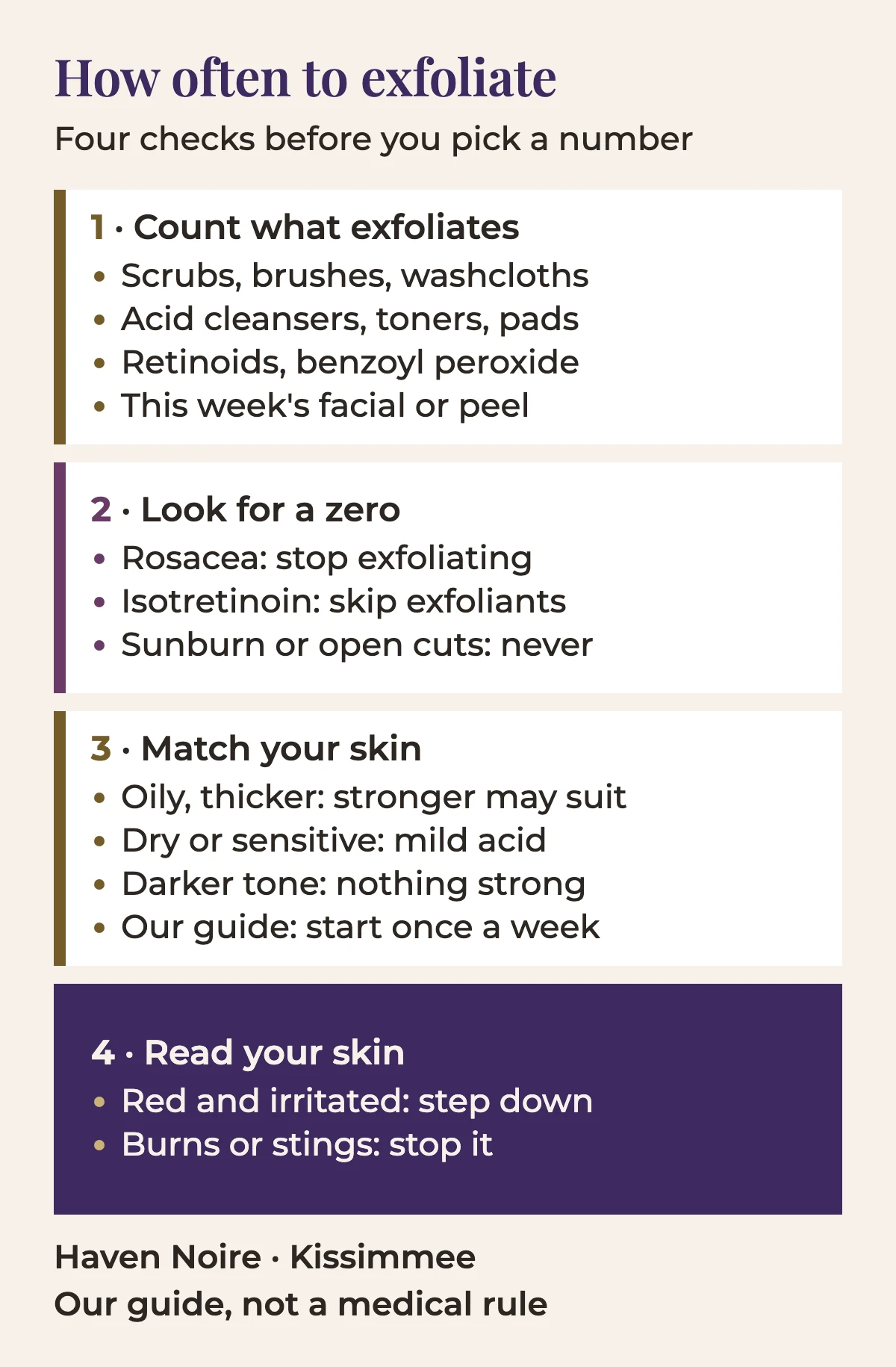
Instead of asking how many days, count everything that exfoliates your face in a week. Then check for a zero, match the method to your skin, and let your skin tell you when to step down.
Count what's already exfoliating you
The AAD's first tip is to consider the skin care products you already use. We'd count each of these toward your week:
- Scrubs, cleansing brushes, pads, and sponges. The AAD calls these mechanical exfoliation.
- A washcloth you scrub with. The AAD's face washing tips say anything other than your fingertips can irritate your skin.
- Cleansers, toners, pads, or serums made with alpha or beta hydroxy acids (AHAs or BHAs), the chemical exfoliants the AAD names. Not sure which kind your toner is? See the three kinds of toner.
- Retinoids, retinol, and benzoyl peroxide. They aren't sold as exfoliants, but the AAD says they can make skin more sensitive or peel, and that exfoliating on top may worsen dry skin or even cause breakouts. Using one with an acid? A skin cycling routine puts them on separate nights.
- A facial, peel, or dermaplaning visit in the last week. More on that below.
Our rule of thumb: if your count already reaches two or three before you pick up a scrub, you may not need the scrub at all.

Look for a zero
Some answers are zero. The number is ours, but the reasons behind it come from the AAD and our own aftercare:
- Rosacea. The AAD's rosacea skin care tips are direct: "If you exfoliate your skin, stop."
- Isotretinoin. The AAD's guide to isotretinoin side effects says to avoid abrasive scrubs or cleansers with an exfoliant, and lists AHAs, BHAs, and exfoliating beads among the things to avoid.
- Open cuts, wounds, or sunburn. The AAD says never to exfoliate.
- A recent spa exfoliation. Each treatment has a wait before home exfoliants return; our table below lists them.
Pregnant, nursing, or using tretinoin or another prescription skin medicine? Ask your doctor or dermatologist before you add an exfoliant. The same goes for eczema, and for skin that scars or forms keloids easily.
Match the method, then start low
The AAD matches the method to the skin: a washcloth and a mild chemical exfoliator for dry, sensitive, or acne-prone skin, because mechanical exfoliation may be too irritating, while oily, thicker skin may want stronger chemical treatments or mechanical exfoliation.
Then start low. Our suggestion: begin at once a week, hold that pace for a few weeks, and add a day only if your skin stays calm. Change one thing at a time.
Read your skin's answer
Your skin tells you when the count is too high. The AAD warns that over-exfoliating "could lead to skin that is red and irritated." Its dark-spot guide adds a rule worth keeping: if a product burns or stings when you apply it, stop using it.
Our advice: when you see either sign, step down. Take a week off exfoliants, then restart at once a week or less, with one product. If irritation lingers, our guide to the skin barrier shows how to tell when it's struggling and what helps.
Physical vs Chemical Exfoliation: How They Differ
Physical exfoliation, which the AAD calls mechanical, uses a tool or a scrub to remove dead skin cells. Chemical exfoliation uses acids, such as alpha and beta hydroxy acids, to dissolve them.
| Physical (mechanical) | Chemical | |
|---|---|---|
| How it works | A tool or scrub physically removes dead skin cells | Acids such as AHAs and BHAs dissolve dead skin cells |
| At home | Scrubs, brushes, pads, sponges, a washcloth | Acid cleansers, toners, pads, and serums |
| In the spa | Dermaplaning and microdermabrasion | Chemical peels, such as our Lactic Peel |
| AAD skin match | Oily, thicker skin | Mild forms for dry, sensitive, or acne-prone skin; stronger for oily, thicker skin |
| Darker skin tones | Avoid strong versions | Avoid strong versions |
Acids carry one extra rule that matters in Central Florida. The FDA says alpha hydroxy acids may increase your skin's sensitivity to the sun, and the label warning it recommends tells you to use a sunscreen, wear protective clothing, and limit sun exposure while you use the product and for a week afterward. For beta hydroxy acids, such as salicylic acid, the FDA's advice is to use sun protection.
Weighing a gentler acid for deeper skin? Our guide to mandelic acid covers what it is and who it suits.
How to Exfoliate Your Face Safely
Technique matters as much as the schedule. Steps 2 to 6 follow the AAD's exfoliation guide:
- Count your exfoliants and check the reasons for a zero above first, so you know your count and your stop signs.
- Apply a scrub or chemical exfoliator gently, in small circles, for about 30 seconds.
- With a brush or sponge, use short, light strokes.
- Rinse with lukewarm water, not hot.
- Moisturize right away, because exfoliating can dry your skin.
- Skip it entirely on open cuts, wounds, or sunburn.
Signs you're exfoliating too often
Beyond red, irritated skin and products that burn or sting, watch for:
- Dry skin that's new or getting worse, especially if you also use a retinoid or benzoyl peroxide.
- New dark spots. The AAD says a skin care product that irritates your skin can cause them, and that gentler products, often labeled "for sensitive skin" or "fragrance-free," are less likely to irritate.
If you notice any of these, step down as described above. For home care between visits, ask us about the professional skincare lines we work with.
Exfoliating Melanin-Rich Skin: Gentler and Less Often
If your skin is brown or Black, the answer to how often you should exfoliate gets stricter. The AAD's exfoliation guide says to avoid strong chemical or mechanical exfoliation if you have a darker skin tone, or if you notice dark spots after burns, bug bites, or acne breakouts. It says that for some people, especially those with darker skin tones, more aggressive exfoliation may lead to increased pigmentation, or dark spots.
The cost of getting it wrong is time. The AAD's guide to fading dark spots in darker skin tones says a spot a few shades darker than your natural color usually fades within 6 to 12 months once its cause stops, and deeper color can take years.

Three habits that help:
- Choose mild over strong. For dry or sensitive skin, the AAD suggests a mild chemical exfoliator.
- Keep the count low. Our suggestion: one exfoliant, once a week, is a sensible ceiling to start.
- Wear sunscreen daily, especially with AHAs or BHAs. Our guide to sunscreen for dark skin shows how to choose one without a white cast.
Acne changes the plan. In its tips for clearing acne in darker skin tones, the AAD advises seeing a dermatologist before using any chemical peel, microdermabrasion, or laser therapy to treat acne, because even at-home versions can cause permanent dark marks and light spots on darkly pigmented skin. Melasma is its own case, too: the AAD's melasma treatment guide lists a chemical peel among the procedures for melasma and says only a board-certified dermatologist should perform them. If you have melasma, see a dermatologist before any peel.
Already have marks? Start with how to fade hyperpigmentation on melanin-rich skin. For how a facial can stay controlled on deeper skin, read our guide to facials for Black skin.
Facials, Peels, and Dermaplaning: Planning Home Exfoliation Around Spa Visits
Most advice on how often you should exfoliate ignores the spa. A professional exfoliation counts toward your week, and each treatment has its own wait before home exfoliants return. Here are the rules we publish:
| Treatment | Exfoliation step | Home exfoliants afterward |
|---|---|---|
| Signature Facial: 60 minutes, $95; 90 minutes, $110 | Exfoliation and extractions as needed | Skip harsh actives and heat for 24 hours |
| Dermaplane + Nano Infusion (Corrective Facial, $135) | A sterile blade removes dead surface cells and peach fuzz | No retinoids or active acids for 3 to 5 days |
| Microdermabrasion + Nano Infusion (Corrective Facial, $135) | Polishes away dull, dead skin | Avoid active exfoliants for a few days |
| Hydrofacial (Corrective Facial, $135) | Water-based hydrodermabrasion that exfoliates while infusing serums | Avoid active exfoliants for a few days |
| Chemical peels (skin consultation first) | Targeted acids resurface the skin | No retinol, retinoids, AHAs, BHAs, or scrubs, usually for 5 to 7 days |
Our advice: a spa exfoliation is that week's exfoliation, so skip the scrub at home. Pause before a visit, too. Our dermaplaning page asks you to stop retinoids, AHAs, BHAs, and other active treatments 3 to 5 days before, and our chemical peels page asks you to stop AHAs, BHAs, and exfoliating acids 5 to 7 days before. Every peel requires a skin consultation first and isn't offered on a first visit.
For day-by-day detail, see our dermaplaning aftercare plan or our chemical peel aftercare guide.
How often to book a professional exfoliation
Our studio's rule of thumb: most skin does best with a facial about every four weeks, and active concerns may call for a shorter series to start. For our corrective facials, many clients start every two to three weeks, then taper to maintenance, and we'll map a plan in your consultation. Our guide to how often to get a facial explains the rhythm.
A monthly visit can anchor your week. The Glow Membership ($74.99 a month) includes a 60-minute Signature Facial; the Corrective Membership ($109.99 a month) includes any corrective facial, Hydrofacial included. Both have a three-month minimum, and members get 10% off extra services and in-spa products. See our memberships.

Body Exfoliation: Legs and Freshly Waxed Skin
The AAD's exfoliation guide doesn't set a separate schedule for the body. We think its core rule still applies: the more aggressive the method, the less often you use it. For a whole-body routine, see how to get smooth skin. Two situations have their own rules:
- Freshly waxed skin. Our aftercare says to avoid heat, friction, sweat, and direct sun for 24 to 48 hours, then exfoliate gently after a few days and keep moisturizing. Our waxing aftercare guide walks through the first 48 hours.
- Dots or bumps on your legs. They have several possible causes, so sort the cause before you choose an exfoliant. Our guide to strawberry legs helps you tell them apart.
When to See a Dermatologist Instead of Exfoliating
Haven Noire is an esthetics spa, not a medical office; Tiffany, our founder, is a Florida-licensed esthetician. Exfoliation isn't a treatment for a skin condition, and the AAD notes that a dermatologist can evaluate your skin and help you decide if exfoliation is beneficial for you. See a dermatologist first when:
- Your face flushes, stays red, or stings with many products. Our page on sensitive and redness-prone skin explains what a facial can and can't do.
- You take isotretinoin, use tretinoin or another prescription skin medicine, or you're pregnant or nursing. Ask the doctor who prescribed it, or your OB-GYN.
- You have eczema, or skin that scars or forms keloids easily.
- You have acne on brown or Black skin and want a peel or microdermabrasion to treat it, or you have melasma and want a peel.
- Dark spots aren't fading. The AAD says that if the treatment you're using fails to deliver the results you want, you may want to see a dermatologist.
- You're not sure what your skin type is.
Not sure which side of the line you're on? Bring your list of exfoliants to your skin analysis, and ask us whether a dermatologist should see your skin first.
Frequently Asked Questions About How Often to Exfoliate
Is it bad to exfoliate your face every day?
It can be. The American Academy of Dermatology gives no set number, but it says the more aggressive the exfoliation, the less often it should be done, and that over-exfoliating can leave skin red and irritated. We suggest starting at once a week and adjusting to how your skin responds.
How often should you exfoliate oily skin?
The American Academy of Dermatology says people with oily, thicker skin may want stronger chemical treatments or mechanical exfoliation. Our advice: start once a week, then build to two or three times a week only if your skin stays calm. Already using benzoyl peroxide or a retinoid? Count it first.
How often should you exfoliate sensitive skin?
Gently, if at all. The AAD suggests a washcloth and a mild chemical exfoliator for sensitive skin, because mechanical exfoliation may be too irritating. We'd say once a week at most. If your face flushes or stings easily, ask a dermatologist first, since the AAD tells people with rosacea to stop exfoliating.
Is physical or chemical exfoliation better for dark skin?
The AAD doesn't pick one. It says to avoid strong chemical or mechanical exfoliation if you have a darker skin tone, because more aggressive exfoliation may lead to dark spots. If your skin is also dry or sensitive, the AAD points toward a mild chemical exfoliator. Whatever you choose, keep it gentle and wear sunscreen daily.
Can you exfoliate while using retinol?
Be careful. The American Academy of Dermatology says retinol, prescription retinoids, and benzoyl peroxide can make skin more sensitive or peel, and that exfoliating while you use them may worsen dry skin or cause breakouts. Count your retinoid as part of your week, and if it's a prescription, ask your prescriber before adding any exfoliant.
How long after a facial can you exfoliate?
It depends. After our Signature Facial, skip harsh actives and heat for 24 hours. After a corrective facial, avoid active exfoliants for a few days, and after dermaplaning, wait 3 to 5 days for retinoids and active acids. After a chemical peel, our aftercare guide says to skip retinoids, acids, and scrubs, usually for 5 to 7 days.
How often should you get a professional exfoliating facial?
Our rule of thumb: a facial about every four weeks, with corrective goals often starting every two to three weeks. We count the visit as that week's exfoliation. At Haven Noire, a Corrective Facial is $135, or $360 for a 3-pack; see what a facial costs in Kissimmee.
More from the Journal

About the author
Tiffany · Licensed Esthetician · Licensed PMU Artist
Tiffany is a Florida-licensed esthetician and permanent makeup artist and the founder of Haven Noire. She specializes in customized facials, corrective skincare, and waxing for melanin-rich and all skin types, and is known for a calm, education-first approach that puts first-time clients instantly at ease.
Meet Tiffany →