

Face waxing removes hair from your brows, upper lip, or chin at the root. At Haven Noire in downtown Kissimmee, each area takes 10 to 15 minutes and costs $10 to $20, and we suggest coming back every 3 to 4 weeks.
Here's what most guides leave out. Whether your skin is ready for wax has less to do with your pain tolerance and more to do with what's in your bathroom cabinet. A retinol serum, an acne prescription, or last week's peel can turn a ten-minute lip wax into a raw patch. On melanin-rich skin, that patch can leave a dark mark that lasts for months.
Below you'll find a three-question check to run before you book, what changes for brows, lip, and chin, aftercare for Florida heat, and the signs that call for a dermatologist instead of an esthetician.
What Is Face Waxing?
Face waxing removes unwanted facial hair with warm wax. An esthetician spreads the wax over a small area, then lifts it away so the hair comes out with it. Common areas are the eyebrows, upper lip, and chin.
It's a temporary method. MedlinePlus, from the U.S. National Library of Medicine, lists waxing among the temporary hair removal options it describes as safe and inexpensive.
Here's what it looks like on our menu:
| Service | Time | Price |
|---|---|---|
| Eyebrow Shape + Wax | 15 minutes | $15 |
| Lip Wax | 10 minutes | $10 |
| Chin Wax | 10 minutes | $10 |
| Lip and Chin Wax | 15 minutes | $20 |
Two things to know before a first visit:
- Hair needs to be about a quarter inch long, roughly two to three weeks of growth, so the wax can grip it.
- We suggest rebooking every 3 to 4 weeks for the smoothest results.
Every service on our waxing menu in Kissimmee is performed by a licensed esthetician in a private, hygienic setting. That covers the basics. The rest of this guide is about the part that decides how your skin looks the day after.
3 Questions to Ask Before You Wax Your Face
"Lifting" is the treatment-room word for wax taking a thin layer of skin along with the hair. Dermatology journals call it epidermal stripping. It's the problem worth planning around, because its known triggers are things you can check in advance.
These three questions are built on the American Academy of Dermatology's waxing guidance and published case reports. That guidance was written for people waxing at home, and in our view the skin rules matter just as much before a professional wax. Answer them at home before you book. They aren't a medical screening, and they don't replace your prescriber's advice.
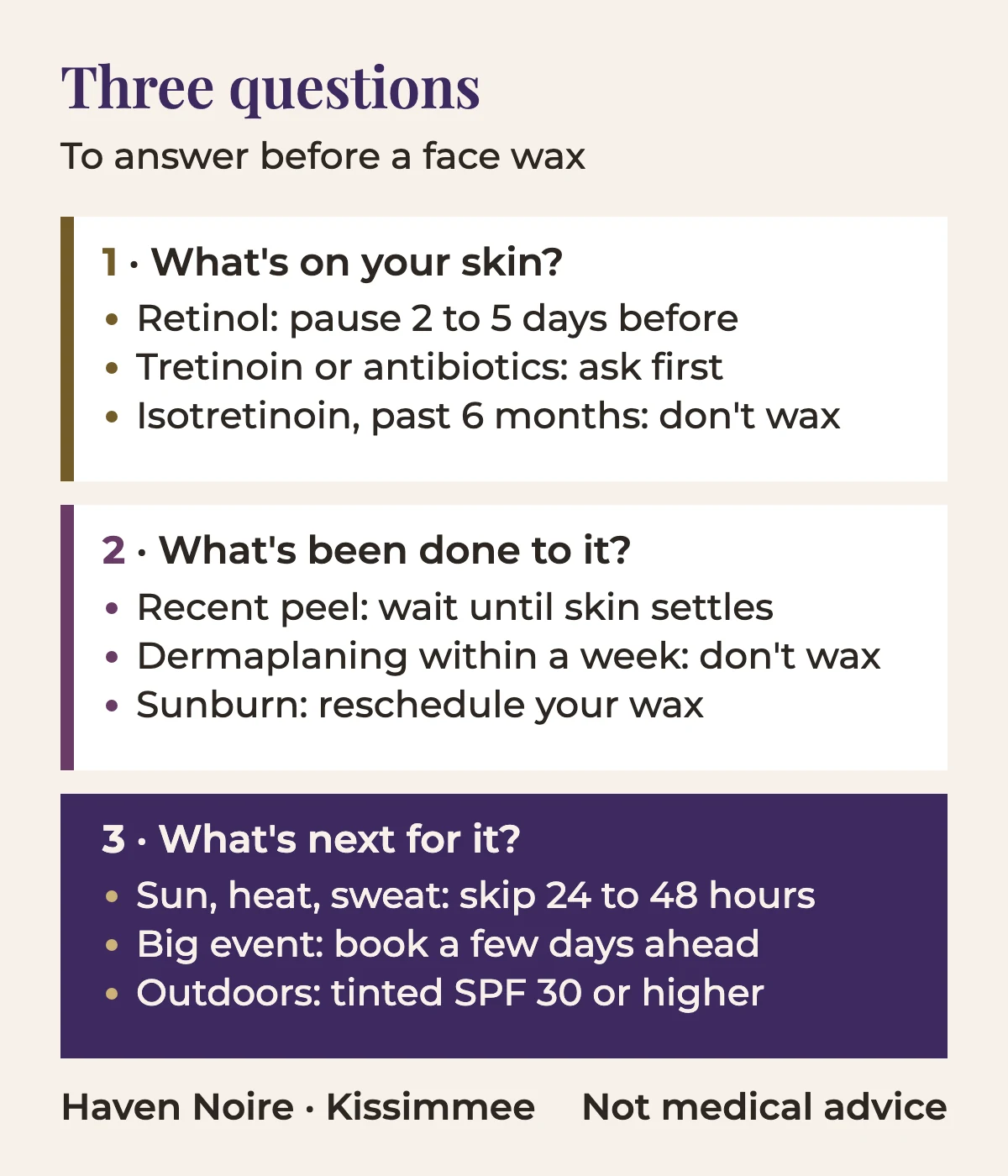
Question 1: What have you put on your skin?
Retinoids come first. The American Academy of Dermatology (AAD) advises avoiding over-the-counter products with retinol, and prescription retinoids, for two to five days before waxing your face, "to avoid removing skin along with your hair."
The medical literature backs this up. A 2018 case report in the Journal of Cosmetic Dermatology warned that topical retinoids, including adapalene (brand name Differin), can lead to epidermal stripping during wax hair removal. Before that report, the authors note, the published cases had all involved oral retinoids.
A second AAD page, 6 ways to remove unwanted hair, is stricter. It says waxing is not recommended if you're currently applying tretinoin or using an antibiotic, because these medications thin your skin and it could tear when the wax comes off.
If you use retinol, tretinoin, or adapalene
- Retinol or adapalene: pause it two to five days before your appointment, as the AAD's waxing guide advises. Rotating actives on a schedule? See how to time a face wax inside a skin cycle.
- Tretinoin (Retin-A): the AAD's hair removal page says waxing isn't recommended while you're applying it. Ask your prescriber whether to pause it or choose another method.
- Tell us what you use and when you last applied it. Include eye creams and any acne treatment you use near your brows or lip.
If you're taking an antibiotic
The same AAD page says waxing isn't recommended while you're using an antibiotic. Tell us when you book, and ask your prescriber when waxing is fine again.
If you take isotretinoin, or finished it in the last six months
The AAD says not to wax if you've taken isotretinoin (often still called Accutane) in the last six months. A 2017 consensus paper from the American Society for Dermatologic Surgery traces that window to the drug's package insert, which advises stopping isotretinoin for six months before cosmetic procedures, waxing included.
If hair removal can't wait, a 2015 paper in Pediatric Dermatology describes threading as a less traumatic option for people on isotretinoin. Ask your dermatologist which method fits your skin.
If you use exfoliating acids or scrubs
No source we checked sets a waiting time for glycolic, lactic, or salicylic acid before a face wax. Our rule of thumb: if a product makes your skin peel, sting, or flake, treat it like a retinoid and tell us before we start.
Question 2: What have you had done to your skin?
Recent treatments matter as much as products. Three to check:
- Chemical peels. Our chemical peel aftercare guide lists waxing in the same area among the things to avoid until your skin settles.
- Dermaplaning. Our dermaplaning aftercare plan says not to wax your face within one week before a dermaplaning appointment.
- Sunburn. The AAD says never to wax sunburned or very sensitive skin.
Planning a wax alongside a chemical peel or a corrective facial? Tell us when you book, and ask us to help you plan the order.
Question 3: What will your skin face next?
Freshly waxed skin needs a quiet day or two. Our aftercare asks you to avoid heat, friction, sweat, and direct sun for 24 to 48 hours. In Central Florida, that rules out more of the calendar than you'd think: pool days, long outdoor lines, hot yoga, a walk along the lakefront at noon.
Before you pick a date, look at the two days after it. If you're waxing for a wedding, photos, or a big event, our advice is to book a few days ahead instead of the day before, so any redness has time to fade.
| Question | Check for | What the source says | What to do |
|---|---|---|---|
| Products | Retinol or adapalene | AAD waxing guide: avoid for two to five days before waxing your face | Pause it, and tell us what you use |
| Products | Tretinoin or an antibiotic, now | AAD hair removal page: waxing not recommended | Ask your prescriber before you book |
| Products | Isotretinoin in the last six months | AAD: don't wax | Skip waxing and ask your dermatologist |
| Procedures | A chemical peel in the same area | Our peel aftercare guide: no waxing until skin settles | Wait, or ask us to plan the order |
| Procedures | Dermaplaning booked within a week | Our dermaplaning guide: no face waxing in the week before | Space them out |
| Procedures | Sunburn or very sensitive skin | AAD: never wax | Reschedule |
| Plans | Sun, heat, or sweat in the next 24 to 48 hours | Our aftercare: avoid all three | Move the wax or move the plans |
Facial Waxing on Melanin-Rich Skin: Preventing Dark Marks
If your skin is brown or Black, these three questions matter more. Here's why.
Post-inflammatory hyperpigmentation is the dark mark left behind after skin is inflamed or injured. It affects darker skin tones more often and more severely, according to a review in the Journal of Clinical and Aesthetic Dermatology. The AAD's guide to dark spots in darker skin tones says spots often appear as an injury such as a cut or burn heals, or when a product irritates your skin.
That AAD guide doesn't name waxing as a cause. Skin injury is the cause it names, and skin that lifts or burns under wax is an injury. So the goal is a wax your skin barely notices, and anything that raises the odds of lifting is worth catching early.

Time is the other reason. The AAD says a spot a few shades darker than your natural color usually fades within 6 to 12 months, and deeper discoloration can take years. A lip wax grows out in weeks. A mark from skin that lifted can outlast it many times over.
Three habits that help:
- Answer Question 1 honestly. Routines for fading dark spots often include a retinoid, and the same review lists retinoids among the agents used for hyperpigmentation. That's exactly what the first question screens for.
- Wear tinted sunscreen. The AAD recommends a tinted sunscreen with iron oxide, SPF 30 or higher, with broad-spectrum protection.
- Tell us if you mark easily. If past waxes, breakouts, or bug bites have left dark marks, say so at your consultation.
For the bigger picture, read our guide to facials for Black skin. If a mark has already formed, start with how to fade hyperpigmentation on melanin-rich skin or our page on hyperpigmentation and dark spots.
Brows, Upper Lip, and Chin: What Changes by Area
Facial waxing isn't one service. Each area has its own timing, its own price, and its own thing to watch.
Eyebrows
Our Eyebrow Shape + Wax ($15, 15 minutes) pairs brow mapping and shaping with gentle waxing, so you leave with brows that look clean, balanced, and polished. Tiffany, our founder, is a Florida-licensed esthetician and a licensed permanent makeup artist.
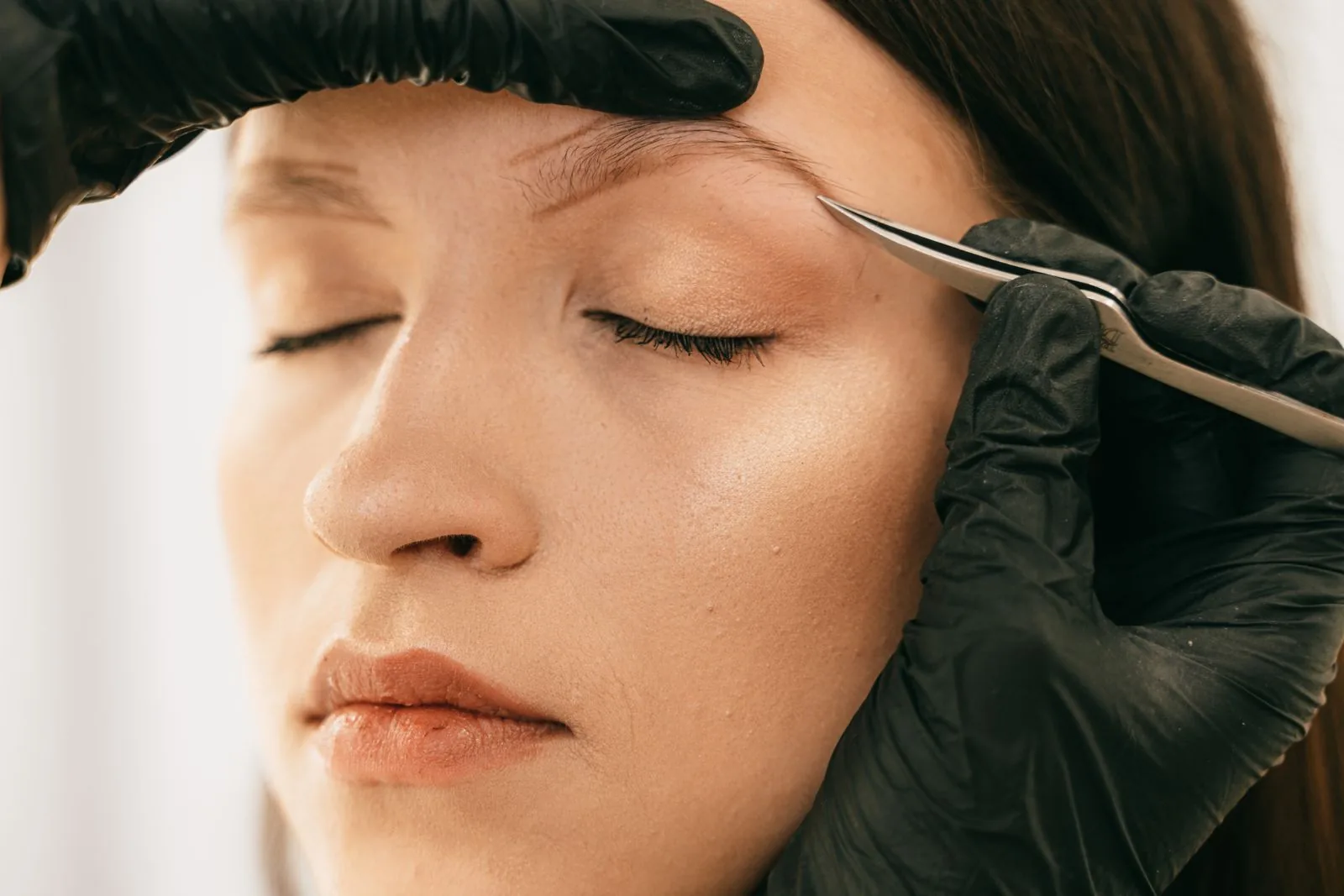
What to watch: products near your eyes. PubMed indexes the 2018 adapalene case report under eyebrow hair removal, so mention retinol eye creams and any acne treatment you use on your forehead. Oiling your brows at home? Mention that too, and see whether castor oil really thickens brows.
How often: every 3 to 4 weeks is our rebooking guidance for waxing.
Upper lip
A Lip Wax is $10 and takes about 10 minutes.
What to watch: if you spread a retinoid or acne treatment across your whole face, it reaches your lip line too. Count it in Question 1.
Chin
A Chin Wax is $10 and takes about 10 minutes. Pair it with your lip in a 15-minute Lip and Chin Wax for $20.
What to watch: the hair itself. If chin hair is new, or it's growing fast, read the section on seeing a doctor before you book.
Cheeks, sideburns, or a full face
These aren't on our online menu. If you want more than brows, lip, and chin, contact us before you book, and we'll tell you what's available and what it costs.
What a Face Wax Appointment Looks Like at Haven Noire
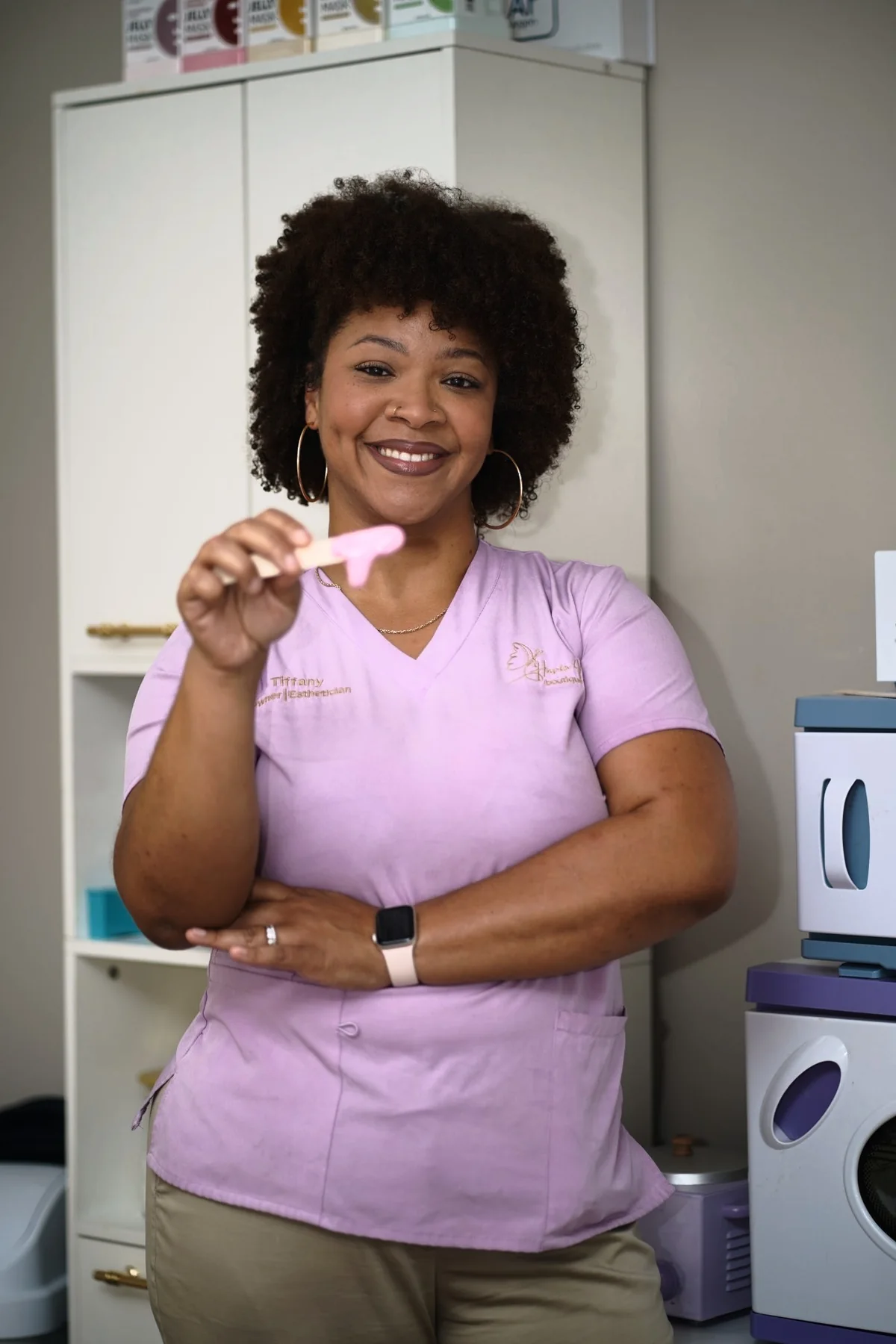
These are the five steps listed on our waxing page:
- Consultation. We review the area, your skin, and any sensitivities. This is where your answers to the three questions go.
- Cleanse and prep. Your skin is cleansed and prepped for comfort.
- Wax. Premium wax is applied and removed with gentle technique.
- Tweeze and tidy. We perfect the finish.
- Soothe and protect. Calming post-wax care, plus guidance on preventing ingrown hairs.
Expect brief discomfort. Most clients find it very manageable.
A few practical notes:
- First time? Mention our waxing page and ask about the complimentary skin patch test for first-time clients.
- Who we see. Waxing at Haven Noire is for women, men, and teens.
- Deposit. A 10% deposit is required when you book.
- Members. Haven Noire members get 10% off extra services, waxing included. See our monthly memberships.
- Adding a Brazilian? Our first Brazilian wax prep guide covers that part of the visit.
Aftercare in Florida Heat: The First 48 Hours and Beyond
After a facial wax, the first two days do most of the work.
The first 24 to 48 hours
- Avoid heat, friction, sweat, and direct sun. That's our aftercare for every wax. Our guide to what to do after waxing shows which of these rules have a medical source.
- Skip hot baths and showers, which the AAD also advises.
- If your skin feels sore, the AAD suggests cold packs.
- Moisturize with something that won't clog your pores. The AAD says to look for labels that say oil-free or non-comedogenic.
- Outside, wear the tinted sunscreen described above and choose shade when you can.

After a few days
Exfoliate gently and keep moisturizing to help prevent ingrown hairs. Our guide to preventing ingrown hairs after waxing walks through the routine.
Not sure when to restart your retinoid? No source we checked gives a restart date after a face wax. Ask us at your appointment, and check with your prescriber.
Between appointments
Avoid shaving between waxes. It disrupts the growth cycle and can cause ingrown hairs. Then rebook at 3 to 4 weeks.
Bumps after a wax
Pimple-like bumps around hair follicles may be folliculitis. MedlinePlus says it starts when hair follicles are damaged or blocked, and it lists keeping the area clean among the ways to prevent more damage.
When to Skip the Wax and See a Dermatologist or Doctor
We're licensed estheticians. We can't diagnose a skin condition or a hormone condition, and face waxing isn't a treatment for either. Here's when a medical appointment comes before a wax. For skin concerns beyond waxing, our guide to esthetician vs. dermatologist sorts who to see first.
Skip the wax for now
- You've taken isotretinoin in the last six months.
- Your skin is sunburned or very sensitive right now. If reactivity is ongoing, see how we approach sensitive and redness-prone skin.
- You're applying tretinoin or using an antibiotic right now. The AAD's hair removal page says waxing isn't recommended.
- You use another prescription retinoid and haven't asked your prescriber about pausing it.
See a dermatologist after a wax
- Redness or swelling that lasts more than two days. That's the AAD's line for seeing a board-certified dermatologist.
- Bumps that get worse, last longer than two or three days, or keep coming back. That's when MedlinePlus says to contact a provider about folliculitis.
- A dark mark that isn't fading with careful home care. The AAD says a dermatologist can help when your own treatment isn't delivering.
When the hair itself is the question
Often there's no identifiable cause. MedlinePlus says that in most cases of unwanted hair in women, the exact cause is never known.
Sometimes hormones are involved. MedlinePlus calls polycystic ovary syndrome (PCOS) a common cause. The Office on Women's Health says PCOS affects 1 in 10 women of childbearing age, and that excess hair affects up to 70% of women who have it.
MedlinePlus says to contact your provider if:
- The hair grows rapidly.
- You also notice male features such as acne, a deepening voice, increased muscle mass, or thinning scalp hair.
- You're concerned that a medicine you take may be increasing hair growth.
For context, the Endocrine Society's clinical guideline suggests against testing androgen levels in women with regular periods whose unwanted hair is limited to a small area. That's a decision for you and your doctor, not for us.
Waxing can still have a place. It removes the hair you see while your doctor looks into why it's there.
Frequently Asked Questions About Face Waxing
How long does a face wax last?
We suggest rebooking every 3 to 4 weeks, which is the schedule on our waxing page for the smoothest results. How quickly your own hair returns is individual, so use your first two or three appointments to find your rhythm. Avoid shaving in between, because it disrupts the growth cycle.
How long does hair need to be for a face wax?
About a quarter inch, roughly two to three weeks of growth. That sits inside the American Academy of Dermatology's range of one-fourth to three-fourths of an inch. If hair is too short, the wax can't grip it. If it's very long, we can trim it first.
Can you get your face waxed if you use retinol or tretinoin?
Retinol, yes, with a pause: the American Academy of Dermatology advises stopping it two to five days before waxing your face. Tretinoin is stricter. A second AAD page says waxing isn't recommended while you're applying tretinoin or using an antibiotic. Ask your prescriber first, and tell us what you use when you book.
How long after Accutane can you wax your face?
The American Academy of Dermatology says not to wax if you've taken isotretinoin, often still called Accutane, in the last six months. Published case reports describe wax stripping the top layer of skin in people taking it. Ask your dermatologist when waxing is safe for you again, and we'll follow their answer.
Does waxing cause dark spots on Black or brown skin?
The AAD's dark-spot guidance doesn't name waxing. It names skin injury and irritation, and darker skin tones develop post-inflammatory hyperpigmentation more often and more severely. So the risk comes from a wax that lifts or burns skin. Checking your products first and wearing tinted sunscreen both help protect you.
Why do I break out after waxing my upper lip?
Pimple-like bumps around hair follicles after a wax may be folliculitis, which MedlinePlus says starts when follicles are damaged or blocked. Keep the area clean, use a moisturizer labeled oil-free or non-comedogenic, and contact a provider if bumps get worse, last longer than two or three days, or keep coming back.
How much does face waxing cost?
At Haven Noire in Kissimmee, an Eyebrow Shape + Wax is $15, a Lip Wax is $10, a Chin Wax is $10, and a Lip and Chin Wax is $20. A 10% deposit is required when you book, and members get 10% off extra services. For facial pricing, see what a facial costs in Kissimmee.
Does waxing your face cause wrinkles?
We searched PubMed in November 2026 and found no study that measured wrinkles after face waxing, so we won't claim it does or doesn't. What published sources do document is short term: redness, swelling, bumps, and skin lifting in people using retinoids. If lines are your main concern, ask us at your consultation.
More from the Journal

About the author
Tiffany · Licensed Esthetician · Licensed PMU Artist
Tiffany is a Florida-licensed esthetician and permanent makeup artist and the founder of Haven Noire. She specializes in customized facials, corrective skincare, and waxing for melanin-rich and all skin types, and is known for a calm, education-first approach that puts first-time clients instantly at ease.
Meet Tiffany →