
The best sunscreen for dark skin is tinted, broad spectrum, SPF 30 or higher, and water resistant, with iron oxide in its ingredient list. That's the American Academy of Dermatology's advice for darker skin tones. It adds two fit checks: the formula should blend with your skin tone, and it should be non-comedogenic if your skin is oily.
And yes, Black people need sunscreen. Dermatologists recommend it for everyone, whatever your skin tone.
Here's what most "best sunscreen" roundups skip. The SPF number on the bottle tells you about UVB, the rays behind sunburn. It doesn't rate visible light, the part of sunlight the AAD says can increase skin darkening, particularly for people with darker skin tones. To check for that protection, you have to turn the bottle over.
Below: why deeper skin still needs sun protection, how to read the label on any bottle, how to wear sunscreen through a Central Florida day, and how it protects your work fading dark marks, at home or with our facials for hyperpigmentation and dark spots in Kissimmee.
Do Black People Need Sunscreen? Yes, for Three Reasons
Melanin gives deeper skin a head start, not a pass. The NHS says naturally brown or black skin is less likely to get skin cancer, "as darker skin has some protection against UV rays," but that you should still avoid burning, because people of all skin tones can get it. Not sure you've ever burned? Read can Black people get sunburn for the signs that don't depend on redness.
The American Academy of Dermatology (AAD) is blunter. Asked whether people with brown or Black skin really need sunscreen, its guide to finding skin cancer in darker skin tones answers: "Yes. Dermatologists recommend sunscreen for everyone." Across that guide and its dark-spot advice, three reasons stand out.
Reason 1: Dark spots
The AAD says the sun's visible light can cause hyperpigmentation, skin that turns darker than your natural tone, in people with darker skin tones. Its dark-spot guide adds that dark spots and patches rank as one of the most common reasons people with darker skin see a dermatologist.
Reason 2: Early aging
"If you have brown or Black skin, the sun can speed up how quickly your skin ages," the AAD says, and sun protection can reduce the likelihood of it. If fine lines are already on your list, see our anti-aging facials.
Reason 3: Skin cancer that's often found late
Skin cancer is less common in darker skin, not absent. The AAD says that when someone with a darker skin tone develops skin cancer, it's often advanced by the time it's diagnosed, which can make treatment difficult. It may also show up where the sun rarely reaches, like the palms, soles, and nails. The same guide is clear that skin cancer found early is highly treatable, and its warning signs are in the dermatologist section below.
What about vitamin D?
Fair question. The AAD's sunscreen FAQ says sun protection may decrease your skin's production of vitamin D, and the NHS notes that darker skin may need more time in sunlight to make the same amount as lighter skin. The AAD's answer is food, naturally rich or fortified, plus a talk with your doctor if you're worried you aren't getting enough.
Why SPF Alone Misses What Darkens Dark Skin
SPF measures a sunscreen's protection from UVB, the burning rays. That's the NHS definition, and the AAD says an SPF of at least 30 blocks 97% of the sun's UVB rays. At heart, SPF is a sunburn number.
That matters when you're choosing sunscreen for dark skin. A 2022 review in the Journal of the American Academy of Dermatology explains that dark skin is naturally better protected against UVB, thanks to its high eumelanin content, but may need additional protection from visible light. (One of its five authors is listed at Beiersdorf, a skincare company.) You still need the SPF. It just isn't the whole job.
The research behind that is specific. In a 2010 study in the Journal of Investigative Dermatology, researchers used two lab light sources, one long-wave UVA and one visible light, on the lower backs of 20 volunteers with skin types IV to VI, the deeper end of the Fitzpatrick scale. Both darkened the skin, but over the two weeks they tracked it, the pigmentation from visible light was darker and lasted longer. On skin type II, a lighter skin type, they saw no pigmentation at all. It was a small lab study, not a sunscreen test.

A bigger SPF number doesn't close that gap on its own. The AAD says tinted sunscreens add visible-light protection on top of UVA and UVB. One small 2020 study of 10 women with skin type IV, whose authors include L'Oréal researchers, shows the idea: on small patches of the back exposed to lab visible light, two foundation-format formulas containing iron oxide protected against darkening significantly better than a non-tinted mineral SPF 50+ sunscreen.
Our take: for sunburn, read the SPF. For dark spots, first ask whether the bottle protects against visible light at all. The same protect-first thinking runs through our guide to facials for Black skin.
How to Choose the Best Sunscreen for Black Skin
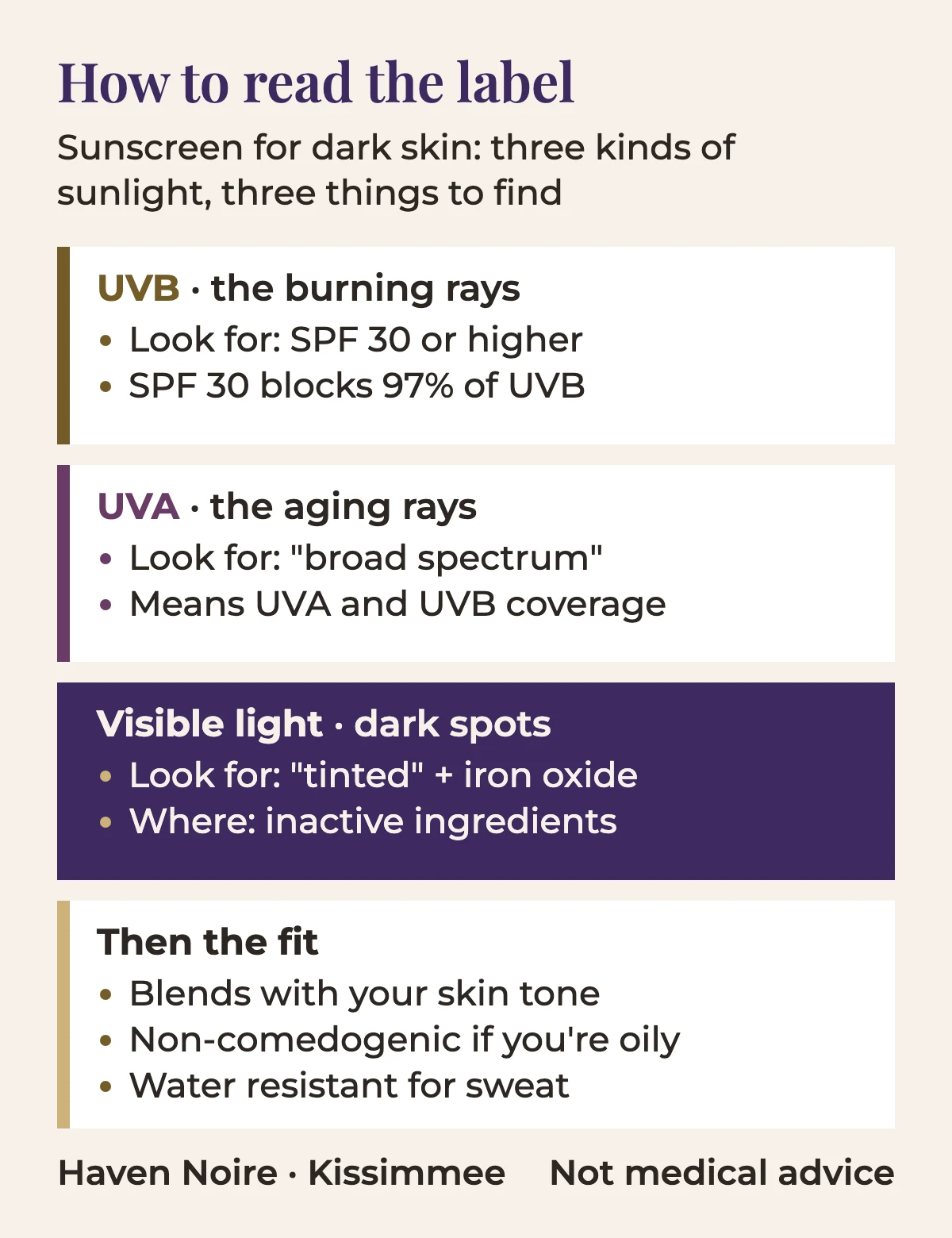
You can choose sunscreen for dark skin without a product list. Match each of three kinds of sunlight with the words on the label that show you're covered.
These checks come from the AAD's sunscreen guidance. They're for shopping, not a medical test, and they work on any bottle in any store.
UVB: the burning rays
Look for SPF 30 or higher. The AAD says higher-number SPFs block slightly more UVB, but no sunscreen blocks 100%, and a high SPF doesn't let you spend more time outside without reapplying.
UVA: the aging rays
Look for the words "broad spectrum." The AAD's guide to choosing a sunscreen says broad spectrum means it protects against both UVA and UVB rays. The AAD calls UVA the aging rays: they can cause wrinkles and age spots, and unlike UVB, they can pass through window glass.
Visible light: what darkens skin
Look for the word "tinted," then confirm iron oxide. The AAD recommends a broad-spectrum sunscreen that says "tinted" on the label, with SPF 30 or higher, and explains that tinted sunscreens contain iron oxide, which helps protect skin against visible light.
You won't find iron oxide where you'd expect. Only ingredients that protect against UV rays are listed as active, so the AAD says to look for iron oxide in the inactive ingredients.
Reading the back of the bottle in 3 steps
- Find the section labeled "Active Ingredients." These are the UV filters.
- Note what's there. Only zinc oxide, titanium dioxide, or both means a mineral sunscreen, which the AAD calls physical. Neither means chemical, and a mix of both groups is a hybrid.
- Scan the inactive ingredients for iron oxide. If it's there, you've found the ingredient the AAD points to for visible light.
Then the fit: will you actually wear it?
The AAD's dark-spot advice ends with fit checks, and its sunscreen FAQ adds a rule worth repeating: the best sunscreen is the one you will use again and again.
- It blends with your skin tone. A tint that matches you helps avoid the white residue, or cast, that some sunscreens leave.
- It's non-comedogenic if you're oily, meaning it won't clog pores. For more on oily skin, see our guide to making pores look smaller.
- It's water resistant. The AAD says water resistance lasts either 40 or 80 minutes on wet or sweaty skin before you need to reapply. That staying power makes it harder to wash off, so see when a second cleanse at night makes sense.
| Sunlight | What it does | Where to look | What to find |
|---|---|---|---|
| UVB | Primary cause of sunburn | The SPF number | SPF 30 or higher |
| UVA | Wrinkles and age spots; can pass through window glass | The label wording | "Broad spectrum" |
| Visible light | Can increase skin darkening, particularly in darker skin tones | The word "tinted," then the inactive ingredients | Iron oxide |
| The fit | Decides whether you'll wear it every day | Your own skin, in daylight | Blends with your tone; non-comedogenic if oily; water resistant |
Mineral, Chemical, or Tinted Sunscreen for Dark Skin?
By the AAD's definitions, a sunscreen's type comes from its active ingredients, and iron oxide isn't one of them. So "tinted" describes something extra a formula carries, not a separate type.
| Type | How to tell on the label | What the AAD says |
|---|---|---|
| Mineral (physical) | Active ingredients are zinc oxide, titanium dioxide, or both | Dermatologists recommend it for people with sensitive skin |
| Chemical | Active ingredients include neither zinc oxide nor titanium dioxide | Can protect you well if it's broad spectrum, water resistant, and SPF 30 or higher |
| Hybrid | Active ingredients from both groups | Same rule: broad spectrum, water resistant, SPF 30 or higher |
| Tinted | Says "tinted"; iron oxide in the inactive ingredients | Adds protection against visible light, and a matching tint helps avoid a white cast |
For texture, the AAD says creams are best for dry skin and the face, gels suit oily complexions, and sticks work well around the eyes.
Our tip for shade-matching: swatch a tinted sunscreen along your jawline and check it in daylight by a window, not under bathroom light. If it reads gray or ashy on you, keep looking.
If your skin is sensitive, the AAD says dermatologists recommend a mineral formula, and our page on sensitive and redness-prone skin explains how we work with reactive skin. For home care, your esthetician will recommend products at your visit; these are the professional skincare lines we treat with.
How to Wear Sunscreen on Dark Skin Through a Central Florida Day
The right bottle still falls short if it goes on thin: the AAD notes many people apply only about 20 to 50% of the amount needed to get the SPF on the label. Here's the routine its pages describe:
- Apply it to dry skin 15 minutes before you go outside.
- Use at least 1 teaspoon on your face, about enough to cover the length of your index and middle fingers.
- Cover your neck and ears, and use a lip balm with SPF 30 or higher, as the AAD's guide on how to apply sunscreen advises.
- Reapply every two hours outdoors, and right after swimming or sweating.
- Add shade and a wide-brimmed hat, and plan around 10 a.m. to 2 p.m., when the AAD says the sun is strongest.
Habits for Kissimmee days
- Cloudy afternoons count. The AAD says up to 80% of the sun's harmful UV rays can get through clouds.
- So does the drive. The AAD says UVA, the aging rays, can pass through window glass, so put sunscreen on before a long commute along US-192 or I-4, not after.
- Don't store it in the car. The AAD says heat, like the inside of a car, speeds up how fast sunscreen ingredients break down.
- Check the date. The AAD notes the FDA requires sunscreens to keep their original strength for at least three years, and says to throw out a bottle past its expiration date.
- SPF makeup is a convenience, not a pass. The AAD says sunscreen still needs reapplying about every two hours when you're outdoors. Here's where sunscreen and makeup go in your routine.
Just had a wax? Our aftercare asks you to stay out of direct sun, heat, and sweat for 24 to 48 hours, and our waxing aftercare guide walks through that window.
Sunscreen While You Fade Dark Marks or Get Facials and Peels
If you're fading dark marks, sunscreen for dark skin isn't a side step. Our guide to fading hyperpigmentation on melanin-rich skin covers the treatment side, and the AAD says effective treatment for dark spots begins with sunscreen. Applied before you go outside to all skin clothing won't cover, it can prevent new dark spots and help clear existing ones. Bare shoulders count too, and our bacne guide explains how sun can darken back acne marks.
The tint matters here too. In a 2014 double-blind randomized trial of 68 people with melasma (61 finished), everyone used the same fading medication, 4% hydroquinone, which the AAD notes is no longer sold without a prescription. Those given a sunscreen with iron oxide improved more over eight weeks than those given a UV-only sunscreen, both at SPF 50 or higher. It was one small trial, in people already on prescription treatment.
The AAD's melasma guidance lists zinc oxide, titanium dioxide, and iron oxide as the sunscreen ingredients dermatologists often recommend for melasma, and says sun protection can help fade it and keep it from returning. Here's how we approach melasma in Kissimmee.
After a facial
Every Signature Facial ends with serums, moisturizer, and SPF. Our aftercare is short: keep skin hydrated, skip harsh actives and heat for 24 hours, and wear SPF daily. After a corrective facial, avoid sun exposure and active exfoliants for a few days, and use SPF daily. Booked dermaplaning? Follow our day-by-day dermaplaning aftercare. Building a glow? See why tone comes first on melanin-rich skin.

Around a chemical peel
Peels raise the stakes. Our chemical peels always start with a skin consultation, and stronger corrective peels are best scheduled in lower-UV months with diligent SPF. Each peel includes a post-care home kit, and our chemical peel aftercare guide covers the days after.
When to See a Dermatologist Instead
We're licensed estheticians. We can't diagnose skin cancer or any skin condition, and no sunscreen replaces checking your own skin. The AAD recommends a skin self-exam and says that in darker skin tones it's especially important to look for these changes:
- A bump, spot, or mole that's growing, bleeding, itching, or changing in any way
- A color change, especially darkening, on your skin, scalp, mouth, lips, or genital area
- A sore that doesn't heal, or heals and comes back
- A dark line or streak in a nail, or a spot under or around a nail that doesn't heal
- A scaly or rough patch that doesn't go away
Check places the sun rarely reaches, too: the AAD says skin cancer in darker skin may show up on the palms, soles, fingers and toes, nails, mouth, buttocks, or genitals. If you see a spot that could be skin cancer, it says to book a board-certified dermatologist right away and explain why when you call.
Also see a dermatologist if
- A dark spot isn't fading with daily sunscreen and gentle care. The AAD says that if the treatment you're using fails to deliver the results you want, you may want to see a dermatologist.
- A mark looks slate blue to gray. The AAD says discoloration deep in the skin often looks that way and can take years to fade, and that some dark spots need a prescription-strength treatment.
- You think you have melasma. The AAD says a dermatologist can tell you whether it's melasma or another condition, and that the most effective treatment often combines sun protection with medication applied to the skin, and sometimes a procedure.
And if a sunscreen burns or stings when you put it on, the AAD's advice for any product that does is simple: stop using it. A rough patch that won't go away belongs with a dermatologist. For everyday roughness, our guide to textured skin helps you sort the common causes.
Frequently Asked Questions About Sunscreen for Dark Skin
Do Black people need sunscreen?
Yes. The American Academy of Dermatology recommends sunscreen for everyone. On brown and Black skin, the sun can speed up aging, its visible light can cause dark spots, and skin cancer, while less common, is often found late. For darker skin, the AAD recommends a tinted, broad-spectrum sunscreen with iron oxide and SPF 30 or higher.
What is the best sunscreen for Black skin?
The one you'll wear every day that meets the AAD's list: tinted with iron oxide, broad spectrum, SPF 30 or higher, and water resistant, plus non-comedogenic if your skin is oily. It should blend with your skin tone. We don't rank brands. Read the label instead, and bring your questions to your next facial.
Is SPF 50 better than SPF 30 for dark skin?
Slightly, for UVB. The AAD says SPF 30 blocks 97% of UVB rays, higher numbers block slightly more, and no sunscreen blocks 100%. A higher SPF also helps make up for applying too little. But SPF doesn't rate visible light, so for dark spots, iron oxide matters too. Either way, reapply every two hours outdoors.
How do I avoid a white cast from sunscreen?
Choose a tinted sunscreen in a shade that matches your skin. The AAD says a tint that matches your skin tone can help you avoid the white residue, or cast, that some sunscreens leave. Our tip: swatch it along your jawline and check it in daylight, since bathroom lighting can hide an ashy finish.
Do I need sunscreen in the car or on cloudy days?
On cloudy days, yes: the AAD says up to 80% of the sun's harmful UV rays can get through clouds. In the car, it says UVA rays, the aging rays, can pass through window glass, so put sunscreen on before a long drive. Its rule is daily sunscreen on skin clothing won't cover whenever you'll be outside.
Does sunscreen block vitamin D?
It may lower how much vitamin D your skin makes, the AAD says. Its advice for healthy adults is to get vitamin D from foods naturally rich in it or fortified with it, which avoids adding skin cancer risk. If you're worried you aren't getting enough, talk with your doctor about your options.
Should I wear sunscreen after a facial?
Yes. Our Signature and Corrective Facials both end with SPF, and our aftercare asks you to wear SPF daily. After a corrective facial, also avoid sun exposure and active exfoliants for a few days. Members get 10% off extra services and in-spa products; see our monthly memberships for details.
Keep exploring
More from the Journal

About the author
Tiffany · Licensed Esthetician · Licensed PMU Artist
Tiffany is a Florida-licensed esthetician and permanent makeup artist and the founder of Haven Noire. She specializes in customized facials, corrective skincare, and waxing for melanin-rich and all skin types, and is known for a calm, education-first approach that puts first-time clients instantly at ease.
Meet Tiffany →