

Your skin barrier is the outermost layer of your skin: skin cells sealed in fats that hold water in and keep irritants out. When it's damaged, products that never bothered you sting or burn, and skin turns dry, flaky, rough, or itchy. The fix is usually gentler, not stronger: stop the irritant, cleanse lightly, moisturize, and wear sunscreen.
Here's what most guides skip: repair is mostly subtraction. The signs also overlap with eczema, contact dermatitis, and rosacea, which can need a doctor or dermatologist rather than another product. And on brown and Black skin, irritation often doesn't look red, and it can leave a dark mark that outlasts the sting.
What Is the Skin Barrier?
The skin barrier is the outermost layer of your skin, called the stratum corneum. It holds water in and keeps irritants and germs out. Skin care brands often call it the moisture barrier.
A 2023 review in the journal Cells describes that layer as cells without nuclei, surrounded by ceramides, fatty acids, and cholesterol. It calls skin a permeability barrier that prevents excessive water loss while protecting the body from mechanical, microbial, and oxidative harm.
Barrier research has long used a brick-and-mortar model, with cells as bricks and fats as mortar, a 2025 review in the Journal of Dermatological Science notes.
The 2023 review adds that ceramides help prevent irritation from outside substances. Our reading, not the review's claim: that may help explain why a stressed barrier makes familiar products sting. Tight in the air conditioning rather than stinging? Read dry vs. dehydrated skin too.
Signs of a Damaged Skin Barrier
These are the signs dermatology sources tie to irritated or overly dry skin:
- Products sting, burn, or tingle. The American Academy of Dermatology (AAD) says those sensations mean a product irritates your skin.
- Dry, scaly, itchy, or red skin, sometimes with fine cracks, as MedlinePlus describes dry skin.
- Flaking, rough texture, or an ashy cast. The AAD's guide to dry skin in darker skin tones says flaking, discoloration, and rough texture are more noticeable on darker skin.
Our read: one sign on one bad day is just a bad day. Several signs that began after a change in your routine point to barrier stress.
Barrier Stress or a Skin Condition?
Stinging and dryness aren't unique to an overworked routine. Three common conditions share them, and the NHS and the AAD route each one differently.
| What it might be | Clues | Source | Next step |
|---|---|---|---|
| Barrier stress from your routine | Began after a new active, more exfoliating, or more washing | AAD: stop a product that stings, burns, or tingles | The four steps below |
| Contact dermatitis | Itchy, blistered, dry, or cracked skin within hours or days of contact with an irritant (most often soaps, detergents, or frequent water) or an allergen; dark brown, purple, or grey on darker skin | NHS | Find and avoid the trigger; a pharmacist can help if it's troubling you; see a doctor if it's persistent, recurrent, or severe |
| Eczema (atopic dermatitis) | Intense itch; on darker skin, dark brown, purple, or grayish patches and small, rough bumps | AAD | A board-certified dermatologist |
| Rosacea in darker skin tones | Feeling warm most of the time, dusky brown discoloration, stinging when you apply skin care, breakouts acne treatment won't clear | AAD | A board-certified dermatologist |
The first row is home territory, and the NHS says contact dermatitis usually improves or clears once the trigger is found and avoided. For signs of eczema or rosacea, the AAD points you to a board-certified dermatologist. Bumpy rather than stinging? Our guide to textured skin sorts those causes.
What Damages the Skin Barrier?
Some causes you can't control, like a skin condition or a dry office. Many you can:
- Too many actives at once. The AAD says using several anti-aging products at the same time can irritate your skin.
- Over-exfoliating. The AAD's exfoliation guide warns it can leave skin red and irritated, and that exfoliating while using retinoids or benzoyl peroxide may worsen dry skin or even cause breakouts.
- Washing too often or too hard. The AAD's face washing tips say to limit washing to twice a day and after sweating, and that scrubbing, washcloths, and mesh sponges can irritate skin. MedlinePlus adds bathing too often or too long, and some soaps and detergents.
- Fragrance. The AAD's dry skin tips favor products labeled fragrance-free and warn that "unscented" ones can contain chemicals that irritate dry, sensitive skin.
- Skin conditions and medicines. MedlinePlus also names eczema, psoriasis, and certain topical and oral medicines.
Stacking acids and serums for a glassy finish can overload your skin. Our glass skin guide chases glow more gently, and how often you should exfoliate sets a safer pace.
How to Repair Your Skin Barrier in 4 Steps
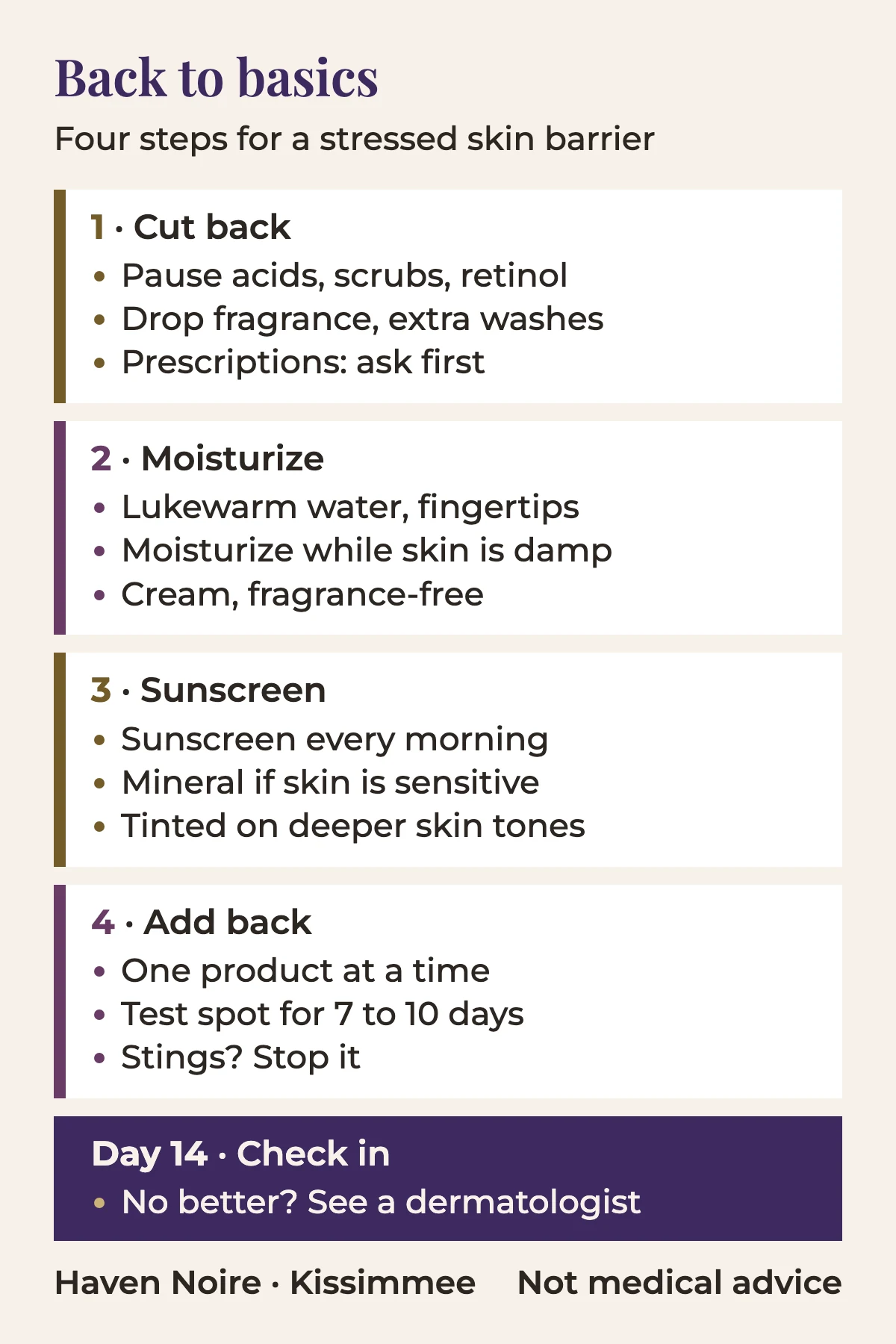
These four steps are for barrier stress your routine likely caused, built from AAD guidance. They're home care, not a medical treatment, and they aren't for suspected eczema or rosacea, which the AAD sends to a dermatologist, or for contact dermatitis that's persistent, recurrent, or severe, which the NHS sends to a doctor. On darker skin, the AAD also lists stinging from skin care as a rosacea sign, so if yours comes with warmth, dusky discoloration, or stubborn breakouts, see a dermatologist first.
The idea: give your skin fewer jobs, protect it while it recovers, then add things back slowly enough to see what each one does.
Step 1: Cut Back to the Basics
Pause everything that exfoliates or stings: acids, scrubs, peel pads, washcloths and brushes, and over-the-counter retinol. Drop fragrance and any extra cleanses. For now, your routine is a gentle cleanser, a moisturizer, and sunscreen.
Prescriptions are different. The AAD says to ask before you stop a prescribed product that stings, since some prescription-strength products will burn or sting. Pregnant, or using isotretinoin, tretinoin, or another prescription skin medicine? Check with your doctor or dermatologist before changing anything; the AAD says retinoids should not be used during pregnancy.
Step 2: Wash Gently and Moisturize
- Wash with lukewarm water, a gentle cleanser that doesn't contain alcohol, and your fingertips, then pat dry, as the AAD's face washing tips advise.
- Apply a mild, fragrance-free moisturizer while your skin is still damp, as the AAD's darker skin guide advises.
- Choose a cream or ointment, which that guide says tends to work better than lotion.
- Look for ingredients listed in the AAD's dry skin tips, such as glycerin, hyaluronic acid, petrolatum, shea butter, or dimethicone.
On deeper skin, add ceramides to that list. In the AAD's darker skin guide, dermatologist Chesahna Kindred says a moisturizer with ceramides can reduce the whitish or grayish-white appearance of dry skin. Ask us about the professional skincare lines we work with.
Step 3: Wear Sunscreen
Wear sunscreen every morning. The AAD's sunscreen label guide says dermatologists recommend mineral sunscreen (titanium dioxide, zinc oxide, or both) for sensitive skin, and that tinted sunscreen can protect against visible light, which is especially helpful for darker skin tones. Our guide to sunscreen for dark skin helps you choose.
Step 4: Add Products Back Slowly
Once nothing has stung for about a week (our rule of thumb), add products back one at a time. The AAD's advice on anti-aging products is to start with one, since several at once can irritate skin.
- Bring back your favorite first, and save exfoliants and retinol for last (our suggestion). The AAD notes that retinol and glycolic acid can irritate sensitive skin. When retinol's turn comes, ease back in with our guide to using retinol.
- Test it first. The AAD's guide to testing skin care products suggests a quarter-sized spot, such as the underside of your arm, twice a day for seven to 10 days. Testing an oil? Our guide to castor oil for skin uses the same test.
- If the spot turns red, itchy, or swollen, wash it off gently and don't use the product again, as the AAD advises.
- If it passes, use it for a week or two before adding the next one (our advice).
Check In at Day 14
Give steps 1 to 3 two weeks. That window is our own choice, borrowed from the AAD's darker skin guide, which says that by following its dry skin tips you should see some improvement within two weeks. A small 2012 study in the Journal of Cosmetic Dermatology saw hydration and barrier measurements improve over two weeks, but it tested one moisturizer on 13 women's forearms, so it can't tell you how fast your face will recover.
Better at day 14, and nothing has stung for about a week? Start step 4. No better, or worse? That's your cue to see a board-certified dermatologist, not to buy a stronger product.
Barrier Care for Melanin-Rich Skin
On brown and Black skin, a stressed skin barrier can look different, and it can leave a mark.
Irritation Doesn't Always Look Red
On deeper skin, look for darker or duller patches, not just redness: the NHS says contact dermatitis can turn darker skin dark brown, purple, or grey, and the AAD lists dark brown, purple, or grayish areas among eczema signs in darker skin tones. Dryness tends to show as an ashy cast.
Why Gentle Matters More
Irritation can outlast itself. The AAD's guide to fading dark spots in darker skin tones lists a skin or hair care product that irritates your skin among the triggers, and says that once the cause is stopped, a spot a few shades darker than your skin usually fades within 6 to 12 months. Color that lies deep in the skin can take years. On the AAD's retinoid page, dermatologist Sonia Badreshia-Bansal says that with skin of color, irritation can trigger dark marks.
The AAD's exfoliation guide makes the same point: avoid strong chemical or mechanical exfoliation if you have a darker skin tone, since aggressive exfoliation can lead to dark spots. Already have a mark? Start with how to fade hyperpigmentation on melanin-rich skin.
Is the Barrier Different in Black Skin? The Research Is Unsettled
You'll read online that Black skin has a weaker barrier, or a stronger one. A 2021 dermatologist panel review in the Journal of Drugs in Dermatology found that studies comparing ethnic groups reported differences in water loss, lipids, and pH, but frequently had methodological flaws, were mainly small, and showed conflicting results. A separate 2021 review in the Archives of Dermatological Research found such wide contradictions in water-loss results between skin of color and white skin that no conclusion could be made.
So neither claim is settled. Our take: read your own skin's signals, not a generalization about your skin tone. For treatment choices, see our guide to facials for Black skin.
Florida Heat, Sweat, and Air Conditioning
Humidity outside doesn't cancel out the rest of a Florida day. Our read: three everyday things here can still stress your skin barrier.
Cold, Dry Indoor Air
MedlinePlus lists dry indoor air from heating or cooling systems among the causes of dry skin. Keep a fragrance-free moisturizer at your desk; the AAD's dry skin tips also suggest a humidifier at home.
Sweat
The AAD's face washing tips say perspiration irritates the skin and advise washing as soon as possible after sweating. After a workout or a long walk outside, rinse with lukewarm water, pat dry, and moisturize. Breaking out after hot days? See why heat and workouts set off breakouts.

Sunscreen and Makeup Removal
Daily sunscreen means real cleansing at night. Our advice: while your barrier is stressed, keep evening cleansing mild, and if you double cleanse, make both steps gentle or drop to one until your skin calms. Our double cleansing guide covers when two steps make sense.
Can a Facial Help a Damaged Skin Barrier?
A facial can't diagnose or treat a skin condition, and no single visit rebuilds a barrier. We searched PubMed in November 2026 for studies measuring barrier function, such as water loss through the skin, after a professional spa facial, and found none. What a gentle facial can offer is a careful cleanse, hydration, sunscreen, and a trained second look at your routine.
Our page on sensitive and redness-prone skin describes the goal: soothe redness, rebuild a stressed barrier, and find what your skin actually tolerates. For sensitive skin, we build slowly and prioritize barrier repair first, with no aggressive exfoliation.
What a Signature Facial Includes
Every Signature Facial begins with a skin analysis, and products and techniques are chosen for your skin that day, including gentle options for sensitive or reactive skin. Our menu lists a double cleanse, exfoliation and extractions as needed, a custom mask and facial massage, then serums, moisturizer, and SPF.
Tell us what stings, what you've paused, and what you use now, prescriptions included. Afterward, keep skin hydrated, skip harsh actives and heat for 24 hours, and wear SPF daily. First visit? See what to expect at your first facial.

Tiffany, our founder, is a Florida-licensed esthetician. Haven Noire is an esthetics spa, not a medical office, so we don't diagnose or treat skin conditions. If your skin fits one of the look-alikes above, see a dermatologist or doctor first; we can recommend a gentle routine alongside your physician's care.
Hold Off on Corrective Exfoliation for Now
Our corrective facials include dermaplaning, microdermabrasion, and hydrodermabrasion options, and chemical peels always require a skin consultation first. Our advice, not a medical rule: wait on all of them until you've finished the four steps above and nothing stings.
What It Costs
| Option | Price |
|---|---|
| Signature Facial, 60 minutes | $95, or 3 for $210 |
| Signature Facial, 90 minutes | $110, or 3 for $285 |
| Glow Membership: one 60-minute Signature Facial a month | $74.99 a month |
| Ritual Membership: one 90-minute Signature Facial a month | $94.99 a month |
Memberships have a three-month minimum; compare them on our memberships page.
When to See a Dermatologist About Barrier Damage
See a board-certified dermatologist, or your doctor where noted, before booking a facial if you notice:
- No improvement after two weeks of gentle care. The AAD's darker skin guide says to see a board-certified dermatologist if dry skin continues after its tips, since an undiagnosed condition such as eczema or psoriasis can be the cause.
- Yellow crusts, pus or other fluid, or swelling and discoloration, which the AAD's dry skin symptoms page lists as signs of infection.
- Very itchy skin with small, rough bumps or dark brown, purple, or grayish patches, which the AAD lists among eczema signs in darker skin tones.
- On darker skin, rosacea signs the AAD names: a face that feels warm most of the time, dusky brown discoloration, acne-like breakouts that acne treatment won't clear, or burning or stinging when you apply skin care. It recommends a dermatology appointment for any of them.
- Contact dermatitis that's persistent, recurrent, or severe. The NHS says to see a doctor, who may refer you to a dermatologist.
- A severe reaction to a new product that doesn't ease with cool compresses or petroleum jelly, which the AAD's product testing guide says may need a dermatologist.
- A prescribed product that stings or burns. Ask your prescriber before you stop it.
For a dermatologist experienced with deeper skin tones, the AAD's darker skin guide suggests its Find a Dermatologist directory with the Skin of Color filter. Unsure which side of the line you're on? Contact us before you book.
Frequently Asked Questions About the Skin Barrier
How long does it take to repair a damaged skin barrier?
It depends on the cause. The American Academy of Dermatology says that by following its dry skin tips you should see some improvement within two weeks. A small 2012 study saw barrier measurements improve over two weeks, but it tested one moisturizer on 13 women's forearms. If your skin isn't better by day 14, see a board-certified dermatologist.
What are the signs of a damaged skin barrier?
Common signs are products that suddenly sting, burn, or tingle, plus dryness, flaking, rough texture, itching, or fine cracks. On brown and Black skin, irritation can look dark brown, purple, or grayish rather than red, and dryness can look ashy. A rash that persists, keeps returning, or is severe needs a doctor or dermatologist, not a new product.
Can I use retinol with a damaged skin barrier?
Our advice: pause over-the-counter retinol until your skin calms, then bring it back last and slowly. The AAD notes retinol can irritate skin, particularly sensitive skin. If yours is a prescription retinoid, ask your dermatologist before you stop it. And if you're pregnant, the AAD says retinoids should not be used.
What ingredients help repair the skin barrier?
For dry skin, the American Academy of Dermatology lists glycerin, hyaluronic acid, petrolatum, shea butter, and dimethicone, ideally in a fragrance-free cream or ointment. On deeper skin tones, an AAD dermatologist says ceramides can reduce the whitish or grayish look of dry skin. Our advice: a few products, used daily, beat a long routine.
Is a facial good for a damaged skin barrier?
It can help alongside gentle home care, but it isn't a treatment. We searched PubMed in November 2026 for a study measuring barrier function after a professional spa facial and found none. Our Signature Facial, from $95, begins with a skin analysis. Tell us what stings. Our advice: wait on peels and corrective facials until your skin calms.
Does air conditioning dry out your skin?
It can. MedlinePlus lists dry indoor air from heating or cooling systems among the causes of dry skin, so in Florida your face may feel fine outside and tight at your desk. Moisturize while skin is damp, keep a fragrance-free moisturizer handy, and consider the humidifier the AAD suggests.
Is a damaged skin barrier the same as sensitive skin?
Not exactly. The American Academy of Dermatology's exfoliation guide describes sensitive skin as skin that may sting or burn after product use, and a stressed barrier is one reason that can happen. Rosacea, eczema, and contact dermatitis can cause stinging too. If it lasts beyond two weeks of gentle care, see a dermatologist.
Keep exploring
More from the Journal

About the author
Tiffany · Licensed Esthetician · Licensed PMU Artist
Tiffany is a Florida-licensed esthetician and permanent makeup artist and the founder of Haven Noire. She specializes in customized facials, corrective skincare, and waxing for melanin-rich and all skin types, and is known for a calm, education-first approach that puts first-time clients instantly at ease.
Meet Tiffany →