

A salmon sperm facial is any skin treatment built around PDRN, short for polydeoxyribonucleotide: purified DNA fragments taken from salmon sperm. As of November 2026, it's one of skin care's loudest trends: Dermatology Times calls PDRN arguably one of the fastest-rising ingredients in prestige skin care, and in 2025 Cosmopolitan described viral videos of people in Korea injecting salmon DNA into their faces, chasing smoother, firmer skin.
Here's the short answer. Injected versions have the most research behind them, and that research is still small. Serums and masks have very little, and Dermatology Times argues that most PDRN is too large to get through intact skin on its own. It also reports that in the United States, injectable PDRN isn't FDA-approved for cosmetic use.
Let's be plain up front: PDRN treatments, polynucleotides, injections, and microneedling aren't on our menu at Haven Noire. Below: the evidence, a surer way to reach each goal the trend promises, and who should skip it.
What Is a Salmon Sperm Facial?
A salmon sperm facial delivers PDRN, purified salmon DNA fragments, to your skin by injection, by microneedling, or as a serum or mask. The goal is firmer, smoother, more hydrated-looking skin.
Despite the name, nobody is putting raw sperm on your face. Dermatology Times describes PDRN as a purified mixture of DNA fragments from the sperm of salmon trout or chum salmon. You'll also see a close cousin, polynucleotides (PN), a related DNA-based ingredient used in injectable "skin boosters."
Three Treatments Sold Under One Name
The name tells you the ingredient, not the method, and the method decides the evidence and the risks.
| Form | How PDRN reaches the skin | Who should do it | At Haven Noire |
|---|---|---|---|
| Injected "skin booster" | A needle places it into the skin | A medical provider only; in the US it isn't FDA-approved for cosmetic use | Not on our menu |
| Microneedling with PDRN | Tiny needles puncture the skin while a PDRN serum goes on | A board-certified dermatologist, as the AAD recommends for microneedling; its notes warn about nonsterile products in needled skin | Not on our menu |
| Serum, cream, or mask | Applied to the skin's surface | You, at home: it's sold as a cosmetic | Not a service on our menu |
Some clinics also sell a needle-free version: one UK clinic's page describes a device it says opens tiny pathways so polynucleotide serums sink in. Ask what any device does to your skin and who runs it. Our guide to nano infusion vs. microneedling separates tools that stay on the surface from tools that break the skin.
Where the Trend Is Heading: From Salmon Sperm to PDRN
The nickname is fading faster than the ingredient. In Google Trends data we checked in November 2026, US searches for "salmon sperm facial" fell over the past year while searches for "PDRN" climbed. The AAD's clinical notes for dermatologists say PDRN has surged in popularity across social media, where it's commonly promoted for injection into or under the skin.
Dermatology Times explains that topical PDRN can be sold in the US as a cosmetic without FDA approval if it makes no medical claims, so the American market runs on serums, creams, and masks. Our guide to types of facials lists the treatments that aren't on our menu, microneedling among them.
What the Research Says About PDRN and Salmon DNA
The biology is real. The proof for what's sold on shelves is thin.
Injections: Promising, Small Studies
Most of the human evidence comes from injections. A 2024 systematic review in the Journal of Cosmetic Dermatology found nine studies of polynucleotide treatment, of low and moderate quality, covering 219 patients. Injections showed promising results for wrinkles, texture, and elasticity, with side effects that were generally mild and short-lived. The authors still call for rigorous, high-quality studies.
Dermatology Times highlights a 2020 split-face trial from Korea: 27 people had three rounds of polynucleotide injections, two weeks apart, beside one eye and a hyaluronic acid filler beside the other. The paper's abstract reports similar overall aesthetic scores on both sides, with bigger gains in roughness, elasticity, and hydration on the polynucleotide side.
Serums and Masks: The Size Problem
Topical PDRN first has to cross your skin's outer layer, which our skin barrier guide describes. Dermatology Times cites a widely used rule that molecules larger than about 500 daltons are unlikely to pass through intact skin on their own, and notes that PDRN fragments range from 50 to 1,500 kilodaltons, far above that line. Its conclusion: any benefit from a PDRN serum is more likely to come from the ingredients mixed in with it, such as hyaluronic acid, glycerin, and ceramides.
A 2025 study in the International Journal of Molecular Sciences tested a cream with low-molecular-weight PDRN made from peony, not salmon, on 10 Korean adults. Skin elasticity around the eyes improved about 4% after four weeks, and the authors name the small sample as the main limitation. All six authors work for the Korean skin science company developing the ingredient.
A July 2026 trial in PLOS One gave 31 Chinese women aged 35 to 55 a salmon-derived PDRN eye cream on one side of the face and a retinol eye cream on the other for 28 days, and the PDRN side improved more. The authors note that 28 days is short and early changes may partly reflect hydration or plumping. Their evidence that PDRN gets into skin came from lab skin models, pig skin, and one volunteer. It reports no specific funding; three of its five authors work for Shanghai biotech companies.
Dermatology Times lands on "honest uncertainty rather than confident dismissal," and finds no evidence that any serum matches what injections do. The dermatologist Cosmopolitan interviewed in 2025 is more upbeat, backing PDRN in nearly every form. We side with caution: a PDRN serum might help a little, mostly as a hydrating extra.
What We Couldn't Find
We searched PubMed in November 2026 for PDRN or polynucleotide skin treatment studies naming skin of color, darker skin, Black or African American patients, or Fitzpatrick skin type VI, and found none. Studies that list skin types mostly enrolled Korean and Thai adults with types III to V. A 2026 systematic review in Aesthetic Surgery Journal Open Forum found all six eye-area polynucleotide studies it included came from Korean and Thai groups, and called for more ethnically diverse trials.
The same month, we searched PubMed for PDRN in pregnancy or breastfeeding and found no study of a PDRN skin treatment in either. The 2026 eye cream trial excluded anyone who was pregnant or breastfeeding.
A Surer Route to What the Salmon Sperm Facial Promises
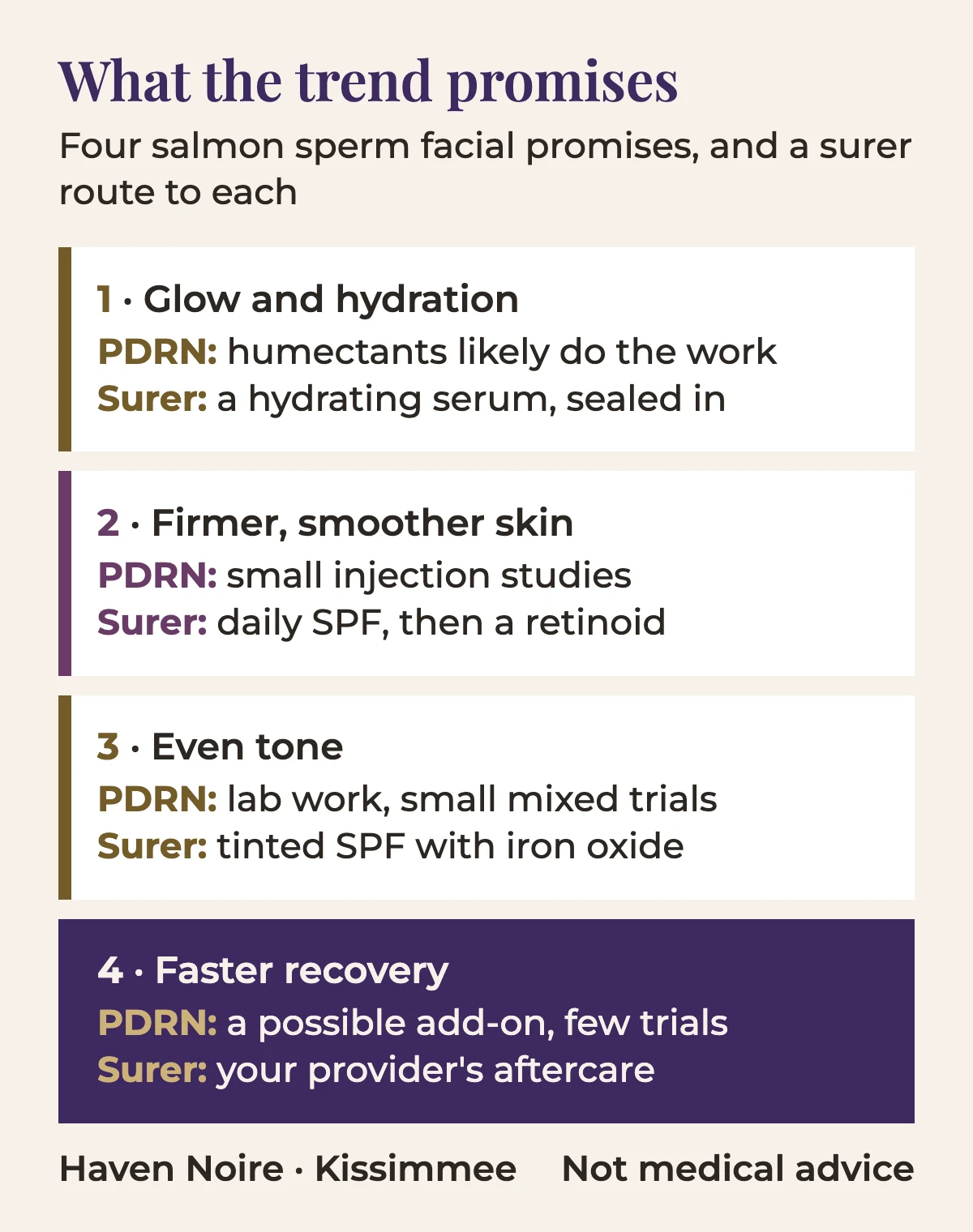
Most people booking a salmon DNA facial don't want DNA. They want what it promises. So take each promise, see what PDRN has actually shown for it, then pick the surer route to the same place. The routes are our suggestions, not medical rules.
Glow and Hydration
What PDRN has shown: Dermatology Times says serum results are more plausibly driven by the humectants and barrier-repair ingredients in the formula than by the PDRN.
Surer route: use those ingredients on purpose. Our suggestion: a hydrating serum on damp skin, sealed with moisturizer; our guides to what a face serum does and skin flooding show how.
Firmer Skin and Softer Fine Lines
What PDRN has shown: small injection studies of low to moderate quality, plus two short cream trials.
Surer route: habits with more evidence behind them. Our guide to how to prevent wrinkles ranks them, daily sunscreen first, and how to use retinol covers starting a retinoid gently. Pregnant or breastfeeding? Ask your doctor before a retinoid.
Even Tone
What PDRN has shown: lab work and small, mixed human results. A 2016 Korean paper in the International Journal of Molecular Sciences described six women whose facial hyperpigmentation improved after three rounds of PDRN injections. But in a 2022 split-face pilot in Thailand, 30 women with melasma had radiofrequency microneedling on both sides plus polynucleotides on one, and at six months the sides didn't differ significantly. We searched PubMed in November 2026 and found no human trial of a PDRN serum for dark spots.
Surer route: sun protection. The AAD's guide to fading dark spots says effective treatment begins with sunscreen and recommends a tinted one with iron oxide. Our guides to sunscreen for dark skin and fading hyperpigmentation on melanin-rich skin go further.
Faster Recovery After a Procedure
What PDRN has shown: a 2026 narrative review in Cureus describes it as a possible add-on after laser resurfacing, chemical peels, microneedling, and radiofrequency. It lists few randomized trials, small samples, and little long-term follow-up as limits.
Surer route: the aftercare plan from whoever did your procedure. After a Corrective Facial with us, the plan is short: avoid sun and active exfoliants for a few days, hydrate well, and wear SPF daily.
Who Should Skip PDRN Skincare and Salmon DNA Treatments
Some readers should check with a doctor before trying any form, even a serum. Our esthetician vs. dermatologist guide can help you decide who to see first.
- A fish or shellfish allergy. The dermatologist Cosmopolitan interviewed says to proceed with caution and talk to your doctor first; the article notes an allergic response could still happen despite heavy purification.
- Pregnancy or breastfeeding. Our PubMed search found no study of PDRN skin treatments in either, so ask your OB-GYN or midwife first.
- Isotretinoin, tretinoin, or another prescription skin medicine. Ask your dermatologist before trying any form. For microneedling, the AAD says at least one month must pass after your last isotretinoin pill.
- Eczema, rosacea, melasma, or acne-prone skin. The AAD's clinical notes on at-home microneedling flag a higher risk of microneedling complications for people with these conditions.
- A keloid, now or in the past, or a weakened immune system. The AAD lists both as reasons not to have microneedling.
- You avoid animal products. Dermatology Times says plant-based and fermented versions are being developed, so ask the brand where its PDRN comes from.
PDRN Injections and At-Home Needling: The Risks Dermatologists Flag
This is where a skin care trend turns into a medical one. The AAD's clinical notes on "pinning," meaning self-injection outside medical settings, list salmon sperm products (PDRN) among the things people inject. The complications the notes describe for self-injection include:
- Lumps: persistent bumps, nodules, and granulomas, which may follow injections of poorly characterized or contaminated products.
- Delayed reactions: swelling, redness, hive-like rashes, and tenderness.
- Infection: a higher risk with nonsterile technique, contaminated vials, or reused needles.
The notes add that for many of these compounds, human safety data remain sparse, and purity and sterility are often unknown. Dermatology Times adds that because injectable PDRN isn't FDA-approved for cosmetic use in the US, there's no federal check on its safety, effectiveness, or quality.
Microneedling at home carries its own warning. The AAD's clinical notes on at-home microneedling say granulomas have been reported when products not meant for the deeper skin, PDRN among them, are introduced into it. They advise dermatologists to counsel patients against putting highly active products into disrupted skin.
Professional devices carry risks too. In October 2025, the AAD issued a statement on the FDA's safety communication about certain uses of radiofrequency microneedling, encouraging anyone considering a cosmetic treatment to consult a board-certified dermatologist.
Our advice: don't inject yourself with anything, and don't needle a serum into your own skin. Weighing a PDRN or polynucleotide injection? Talk it through with a board-certified dermatologist first. For another viral fix for lines, see our face taping guide.
Salmon DNA Facials on Melanin-Rich Skin
If your skin is brown or Black, the research gap matters most. In our PubMed search, we found no PDRN study that named Black skin or the deepest skin type, so we found no data on how your skin responds.
What is known concerns the needles. The AAD calls microneedling safe for all skin tones, and says that right after treatment, darker skin tones may show darker shades instead of redness, which usually fade within a few days to a week. Its clinical notes on at-home microneedling add that people with skin of color may be particularly prone to discoloration after aggressive or repeated treatments.

In our view, that makes the surface routes above the better first step for melanin-rich skin, and a board-certified dermatologist the right person for anything that breaks the skin. See our guides to skin care for Black skin for a daily routine and facials for Black skin for choosing a facial.
Where Haven Noire Fits, and What's Not on Our Menu
Plainly: we don't offer PDRN treatments, polynucleotides, injections, or microneedling. Haven Noire is an esthetics spa, not a medical office. Our nano infusion facials are surface care, meant to stay on the skin's outer layer, so they aren't a way to deliver PDRN.
What we do offer for the same goals are two corrective facials:
- Hydrofacial, $135 for 60 minutes: a gentle, water-based hydrodermabrasion treatment for hydration. Here's how hydrodermabrasion compares with the branded machine facial.
- Luxe Lift Anti-Aging, $135 for 60 minutes: advanced peptides and collagen-stimulating actives targeting fine lines, wrinkles, and loss of tone. See our anti-aging facials.
- Either one as a series: the Corrective Facial 3-pack is $360, and the Corrective Membership is $109.99 a month for one corrective facial of your choice, with a three-month minimum.

Each starts with a skin consultation and analysis and ends with serums, moisturizer, SPF, and a home-care plan. Curious what's in the serums? Ask at your consultation, or browse the professional skincare lines we work with.
When to See a Dermatologist or Doctor Instead
We're estheticians, not doctors. See a board-certified dermatologist or your doctor if:
- You've had a PDRN or polynucleotide injection and notice swelling, lumps, pain, drainage, or inflammation that's getting worse. The AAD's notes on self-injection say those signs call for medical evaluation.
- You want to change deep wrinkles, sagging, or acne scars. Those are structural goals, and the AAD encourages a board-certified dermatologist consultation for cosmetic treatments.
- You're in any group on the skip list above, from pregnancy to a fish allergy or isotretinoin, and want to try any form of PDRN.
- A new product burns or stings. The AAD's dark-spot guide says to stop using it, and suggests seeing a dermatologist if the treatment you're using for dark spots isn't working.
If redness is what bothers you most, see how we approach sensitive and redness-prone skin alongside your doctor's care.
Frequently Asked Questions About the Salmon Sperm Facial
Is a salmon sperm facial really made with salmon sperm?
Sort of. PDRN is purified DNA taken from salmon sperm, not the raw material. Dermatology Times describes it as a mixture of DNA fragments from salmon trout or chum salmon sperm, and notes that newer versions are being developed from plants or through fermentation. If the source matters to you, ask the brand or provider before you buy.
What is PDRN in skincare?
PDRN, short for polydeoxyribonucleotide, is a mix of small DNA fragments, usually from salmon. In skincare it's sold in serums, creams, and masks for hydration and firmness. Most of its human research comes from injections, though, and Dermatology Times argues that most PDRN is too large to pass through intact skin on its own.
Does PDRN serum actually work?
Maybe a little, and possibly not because of the PDRN. Two small, short trials reported gains around the eyes. Dermatology Times argues that most serum benefits likely come from the ingredients mixed in, such as hyaluronic acid and glycerin. Treat a PDRN serum as a hydrating extra, not a stand-in for an injection.
Is a salmon DNA facial safe?
It depends on the form. Serums are cosmetics: stop one that burns or stings. Injections and microneedling are medical procedures, and the AAD lists lumps, delayed reactions, and infection among the risks of self-injection. Dermatology Times reports that injectable PDRN isn't FDA-approved for cosmetic use in the US.
Can you use PDRN if you're allergic to fish?
Ask your doctor or allergist first. The dermatologist Cosmopolitan interviewed advises caution for anyone with a fish or shellfish allergy, and the article adds that an allergic response could still happen even though these products are usually heavily purified. Newer plant-based and fermented versions are being developed, but confirm the source with the brand before you try a product.
Is PDRN safe for dark skin?
Not much is known yet. Our November 2026 PubMed search found no PDRN study naming Black skin or the deepest skin type; most enrolled Korean and Thai adults. The AAD's notes say skin of color may discolor after aggressive or repeated at-home microneedling. Start with gentle surface care, and take anything that breaks the skin to a board-certified dermatologist.
How is PDRN different from copper peptides?
PDRN is made of DNA fragments, usually from salmon. Copper peptides attach copper to a tiny protein fragment. Both trend as anti-aging serums and as injections, and both have thin evidence for what a serum can do on its own. Our guide to copper peptides covers that ingredient's research, and how to sort its claims by where each result happened.
Does Haven Noire offer PDRN treatments?
No. PDRN treatments, polynucleotides, injections, and microneedling aren't on our menu. For hydration we offer a Hydrofacial, and for fine lines and loss of tone, Luxe Lift Anti-Aging. Each is a $135 Corrective Facial that starts with a skin consultation and analysis at 231 Ruby Avenue, Unit E, in downtown Kissimmee.
More from the Journal

About the author
Tiffany · Licensed Esthetician · Licensed PMU Artist
Tiffany is a Florida-licensed esthetician and permanent makeup artist and the founder of Haven Noire. She specializes in customized facials, corrective skincare, and waxing for melanin-rich and all skin types, and is known for a calm, education-first approach that puts first-time clients instantly at ease.
Meet Tiffany →