

The best-proven way to prevent wrinkles, in our reading of the evidence, is broad-spectrum sunscreen worn every day; the AAD advises SPF 30 or higher. Next come skipping tans and not smoking. Then a retinoid at night and a daily moisturizer. Diet, sleep position, and overnight hacks sit at the bottom, because the evidence behind them is thin.
That order isn't how most guides present it. The American Academy of Dermatology (AAD) lists 11 ways to reduce premature skin aging, and the top-ranking guides we read mostly give you lists too, with little on how strong the proof behind each tip is. The tips don't carry equal weight. Daily sunscreen has a 4.5-year randomized trial behind it. The sleep-position study we found involved 100 women and found no clear link.
Below you'll find what causes wrinkles and fine lines, a ranked list for spending your effort in order, what changes for melanin-rich skin, where a facial honestly fits, and when to see a dermatologist instead.
What Causes Wrinkles and Fine Lines?
Wrinkles are creases in the skin, which doctors call rhytids, as MedlinePlus explains. Fine lines are the shallow, early version.
A Cleveland Clinic article on wrinkles describes fine lines as the start of wrinkles, sitting closer to the surface of your skin, and says they can start to appear after age 25. Met with age and gravity, it says, fine lines form wrinkles.
The Aging You Can't Change
Some lines arrive no matter what you do. The AAD calls this intrinsic aging and says our genes largely control when these changes occur. With time, it says, we all get visible lines on our face.
The Aging You Can Slow
The rest is extrinsic aging, driven by your environment and lifestyle, and the AAD says preventive actions can slow it. MedlinePlus names the biggest lever plainly: skin changes with age have many causes, but the greatest single factor is sun exposure. Its wrinkles page adds that cigarette smoke can make skin wrinkle sooner.
Movement plays a part too. The AAD explains that when you contract the same facial muscles for many years, the lines they make become permanent.

Not Every Line Is a Wrinkle
Some fine lines are dehydration, not age. Our guide to dry vs. dehydrated skin describes dehydrated skin as looking dull, with fine lines that soften once you moisturize. It's worth ruling that out before you buy anything sold as anti-aging.
How to Prevent Wrinkles in Order of Proof
Here's the common advice on preventing wrinkles, sorted by the kind of evidence behind each habit, from a randomized trial at the top to a few small studies at the bottom. The ranking is our reading of the evidence, not medical rules or a measurement.
The idea is simple: start from the top. A habit lower on the list can't make up for one you skipped higher up.
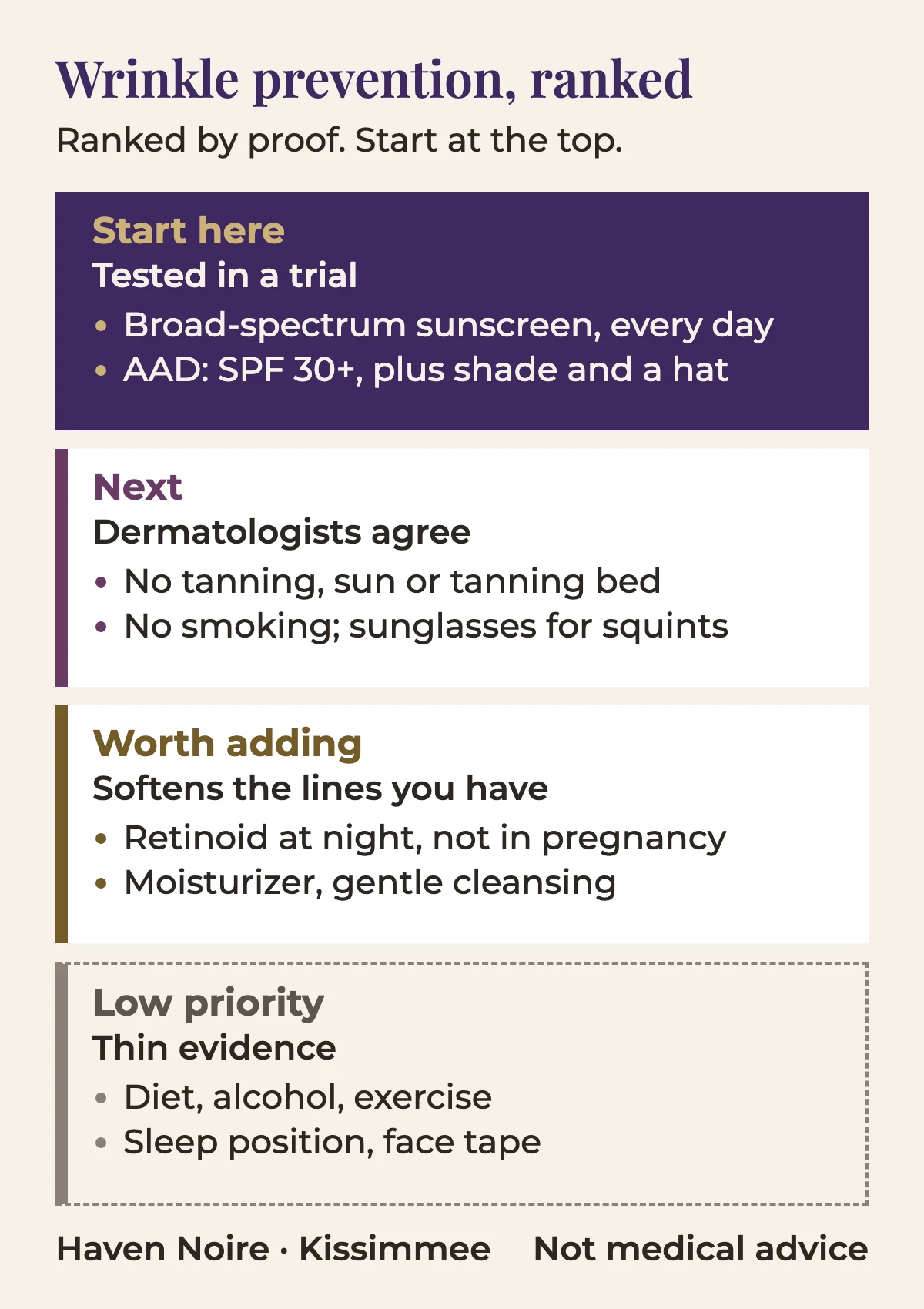
Start Here: Daily Sunscreen, Tested in a Trial
The AAD's first tip is sun protection every day, whether you're at the beach or running errands. It means shade, sun-protective clothing, a wide-brimmed hat, sunglasses with UV protection, and a broad-spectrum, water-resistant sunscreen with SPF 30 or higher on all skin clothing doesn't cover.
Daily sunscreen has the strongest proof we found. In a randomized trial in Nambour, Australia, researchers assigned 903 adults under 55 either to daily broad-spectrum sunscreen or to using it whenever they chose. After 4.5 years, the daily group showed no detectable increase in skin aging, and their skin aged 24% less than the comparison group's. The authors note some missing data and modest statistical power, and the published summary doesn't report participants' skin tones. The trial tested sunscreen, not shade, hats, or sunglasses; those sit at this level because the AAD pairs them with sunscreen.
In Central Florida, daily means daily: rainy-season mornings, school drop-off, the drive down US-192. Carry it down your neck too; our guide to tech neck lines covers that skin.
Next: No Tanning, No Smoking, and Sunglasses
Dermatologists agree on these: each one is on the AAD's list of tips. They sit one step down only because we're ranking by the kind of evidence, and daily sunscreen has a trial.
- Skip the tan. The AAD says every time you get a tan, you prematurely age your skin, whether it comes from the sun, a tanning bed, or other indoor tanning equipment. Its suggestion is self-tanner instead.
- Stop smoking. The AAD says smoking greatly speeds up how quickly skin ages and causes wrinkles and a dull, sallow complexion. MedlinePlus adds secondhand smoke to the list to avoid.
- Wear sunglasses. The AAD says they can help reduce lines caused by squinting.
Already tanned or smoked for years? The AAD says it's never too late. Protecting your skin from the sun gives it a chance to repair some of the damage, and smokers who stop often notice their skin looks healthier.
Worth Adding: A Retinoid, a Moisturizer, and Gentle Care
In our view, this level does more to soften fine lines you already have than to prevent new ones. Retinoids are vitamin A-based ingredients. The AAD's retinoid guide says dermatologists noticed that tretinoin, first approved for acne, also improves skin tone and reduces fine lines and wrinkles. It calls a retinoid a good option for mild fine lines and wrinkles.
How to Start a Retinoid Gently
- Choose the least-intense formula you can find, as a dermatologist quoted by the AAD advises.
- Use it every other night at first, then build up slowly.
- Apply it at night only, because retinoids can make skin more sensitive to the sun.
- Wear sunscreen every morning. A retinoid leans on that habit.
For a night-by-night start, see our guide to how to use retinol.
Pregnant? Skip it. The AAD says retinoids should not be used during pregnancy, and the American College of Obstetricians and Gynecologists (ACOG) says it's generally recommended that topical retinoids be avoided, adding that some are sold over the counter, so read labels carefully. Planning a pregnancy? Ask your OB-GYN or midwife before you start one.
The AAD adds three supports:
- Moisturize daily. The AAD's wrinkle remedies say moisturizing traps water in the skin and a moisturizer can immediately plump up fine lines, while most products take at least six weeks to work, sometimes three months.
- Cleanse gently. Scrubbing irritates skin, and the AAD says irritating your skin accelerates skin aging.
- Limit your products. Using too many products, especially more than one anti-aging product, tends to irritate skin, the same page says, and it advises stopping products that sting or burn unless a dermatologist prescribed them.
If your skin already stings, our four-step plan for a stressed skin barrier comes first. Curious about the peptide serums trending now? Our guide to copper peptides looks at the evidence behind them.
Low Priority: Diet, Sleep Position, and Overnight Hacks
These show up on nearly every list, so here's how much weight the sources give them:
- Diet. The AAD says findings from a few studies suggest fresh fruits and vegetables may help prevent damage that leads to premature aging, and that research suggests a diet with lots of sugar or other refined carbohydrates can accelerate aging. As for supplements, the same Nambour trial found beta-carotene supplements had no overall effect on skin aging.
- Alcohol and exercise. The AAD says alcohol dehydrates the skin and, in time, damages it, and that a few studies suggest moderate exercise may give skin a more youthful appearance.
- Sleep position. A 2016 review in Aesthetic Surgery Journal describes sleep wrinkles as different from expression lines in cause, location, and pattern. But a small 2013 observational study of 100 women in Dermatologic Surgery found sleep side wasn't significantly linked to which side of the face had more wrinkles. We searched PubMed in November 2026 for sleep position and wrinkles and found no trial testing whether switching to back sleeping prevents wrinkles.
- Face taping. If you're tempted to tape your face overnight, read our guide to face taping first.
Our advice: eat well and move for your health. Just don't let a silk pillowcase stand in for sunscreen.
| Level | Habit | Evidence behind it | What to do |
|---|---|---|---|
| Start here | Daily broad-spectrum sunscreen (the AAD advises SPF 30 or higher), plus shade and a hat | A 4.5-year randomized trial of 903 adults tested daily sunscreen | Every morning, on all skin clothing won't cover |
| Next | No tanning, no smoking, sunglasses | AAD dermatologists' tips; MedlinePlus agrees on smoke | Self-tanner, support to quit, UV sunglasses |
| Worth adding | Retinoid, moisturizer, gentle cleansing | AAD guidance; softens fine lines you already have | Retinoid at night, slowly; moisturize daily |
| Low priority | Diet, alcohol, exercise, sleep position, face taping | A few studies, small studies, or none we found | Good for your health, low priority for wrinkles |
Putting the List Into Your Day
- Morning: cleanse gently, moisturize, then apply broad-spectrum sunscreen, SPF 30 or higher, to all skin clothing won't cover.
- Outdoors: add a wide-brimmed hat and UV sunglasses, and look for shade.
- Evening: cleanse gently, apply a retinoid if it suits you and you're not pregnant, then moisturize.
- Every new product: add one at a time, and give it at least six weeks before you judge it.
Preventing Wrinkles on Melanin-Rich Skin
Melanin is a head start, not an exemption.
MedlinePlus says natural pigments seem to provide some protection against sun-induced skin damage, and that fair-skinned people show more aging skin changes than people with darker, more heavily pigmented skin. A 2016 review in the Journal of Clinical and Aesthetic Dermatology adds a structural reason: a thicker, more compact dermis makes facial lines less noticeable.
The same review says darkly pigmented skin is more vulnerable to dyspigmentation, meaning uneven color and dark spots. And the AAD's sun advice for darker skin tones is direct: if you have brown or Black skin, the sun can speed up how quickly your skin ages, and its visible light can cause hyperpigmentation. Sun protection, it says, can reduce the likelihood of both.
So on deeper skin, preventing fine lines and preventing dark spots run on the same habit. Three adjustments help:
- Choose a tinted sunscreen. The AAD recommends tinted sunscreen with iron oxide for darker skin tones, with SPF 30 or higher, broad-spectrum protection, and water resistance. Our guide to sunscreen for dark skin shows how to read the label.
- Go slow with retinoids. A dermatologist quoted in the AAD's retinoid guide warns that with skin of color, irritation can trigger dark marks, and that starting slowly and using moisturizer helps.
- Keep resurfacing gentle. If bug bites or breakouts leave dark marks on you, our guide to facials for Black skin explains how to choose treatments that cause less irritation.
If a dark spot has already formed, start with how to fade hyperpigmentation on melanin-rich skin. Sun protection, the AAD says, can also help fade dark spots, so the same morning sunscreen does both jobs.
Where a Facial Fits in Wrinkle Prevention
Here's our honest take. None of the AAD's 11 tips is a facial, and no facial replaces daily sunscreen. A facial earns its place as support: a trained look at your skin, care your skin tolerates, and a plan for the habits you keep at home.
What We Offer for Fine Lines
Our anti-aging facials page lists the signs those treatments are built for: fine lines around the eyes and mouth, loss of firmness, rough texture, and sun damage from years of Florida living. Three options fit:
- Luxe Lift Anti-Aging, $135 for 60 minutes: a Corrective Facial with advanced peptides and firming actives aimed at fine lines, wrinkles, and loss of tone. A 3-pack is $360.
- The 90-minute Signature Facial, $110 or 3 for $285: facial massage, a hand and arm massage, and an added eye treatment, for a slower, restorative visit.
- The Corrective Membership, $109.99 a month: one Corrective Facial of your choice each month, Luxe Lift included, with a progress check at every visit and a three-month minimum.
Every facial starts with a skin analysis, and your esthetician recommends home-care products for between visits from the professional lines we treat with. Our menu says corrective care works best as a consistent series, and we'll suggest a cadence at your visit. For the usual rhythm, see how often you should get a facial.
What Isn't on Our Menu
Wrinkle injections, fillers, lasers, and microneedling are medical treatments, and none of them is on our menu. MedlinePlus says a dermatologist or a plastic surgeon can discuss nonsurgical and surgical wrinkle treatments with you, and our map of types of facials shows which popular treatments belong in a doctor's office.
Had wrinkle injections or filler recently? Tell us when you book. Our guide to what to tell your esthetician before a facial explains why.
When to See a Dermatologist or Doctor Instead
We're estheticians, not doctors. We can't diagnose a skin condition, and some lines and spots need a doctor's eye. See a board-certified dermatologist or your doctor if:
- Your skin seems to be wrinkling faster than normal for your age. That's when MedlinePlus says to talk to your health care provider.
- A bump, spot, or mole is growing, bleeding, itching, or changing in any way. The AAD says a new or changing spot could be skin cancer.
- You're pregnant or planning a pregnancy and want an anti-aging product. Ask your OB-GYN or midwife first.
- You take isotretinoin, use tretinoin or another prescription skin medicine, or have eczema, rosacea, or very sensitive skin. Ask your dermatologist before adding a retinoid or booking a facial.
- Your skin is very red or inflamed. The AAD's retinoid guide says to avoid retinoids then and ask a dermatologist about other therapies, and that people with skin allergies or dryness probably aren't good candidates.
If redness is what bothers you most, see how we approach sensitive and redness-prone skin alongside your doctor's care.
Frequently Asked Questions About Preventing Wrinkles
At what age should you start anti-aging skin care?
Sun protection helps at any age, so start now. A Cleveland Clinic article says fine lines can start to appear after age 25, and many of our clients start anti-aging treatments in their late twenties or thirties. The AAD adds it's never too late: sun protection gives skin a chance to repair some damage.
Does sunscreen really prevent wrinkles?
It has the best evidence we found. In a randomized trial of 903 Australian adults under 55, those assigned daily broad-spectrum sunscreen showed no detectable increase in skin aging after 4.5 years, and their skin aged 24% less than that of people using it when they chose. It's one trial, and its published summary doesn't report skin tones.
Do Black people get wrinkles later?
Fine lines may show less on darker skin, but it still ages. MedlinePlus says fair-skinned people show more aging skin changes than people with darker skin, and a 2016 review credits a thicker, more compact dermis. The AAD says the sun can still speed up aging in brown and Black skin and cause dark spots.
Can you use retinol while pregnant?
Skip it. The American Academy of Dermatology says retinoids should not be used during pregnancy, and ACOG says it's generally recommended that topical retinoids be avoided, noting some are sold over the counter. Read labels, ask your OB-GYN or midwife what's safe, and lean on sunscreen and moisturizer in the meantime.
Does sleeping on your side cause wrinkles?
It may cause sleep lines, but the evidence is thin. A 2016 review in Aesthetic Surgery Journal says sleep wrinkles differ from expression lines in cause and pattern. A small 2013 study of 100 women found sleep side wasn't significantly linked to which side had more wrinkles. In our ranking, sunscreen comes first.
Does drinking water help with fine lines?
No source we read names drinking water as a way to prevent fine lines or wrinkles. MedlinePlus says good nutrition and adequate fluids are helpful for aging skin, and the AAD says alcohol dehydrates skin. For lines you see in the mirror, the AAD points to moisturizer, which traps water in your skin and can plump lines quickly.
Can a facial help with fine lines and wrinkles?
It can support your daily habits, not replace them. None of the AAD's 11 tips for reducing premature skin aging is a facial. At Haven Noire, Luxe Lift Anti-Aging ($135) uses peptides and firming actives aimed at fine lines and loss of tone, and every facial starts with a skin analysis.
More from the Journal

About the author
Tiffany · Licensed Esthetician · Licensed PMU Artist
Tiffany is a Florida-licensed esthetician and permanent makeup artist and the founder of Haven Noire. She specializes in customized facials, corrective skincare, and waxing for melanin-rich and all skin types, and is known for a calm, education-first approach that puts first-time clients instantly at ease.
Meet Tiffany →