

How to use retinol, in short: smooth a pea-sized amount over clean, dry skin at bedtime, start with a few nights a week, follow with moisturizer, and wear sunscreen every morning. Add nights only when your skin stays calm. That slow, night-only start is what the dermatologists quoted by the American Academy of Dermatology (AAD) recommend, because rushing a retinoid is how people irritate their skin.
Here's what most guides to retinol for beginners miss. Their starting schedules disagree, from once a week to every other day. None of the four top-ranking guides we could read in November 2026 said what irritation looks like on brown or Black skin, where an AAD dermatologist warns it can leave dark marks.
Below: a step-by-step routine, a gentle schedule for how often, the truth about the retinol sandwich, what changes on melanin-rich skin, and how to plan around a wax, a facial, or a peel. Pregnant or breastfeeding, on isotretinoin, tretinoin, or another prescription skin medicine, or living with eczema, rosacea, or keloid-prone skin? Talk to your doctor or dermatologist before you start.
What Is Retinol? How It Differs From Other Retinoids
Retinol is an over-the-counter form of vitamin A. It belongs to the retinoid family, and the AAD says people routinely use it to improve uneven skin tone, pigmentation, and texture.
The rest of the family is mostly prescription. Here's how the AAD sorts them:
| Retinoid | How you get it | What the AAD says it's used for |
|---|---|---|
| Retinol | Over the counter | Uneven skin tone, pigmentation, and texture |
| Adapalene | Over the counter or by prescription | Acne |
| Tretinoin, tazarotene, trifarotene | Prescription, applied to skin | Acne; dermatologists also noticed tretinoin's anti-aging effects |
| Isotretinoin | Prescription pill | Severe acne |
Does retinol work on its own? In a 2007 trial in Archives of Dermatology, a 0.4% retinol lotion improved fine wrinkles compared with a plain lotion. It was small: 36 people with an average age of 87, living in senior residences, with study staff applying it to one arm up to three times a week for 24 weeks. It tested arms, not faces, so it can't promise what a store-bought face product will do.
AAD dermatologist Tina Alster calls a retinoid product a good option for mild acne, mild pigmentation irregularities, or mild fine lines and wrinkles. For where a retinoid ranks next to daily sunscreen, see our guide to preventing wrinkles. Already using adapalene for clogged pores? That's a retinoid too. Our advice, not a medical rule: one retinoid at a time. Our blackheads guide covers that routine.
Why the Percentage Won't Guide You
AAD dermatologist Anne Chapas says over-the-counter products have no standard requirement to show the percentage of retinol on the label. Her advice: use the lowest formulation you can find.
How to Use Retinol, Step by Step
This routine is for over-the-counter retinol. If a doctor prescribed your retinoid, follow their directions instead.
- Choose the gentlest product you can find, and make it your only new product. The AAD's anti-aging guide says using several anti-aging products at once can irritate your skin.
- At bedtime, wash with a mild cleanser and your fingertips, then let your skin dry.
- If your skin is sensitive, wait 30 minutes. The AAD's large pores guide says washing, then waiting 30 minutes to apply retinol, can prevent irritation.
- Use a pea-sized amount for your whole face, in a thin layer. That's Cleveland Clinic's dose.
- Keep it out of your eyes, mouth, and nose, as Cleveland Clinic advises for retinol. For tretinoin, MedlinePlus also names the corners along your nose.
- Follow with moisturizer. The sandwich section below explains why.
- Wear sunscreen every morning. The AAD says retinoids can make skin more sensitive to sun, so its dermatologist advises using them only at night, plus shade, a wide-brimmed hat, and sunscreen on uncovered skin.
Skip retinol while your skin is sunburned, broken, or irritated, as Cleveland Clinic advises. On brown and Black skin a burn may not look red, so check how sunburn shows on dark skin if you're unsure.
The Morning Half, in Florida Sun
In Kissimmee, sunscreen is the half of a retinol routine that does the protecting. For sensitive skin, the AAD suggests a physical sunscreen with titanium dioxide, zinc oxide, or both. Our guide to sunscreen for dark skin helps you choose one you'll wear daily.
How Often to Use Retinol as a Beginner
How often is where most beginners run into trouble. Our view: your skin, not the calendar, should decide when you add a night.
The schedule below builds on the AAD's advice to start every other night and build up slowly, and on its warnings about stinging and dark marks. Its numbers are our suggestions, not medical rules. It's for over-the-counter retinol; a prescription follows your prescriber's plan.
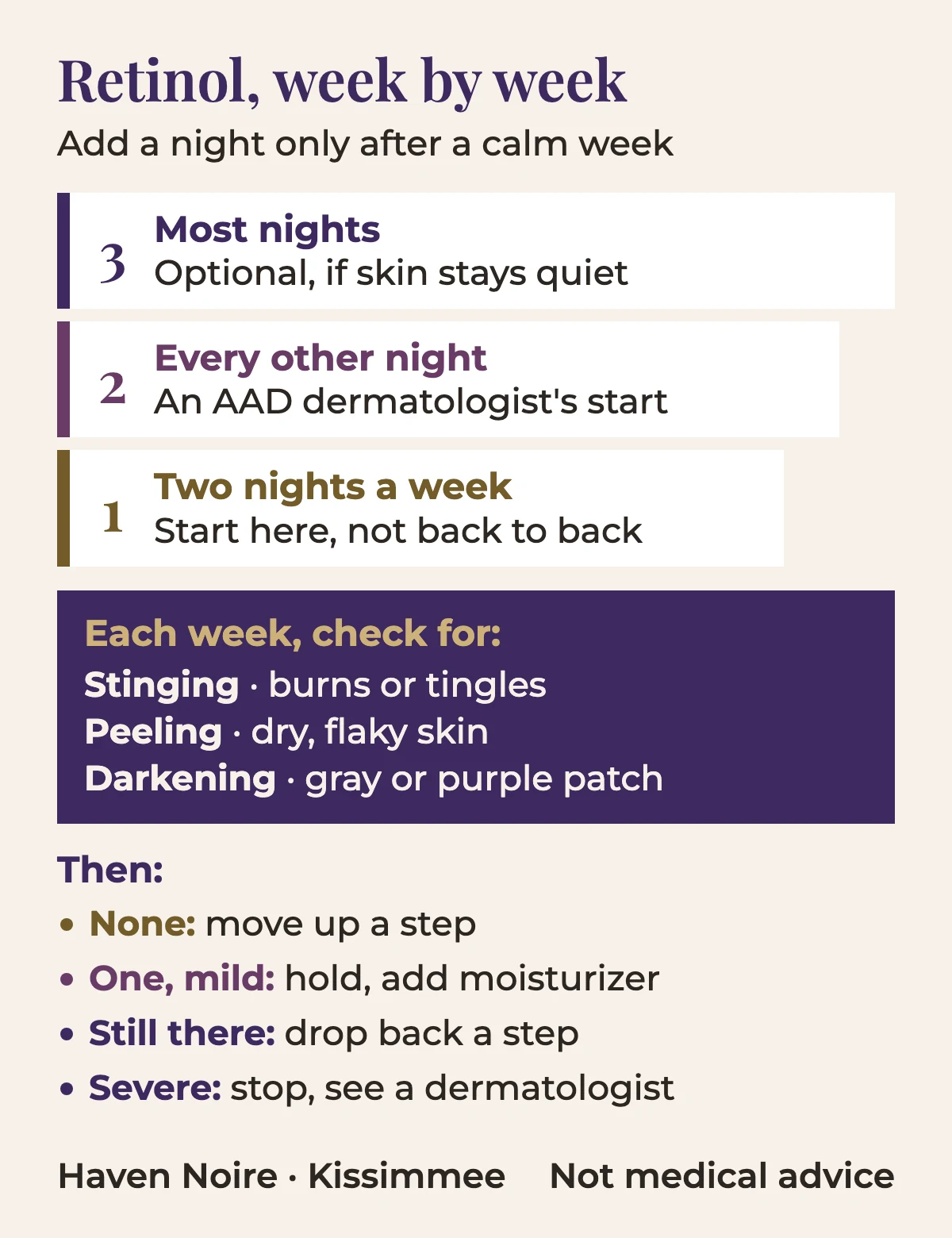
The Three Steps
| Step | How often | Where it comes from |
|---|---|---|
| 1. Start | Two nights a week, not back to back | Our starting point, a step gentler than the AAD's |
| 2. Build | Every other night | Where the AAD's dermatologist starts patients |
| 3. Maintain | Most nights, if skin stays quiet | Optional: Cleveland Clinic describes ramping up gradually, and step 2 is a fine place to stay |
Move up one step only after a full week of calm skin, meaning none of the three signs below.
Three Signs to Check Each Week
- Burning, stinging, or tingling. The AAD says those mean a product irritates your skin, and to stop using it. On a prescription, ask your dermatologist first, since some prescription-strength products will burn or sting.
- Dryness, flaking, or peeling. MedlinePlus lists all three among tretinoin's side effects, and Cleveland Clinic says such effects should gradually go away as your skin adjusts.
- A patch turning darker, grayish, or purplish. Irritation doesn't always look red: the NHS says contact dermatitis, the rash an irritating product can cause, can turn darker skin dark brown, purple, or grey.
What to Do After Each Week
- A calm week: move up one step.
- One mild sign: stay at the same pace another week, and try the sandwich below.
- A sign that outlasts that week, or two at once: step back down for a week.
- Severe burning, swelling, blistering, or a spreading dark patch: stop, and read the dermatologist section below.
Taking a break? Our guide to calming a stressed skin barrier gives your skin fewer jobs until it calms, then brings retinol back last.
How Long Until You See Results
Give it time. The AAD's anti-aging guide says most products take at least six weeks to work, sometimes up to three months, and Cleveland Clinic says wrinkles usually take several months of retinol use. More breakouts in the first weeks? Our skin purging guide helps you tell an adjustment from a reaction.
The Retinol Sandwich: What It Is and What's Proven
The retinol sandwich is a layering method: a thin layer of moisturizer, then your retinol, then more moisturizer. The aim is less dryness and stinging while your skin adjusts.
It's a popular name, not a medical term; none of the AAD, MedlinePlus, or Cleveland Clinic pages we read uses it.
What's Sourced
- AAD dermatologist Sonia Badreshia-Bansal says starting slowly and using moisturizer will help lower the risk of dark marks on skin of color.
- MedlinePlus says your doctor may tell you to use a moisturizer to help with dryness on tretinoin.
- An 8-week study of 120 people with acne in Thailand, published in 2015 in the Journal of Dermatological Treatment, found less irritation, without weaker results, when one anti-inflammatory moisturizer was added to adapalene gel.
What Isn't
We searched PubMed in November 2026 for studies of the retinol sandwich, and for trials pairing moisturizers with retinoids. None tested the layering order itself: whether moisturizer underneath helps more than moisturizer on top, or dilutes the retinol. So it's a reasonable comfort step, not a proven technique.
Our take: use it during a week you stay at the same pace, or from night one if your skin runs dry or marks easily. Choose a fragrance-free moisturizer labeled non-comedogenic or won't clog pores; the AAD's acne tips for skin of color warn that cocoa or shea butter on your face can clog pores. Ask about the professional skincare lines we work with.
How to Use Retinol on Melanin-Rich Skin
On brown and Black skin, retinol cuts both ways. The AAD's acne tips for skin of color say retinol can unclog pores and fade dark spots, and the AAD's dark spot guide lists retinoids among the ingredients that fade them. That same guide says a product that irritates your skin can cause dark spots.
So the AAD's retinoid page asks people with darker skin to be especially vigilant about irritation. "With skin of color, irritation can trigger dark marks," Dr. Badreshia-Bansal says.
What a 1993 Study Found
A 1993 trial in the New England Journal of Medicine tested prescription tretinoin cream on dark marks left by inflammation in 54 Black patients who completed it. After 40 weeks, facial marks were significantly lighter with tretinoin than with a plain cream. But half the tretinoin users who finished, 12 of 24, developed retinoid dermatitis, an irritation of the skin, though it eased as the study went on.
That was prescription tretinoin at 0.1%, used daily, more than 30 years ago. It wasn't over-the-counter retinol, so it can't show what retinol will do. Our reading, in line with the AAD warnings above: on melanin-rich skin a retinoid can help and still irritate, so the slowest pace your skin accepts is the safest one.
Protect the Progress
- Check for darkening, not just redness, every week.
- Wear sunscreen daily. The AAD's dark spot guide recommends a tinted sunscreen with iron oxide, which helps protect against visible light, a cause of dark spots.
- Go easy on scrubs and strong acids. The AAD's exfoliation guide says to avoid strong chemical or mechanical exfoliation if you have a darker skin tone or get dark spots after bug bites or breakouts.
- Already have a mark? Once the cause stops, the AAD says a spot a few shades darker than your skin usually fades within 6 to 12 months.
For a full fading routine, read how to fade hyperpigmentation on melanin-rich skin.
What Not to Mix With Retinol, and When to Pause It
At home, keep one active at a time. The AAD's exfoliation guide says retinol can make skin more sensitive or peel, and exfoliating while you use it may worsen dry skin or even cause breakouts. Count retinol as part of your week before adding an acid or scrub; our guide to how often you should exfoliate shows how. Want a set rotation of retinol, exfoliant, and rest nights? That's skin cycling.
Retinol and Your Appointment Calendar
| Appointment | Before | After | Source |
|---|---|---|---|
| Face wax: brows, lip, or chin | Pause retinol and prescription retinoids 2 to 5 days | Ask us; no source we read sets a restart day | AAD waxing guide |
| Any wax while applying tretinoin or using an antibiotic | Not recommended | Ask your prescriber | AAD hair removal guide |
| Any wax within 6 months of isotretinoin | Don't wax | Ask your dermatologist | Both AAD pages |
| Dermaplaning | Avoid retinoids 3 to 5 days | Avoid retinoids 3 to 5 days | Our dermaplaning page |
| Chemical peel (skin consultation first) | Stop retinoids 5 to 7 days | Skip retinoids, usually 5 to 7 days | Our peel page and peel aftercare guide |
| Signature or Corrective Facial | Tell us you use retinol | Menu aftercare: Signature, skip harsh actives and heat for 24 hours; Corrective, avoid active exfoliants for a few days. Ask us if your retinol counts | Our facial menu |
Brows, lip, or chin on the calendar? Our face waxing guide runs the full three-question check. Every chemical peel needs a skin consultation first and isn't a first-visit service; one, the MandeliClear Peel, includes a Vitamin A Accelerator, so bring a list of everything you use.
When to Skip Retinol or See a Dermatologist First
We're estheticians, not doctors. Talk to your doctor or a board-certified dermatologist before you start retinol if any of these fit:
- You're pregnant or planning to be. The AAD says retinoids should not be used during pregnancy, and ACOG says to read labels carefully, since some over-the-counter products contain them. Ask your OB-GYN or midwife.
- You're breastfeeding. The AAD's large pores guide says not to use retinol then.
- You take isotretinoin, or use tretinoin, prescription adapalene, or another prescription on your skin.
- Your skin is red or inflamed much of the time. Dr. Chapas says to avoid retinoids and ask your dermatologist about therapies for rosacea.
- You have eczema, skin allergies, or very dry skin. The AAD calls people with skin allergies or dryness probably not good candidates, and MedlinePlus says not to apply tretinoin to skin affected by eczema.
- Your acne leaves moderate or severe scars, or flares with your periods or new hair growth. Dr. Chapas says to see a board-certified dermatologist first.
- Your skin scars or forms keloids easily.
Stop and call your doctor or dermatologist if dryness, burning, stinging, peeling, swelling, redness, or blistering is severe or doesn't go away, as MedlinePlus advises for tretinoin, or if a dark patch keeps spreading. If redness is your everyday, start with your dermatologist; our page on sensitive and redness-prone skin explains how a facial can sit alongside your physician's care.
Where a Facial Fits in a Retinol Routine
A facial doesn't replace your retinol, and we don't prescribe retinoids. We can look at your skin, hear what you use, and help you plan around it. Tiffany, our founder, is a Florida-licensed esthetician, and Haven Noire is an esthetics spa, not a medical office.
Every facial begins with a skin analysis. Tell us how many nights a week you use retinol and whether you've noticed any stinging, peeling, or darkening. For fine lines and firmness, the Luxe Lift Anti-Aging option on our corrective facials menu uses advanced peptides and collagen-stimulating actives. For dullness and discoloration, Radiance Brightening uses antioxidants and vitamin blends. Pregnant, or curious what goes on your skin? Ask at your consultation.
| Option | Price |
|---|---|
| Corrective Facial, 60 minutes (including Luxe Lift Anti-Aging) | $135, or 3 for $360 |
| Corrective Membership: one corrective facial a month | $109.99 a month |
| Signature Facial, 60 minutes | $95, or 3 for $210 |
Memberships have a three-month minimum, and members get 10% off extra services and in-spa products; compare them on our memberships page. For the bigger picture, see our anti-aging facials.
Frequently Asked Questions About Using Retinol
Do you put retinol on before or after moisturizer?
Retinol usually goes on clean, dry skin, then moisturizer. If your skin is dry or stinging, try the retinol sandwich: moisturizer, retinol, then more moisturizer. An American Academy of Dermatology dermatologist says moisturizer helps limit dark marks on skin of color, but our PubMed search found no study testing the sandwich order, so treat it as a comfort step.
How long does retinol take to work?
Plan on months, not days. The American Academy of Dermatology says most anti-aging products take at least six weeks to work, and sometimes up to three months. Cleveland Clinic says wrinkles usually take several months of retinol use. In a small 2007 trial on the arms of 36 older adults, a 0.4% retinol lotion improved fine wrinkles after 24 weeks.
Can you use retinol every night?
Some people can, but don't start there. The American Academy of Dermatology quotes a dermatologist who starts patients every other night and builds up slowly. Our suggested schedule starts at two nights a week and adds nights only after a full week without stinging, flaking, or darkening. Every other night is a fine place to stay.
Is it normal for retinol to make your skin peel?
Some dryness and flaking can happen at first, and Cleveland Clinic says side effects like these should gradually go away as your skin adjusts. Our advice: if peeling outlasts a week, step back to fewer nights. Severe burning, swelling, or blistering means stop and call your doctor or dermatologist.
Is retinol safe for dark skin?
Retinol can help brown and Black skin; the American Academy of Dermatology says it can unclog pores and fade dark spots. The catch is irritation: an AAD dermatologist warns that on skin of color, irritation can trigger dark marks. Start slowly, use moisturizer, wear sunscreen daily, and watch for patches turning darker, not just red.
Can I use retinol while pregnant or breastfeeding?
No. The American Academy of Dermatology says retinoids should not be used during pregnancy, and its large pores guide says not to use retinol while breastfeeding. ACOG advises reading labels carefully, since some over-the-counter products contain retinoids. Ask your OB-GYN or midwife what to use instead, and tell us when you book a facial.
Should I stop retinol before waxing, dermaplaning, or a peel?
Usually, yes. The American Academy of Dermatology advises pausing retinol two to five days before waxing your face, and says waxing isn't recommended while you're applying tretinoin or using an antibiotic. Our dermaplaning page asks for a 3 to 5 day pause, and our peel page asks for 5 to 7 days. Tell us what you use when you book.
More from the Journal

About the author
Tiffany · Licensed Esthetician · Licensed PMU Artist
Tiffany is a Florida-licensed esthetician and permanent makeup artist and the founder of Haven Noire. She specializes in customized facials, corrective skincare, and waxing for melanin-rich and all skin types, and is known for a calm, education-first approach that puts first-time clients instantly at ease.
Meet Tiffany →