

Face taping is a social media beauty trend: people stick tape or adhesive patches over lines on the forehead, between the brows, or around the eyes and mouth, usually overnight, hoping to smooth wrinkles or stop new ones. As of November 2026, the most recent coverage we found dates from 2025: NBC News Select reported in March 2025 that the trend had "taken social media by storm," and Baptist Health published a guide to it that September.
The short answer: tape can make skin look smoother for a few hours, not for good. Baptist Health says the effect usually fades within hours as you speak, laugh, and go about your day, and that reliable clinical data are scarce. The two small trials of adhesive wrinkle pads we found on PubMed in November 2026 fit that picture: neither showed a lasting change.
What most guides skip is the moment the tape comes off. Pulling adhesive off the same skin night after night can irritate it, and on melanin-rich skin, irritation can leave a dark mark that outlasts any smoothing. Below: how to sort which lines tape can touch, who should skip it, and safer ways to soften lines.
What Is Face Taping?
Face taping means sticking tape or adhesive patches across skin that creases, like your forehead or the lines beside your mouth, to hold it still or pull it smooth. Most people wear it overnight and peel it off in the morning.
Baptist Health lists three common kinds of tape: breathable paper tape sold in pharmacies, kinesiology tape used by athletes, and purpose-made wrinkle patches of silicone or hydrogel. In NBC Select's report, a plastic surgeon describes two techniques: adhesive on areas that crease with movement, or clear tape at the temples, cheeks, and jawline, joined behind the head with an elastic band to lift the face.
Supporters say tape limits frowning and squinting, traps moisture that briefly plumps the surface, and reminds you to relax your face overnight, as Baptist Health lays out. Our guides to copper peptides and the salmon sperm facial look at two other anti-aging trends.
Does Face Taping Work for Wrinkles? What the Evidence Says
Not in any lasting way we could find. The expert sources we read agree:
- Smoother at first. Baptist Health says many users wake up with smoother-looking skin, because hydration and stillness reduce puffiness and creasing.
- Then the lines return. An Ohio State Wexner Medical Center plastic surgeon says lines that seem to disappear will reappear soon, and advises against the practice.
- No collagen. A dermatologist quoted by NBC Select says overnight taping may reduce sleep creases, "but it doesn't rebuild collagen."
- No reversal. Baptist Health says true wrinkles form in deeper layers where collagen and elastin break down, a process tape can't reverse.
The two small trials we found point the same way. In a 2009 study, 30 volunteers wore over-the-counter adhesive pads on the forehead and between the brows about 7 hours a night for 4 weeks. Facial plastic surgeons judging the photos blind found no statistically significant improvement; volunteers rated their frown lines slightly better, which the authors said may reflect bias. A 2017 placebo-controlled trial of 39 people in the Journal of Cosmetic Dermatology measured smoother crow's feet for about the first hour after use. Our PubMed search found no study longer than 4 weeks.
Where lasting lines come from
The American Academy of Dermatology (AAD) says the sun plays a major role in prematurely aging skin, and MedlinePlus calls sun exposure the greatest single factor in skin aging. The AAD also says that if you repeatedly contract the same muscles for many years, those lines become permanent.
That's the kernel of truth behind the trend. But tape works only while it's on, and most expressions happen during the day, without it. A plastic surgeon in NBC Select's piece adds a caution: taping repeatedly can make your face look more saggy when it isn't taped.
For the habits with stronger support, see our guide to preventing wrinkles, which ranks face tape as low priority for wrinkles.
Face Taping Before and After: What the Photos Don't Show
Before-and-after pictures are a big part of this trend. We don't show any, because they can't answer the real question: what your face looks like at 3 PM a month from now. Here's why we think they mislead:
- Timing. The "after" is usually snapped minutes after the tape comes off, and in the 2017 trial the smoothing lasted about an hour.
- Creases fade anyway. A pillow line at 7 AM often softens by midmorning with or without tape.
- Swelling. Baptist Health credits part of the morning smoothness to less puffiness, which has causes of its own, covered in our guide to puffy eyes in the morning.
- Light and edits. Window light, angles, makeup, and filters all change how lines read.

For a fair test of any routine, photograph your face in the same light, at the same time of day, at rest, a few hours after waking. Compare month to month, not morning to morning.
Which Lines Can Face Tape Touch?
Most taping advice treats every line the same. The research doesn't. A 2016 review in Aesthetic Surgery Journal says sleep wrinkles and expression wrinkles differ in cause, location, and pattern, and the AAD lists repeated expressions and the sun as separate causes of early aging.
So before you buy tape, ask when you see the line. Sorting lines this way is a rule of thumb, not a medical test or a medical rule.
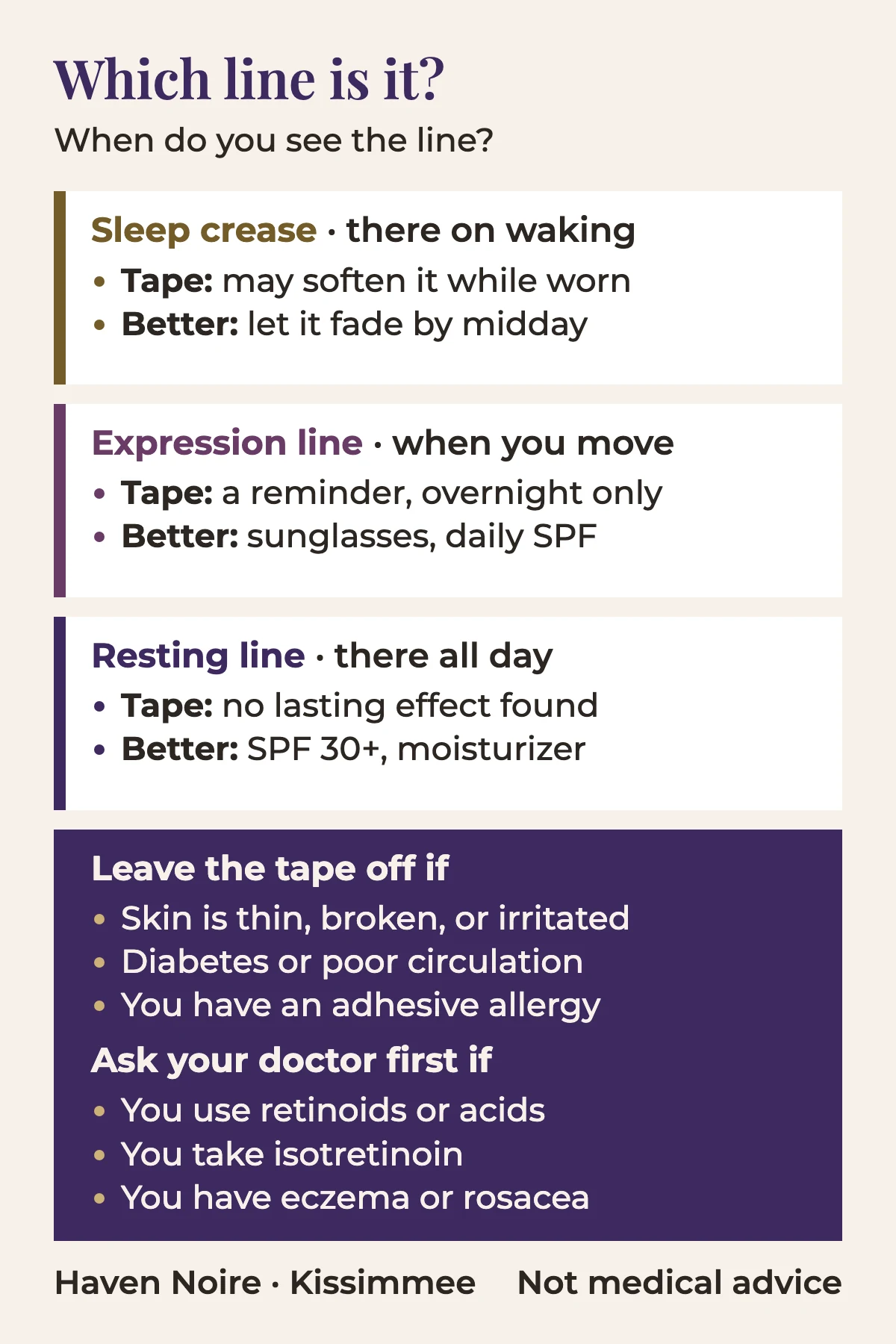
Sleep creases: there when you get up
These are creases pressed in by your pillow. The NBC Select dermatologist says overnight taping may reduce sleep creases, and that's tape's best case: a softer line while it's on. Our advice: a crease that fades by lunch on its own isn't worth a nightly adhesive.
Expression lines: there only when you frown, squint, or smile
These appear with expression and relax when your face does. The AAD's advice here isn't tape: it says wearing sunglasses can help reduce lines caused by squinting. Tape might remind you not to frown in your sleep, but tape on a wrinkle shows, so many people wear it only at night, NBC Select notes. Sunglasses come with you to a Florida parking lot at noon.
Resting lines: there all day, even when your face is still
A month of nightly pads didn't significantly change forehead or frown lines in the 2009 study. These sit in deeper layers where, Baptist Health says, collagen and elastin break down. The AAD's defenses are daily sunscreen and moisturizer, covered below; these lines are a job for a dermatologist, or for a corrective facial aimed at how your skin looks and feels.
| When you see it | Likely type | Tape's best case | Lower-risk move |
|---|---|---|---|
| On waking, fading by midday | Sleep crease | May soften it while worn | Let it fade; skip the adhesive |
| Only when you frown, squint, or smile | Expression line | A reminder not to frown overnight | Sunglasses outdoors and daily sunscreen |
| All day, with your face at rest | Resting line | No lasting effect in the studies we found | Daily SPF 30 or higher, moisturizer, a corrective plan |
| Any line on red, broken, or treated skin | Not a tape question | Not worth the risk | Read who should skip it, below |
Face Taping Risks: What Happens When the Tape Comes Off
What peeling can do to your outer layer
Baptist Health says repeated taping can irritate or even tear delicate facial skin, especially if you have eczema, rosacea, or a history of contact allergies. MedlinePlus adds that aging skin is thinner and more fragile, and that rubbing or pulling on it can cause skin tears.
Two nearby lines of research study hospital tape and lab methods, not face tape, so this is our reading, not proof. A 2013 wound-care consensus statement on medical adhesive-related skin injury says tissue trauma can occur when adhesive isn't applied or removed with proper technique, and a 2024 update still calls it clinically relevant. A 2016 review in Skin Research and Technology lists sequential tape stripping, pulling tape off one spot again and again, among the ways researchers make wounds in volunteers for healing studies, the shallowest removing only the stratum corneum, the skin's outer barrier layer. Neither shows one strip a night will hurt your face; both show why gentle removal matters.
In fairness, NBC Select reports minimal risk with the right tape, and the 2017 crow's feet trial called adhesive pads safe to use and tolerable for most users. NBC's dermatologist names the biggest danger as tape that isn't skin-friendly, which can damage your skin barrier with repeated use and trigger contact dermatitis, especially around the eyes and mouth. If your skin already stings or flakes, start with our skin barrier guide.
Rashes, breakouts, and adhesive allergy
MedlinePlus lists adhesives, including those used for false eyelashes or toupees, among the common causes of allergic contact dermatitis. The Ohio State surgeon says tape can irritate your skin, causing acne and rashes, and Baptist Health adds that adhesive may trap bacteria, raising the risk of acne or folliculitis.
Why brown and Black skin has more to lose
None of the taping guides we read mention dark marks, and on melanin-rich skin, that's the risk we'd weigh first. The AAD's guide to dark spots in darker skin tones says spots often appear when a skin care product irritates your skin or when an injury heals. A spot a few shades darker than your natural color usually fades within 6 to 12 months, it says, and deeper color can take years.

We found no study of face tape and dark marks, so this is our reasoning, not a finding: if tape irritates your skin, a few smoother morning hours aren't worth a mark that can last a year. To protect tone, the AAD recommends tinted sunscreen with iron oxide. If a mark has already formed, start with how to fade hyperpigmentation on melanin-rich skin.
Who Should Skip the Tape
Baptist Health says to skip taping if you have:
- Thin, fragile, or sun-damaged skin
- Active acne, dermatitis, or open sores
- An adhesive allergy
- Diabetes or poor circulation
It adds that anyone using prescription acne or anti-aging creams with retinoids or acids should check with a provider, because tape can intensify irritation. With eczema or rosacea, which it says raise the risk of irritation and tearing, ask your dermatologist first.
Tretinoin, isotretinoin, and antibiotics
The AAD's guide to removing unwanted hair says waxing isn't recommended while you apply tretinoin or use an antibiotic, or within six months of isotretinoin, because these medications thin your skin and it could tear when the wax comes off. That page is about wax, not tape. Our view: anything sticky you peel off your face deserves the same caution, so ask your dermatologist first. Our face waxing guide covers those medicines for brows, lip, and chin.
Pregnancy, keloids, and recent procedures
Pregnant, or prone to keloids? Talk with your doctor or dermatologist before adding anything new to your routine, tape included. Had injectables, fillers, a peel, or another procedure recently? Ask the person who treated you first.
A note on mouth taping
Mouth taping is a sleep and breathing trend, not a skin one; our morning shed guide explains why we say ask your doctor first. MedlinePlus calls loud snoring a telltale symptom of obstructive sleep apnea, though not everyone who snores has it. If you snore loudly or feel very sleepy by day, talk with a doctor.
If you still want to try it
If your skin is healthy and nothing above applies, Baptist Health's precautions are a sensible floor:
- Start with clean, dry skin. Oil or makeup under tape can cause breakouts.
- Use hypoallergenic, medical-grade tape, never duct tape or household tape.
- Apply it with minimal tension, so it doesn't pull your skin.
- Remove it slowly in the morning while skin is damp from cleanser, to prevent tearing.
- Stop if you notice redness, itching, or a rash, and see a provider if irritation lasts.
We'd add: keep tape off your eyelids, lips, and any broken skin, and skip a night if skin still looks pink from the last strip.
Safer Ways to Soften Lines, and Where a Facial Fits
From the AAD's tips on premature skin aging:
- Wear broad-spectrum, water-resistant sunscreen, SPF 30 or higher, every day. Our guide to sunscreen for dark skin shows how to choose one.
- Wear sunglasses outdoors.
- Apply a facial moisturizer every day.
- Cleanse gently. The AAD says scrubbing can irritate your skin.
- Stop products that sting or burn. Irritating your skin can make it look older, the AAD says.

Our guide to face icing looks at another morning trend, and tech neck lines covers lines below the jaw.
What a facial can do for fine lines
No facial erases wrinkles, and we won't promise one will. Haven Noire is an esthetics spa, not a medical office. Every facial starts with a skin analysis. Here's where to start on our menu:
| Facial | What our menu says | Price |
|---|---|---|
| Luxe Lift Anti-Aging (Corrective Facial, 60 minutes) | Advanced peptides and collagen-stimulating actives targeting fine lines, wrinkles, and loss of tone | $135, or 3 for $360 |
| Signature Facial, 90 minutes | Facial massage, a hand and arm massage, and an added eye treatment | $110, or 3 for $285 |
After a corrective facial, our aftercare is to avoid sun and active exfoliants for a few days, hydrate well, and use SPF daily. Prefer a monthly rhythm? The Corrective Membership ($109.99 a month) includes one corrective facial of your choice, and the Ritual Membership ($94.99 a month) a 90-minute Signature Facial. See our memberships.
Neuromodulator injections, fillers, lasers, and microneedling are medical procedures, and none of them is on our menu. Ask a board-certified dermatologist about those. For how we approach lines and firmness, see our page on anti-aging facials.
When to See a Dermatologist or Doctor Instead
We're estheticians, not doctors, and tape isn't a treatment for any skin condition. See a board-certified dermatologist or your doctor if:
- A rash after taping is severe, doesn't improve with treatment, or shows signs of infection such as tenderness, redness, warmth, or fever. MedlinePlus lists those as reasons to contact a provider about contact dermatitis.
- Bumps around hair follicles come back often, get worse, or last longer than 2 or 3 days, when MedlinePlus says to call a provider about folliculitis.
- Skin tore or broke open when the tape came off.
- A dark mark isn't fading with the treatment you're using. The AAD says you may want to see a dermatologist then.
- You're pregnant, or you use isotretinoin, tretinoin, or another prescription skin medicine, and want to change your routine.
Already working with a physician on redness or reactive skin? See how we approach sensitive and redness-prone skin alongside a doctor's care.
Frequently Asked Questions About Face Taping
Does face taping really get rid of wrinkles?
Not for good, in anything we found. Tape can make lines look smoother for a few hours, and Baptist Health says true wrinkles form where collagen and elastin break down, which tape can't reverse. In a small 2009 study, surgeons judging blinded photos found no significant change after 4 weeks of nightly adhesive pads.
How long do face tape results last?
A few hours at most. Baptist Health says the smoothing usually fades within hours as you speak, laugh, and go about your day, and an Ohio State plastic surgeon says lines that seem to disappear will reappear soon. That's why photos taken right after the tape comes off can mislead.
Is it safe to sleep with tape on your face?
NBC Select reports minimal risk with skin-friendly tape, but its dermatologist warns that repeated use of the wrong tape can damage your skin barrier and trigger contact dermatitis. Skip it on broken or irritated skin, ask a provider first if you use retinoids or acids, keep it off your eyelids, and stop at any redness, itching, or rash.
Can tape on your face cause dark spots on Black or brown skin?
We found no study of tape and dark spots, but the American Academy of Dermatology says dark spots in darker skin tones often follow an irritating product or a healing injury. A spot a few shades darker usually fades within 6 to 12 months, while deeper color can take years. Stop taping at the first sign of redness.
Can face taping replace wrinkle injections?
Not in any study we found. A plastic surgeon in NBC Select's report points to neuromodulator injections for longer-lasting results, and those are a medical treatment and a question for a board-certified dermatologist. Tape holds skin only while it's on, and our PubMed search found no study comparing the two. Injections aren't on our menu.
What kind of tape do people use on their face for wrinkles?
Guides mention breathable paper tape, kinesiology tape, and silicone or hydrogel wrinkle patches. A dermatologist quoted by NBC Select suggests medical-grade silicone because it's skin-friendly and removes gently, and Baptist Health warns against duct tape or other household tapes. Whatever you use, keep it off broken or irritated skin.
Can a facial help forehead lines?
A facial can't erase lines, and we don't promise results. Our Luxe Lift Anti-Aging facial uses advanced peptides and collagen-stimulating actives aimed at fine lines and loss of tone, as a $135 Corrective Facial in Kissimmee. Daily sunscreen does the long-term work, and a dermatologist can discuss medical options for deeper lines.
More from the Journal

About the author
Tiffany · Licensed Esthetician · Licensed PMU Artist
Tiffany is a Florida-licensed esthetician and permanent makeup artist and the founder of Haven Noire. She specializes in customized facials, corrective skincare, and waxing for melanin-rich and all skin types, and is known for a calm, education-first approach that puts first-time clients instantly at ease.
Meet Tiffany →