

Dark knees and elbows often come from pressure, friction, dryness, or an old irritation that left color behind. Some are simply the shade your skin has always been. Here's how to get rid of dark knees from those causes: stop what's rubbing, moisturize, protect them from the sun, and give them time. The American Academy of Dermatology (AAD) says many spots clear on their own once you remove the cause, and that a spot a few shades darker than your natural color usually fades within 6 to 12 months after that.
Darkening that feels velvety, looks scaly, or shows up suddenly is different. A doctor should see it before you treat the color.
Below: why knees, elbows, and knuckles darken, three quick checks to sort what you're seeing, a gentle fading routine, and when to see a dermatologist. One honest note: there's no knee, elbow, or knuckle treatment on our menu at Haven Noire, so this guide covers home care and when to get medical help. Wherever a tip doesn't name a source, it's our own advice, not a medical rule.
Why Do Knees and Elbows Get Dark?
Dark knees and elbows are patches where skin has made extra melanin, built a thicker surface layer, or both. Pressure, friction, dryness, and healed irritation are the usual triggers, and family patterns can play a part.
These joints bend all day, carry your weight when you kneel or lean, and rub against fabric. The AAD notes that many everyday things can trigger extra melanin in people with darker skin tones, and knees and elbows meet plenty of them.
Friction and pressure: the most common pattern
Dermatologists have a name for the classic version. A 2005 case series in the journal Cutis described frictional asymptomatic darkening of the extensor surfaces, or FADES: even, painless brown darkening over the outer elbows and knees, with minimal scaling. Biopsies showed a thickened top layer of skin. The authors wrote that both friction and family history may play a role, and that dermatologists see it commonly.
Long, repeated kneeling counts. A 2002 study in the International Journal of Dermatology examined 349 Muslim men and women who pray regularly and described prayer marks: thicker, darker skin on the knees, ankles, tops of the feet, and forehead from repeated, extended pressure on those spots during prayer. The authors reported no complications, such as infections, from the marks. Our read: any habit that loads the same spot day after day may work the same way, from kneeling at church or your bedside to scrubbing floors, gardening, or leaning your elbows on a desk or armrest.

Friction darkens other spots the same way. Our guide to dark inner thighs explains how rubbing turns into color, and which skin lighteners to skip.
Dryness that looks like darkness
Gray, chalky, or dull knees are often dry rather than darker. The AAD's dry skin tips say tight clothes such as leggings and body-hugging jeans rub against your skin and can worsen dryness. Our rule of thumb: ash lifts once moisturizer goes on, and true darkening doesn't. Our guide to ashy skin covers the moisturizing fix in full.
Marks left by old irritation
The AAD lists the everyday triggers of dark spots in darker skin tones: a wound healing, a pimple or psoriasis patch clearing, certain medicines, a product that irritates your skin, and hormone changes such as pregnancy. Knees and elbows collect scrapes, bug bites, and rug burns over a lifetime, and each can leave a mark.
Eczema shows up here too. The AAD's eczema symptoms page says that in children with darker skin tones, patches tend to form on the fronts of the knees, the elbows, and the backs of the hands. It adds that skin may be lighter or darker where eczema has healed, and that skin that's constantly rubbed or scratched can thicken.
Sometimes it's simply your skin
Not every darker knee is a problem to solve. If both knees or both elbows match, the skin is smooth and flat, and it has looked this way as long as you remember, nothing in this guide flags it. The FADES authors named family history as a possible factor, so if your mother's elbows look like yours, that's worth knowing. That shade is simply yours.
Dark Knuckles: Why the List of Causes Is Longer
Dark knuckles share the everyday causes above: hand washing dries them, and fingers bend and crease all day. The same triggers we cover in our guide to skin care for Black skin apply here. But knuckles can also show a few medical signs, so a new change deserves a closer look.
- Acanthosis nigricans (AN). The AAD lists the knuckles, elbows, and knees among the places this velvety, thicker darkening can form. Elsewhere, the AAD says AN can be a sign of pre-diabetes.
- Low vitamin B12. A 2015 review in the American Journal of Clinical Dermatology names hyperpigmentation as the most common skin sign of B12 deficiency, and two case reports describe darkened knuckles that lightened after treatment.
- Adrenal problems. The NHS lists areas of skin darker than the skin around them among the symptoms of Addison's disease, along with extreme tiredness, weight loss, and dizziness on standing, and notes the darker skin may be harder to see on brown or black skin. A National Institutes of Health page (NIDDK) adds that it shows most on pressure points such as the elbows, knees, and knuckles.
- Medicines. The AAD names certain medications among the triggers of dark spots. Don't stop a prescription on your own; ask the doctor who prescribed it.

MedlinePlus lists fatigue, pale skin, and numbness or tingling among the symptoms of B12 deficiency anemia. Among its causes, it names a strict vegetarian diet, some stomach or small-intestine surgeries, and long-term use of metformin.
None of this means your knuckles are a symptom. Plenty of people have darker knuckles their whole lives. The signal is change: knuckles that darken over months, especially with tiredness, tingling, or weight loss, are worth raising with your doctor before you reach for a lightening cream.
Dark Knees: Ash, Friction Mark, Your Shade, or a Sign?
Run these three checks before you buy anything for dark knees, elbows, or knuckles. They're built on AAD, NHS, and MedlinePlus guidance and the dermatology papers above. They sort; they don't diagnose. Take them in order and stop at your first yes.
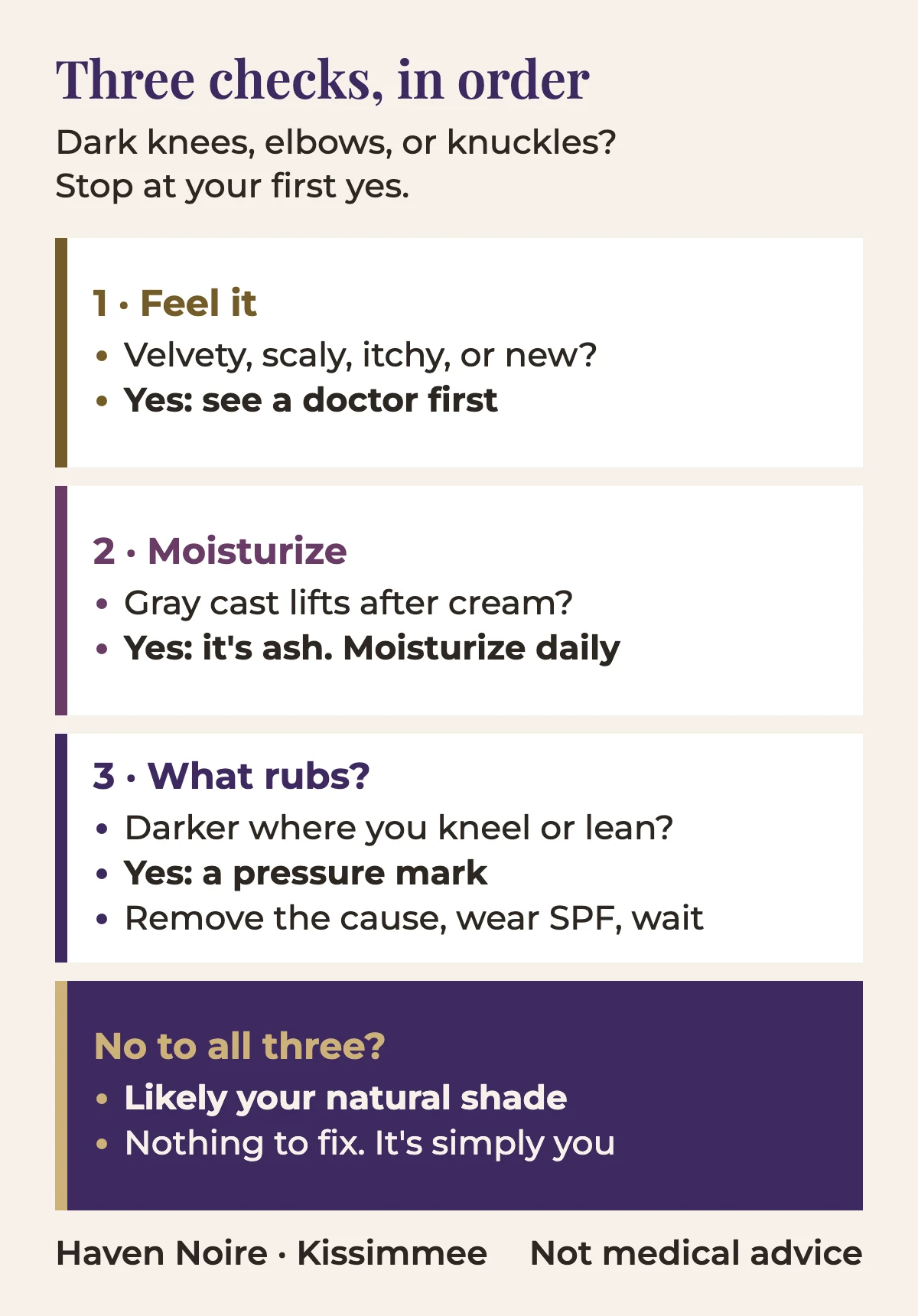
Check 1: does it feel velvety, scaly, itchy, or new?
Run your fingertips over the patch and compare it with the skin around it. The AAD says skin with AN often feels like velvet, and that AN appearing suddenly calls for an immediate appointment with a board-certified dermatologist, because it can be a warning sign of cancer. Thick, raised patches with scale point another way: the AAD's psoriasis guide says plaques usually appear on the scalp, elbows, knees, or lower back. Itchy, rough patches can be eczema.
Friction marks can feel a little thicker too, so you're not diagnosing here. You're deciding who looks first. Any yes, or any doubt, means a dermatologist or your doctor. Not sure which? Our guide to esthetician vs. dermatologist shows who to book first.
Check 2: does moisturizer change it?
Smooth a cream onto clean skin, wait about ten minutes, and look again in daylight. If the gray or chalky cast is gone, you were looking at ash, not extra pigment. Keep it away with cream after every shower; the AAD says to apply moisturizer while your skin is still damp. If the color hasn't changed, go on to check 3.
Check 3: what presses or rubs here every day?
List what touches the spot: kneeling, leaning, tight jeans, a gym mat, a scrub brush, an old scrape or eczema patch. If something lines up with the patch, you're likely looking at a pressure or irritation mark, the kind the routine below helps with.
No to all three: it's probably your shade
Smooth, flat, even on both sides, unchanged for years, and nothing you can trace? Nothing here flags it. If it's new and you can't explain it, have it checked anyway.
| What you notice | Likely cause | Next step |
|---|---|---|
| Velvety, scaly, itchy, sore, or new and spreading | Possible medical sign | Dermatologist or doctor first |
| Gray cast that lifts after moisturizer | Ash (dryness) | Moisturize damp skin after every shower |
| Darker where you kneel, lean, rub, or once had a scrape | Pressure or irritation mark | Remove the cause, protect, give it months |
| Even on both sides for as long as you remember | Your natural shade | Nothing to fix; it's simply your skin |
How to Get Rid of Dark Knees and Elbows: A Gentle Routine
If your patch looks like a pressure mark, the order matters: remove the cause first, then fade. Pregnant, breastfeeding, or using isotretinoin, tretinoin, or another prescription skin medicine? Ask your doctor or dermatologist before adding any acid or fading product. The same goes for eczema or psoriasis on the area.
- Take the pressure off. Kneel on a folded towel, cushion, or kneeling pad, and lift your elbows off hard desks and armrests. The FADES authors list avoiding friction as part of managing it.
- Stop scrubbing. The AAD's exfoliation guide advises avoiding strong chemical or mechanical exfoliation if you have a darker skin tone, since more aggressive exfoliation may lead to dark spots. Pumice stones and gritty scrubs on your knees work against you, and so can a stiff brush; read what dry brushing can and can't do first.
- Moisturize damp skin. Apply cream right after your shower. The AAD's dry skin tips say ointments and creams add more moisture and are more effective than lotions.
- Choose a cream with lactic acid or urea. The FADES case series reports that these keratolytic creams, which soften a thickened top layer, can help when paired with avoiding friction. The AAD also lists lactic acid among moisturizer ingredients to look for. Our guide to lactic acid for skin explains the gentle, everyday strength.
- Wear sunscreen on bare knees and elbows. The AAD says to apply it before going outside to all skin that clothing won't cover. Our guide to sunscreen for dark skin shows how to read the label.
- Add one fading ingredient if you want one. Once the cause is gone, the AAD lists azelaic acid, glycolic acid, kojic acid, retinoids, and vitamin C as ingredients that can fade dark spots, and says to stop any product that burns or stings. If you choose a retinoid, start slowly with our beginner's retinol plan.
- Track it monthly. Take a photo in the same light once a month. The AAD says a spot a few shades darker usually fades within 6 to 12 months, and that fading can take years when the color lies deep in the skin.
What about lemon, baking soda, or turmeric?
Kitchen remedies fill the top search results. We searched PubMed in November 2026 for studies pairing knee or elbow hyperpigmentation with lemon, potato, baking soda, turmeric, or aloe vera and found none. The AAD's rule covers anything you mix at home: if it burns or stings, stop. And never put liquid bleach on your skin, which the AAD calls a harmful treatment for dark spots.
Leave lighteners and hydroquinone to a dermatologist
Over-the-counter skin lighteners carry risks of their own, which we cover in the lighteners section of our dark inner thighs guide. Prescription hydroquinone is a dermatologist's call. If your darkening might be AN, the AAD's self-care advice says bleaching creams and exfoliants rarely fade it and can irritate the skin, making it worse. Improving the medical condition behind it often helps clear the skin.
When to See a Doctor About Dark Knees, Elbows, or Knuckles
Haven Noire is an esthetics spa, not a medical office, and we can't diagnose any of these conditions. Here's when a medical visit comes first.
Make an appointment right away
- Dark, velvety patches that appear suddenly. The AAD says to make an immediate appointment with a board-certified dermatologist, because sudden AN can be a warning sign of cancer.
Book a visit with a dermatologist or your doctor
- Velvety or thicker darkening, even if it came on slowly, especially with dark, velvety skin in your neck folds or armpits. Our guide to dark underarms explains what the AAD links AN to, from pre-diabetes to medicines and hormonal conditions.
- Thick, raised, scaly patches on your elbows or knees, which can be psoriasis.
- Itchy, rough patches, especially on a child's knees or elbows, which can be eczema.
- Knuckles that darken along with tiredness, numbness, or tingling. Ask about vitamin B12, and mention a strict vegetarian diet, long-term metformin, or stomach surgery.
- Darker patches with extreme tiredness, weight loss, or dizziness when you stand. The NHS lists these together among the symptoms of Addison's disease.
- Darkening that started after a new medicine. Don't stop it on your own; ask your prescriber.
- Pressure marks that haven't changed after months of careful home care. The AAD says a dermatologist can safely combine treatments when yours isn't delivering.
This is general information, not medical advice. Your own doctor has the final word on your skin and your health.
Where Haven Noire Fits (and Where We Don't)
We'll be plain: there's no treatment for dark knees, elbows, or knuckles on our menu. Our body treatments cover other areas: the Vajacial, the Inner Thigh Facial, the Underarm Wax + Detox, and the Firming Back + Booty ($135, 60 minutes), which treats the back, the back of the legs, and the booty. None of them is built for knees, elbows, or knuckles.
Where we can help is your face. If dark marks there are part of the same story, our Corrective Facials include Radiance Brightening at $135 for 60 minutes, and every facial begins with a skin analysis. We treat with professional lines, Circadia by Dr. Pugliese, Dermalogica, and Skin Script; see our professional skincare page.
Beyond your joints, our guide to how to get smooth skin without scrubbing harder covers gentle exfoliation for the rest of your body.
We're at 231 Ruby Avenue, Unit E, in downtown Kissimmee, across from Lakefront Park, open Monday to Saturday, 10 AM to 7 PM. Questions before you book? Call (321) 900-1144 or email info@havennoire.com.
Frequently Asked Questions About Dark Knees and Elbows
Why are my knees darker than the rest of my legs?
Often pressure, friction, or dryness. Knees carry your weight when you kneel and rub against fabric, and the American Academy of Dermatology says many everyday things can trigger extra melanin in darker skin tones. A 2005 case series also named family history. If the darker skin feels velvety or appeared suddenly, see a doctor first.
Can dark elbows and knees be a sign of diabetes?
Sometimes. Darkening that feels velvety and thicker than the skin around it may be acanthosis nigricans, which the American Academy of Dermatology says can form on elbows, knees, and knuckles and can be a sign of pre-diabetes. Friction marks can feel thicker too, so a mirror can't settle it. A dermatologist can help you find out which you have.
Why are my knuckles so dark?
Often it's your natural pattern plus dryness from hand washing. Knuckles can also darken with acanthosis nigricans, low vitamin B12, Addison's disease, or some medicines. If yours darkened recently, especially with tiredness, tingling, or weight loss, ask your doctor before you try a lightening cream. A long-standing, even shade is often simply your skin.
Does lemon juice lighten dark knees?
We searched PubMed in November 2026 and found no study testing lemon, baking soda, potato, turmeric, or aloe vera on darkened knees or elbows. The American Academy of Dermatology's rule for anything you apply is simple: if it burns or stings, stop. Taking the pressure off and wearing sunscreen are better-supported first steps.
How long does it take for dark knees to fade?
Months, not weeks, and only after the cause stops. The American Academy of Dermatology says a spot a few shades darker than your natural color usually fades within 6 to 12 months, while color deep in the skin can take years. If you still kneel on the same spot every day, start there.
Should I scrub my dark elbows?
No. The American Academy of Dermatology advises avoiding strong chemical or mechanical exfoliation on darker skin tones, because more aggressive exfoliation may lead to dark spots. A cream with lactic acid or urea, applied to damp skin after a shower, softens a rough top layer more gently. Skip pumice stones and gritty scrubs.
Can a spa treatment lighten my knees or elbows?
Not at Haven Noire: there's no knee, elbow, or knuckle service on our menu, and no spa treatment can change your natural shade. For dark marks on the face, our Radiance Brightening Corrective Facial is $135 for 60 minutes. For persistent or unusual darkening on your joints, a board-certified dermatologist is the right first stop.
More from the Journal

About the author
Tiffany · Licensed Esthetician · Licensed PMU Artist
Tiffany is a Florida-licensed esthetician and permanent makeup artist and the founder of Haven Noire. She specializes in customized facials, corrective skincare, and waxing for melanin-rich and all skin types, and is known for a calm, education-first approach that puts first-time clients instantly at ease.
Meet Tiffany →