

Tech neck lines are the horizontal creases across the front of your neck, named for the hours we spend looking down at phones and laptops. They can show up in your 20s and 30s. What helps most is simple: sunscreen that reaches below your jaw, a daily moisturizer, and screens raised closer to eye level.
Here's what most tech neck guides skip. The phone theory is plausible, but it's thinly studied. The sun's role in skin aging is well documented. So the smart plan treats your phone as a habit to adjust and the sun as something to protect against every day.
Below: what the research shows, a 30-second mirror check for sorting your lines, habits and skincare for your neck, and when to see a doctor. Our own rules of thumb are just that, not medical rules.
What Are Tech Neck Lines?
Tech neck lines are horizontal creases across the front of the neck that people link to looking down at phones, tablets, and laptops. Medical papers call them horizontal or transverse neck lines. The word "tech" names a suspected cause, not a separate condition.
The term has gone mainstream. A January 2026 article from the American Society of Plastic Surgeons says tech neck describes "the creases, sagging skin and early signs of aging" that can occur in the neck and lower face from repeatedly looking down at devices. A surgeon quoted there adds that it can involve neck pain, a different problem covered in the doctor section below.
Neck lines are part of aging, too
Whatever phones do, age plays a part. A 2026 paper in the Journal of Craniofacial Surgery, which notes they're sometimes called "Venus rings," says they deepen with age as skin thins, the tissue layers beneath it change, and the platysma (the thin sheet of muscle at the front of your neck) moves again and again.
Age isn't the whole story. A 2025 review in Aesthetic Surgery Journal Open Forum calls horizontal neck lines a common concern among aging and younger people alike. So one or two faint lines at 25 aren't proof that your phone did it.
Social media sells fixes from neck creams to overnight tape; our look at face taping covers the tape trend.
Do Phones Cause Neck Wrinkles? What the Research Shows
The idea makes sense: look down at a screen and your neck folds. Here's how it holds up.
The evidence for the phone theory
We searched PubMed in November 2026 for studies pairing smartphones, screen time, "text neck," or "tech neck" with wrinkles, neck lines, creases, or skin aging. We found no study that measured phone use and neck lines in the same group of people.
The closest support is a 2015 case report in the Annals of Dermatology about treating two women, ages 29 and 32, with a radiofrequency device. Its authors note that more young patients were presenting with neck wrinkles, "possibly" because of the head-down posture they adopt at computers and smartphones. That's a reasonable hunch from clinicians, not a measurement.
The only study our search found with "tech neck" in its title, published in 2022, was an industry-run, open-label study: it tested a topical neck treatment on 35 women for 84 days, with no comparison group, and three of its four authors list a skincare company as their affiliation. It didn't measure phone use at all, and one uncontrolled study can't show that a neck cream works.
Why the habit is still worth changing
There's an indirect argument. The American Academy of Dermatology (AAD) explains that a facial expression contracts the muscles underneath, and that if you repeatedly contract the same muscles for many years, "these lines become permanent." That's about your face, not your neck. Still, in our view, a fold you hold for hours a day is worth reducing, since the fix is free.
The evidence for the sun
The sun is a different story. MedlinePlus, from the U.S. National Library of Medicine, says skin changes with age come from many factors, but "the greatest single factor, though, is sun exposure." The AAD agrees that the sun plays a major role in prematurely aging skin. Your neck catches the same sun as your face, and a routine that stops at the jawline leaves it out.
Melanin helps, but only partly. MedlinePlus says natural pigments "seem to provide some protection" against sun-induced skin damage. The AAD's guide to skin cancer in darker skin tones says that if you have brown or Black skin, the sun can speed up how quickly your skin ages. Our guide to sunscreen for dark skin shows how to read the label.
| Claim | Where it stands | What it means for you |
|---|---|---|
| Sun speeds up skin aging | Well documented by MedlinePlus and the AAD | Sunscreen on your neck every day |
| Neck lines deepen with age | Described in medical papers on neck lines | A few lines are common, at any age |
| Looking down at phones etches lines | Plausible; suggested in a case report, not measured in any study our search found | Raise your screens; it costs nothing |
| A special "tech neck" cream fixes it | One small, industry-run study with no comparison group | A daily moisturizer and sunscreen are the basics |
Sort Your Tech Neck Lines in 30 Seconds
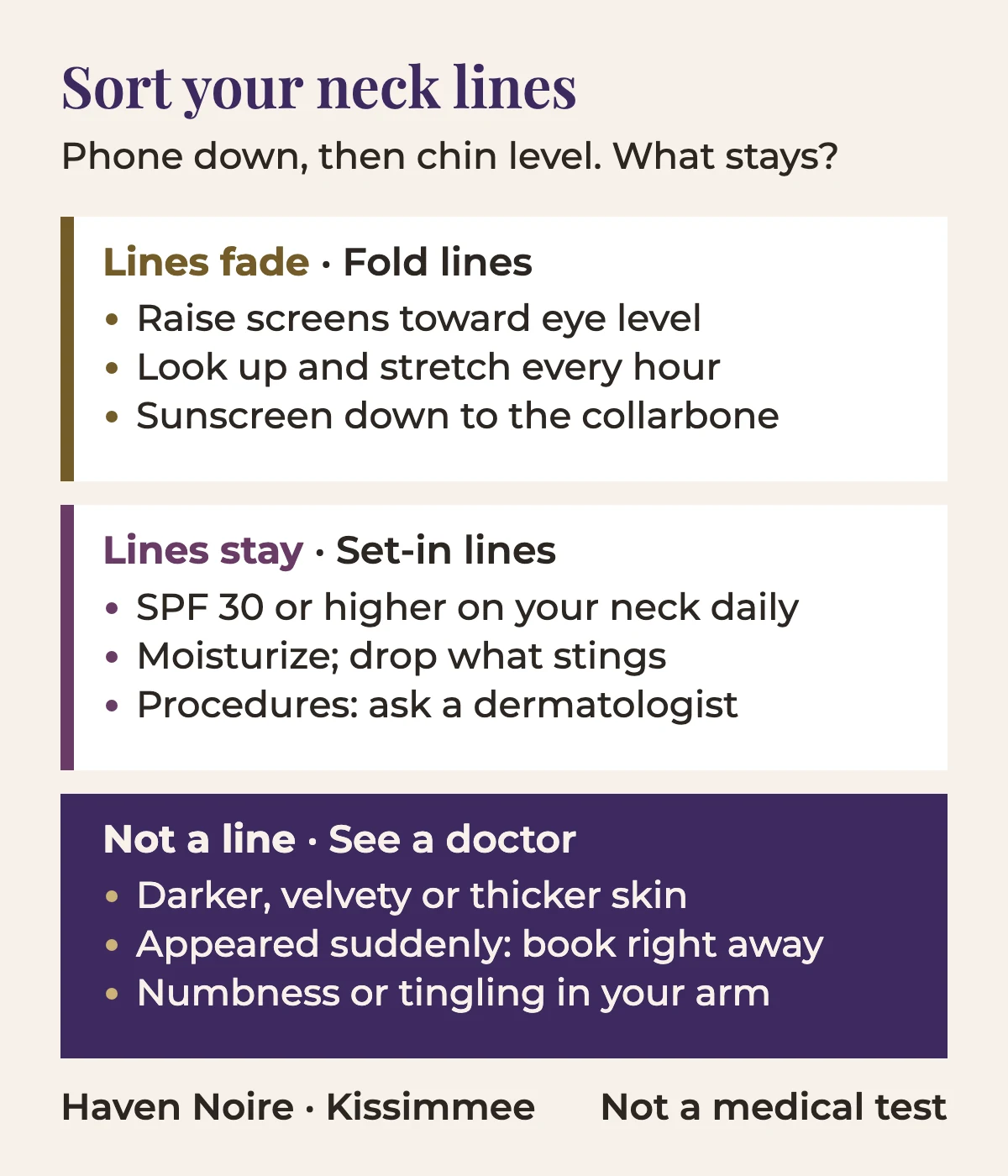
Not every neck line calls for the same response. This mirror check sorts yours. It borrows a distinction from dermatology research, which grades lines at rest and in motion, and adds a third result for changes that aren't lines at all. It's a tool for you, not a medical test.
How to run the check
- Stand at a mirror in daylight, or face a window.
- Hold your phone at chest height and look down at it for 10 seconds, the way you usually scroll.
- Raise the phone to eye level and bring your chin back to level. Don't tip your head back.
- Look at your neck. Are the lines gone, faint, or unchanged?
- Run your fingertips along the creases. Is any skin darker, velvety, or thicker than the skin around it?
Result 1: The lines fade when your chin is level
These are fold lines, creases from bending that ease when you stop bending. Our advice: this is where habits pay off most, so start with screen height and breaks, below, then add daily sunscreen and moisturizer.
Result 2: The lines stay when your chin is level
These are set-in lines: they're there at rest. Daily sun protection and moisturizer still matter: the AAD says that by protecting your skin from the sun, you give it "a chance to repair some of the damage." Our advice: expect slow, modest change from skincare. If you want more than skincare can do, that's a conversation for a dermatologist.
Result 3: Something that isn't a line
If the skin in your neck folds looks darker and feels velvety or thicker than the skin around it, it may not be a tech neck line at all, and it isn't something to diagnose in a mirror. The AAD describes acanthosis nigricans as a brown or black discoloration that "feels velvety and thicker than the surrounding skin," and says darker skin in the folds of the neck is common with it. Let a board-certified dermatologist take a look. If it appeared suddenly, the AAD says to make that appointment immediately. Our guide to dark underarms explains more.
Neck pain with numbness or tingling in your arm or hand is also outside this check. That's a question for a doctor.
| Result | What you see | Start here |
|---|---|---|
| Fold lines | Lines fade when your chin is level | Screen height, breaks, daily sunscreen |
| Set-in lines | Lines stay when your chin is level | Daily sunscreen and moisturizer; ask a dermatologist about procedures |
| Not a line | Darker, velvety, or thicker skin in the folds | A board-certified dermatologist |
How to Prevent Tech Neck Lines: Screens, Breaks, and Pillows
If folding plays a part, prevention starts with where your screens sit and how long your chin stays down.
The surgeon in the ASPS article suggests lifting your tablet or device to a more horizontal position, or getting up periodically to stretch your neck. MedlinePlus lists a computer monitor "positioned too high or too low" and bending over a desk for a long time, often an hour or more, among the causes of neck pain. So the habits that fold your neck are linked to neck strain, whatever they do to your skin.
Five habits for screen-heavy days
- Hold your phone closer to eye level when you scroll, elbows resting on a table or armrest.
- Raise your laptop on a stand or a stack of books, and add a separate keyboard if you work on it for hours.
- Look up and stretch your neck every hour or so, as MedlinePlus advises in its neck pain self-care guide.
- Put documents you read or type from in a holder at eye level, as MedlinePlus suggests, instead of flat on the desk.
- Sleep with a pillow that supports your neck, which MedlinePlus also suggests for neck pain.
Habits 1 and 2 are our own suggestions, and none of the five will erase a line that's already set in. Their job is to cut the hours your neck spends folded.
Screen-heavy week? Our 90-minute Signature Facial ($110) adds a hand and arm massage and an eye treatment: 90 calm minutes away from screens, not a posture fix.
Neck Wrinkles and Sun: Skincare That Reaches Below Your Jaw
Whatever your mirror check showed, these steps stay the same, and they're where the evidence is strongest.
Take sunscreen down to your collarbone
The AAD's guide on how to apply sunscreen says to "remember your neck," along with your face, ears, the tops of your feet, and your legs. It says to reapply every two hours outdoors, and right after swimming or sweating.
Our tip: when you finish your face, take a fresh dab for your neck and smooth it from your jaw to your collarbone, front and sides.
On brown and Black skin, protect your tone too
On melanin-rich skin, your neck has two things to protect: texture and tone. The AAD's guide to fading dark spots recommends tinted sunscreen with iron oxide and SPF 30 or higher, because iron oxide helps protect against visible light, a cause of dark spots.
The same guide warns that a skin or hair care product that irritates your skin can cause dark spots. In our view, that matters on the neck, which catches hair products, fragrance, and the edges of face treatments. If a mark has already formed, start with our guide to fading hyperpigmentation on melanin-rich skin.
Moisturize, keep it gentle, and ask first
Take your face moisturizer down your neck: the AAD says moisturizer "traps water in our skin, giving it a more youthful appearance." It also says to stop products that sting or burn, because irritated skin can look older; a prescription product that stings can be OK, as long as your dermatologist knows. If your neck reacts easily, start with repairing a stressed skin barrier.
Retinoids and peptides have their own coverage in our guides to how to prevent wrinkles and copper peptides, so we won't repeat them here.
Before you add any active to your neck: if you're pregnant or breastfeeding, or you use isotretinoin, tretinoin, or another prescription skin medicine, ask your doctor or dermatologist first. The same goes if you have eczema, rosacea, or skin that forms keloids.
Where a Facial Fits for Neck Lines, and What's Off Our Menu
Haven Noire is an esthetics spa, not a medical office. A facial won't erase a set-in crease, and we won't promise it will. What we offer is consistent care for the skin itself.
- Luxe Lift Anti-Aging. A 60-minute Corrective Facial ($135, or $360 for three) that our menu describes as advanced peptides and collagen-stimulating actives targeting fine lines, wrinkles, and loss of tone. Read more about our anti-aging facials.
- 90-minute Signature Facial. $110, or 3 for $285, with facial massage, a hand and arm massage, and an added eye treatment.
- Corrective Membership. $109.99 a month for one Corrective Facial of your choice, Luxe Lift included, with a three-month minimum. Members get 10% off extra services and in-spa products. See our memberships.
Every facial begins with a skin analysis. If your neck is the concern, tell us at your consultation and ask what we can include that day.
Each Corrective Facial ends with serums, moisturizer, and SPF, plus a home-care plan. Afterward, avoid sun exposure and active exfoliants for a few days, and use SPF daily.
Off our menu
Most tech neck treatment lists online are medical procedures: fillers, botulinum toxin, lasers, microneedling, and radiofrequency devices. None of them is on our menu. If you're weighing one, see a board-certified dermatologist. Our guide to types of facials explains which popular treatments we don't offer.
When to See a Dermatologist or Doctor Instead
We're estheticians, not doctors. We can't diagnose what's happening on your neck or under it, and not every change there is a tech neck line. Book a medical appointment first if any of these apply.
For the skin on your neck
- Dark, velvety, or thick skin in your neck folds. The AAD says to see a board-certified dermatologist immediately if acanthosis nigricans appears suddenly.
- A spot, bump, or patch that's growing, bleeding, itching, or changing. Our sunscreen guide lists the AAD's warning signs for darker skin tones.
- Eczema, rosacea, or redness that keeps returning. Ask a dermatologist, and see how we work with sensitive and redness-prone skin.
For neck pain
Tech neck can also mean neck pain, and that's a doctor's question. The MedlinePlus guide to neck pain self-care lists these among the reasons to contact your provider:
- You have numbness, tingling, or weakness in your arm or hand.
- Symptoms don't go away in a week with self-care.
- The pain gets worse when you lie down or wakes you up at night.
- You have trouble walking and balancing, or lose control over urination or bowel movements.
Some signs can't wait. The MedlinePlus neck pain page says to seek medical help right away for heart attack symptoms, such as shortness of breath, sweating, nausea, vomiting, or arm or jaw pain. For a fever and headache with a neck so stiff you can't touch your chin to your chest, it says to call 911 or get to a hospital.
Frequently Asked Questions About Tech Neck Lines
Can tech neck lines go away?
In our view, lines that fade when you lift your chin are the ones habits help most, because they're creases from bending. Lines that stay at rest rarely vanish with skincare, though daily sunscreen and moisturizer keep skin looking its best. Procedures for set-in lines are medical, so ask a board-certified dermatologist.
Why do I have neck lines in my 20s?
You're not alone. A 2025 review in Aesthetic Surgery Journal Open Forum calls horizontal neck lines a common concern among aging and younger people alike, and medical papers describe them as creases that deepen with age. A 2015 case report suggested head-down screen posture as a possible reason in younger patients, but that's unproven.
Do neck creams get rid of neck wrinkles?
Be cautious with big promises. The only "tech neck" study our PubMed search found was industry-run and open-label: one neck treatment, 35 women, no comparison group. A study like that can't prove a cream works. A plain daily moisturizer still helps: the AAD says it traps water in skin, giving it a more youthful appearance.
Should I put sunscreen on my neck every day?
Yes. The American Academy of Dermatology says to apply sunscreen every day to all skin clothing doesn't cover, and its how-to guide reminds you to include your neck. For darker skin tones, it recommends tinted sunscreen with iron oxide and SPF 30 or higher, which also helps prevent dark spots.
Why are the lines on my neck dark?
Darker creases can have more than one cause. The AAD says acanthosis nigricans often darkens neck folds and feels velvety or thicker than the skin around it. If you notice that, see a board-certified dermatologist, immediately if it appeared suddenly. The AAD also notes that irritating skin or hair products can cause dark spots.
Can a facial help with neck lines?
A facial cares for your skin; it won't erase a set-in crease. Our menu describes Luxe Lift Anti-Aging ($135) as advanced peptides and collagen-stimulating actives targeting fine lines and loss of tone. Every facial begins with a skin analysis, so tell us if your neck is the concern. New to facials? See what to expect at your first facial.
Does looking down at my phone cause neck pain?
MedlinePlus doesn't name phones, but it lists bending over a desk for a long time, poor posture while watching TV or reading, and a monitor positioned too high or too low among causes of neck pain. Contact a provider for numbness, tingling, or weakness in your arm or hand, or pain that lasts a week despite self-care.
More from the Journal

About the author
Tiffany · Licensed Esthetician · Licensed PMU Artist
Tiffany is a Florida-licensed esthetician and permanent makeup artist and the founder of Haven Noire. She specializes in customized facials, corrective skincare, and waxing for melanin-rich and all skin types, and is known for a calm, education-first approach that puts first-time clients instantly at ease.
Meet Tiffany →