

Epilator vs waxing is a closer contest than most guides admit. Both pull hairs out at the root, so in our judgment both buy you weeks of smooth skin, not days. The difference is who pulls and how often: you run an epilator over your own skin at home, while wax lifts many hairs in one quick pull, often in a professional's hands. Hair removal cream is the outlier. It dissolves hair at the surface, and the American Academy of Dermatology (AAD) says its results tend to last longer than shaving.
So the better question is which method your skin, your hair, and your medicine cabinet can live with. The AAD says waxing isn't recommended if you're applying tretinoin, using an antibiotic, or have taken isotretinoin in the last six months. A cream that stings in a patch test is out. And on brown and Black skin, irritation from any method can leave dark marks that take months to fade.
Full disclosure: at Haven Noire in downtown Kissimmee, we offer waxing, not epilators or creams. We've tried to be fair to the at-home options anyway.
Epilator vs Waxing vs Hair Removal Cream: What's the Difference?
An epilator is a handheld electric device whose rotating tweezers grab hairs and pull them out at the root. Waxing spreads wax over the skin and pulls it off, taking the hairs with it. Hair removal cream dissolves hair at the skin's surface.
The AAD's guide to removing unwanted hair covers wax and depilatory creams but not epilators, so the epilator column below rests on how the device works. Where we give our own judgment, it's opinion, not a medical rule.
| Epilator | Waxing | Hair removal cream | |
|---|---|---|---|
| How it works | Plucks hairs out at the root | Pulls hairs out at the root (AAD) | Dissolves hair at the surface (FDA, 2007) |
| How long it lasts | Similar to wax, in our judgment | A few weeks or longer (AAD) | Longer than shaving (AAD) |
| How it feels | Plucking, pass after pass | Removing the wax can be painful (AAD) | No pulling; some people dislike the odor (AAD) |
| Main skin risk | Ingrown hairs; the NHS lists plucking as a cause | Brief redness; burns if the wax is too hot (AAD) | Irritation; burns and rashes have been reported (FDA, 2007) |
| Medication limits | None in the AAD pages we read; ask your dermatologist | Not recommended with tretinoin, an antibiotic, or recent isotretinoin (AAD) | None in the AAD pages we read; patch test every product (AAD) |
| Cost | A one-time device purchase | From $10 (lip) to $80 (full legs) at Haven Noire | A product you rebuy |
Weighing a razor too? See waxing vs shaving. Curious about sugar paste? See sugaring vs waxing.
Root or Surface: Why an Epilator and Wax Are Closer Than You Think
Hair removal comes in two families. A 2021 literature review in Skin Therapy Letter calls them depilation, which removes the hair shaft and includes shaving and chemical depilatories, and epilation, which removes the hair shaft, follicle, and bulb and includes plucking and waxing.
An epilator plucks, so it sits in the same family as wax. A hair removal cream sits with your razor. The U.S. Food and Drug Administration (FDA) drew the same line in a 2007 consumer article on removing hair safely: chemical depilatories remove hair at the skin's surface, while waxing plucks hairs out of the follicle, below it.
What that means for epilator vs waxing
Since both pull from the root, in our judgment an epilator and a wax keep you smooth for a similar stretch. Hair grows in cycles, so a few strands surface early either way, as how long a Brazilian wax lasts explains. What's left to compare is everything around the pull:
- Who pulls: you, or a professional.
- How many hairs at once: an epilator grabs a few as you glide it; wax lifts a strip's worth in one pull.
- How often: a device in your drawer invites a session every few days; a wax comes every 3 to 4 weeks.
We searched PubMed in November 2026 for the terms epilator, epilators, and mechanical epilation, and found no study comparing a handheld epilator with waxing for pain, regrowth, or skin reactions. Any chart that crowns a winner is opinion, including ours.
Is Hair Removal Cream Bad for Your Skin?
Not for everyone, but it's the method with the most chemistry in it. The FDA's 2007 article describes depilatories as highly alkaline, or in some cases acidic, formulas that affect the protein structure of the hair. That's how they dissolve it.
The FDA said its cosmetics office had received reports of burns, blisters, stinging, itchy rashes, and skin peeling associated with depilatories and other cosmetic hair removers. It added that depilatories should not be used for eyebrows or around the eyes, or on inflamed or broken skin.
The AAD's answer is to test. It says these products can irritate your skin, sometimes only after months or years of use. Before a first use, or on a new part of your body:
- Apply a small amount where you plan to use it.
- Leave it on for the time on the instructions, or until your skin starts to burn or sting.
- Rinse it off right away and thoroughly, at that time or at the first sign of burning or stinging.
- If it burned or stung, don't use that product; the AAD suggests testing a different one.
- If you have no skin reaction within 24 hours, you can use it in that area.
If a cream burns
Rinse it off at the first sting. If you're left with a burn, the NHS, the UK's health service, says to call 999 or go to A&E, its emergency services, for a burn caused by a chemical, or one on the face, genitals, or bottom. In the US, that means 911 or the emergency room. It also says not to burst any blisters or put creams, oils, or butter on a burn.
Hair removal cream vs waxing
Cream skips the pulling, which matters if pain is what keeps you from wax. Wax, which takes the hair from below the surface, can last a few weeks or longer, says the AAD.
The AAD's guide to dark spots in darker skin tones says spots often appear when a skin or hair care product irritates your skin, or when a burn heals. It also says to stop using any product that burns or stings when you apply it. That includes a cream that worked last month, since some people react only after months or years of use. Our guide to skin care for Black skin calls irritation the quietest door to dark marks.
Epilator, Cream, or Wax: Choose Your Method in Three Questions
Built from AAD, NHS, and FDA guidance plus our own waxing guidance, these three questions answer the question behind most epilator vs waxing searches: which one should I use? They're a way to choose, not a medical screening.
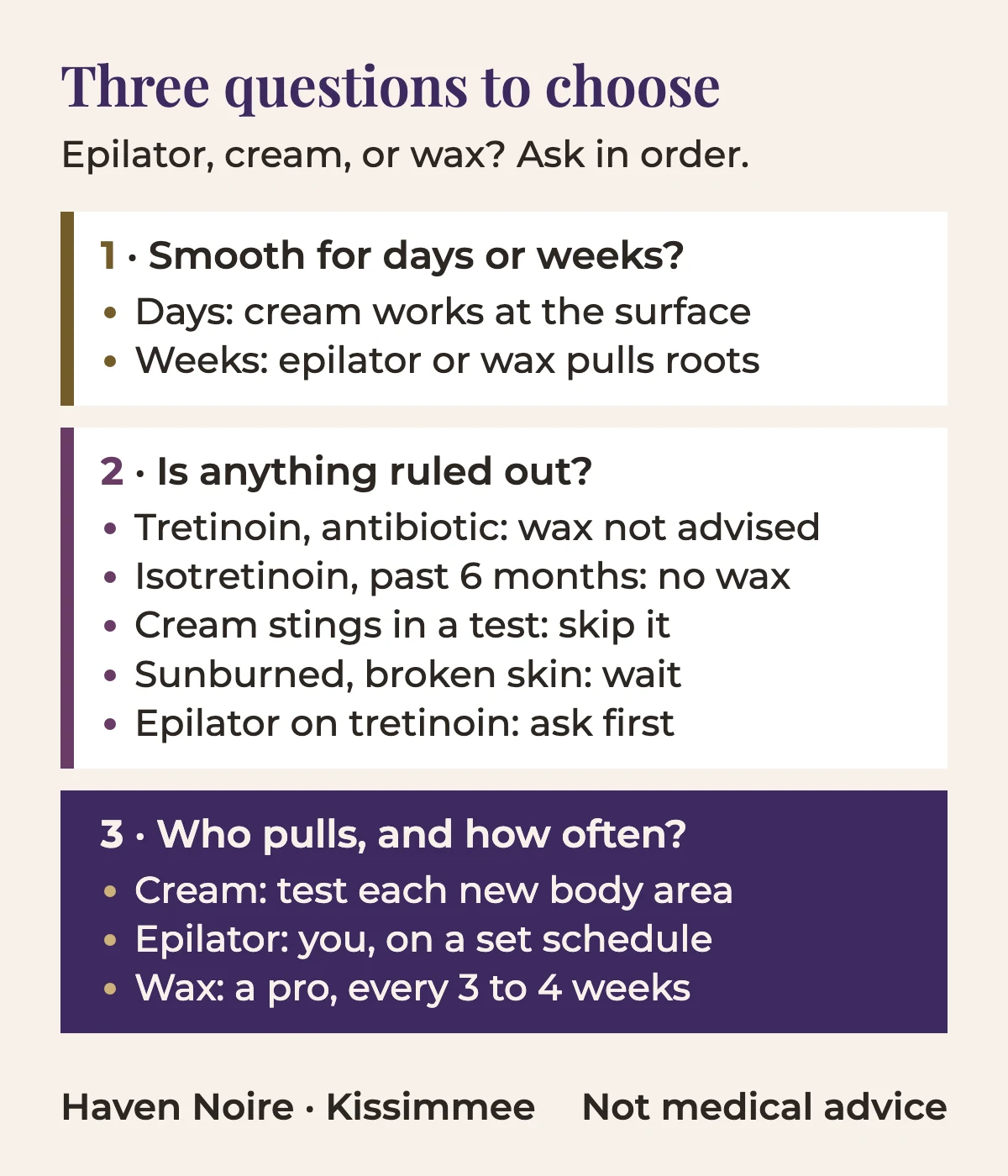
Question 1: Do you need days or weeks?
If smooth for a few days is enough, a surface method like cream will do. If you want weeks, you want a root method: an epilator or wax.
Question 2: Does anything rule a method out?
Check this before comfort or cost:
- Wax and medicines: the AAD says waxing isn't recommended while you're applying tretinoin or using an antibiotic, or within six months of isotretinoin, because these medications thin your skin and it could tear when the wax comes off.
- Wax on your face: the AAD's waxing tips say to pause retinol and prescription retinoids two to five days before, and never to wax sunburned or very sensitive skin.
- Wax and circulation: the FDA's 2007 article noted that wax labels may caution that people with diabetes or circulatory problems shouldn't use them, and that wax shouldn't go over varicose veins, moles, or warts.
- Cream: a patch test that burns or stings rules that product out. Keep creams off inflamed or broken skin.
- Epilator: the AAD pages we read don't address epilators and medicines. On tretinoin or isotretinoin? Ask your dermatologist first.
Booking brows, lip, or chin? Read what to check before a face wax too.
Question 3: How often will your skin take a hit?
A 2020 study in the International Journal of Cosmetic Science looked at the underarms of 64 Thai women, each using her usual method: shaving, plucking with tweezers, or a professional hot wax. Thirty minutes later, plucking and waxing had left more redness than shaving, while shaving left more dryness. At 48 hours, the three methods showed no difference in darkening. The authors concluded that one session didn't appear to cause darkening, so the darkening people notice over time must come from cumulative effects.
It's one small study by researchers at a personal care company, so treat it as a pointer. Our advice is to count sessions, not just stings:
- Epilator: pick a schedule and keep it, instead of chasing every stray hair.
- Wax: our waxing guidance is to rebook every 3 to 4 weeks, with no shaving in between.
| Your answers | Best fit |
|---|---|
| Days are enough, and a cream passed its patch test | Hair removal cream |
| Weeks, but your medicines flag wax | Your dermatologist first; don't assume an epilator is a safe swap |
| Weeks, no flags, and you'd rather do it yourself | An epilator, on a set schedule |
| Weeks, no flags, and you'd rather sit still once a month | Salon wax every 3 to 4 weeks |
Epilator vs Waxing on Coarse, Curly Hair and Melanin-Rich Skin
On coarse, curly hair and brown or Black skin, the question shifts from comfort to bumps and marks.
Ingrown hairs come with both
The NHS page on ingrown hairs says you may be more likely to get them if you have coarse or curly hair, and that waxing, plucking, and threading can lead to them. An epilator plucks, so neither root method is ingrown-proof. Among its prevention tips, the NHS suggests trying another method, such as hair removal cream.
That's the trade on melanin-rich skin: root methods carry an ingrown risk, and cream carries an irritation risk. Either way, leave bumps alone; the NHS warns that picking or squeezing them can damage your skin and lead to infection. Our guide to preventing ingrown hairs after waxing covers the routine.
Plucking and underarm darkening
Thinking of an epilator for your underarms? A 2006 biopsy study of 20 Filipino women, seven of them with darker underarms, concluded that hair plucking was a key stimulus for the extra pigment. Personal care company researchers ran this one too. It looked at plucking in general, not epilators or wax, and it's small; the 2020 study above found no difference in darkening between methods after one session. Our advice: since an epilator and wax both pull from the root, keep those sessions on darker underarms few and spaced out, whichever you choose. Already seeing darker underarms? Start with how to get rid of dark underarms.
Marks take longer than hair
The AAD says a spot a few shades darker than your natural skin color usually fades within 6 to 12 months once its cause is stopped. Hair grows back in weeks. Our take: that math favors the gentlest method you can repeat. If marks have formed, read how to fade hyperpigmentation on melanin-rich skin.

Epilator vs Waxing by Body Area
The right answer can change from your shins to your bikini line. Prices come from our waxing menu in Kissimmee.
| Area | Epilator | Hair removal cream | Waxing at Haven Noire |
|---|---|---|---|
| Legs | Large, easy-to-reach areas suit a device | Patch test on your leg first | Lower or Upper Legs $40; Full Legs $80 |
| Underarms | Easy to reach; space sessions out, since one small study linked plucking to darkening | Test here separately (AAD) | $15, about 15 minutes |
| Bikini and Brazilian | Hard to see and reach yourself | Test here separately and follow the label | Bikini $30; Brazilian $60. The AAD suggests leaving Brazilians to professionals |
| Brows, lip, chin | Small areas; a device gives little control | Never on eyebrows or around the eyes (FDA, 2007) | Brows $15, Lip $10, Chin $10 |
Every wax at Haven Noire is performed by a licensed esthetician in a private, hygienic setting. For legs, see our leg waxing guide; for underarms, what to expect from underarm waxing. Choosing bikini coverage? Compare Brazilian vs bikini wax.
If you'd wax a Brazilian every few weeks
Settling into a Brazilian every 3 to 4 weeks? The Smooth Membership is $59.99 a month for unlimited Brazilian waxes, against $60 a visit, with a three-month minimum. It covers Brazilians only; members get 10% off other waxing services.
Switching From an Epilator or Cream to Wax
Most epilator vs waxing guides stop at the verdict. If wax is your pick, here's the switch:
- Let it grow to about a quarter inch, roughly two to three weeks. The AAD's range is one-fourth to three-fourths of an inch.
- Put the epilator, cream, and razor away for that area meanwhile, so the hair grows in evenly (our suggestion).
- When you book, tell us about any retinoid, antibiotic, or isotretinoin, and any cream you've used there lately.
- Pick a date with two quiet days after it. For 24 to 48 hours, avoid heat, friction, sweat, and direct sun.
- Rebook every 3 to 4 weeks and skip shaving in between, which can cause ingrown hairs.
Nervous about the sting? Read how much waxing hurts, and how to make it easier. For the first two days, follow our waxing aftercare guide. Trying wax yourself first? See how to wax at home. For flakes and bumps beyond hair, see how to get smooth skin.
When to See a Dermatologist or Doctor Instead
Haven Noire is an esthetics spa, not a medical office, and none of these methods treats a skin condition. Check with your doctor or dermatologist first if any of these apply.
Before you remove hair
- You use tretinoin or another prescription skin medicine, take an antibiotic, or have taken isotretinoin in the last six months.
- You have diabetes or circulation problems, you're pregnant, or you have eczema, rosacea, or keloid-prone skin.
- You suddenly have a lot more unwanted hair. The AAD says a board-certified dermatologist can explain what's happening.
After you remove hair
- Hair removal is causing a skin problem, or redness or swelling after a wax lasts more than two days. The AAD says to see a board-certified dermatologist.
- An ingrown hair is very painful, hot, or swollen, or you have a high temperature. The NHS says to see a doctor.
- A cream left a chemical burn. See the NHS burn advice above.
Not sure whether a bump is a spa question or a doctor question? Our guide to esthetician vs dermatologist sorts out who to see first.
Frequently Asked Questions About Epilators, Waxing, and Hair Removal Cream
Is an epilator better than waxing?
We can't name a winner. We searched PubMed in November 2026 and found no study comparing a handheld epilator with waxing. Both pull hair from the root, so in our judgment smoothness lasts a similar time. Choose by who you want doing the pulling, how often, and which medication rules apply to you.
Does an epilator hurt more than waxing?
Our November 2026 PubMed search found no study measuring it. Both pull hairs from the root, and the American Academy of Dermatology notes that removing wax can be painful. An epilator plucks as you glide it, so in our judgment the sensation is spread across the session, while wax comes off in quick pulls. Your tolerance decides.
How long do epilator results last compared with waxing?
The American Academy of Dermatology says waxing results can last a few weeks or longer. Our November 2026 PubMed search found no study timing epilator regrowth, but because an epilator also pulls hair from the root, we'd expect a similar range. We suggest rebooking a wax every 3 to 4 weeks.
Is Nair bad for your skin?
Hair removal creams aren't bad for everyone, but they can irritate. In 2007, the FDA said it had received reports of burns, blisters, stinging, itchy rashes, and peeling linked to depilatories. The American Academy of Dermatology says to test each product first, and again on each new body area, and to skip any that burns or stings.
Is hair removal cream better than waxing?
It depends on what you want. Cream dissolves hair at the surface, and the American Academy of Dermatology says it lasts longer than shaving. Wax pulls hair from the root and can last a few weeks or longer. Cream skips the pulling; wax skips the chemicals. On melanin-rich skin, choose whichever your skin tolerates without stinging or bumps.
Can I use an epilator or hair removal cream on tretinoin or isotretinoin?
Ask your dermatologist first. The American Academy of Dermatology says waxing isn't recommended while you're applying tretinoin or using an antibiotic, or within six months of isotretinoin, because these medications thin your skin. The AAD pages we read don't address epilators or creams with these medicines, so don't assume either is a safe swap.
Can I switch from an epilator to waxing?
Yes. Let your hair grow to about a quarter inch, roughly two to three weeks of growth, so the wax can grip it, and avoid shaving in between. When you book, tell us what you've been using and whether you take retinoids or acne medication. After that, we suggest rebooking every 3 to 4 weeks.
More from the Journal

About the author
Tiffany · Licensed Esthetician · Licensed PMU Artist
Tiffany is a Florida-licensed esthetician and permanent makeup artist and the founder of Haven Noire. She specializes in customized facials, corrective skincare, and waxing for melanin-rich and all skin types, and is known for a calm, education-first approach that puts first-time clients instantly at ease.
Meet Tiffany →