

Does waxing hurt? Yes, for a moment. Wax grips your hair and pulls it out from the root, so you feel a quick, sharp sting each time a section comes off. At Haven Noire in downtown Kissimmee, most clients find that brief discomfort very manageable, and a lip or chin wax takes about 10 minutes.
How much it hurts depends on more than your pain tolerance. The American Academy of Dermatology (AAD) says waxing "can be painful for some people," and it links comfort to things you can plan: how long your hair is, and a cold pack or over-the-counter pain reliever beforehand, which it says "may help." It also says wax should feel warm, "but not hurt or burn." Many guides skip that line. Some pain is normal, and some is a warning.
Below you'll find how waxing feels by area, four ways to make it hurt less, the hair length to aim for, how to tell a normal sting from a warning sign, and what a first visit with us looks like.
Does Waxing Hurt? What It Actually Feels Like
Waxing hurts briefly. Wax grips each hair, then comes off quickly and pulls the hair out from the root. You feel a sharp sting with each pull, and the skin can look red and irritated for a short while afterward.
Here's what the AAD's guide to removing unwanted hair and its waxing tips say about each stage:
- Going on: the wax should feel warm, not hurt or burn.
- Coming off: the AAD notes that removing the wax can be painful.
- Afterward: newly waxed skin can be red and irritated for a short while.
What nobody can honestly give you is a pain score. We searched PubMed in November 2026 for studies on waxing pain, pairing waxing or epilation with pain, body area, and repeated sessions, and found no study that compared how much a wax hurts on different parts of the body. The pain charts you'll find online are opinions, including ours below.
Every service on our waxing menu in Kissimmee is performed by a licensed esthetician in a private, hygienic setting, using premium wax chosen for comfort and precision.
Waxing Pain by Area
Many guides that answer "does waxing hurt" rank body parts from least to most painful. Since we found no study behind those rankings, ours is labeled for what it is. It sorts our menu by two things you can check: how long the wax takes, and what to watch in that area.
| Area | On our menu | Our note |
|---|---|---|
| Brows | 15 minutes, $15 | A small area near your eyes. Count retinol eye creams and retinoid acne treatments nearby. |
| Upper lip or chin | 10 minutes, $10 each | Over quickly. Count any retinoid you spread across your face. |
| Underarms | 15 minutes, $15 | A small area that meets sweat and friction afterward, so plan the next 24 to 48 hours. |
| Bikini line | 15 minutes, $30 | Customizable to your comfort. Tell us how much you want removed. |
| Brazilian | 30 minutes, $60 | The AAD calls the skin in this area particularly delicate and suggests leaving Brazilian waxes to professionals. |
| Legs | Lower or upper 30 minutes, $40; full 45 minutes, $80 | A large area; a full leg wax is the longest visit on our waxing menu. |
| Back | 15 minutes, $40 | A wide area you can't easily see yourself, so mention any sore spots. |
In our view, two patterns hold across the menu. Small areas are over fast, so the sting doesn't last long. Areas with more delicate skin, like the Brazilian, usually feel like more. Choosing between the two bikini services? Compare what a bikini wax covers versus a Brazilian. For bigger areas, our guides to leg waxing and underarm waxing go deeper.
Area is the one thing you choose when you book. The next four, you can plan for.
How to Make Waxing Less Painful
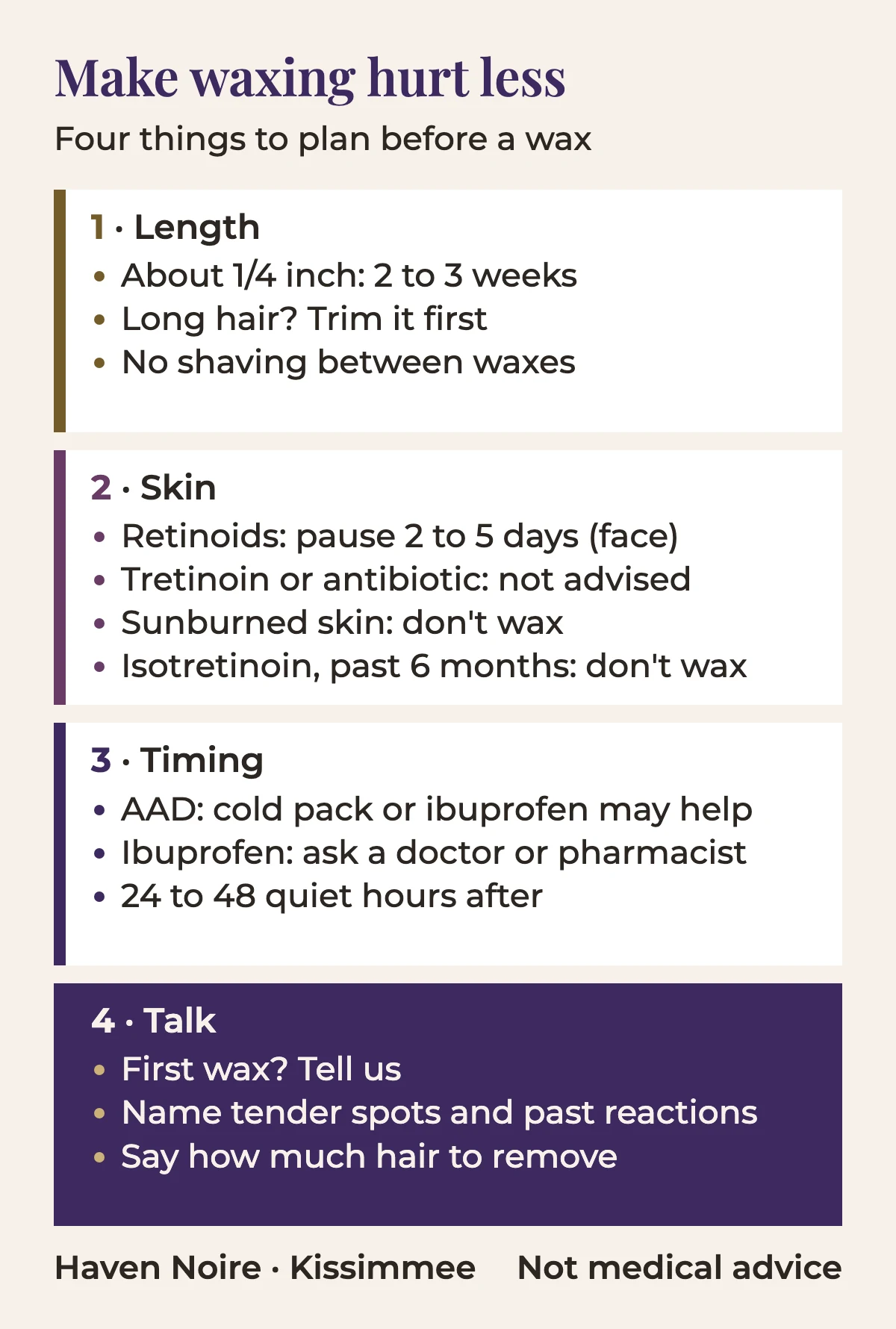
Four things you can plan before your appointment make a wax easier: length, skin, timing, and talk. The advice comes from the AAD's waxing guidance and our own waxing guidance at Haven Noire. Skin matters most, because it's about safety as much as comfort.
The AAD wrote its tips for people waxing at home. In our judgment, its length, skin, and timing rules matter just as much before a professional wax. This is a tool for you, not a medical screening, and it doesn't replace advice from your doctor. Waxing at home instead? Our step-by-step DIY waxing guide starts with a wrist test.
Hair length
Aim for about a quarter inch, roughly two to three weeks of growth. Too short, and the wax can't grip the hair. Longer than three-fourths of an inch, and the AAD says to trim it first so waxing will be "less messy and painful." The full hair length guide is in the next section.
Skin and medications
Some products and medicines change what wax does to your skin. The AAD's waxing guide advises avoiding retinol and prescription retinoids for two to five days before waxing your face, "to avoid removing skin along with your hair." It also says never to wax sunburned or very sensitive skin, and not to wax if you've taken isotretinoin in the last six months.
The AAD's hair removal guide goes further. It says waxing isn't recommended while you're applying tretinoin or using an antibiotic, because these medications thin your skin, and when the wax comes off, "your skin could tear." That isn't a sting to push through. It's why skin comes before any comfort tip.
Booking brows, lip, or chin? See the three questions to ask before a face wax. Pregnant, or managing eczema, rosacea, skin that forms keloids, or any prescription skin medicine? Ask your doctor or dermatologist before a first wax, and tell us when you book.
Timing
Timing matters at three points:
- Thirty minutes before. The AAD says over-the-counter pain medication, such as ibuprofen, or cold packs on the skin about 30 minutes before waxing may help. We're estheticians, not doctors, so ask your doctor or pharmacist if ibuprofen is right for you. The NHS guide to ibuprofen says it may not be suitable for everyone, including people with asthma, and to avoid it during pregnancy unless a doctor or pharmacist advises it.
- Your cycle. Our first Brazilian wax prep guide suggests booking for the week after your period if you can.
- The two days after. Our aftercare asks you to avoid heat, friction, sweat, and direct sun for 24 to 48 hours, and the AAD suggests cold packs if you're sore. Our waxing aftercare guide turns that into four questions for your plans.
A word on numbing creams
Some guides suggest a numbing cream or spray before a wax. Be careful. In March 2024, the U.S. Food and Drug Administration (FDA) warned consumers not to use certain over-the-counter pain relief products marketed for cosmetic procedures such as laser hair removal and tattooing. It said high-concentration lidocaine products used in ways that raise absorption through the skin may lead to serious injury, such as irregular heartbeat, seizures, and breathing difficulties.
The FDA advises against products with more than 4% lidocaine, against heavy use over large areas or on irritated or broken skin, and against wrapping treated skin in plastic wrap. Its warning doesn't name waxing. Our advice, not a medical rule: don't apply a numbing product before a wax without asking your doctor or pharmacist, and tell us at your consultation if you have.
Talk to us
Every wax at Haven Noire starts with a consultation, where we review the area, your skin, and any sensitivities. Use it. Tell us if it's your first wax, which spots feel tender, what hurt last time, and how much hair you want removed. To us, saying you're nervous is useful information, not an apology.
| What to plan | What to do | Where the advice comes from |
|---|---|---|
| Length | About a quarter inch; trim long hair; no shaving between waxes | Haven Noire waxing guidance; AAD (trimming longer hair) |
| Skin | Pause retinoids 2 to 5 days before a face wax; never wax sunburned or very sensitive skin, or within 6 months of isotretinoin; waxing isn't recommended while using tretinoin or an antibiotic | AAD waxing guide and hair removal guide |
| Timing | The AAD says a cold pack or ibuprofen about 30 minutes before may help (ask your doctor or pharmacist about ibuprofen); 24 to 48 quiet hours after | AAD; NHS; Haven Noire aftercare |
| Talk | Say it's your first time, what's tender, and what you want removed | Our judgment |
How Long Should Hair Be to Wax?
Hair should be about a quarter inch long to wax, roughly two to three weeks of growth. That's our guidance at Haven Noire, and it sits at the short end of the AAD's range of one-fourth to three-fourths of an inch.
Length changes how a wax goes in both directions:
- Too short: the wax can't grip the hair.
- Too long: the AAD advises trimming hair longer than three-fourths of an inch so waxing is less messy and painful. If yours is very long, we can trim it first.
- Shaved in between: shaving disrupts the growth cycle and can cause ingrown hairs, so avoid it between waxes.
How to time your hair for a first wax
- Pick your wax date.
- Count back two to three weeks. That's your last shave.
- Leave the razor alone after that, edges included. Any shave restarts the count.
- Unsure it's long enough? A little longer beats too short, since longer hair can be trimmed. That's our rule of thumb.
- After your first wax, rebook every 3 to 4 weeks.
Switching from a razor? Our guide to waxing vs shaving covers the grow-out weeks in detail.
Sting or Signal: When Waxing Pain Isn't Normal
A wax is supposed to sting. It isn't supposed to burn, tear, or linger. Most "does waxing hurt" guides stop at comfort tips, but telling the two apart is what protects your skin.
That matters on brown and Black skin. The AAD's guide to fading dark spots in darker skin tones calls dark spots one of the most common reasons people with darker skin see a dermatologist. It says spots can form as a cut, burn, or other injury heals, and that once the cause is found and stopped, a spot a few shades darker than your natural color usually fades within 6 to 12 months. That guide doesn't name waxing, but a burn or a patch of lifted skin is an injury.
| What you notice | When | What it means | What to do |
|---|---|---|---|
| A quick sting as each section comes off | During | Normal: the AAD notes removing wax can be painful | Tell us how you're doing |
| Redness and mild irritation | Shortly after | Normal: the AAD says it lasts a short while | A cold pack if you're sore, then our aftercare |
| Wax that hurts or burns as it goes on | During | Signal: the AAD says wax should be warm, not hurt or burn | Say so right away |
| Skin that comes away with the hair, leaving a raw patch | During or after | Signal: the AAD links this to retinoids and skin-thinning medicines | Tell us, and don't wax that spot until it heals |
| Redness or swelling past two days | After | Signal (AAD) | See a board-certified dermatologist |
| Bumps that get worse, keep coming back, or last over 2 or 3 days | After | Signal (MedlinePlus) | Contact your provider |
| An ingrown hair that's very painful, hot, or swollen, or a high temperature | After | Signal of infection (NHS) | See a doctor |
When to see a dermatologist or doctor instead
We're estheticians, not doctors. We can't diagnose a skin problem, and a wax isn't a treatment for one. These signs call for a medical appointment:
- Redness or swelling after waxing that lasts more than two days. The AAD says to see a board-certified dermatologist.
- Pimple-like bumps around hair follicles that come back often, get worse, or last longer than 2 or 3 days. MedlinePlus says folliculitis starts when follicles are damaged or blocked, and to contact your provider then.
- An ingrown hair, or the skin around it, that's very painful, hot, or swollen, or one that comes with a high temperature or feeling very unwell. The NHS page on ingrown hairs says to see a GP.
- A dark mark that isn't fading with gentle care. Our advice: see a dermatologist before you try to treat it yourself.
Bumps after waxing are your pattern? Our guide to preventing ingrown hairs after waxing covers the routine between visits.
Your First Wax at Haven Noire: What to Expect
First-wax nerves are normal, and knowing the order of things helps. These are the five steps on our waxing menu:
- Consultation. We review the area, your skin, and any sensitivities. This is where you tell us about your skin, medications, and any nerves.
- Cleanse and prep. Your skin is cleansed and prepped for comfort.
- Wax. Premium wax is applied and removed with gentle technique.
- Tweeze and tidy. We perfect the finish.
- Soothe and protect. Calming post-wax care, plus ingrown-prevention guidance.

Waxing at Haven Noire is for women, men, and teens, in a private, judgment-free setting. Tiffany, our founder, is a Florida-licensed esthetician and licensed permanent makeup artist.
- Deposit: a 10% deposit is required when you book.
- Where: 231 Ruby Avenue, Unit E, in downtown Kissimmee, across from Lakefront Park. Open Monday to Saturday, 10 AM to 7 PM.
- Brazilians every few weeks: the Smooth Membership is $59.99 a month for unlimited Brazilian waxes, with a three-month minimum. Members get 10% off other waxing services.
- Questions about a medication or a past reaction: contact us before you book.
Frequently Asked Questions About Waxing Pain
Does waxing hurt the first time?
It stings for a moment with each pull. The American Academy of Dermatology says waxing can be painful for some people, and at Haven Noire most clients find the discomfort brief and very manageable. If it's your first time, say so at your consultation. Arriving with about a quarter inch of growth helps too.
Does waxing get less painful the more you do it?
In our experience, it often eases with regular visits. We can't give you a proven reason: we searched PubMed in November 2026 and found no study measuring whether waxing hurts less over time. Rebooking every 3 to 4 weeks, with no razor in between, keeps hair at a wax-ready length. See how long a Brazilian wax lasts.
Can I take ibuprofen before waxing?
The American Academy of Dermatology says over-the-counter pain medication, such as ibuprofen, or a cold pack about 30 minutes before waxing may help. Ask your doctor or pharmacist whether ibuprofen is right for you. The NHS says to avoid it during pregnancy unless a doctor or pharmacist advises it, and that it may not suit people with asthma.
Is it safe to use numbing cream before a wax?
Ask your doctor or pharmacist first. In March 2024, the FDA warned consumers about certain over-the-counter numbing products sold for cosmetic procedures like laser hair removal and tattooing, citing risks such as irregular heartbeat and seizures. The warning doesn't name waxing. It advises against products with more than 4% lidocaine. Tell us at your consultation if you've applied anything.
What part of the body hurts most to wax?
We searched PubMed in November 2026 and found no study ranking body areas by waxing pain, so any answer is opinion, ours included. Our view: larger areas take longer and areas with delicate skin feel like more. The American Academy of Dermatology calls the skin in the Brazilian area particularly delicate and suggests leaving Brazilian waxes to professionals.
How long should hair be to wax with less pain?
About a quarter inch, roughly two to three weeks of growth, which sits inside the American Academy of Dermatology's range of one-fourth to three-fourths of an inch. If hair is too short, the wax can't grip it. If it's longer than three-fourths of an inch, the AAD says to trim it so waxing is less messy and painful.
Is it normal for wax to burn?
No. The American Academy of Dermatology says wax should feel warm, but not hurt or burn, and that wax that's too hot can burn your skin. Speak up the moment wax feels hot rather than warm. If redness or swelling lasts more than two days after a wax, the AAD says to see a board-certified dermatologist.
More from the Journal

About the author
Tiffany · Licensed Esthetician · Licensed PMU Artist
Tiffany is a Florida-licensed esthetician and permanent makeup artist and the founder of Haven Noire. She specializes in customized facials, corrective skincare, and waxing for melanin-rich and all skin types, and is known for a calm, education-first approach that puts first-time clients instantly at ease.
Meet Tiffany →