

How long does leg waxing last? Plan on a few weeks. The American Academy of Dermatology (AAD) says waxing results "can last a few weeks or longer," and at Haven Noire in downtown Kissimmee we suggest rebooking every 3 to 4 weeks for the smoothest results. When your own stubble shows up depends on your hair, so we won't promise you a set number of weeks.
Here's what most leg waxing guides skip. "How long does it last?" has three honest answers: how long your skin needs to settle, how long you stay smooth, and how long until your hair can be waxed again. In the salon and wax-brand guides we read for this article, the ranges ran anywhere from two to six weeks. In our view, that's one number trying to answer three questions.
Below: those three answers, full vs half leg wax prices, habits that help a wax last, Florida beach timing, and when to see a dermatologist instead.
Leg Waxing: What It Is and How Long It Lasts
Leg waxing removes hair from your legs at the root. Wax grips the hairs, then comes off quickly and pulls them out. The AAD lists legs among the large areas you can wax.
That root is the reason a wax outlasts a razor. The same AAD page says shaving results are short-lived, so you may need to shave daily or every few days.
On our leg waxing menu in Kissimmee, Lower Legs and Upper Legs are $40 each and take about 30 minutes, and Full Legs are $80 for about 45 minutes.
Why a few hairs come back early
Hair grows in phases. Germany's Institute for Quality and Efficiency in Health Care (IQWiG) describes a growth phase, a transition of about two to four weeks, and a resting phase that can last several months. It also notes that body hair grows more slowly than the hair on your head.
So on wax day, some follicles may be between hairs, and some new hairs may still be too short for the wax to grip. Those surface over the following weeks. That's normal growth, not a wax that failed. Our guide to how long a Brazilian wax lasts walks through the cycle in more detail.
One more honest note. We searched PubMed in November 2026 for studies of waxing and hair regrowth in people, and found none whose summary sets a typical number of weeks for a leg wax. Treat any exact figure online as a planning rhythm, not a measurement.
Three Answers to How Long a Leg Wax Lasts
Instead of one fuzzy range, here are three numbers, built from the AAD's waxing guidance, IQWiG's explanation of hair growth, and our own waxing guidance. The first sets your wax date, the second your expectations, and the third your next appointment.
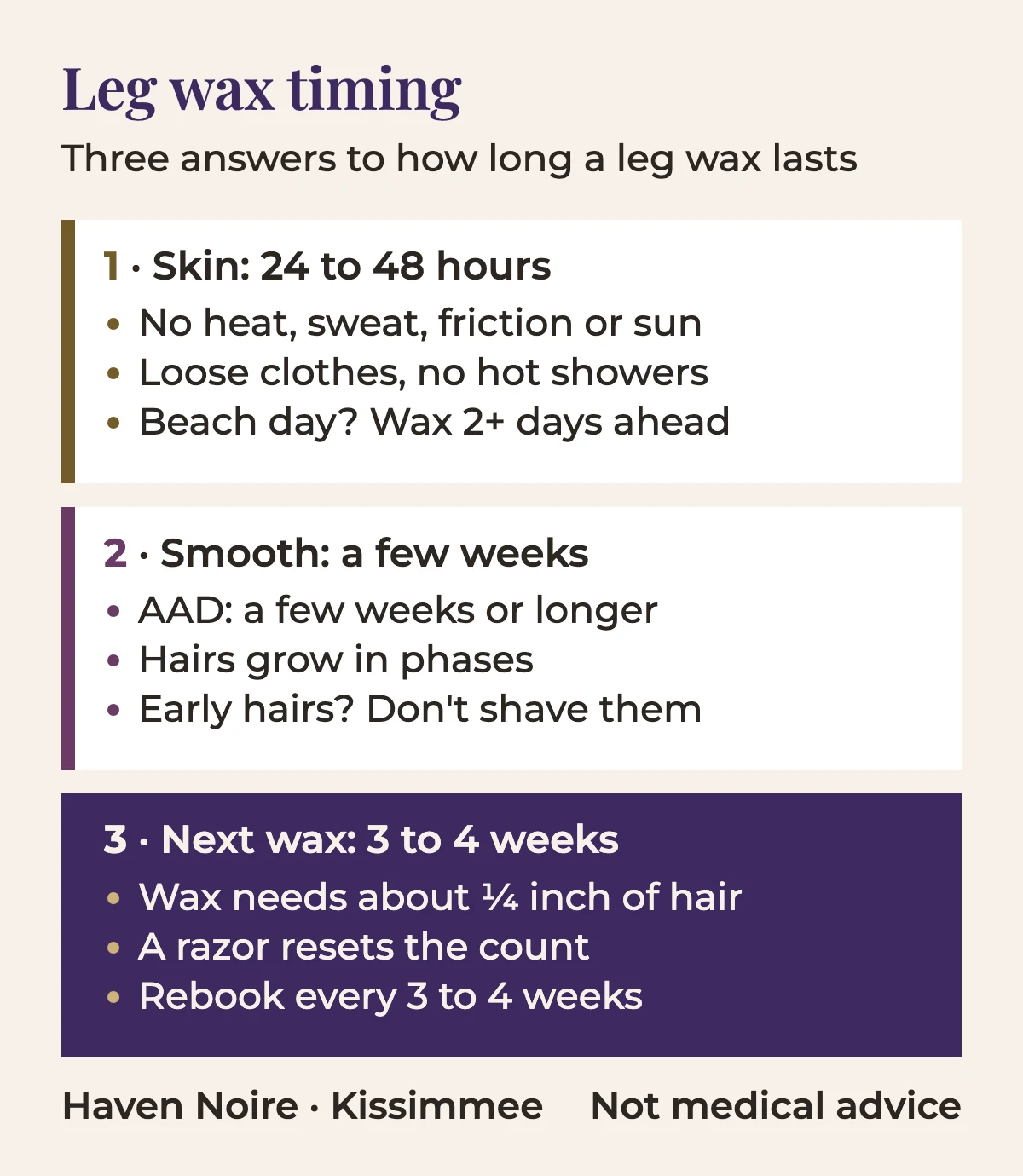
Your skin: 24 to 48 hours
This is how long freshly waxed legs need before they're ready for the world. Our aftercare for every wax is to avoid heat, friction, sweat, and direct sun for 24 to 48 hours. The AAD's at-home waxing tips add cold packs if you're sore, skipping hot baths and showers, loose clothing, and a moisturizer labeled "oil-free" or "non-comedogenic." Its hair removal page notes that newly waxed skin can be red and irritated for a short while.
What it decides: your wax date. Our advice, the same as in our waxing aftercare guide, is to book at least two days before a beach day, a pool party, or an event in shorts.
Smooth skin: a few weeks
This is the answer most people mean when they ask how long leg waxing lasts: the stretch before you notice regrowth. The AAD's answer is a few weeks or longer, and the hair cycle explains why it varies. It's the one number we can't set for you.
What it decides: your expectations. A few early hairs don't mean the wax failed, and they're no reason to reach for a razor. Our tip: note when stubble shows up after your first two or three waxes, and you'll learn your own pace.
Your next wax: 3 to 4 weeks
This is how long until your hair is ready for the next wax. Wax needs hair about a quarter inch long, roughly two to three weeks of growth, to grip it. The AAD's range is one-fourth to three-fourths of an inch, and it suggests trimming hair that's longer. Our own waxing guidance is to rebook every 3 to 4 weeks.
What it decides: your next appointment. One warning: a razor resets the count. Shaving between waxes cuts your hair back to the surface, disrupts the growth cycle, and can cause ingrown hairs.
| Timeline | How long | What it decides | Mistake to avoid |
|---|---|---|---|
| Skin settles | 24 to 48 hours | Your wax date | A beach day or hot workout too soon |
| Smooth skin | A few weeks or longer (AAD) | Your expectations | Shaving the first few early hairs |
| Next wax | About a quarter inch of growth; rebook every 3 to 4 weeks | Your next appointment | Booking before hair can grip |
Full Leg Wax vs Half Leg Wax: Which to Book
"Half leg wax" doesn't mean the same thing everywhere: depending on the salon, it can be the lower half of the leg or the upper half. On our menu, the knee is the line.
| Service | Covers | Time | Price |
|---|---|---|---|
| Lower Legs Wax | From the knee down | 30 minutes | $40 |
| Upper Legs Wax | From the knee to the thigh | 30 minutes | $40 |
| Full Legs Wax | The full leg | 45 minutes | $80 |

Half leg wax: pick the half you'll show
Our take: Lower Legs suits knee-length shorts, skirts, and dresses. Swimsuits, short shorts, and high slits usually call for both halves. Noticing dimples on the backs of your thighs, too? Our cellulite guide explains why most women have them.
Full leg wax: the same price as two halves
Here's the menu math. Booked separately, Lower Legs and Upper Legs come to $80, with 30 plus 30 minutes listed. Full Legs is also $80 and is listed at 45 minutes. So a full leg wax doesn't cost less than two halves; its listed booking time is about 15 minutes shorter. If you want both, book Full Legs.
Knees, feet, and the bikini line
Our online menu doesn't spell out knees, feet, or toes, so ask us when you book. The bikini line is a separate service on our menu, a Bikini Wax for $30 (about 15 minutes). Our Brazilian vs bikini wax guide explains how far each one goes.
Upper legs: watch for bumps
One small study is worth knowing about. In a 2013 study of 28 women in New Delhi who developed bumps around hair follicles after waxing, the bumps were more frequent on the upper parts of the arms and legs than on the lower parts, even though the lower parts were waxed more often. It only looked at 28 women who already had bumps, so it can't tell you how likely bumps are for you. Read it as a reason to keep an eye on your thighs, not a rule.
The AAD also notes that shaving or waxing skin with keratosis pilaris, the tiny rough bumps most often found on the upper arms and thighs, can cause more bumps. If you have it, tell us before you book.
How to Make a Leg Wax Last Longer
You can't change your hair cycle, but you can stop working against it. These six habits come from our own waxing guidance and the AAD.
- Come in at the right length: about a quarter inch, roughly two to three weeks of growth. If hair is too short, the wax can't grip it, and the hairs left behind can look like early regrowth.
- Put the razor away. Shaving between waxes disrupts the growth cycle and resets your hair length. Switching from shaving? Our waxing vs shaving guide has a plan for the grow-out weeks.
- Rebook by hair length, every 3 to 4 weeks, not on the first stubble.
- Protect the first 48 hours: loose clothes, no hot showers or baths, no sweaty workouts, and no direct sun.
- Exfoliate gently after a few days, then keep moisturizing, as our aftercare suggests. For a schedule that won't overdo it, see how often you should exfoliate.
- Leave bumps alone. The NHS warns that scratching, picking, or squeezing ingrown hairs can damage your skin and lead to infection. Our guide to preventing ingrown hairs after waxing covers the full routine.

What we won't promise
You'll see salons promise that leg hair grows back finer or sparser with regular waxing. We searched PubMed in November 2026 for studies of waxing and hair regrowth in people and found none showing that. So we don't promise finer hair. Plan on the same hair you have now, removed from the root. The waxing vs shaving guide above checks the regrowth myth in both directions.
Leg Waxing Before Florida Beach and Pool Season
In Central Florida, shorts season runs long, and a pool day brings everything to avoid in the first 48 hours: sun, heat, sweat, and a damp swimsuit. If your thighs rub on those long days, our thigh chafing guide shows how to time a thigh wax around it.
Work back from the beach date
- Pick the date you want smooth legs.
- Book your wax at least two days before it, so the 24 to 48 hours have passed. That's our rule of thumb.
- Keep the trip early in your 3 to 4 week rebook window, not right before your next wax, when regrowth is closest to grip length.
- Switching from shaving? Your last shave comes two to three weeks before the wax, so start earlier than you think.
- Already sunburned? Reschedule. The AAD says never to wax sunburned or very sensitive skin. Not sure? Here's how sunburn shows up on Black and brown skin.
After 48 hours: sunscreen on your legs
In the first two days, our aftercare is to stay out of direct sun, so shade and loose clothing do most of the work. None of the sources we checked for this article sets a separate rule for sunscreen on freshly waxed skin. If you can't avoid the sun, ask us at your appointment what to use.
After that, sun protection is the habit that matters most. The AAD's guide to applying sunscreen says to apply it to all skin not covered by clothing, and names legs and the tops of your feet among the spots to remember. It recommends SPF 30 or higher, water resistant and broad-spectrum, reapplied every two hours and right after swimming or sweating.

On melanin-rich skin, guard against dark marks
On brown and Black skin, dark marks are the bigger worry. The AAD's guide to dark spots in darker skin tones calls them one of the most common reasons people with darker skin see a dermatologist. It says spots can appear as a cut, burn, or other injury heals, or when a product irritates your skin, and that treating them begins with sunscreen.
That guide doesn't name waxing. It names injury and irritation, which is why gentle aftercare and sun protection matter on freshly waxed legs. For sunscreen that suits deeper skin, see our guide to sunscreen for dark skin. Already seeing small dark dots on your legs? Our guide to strawberry legs sorts out the causes and what helps each one.
What a Leg Wax Is Like at Haven Noire
Every waxing service at Haven Noire is performed by a licensed esthetician in a private, hygienic setting, for women, men, and teens. Here are the five steps listed on our waxing page.

- Consultation. We review the area, your skin, and any sensitivities.
- Cleanse and prep. Your skin is cleansed and prepped for comfort.
- Wax. Premium wax is applied and removed with gentle technique.
- Tweeze and tidy. We perfect the finish.
- Soothe and protect. Calming post-wax care, plus guidance on preventing ingrown hairs.
Tell us about any medicines you use at the consultation. Expect brief discomfort; most clients find it very manageable. Nervous? Our guide to whether waxing hurts explains what to expect and what may help.
- Deposit: a 10% deposit is required when you book.
- Members get 10% off extra services, waxing included. The Smooth Membership ($59.99 a month) covers unlimited Brazilian waxes only. See our monthly memberships.
We're at 231 Ruby Avenue, Unit E, in downtown Kissimmee, across from Lakefront Park, open Monday to Saturday from 10 AM to 7 PM. Meet Tiffany, our founder, a Florida-licensed esthetician and licensed permanent makeup artist.
Who Should Wait, and When to See a Dermatologist or Doctor
We're estheticians, not doctors. Haven Noire is an esthetics spa, not a medical office, and a leg wax isn't treatment for any skin condition. Here's when a medical opinion comes first.
Wait, or ask your doctor first
- Isotretinoin now or in the past six months: the AAD says not to wax.
- Applying tretinoin to your skin, or using an antibiotic: the AAD's hair removal page says waxing isn't recommended, because these medicines thin your skin and it could tear when the wax comes off. Ask your prescriber.
- Retinol or another retinoid on your legs: the AAD's two-to-five-day pause is written for waxing your face. Tell us what you use, and ask your doctor or dermatologist what applies to your legs.
- Sunburned or very sensitive skin: the AAD says never to wax it.
- Pregnant: ask your OB-GYN or midwife first, and tell us when you book.
- Eczema, skin that forms keloids easily, or a rash or infection on your legs: ask your dermatologist before waxing.
- A health condition that affects the skin or circulation in your legs: our advice, not a medical rule, is to ask your doctor before your first leg wax.
See a dermatologist or doctor after a wax
- Redness or swelling that lasts more than two days. That's the AAD's line for seeing a board-certified dermatologist.
- Bumps around hair follicles that keep coming back, get worse, or last longer than 2 or 3 days. MedlinePlus says to contact your provider when folliculitis symptoms do any of these.
- An ingrown hair, or the skin around it, that's very painful, hot, or swollen, or an ingrown hair along with a high temperature or feeling very unwell. The NHS says to see a GP.
- A dark mark that isn't fading with gentle care. The AAD says that if what you're using isn't delivering, you may want to see a dermatologist. Our page on hyperpigmentation and dark spots shows how we approach marks.
This is general information, not medical advice. If you're unsure, see a doctor first. Your wax can wait.
Frequently Asked Questions About Leg Waxing
How long does a leg wax last?
A few weeks. The American Academy of Dermatology says waxing results can last a few weeks or longer, and we suggest rebooking every 3 to 4 weeks, once hair reaches about a quarter inch. A few early hairs are normal, because hair grows in phases and not every hair is long enough to grip on wax day.
How often should you wax your legs?
Every 3 to 4 weeks is the rhythm we suggest. It lines up with the length wax needs to grip, about a quarter inch or two to three weeks of growth. Running late? Skip the razor. The American Academy of Dermatology puts a good length at up to three-fourths of an inch, and longer hair can be trimmed first.
What is a half leg wax?
It's a wax of either the lower or the upper half of your legs. At Haven Noire, Lower Legs covers the knee down and Upper Legs covers the knee to the thigh, each $40 and about 30 minutes. Full Legs is $80, the same as both halves, and is listed at about 45 minutes.
How long should leg hair be before waxing?
About a quarter inch, roughly two to three weeks of growth, so the wax can grip it. That sits inside the American Academy of Dermatology's range of one-fourth to three-fourths of an inch. If your hair is much longer, we can trim it first. Skip the razor while you wait, or the count starts over.
How long before a beach trip should I wax my legs?
At least two days before. Our aftercare asks you to avoid heat, friction, sweat, and direct sun for 24 to 48 hours, and a beach day brings all four. That's our advice, not a medical rule. Keep the trip well inside your three-to-four-week rebook window, and never wax sunburned skin.
Does leg hair grow back thinner after waxing?
We can't promise that. Many salons say regular waxing makes hair finer or sparser, but we searched PubMed in November 2026 and found no study in people showing it. We also found no source saying waxing makes hair thicker. Plan on the same hair you have now, removed from the root and back in a few weeks.
Can I wax my legs if I use retinol or tretinoin?
Ask first. The American Academy of Dermatology says waxing isn't recommended while you're applying tretinoin or using an antibiotic, or within six months of isotretinoin, because these medicines thin your skin. Its two-to-five-day retinol pause is written for the face. Tell us what you use on your legs, and check with your doctor or dermatologist.
More from the Journal

About the author
Tiffany · Licensed Esthetician · Licensed PMU Artist
Tiffany is a Florida-licensed esthetician and permanent makeup artist and the founder of Haven Noire. She specializes in customized facials, corrective skincare, and waxing for melanin-rich and all skin types, and is known for a calm, education-first approach that puts first-time clients instantly at ease.
Meet Tiffany →