

To wax at home, start with hair about one-fourth to three-fourths of an inch long, wash and dry the skin, and test the warm wax on the inside of your wrist. Spread it in the direction your hair grows, press a cloth strip on for two to three seconds, then hold your skin taut and pull fast the opposite way. That's the American Academy of Dermatology (AAD) method in brief.
Here's what most at-home waxing guides skip. Where you wax matters as much as how, and a burn can happen before the wax ever touches your skin. In one hospital burns unit's records, every wax burn with a known cause came from wax spilled right after heating, and the hands were hurt in most cases.
Pregnant, or using isotretinoin, tretinoin, or another prescription skin medicine? Talk to your doctor or dermatologist before you wax at all.
How to Wax at Home, Step by Step
At-home waxing means applying wax yourself and pulling it off so the hairs come out at the root. The AAD calls it an affordable method that's safe and effective when you follow the instructions.
What to have ready
- Your wax kit and its package directions, which the AAD says to follow.
- Safety scissors, a cold pack, and cloth strips if your kit uses them.
- A moisturizer labeled oil-free or non-comedogenic.
The steps
These follow the AAD's tips in order:
- Check your hair length. Trim anything past three-fourths of an inch with safety scissors, so waxing is less messy and painful.
- Check your skin and medicines against our list of who should skip DIY waxing, below.
- Ease the sting if you like: the AAD says over-the-counter pain medicine such as ibuprofen, or a cold pack about 30 minutes before, may help. Ask a pharmacist if ibuprofen suits you, and see whether waxing hurts for more.
- Wash and dry the area. Clean, dry skin lets the wax grip properly.
- Warm the wax by the package directions, then test a small dab on the inside of your wrist. It should feel warm, but not hurt or burn.
- Spread the wax on a small section, in the direction your hair grows.
- Press a cloth strip on firmly and leave it for two to three seconds.
- Hold your skin taut with one hand. With the other, pull the strip off quickly, against the direction of hair growth.
- Soothe your skin: a cold pack if it hurts, no hot baths or showers, loose clothing, and an oil-free or non-comedogenic moisturizer.
If your kit uses wax that comes off without a strip, follow its directions for steps 6 to 8. Our advice for a first try: make it a small patch on your shin, on a day with nothing planned for the next 48 hours.
Still deciding whether wax is your method at all? Our guide to epilator vs waxing weighs it against epilators and depilatory creams.
Which Areas to Wax at Home: Three Questions
The AAD's steps hide a test: step 8 needs one hand holding your skin taut and the other pulling. Its guide to removing unwanted hair adds that waxing takes practice to learn, and that wax that's too hot can burn your skin.
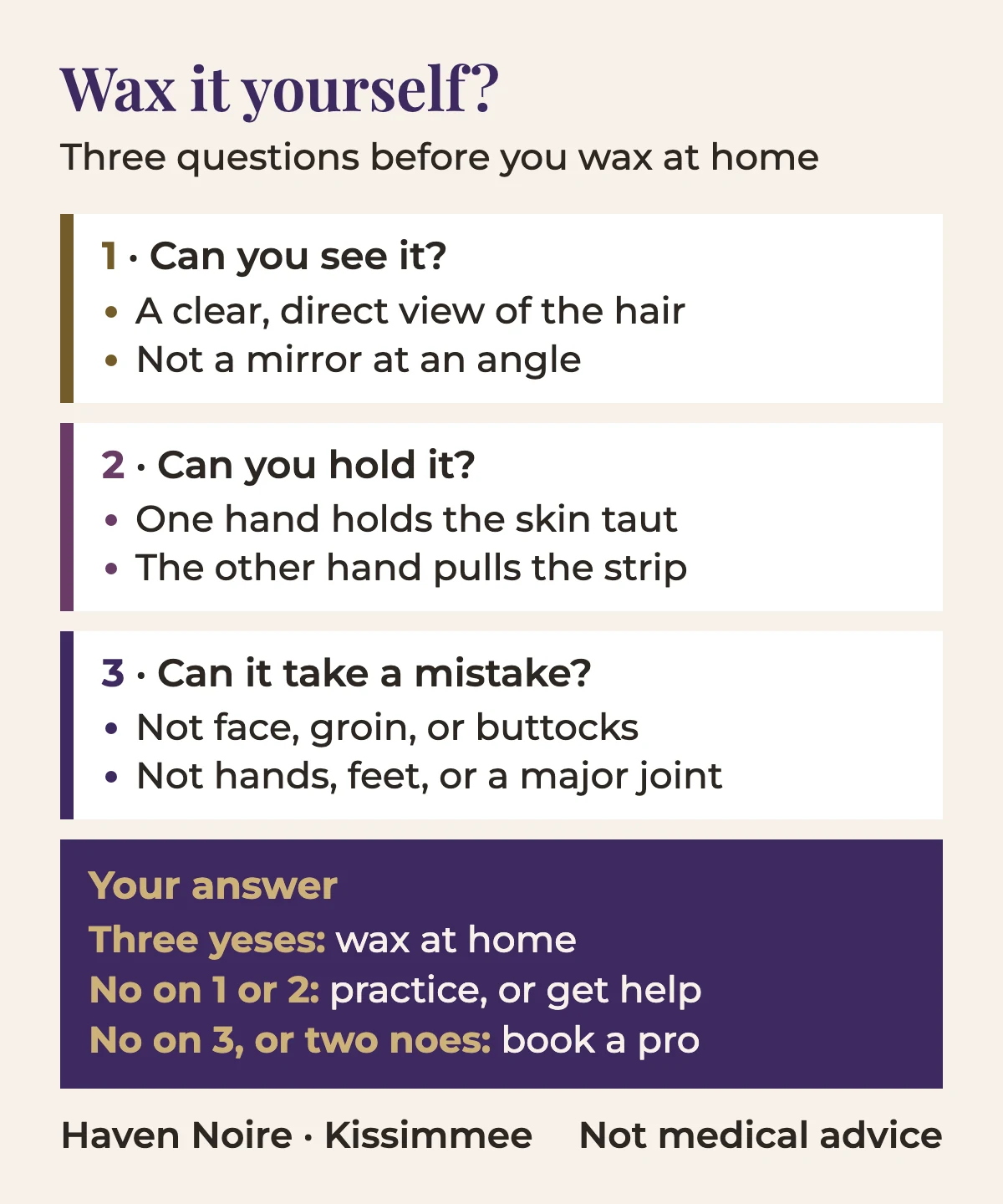
So here's the short version for DIY waxing: wax at home only where you can see the skin clearly, work it with both hands, and afford a mistake. It's our rule of thumb, not a medical rule.
Question 1: Can you see it?
You need a clear, direct view to spread wax with the hair's growth and pull against it, and a mirror makes that harder. Shins and the fronts of your thighs pass. Your back, butt, and most of a Brazilian don't.
Question 2: Can you hold it?
Waxing your own forearm leaves you one free hand. The AAD calls the underarms a tricky spot to reach and suggests asking a friend or relative to help.
Question 3: Can it take a mistake?
Some places raise the stakes of a slip. MedlinePlus, from the U.S. National Library of Medicine, counts second-degree burns on the hands, feet, face, groin, or buttocks, or over a major joint, as major burns that need urgent medical care. The AAD adds that it may be a good idea to leave Brazilian waxes to the professionals, since the skin there is particularly delicate.
How to score it
- Three yeses: wax at home.
- A no on question 1 or 2: practice somewhere easier first, or ask a helper.
- A no on question 3, or two noes: book a professional.
A helper can answer questions 1 and 2 for you; nobody can change question 3. Knees and ankles sit over major joints, so we'd wax the shin and thigh between them and leave the joints to a pro. Our menu doesn't spell out knees, so ask us when you book; our leg waxing guide shows where the lower and upper halves meet.
| Area | See it? | Hold it? | Can it take a mistake? | Our call |
|---|---|---|---|---|
| Shins and fronts of thighs | Yes | Yes | Yes | Wax at home |
| Backs of calves and thighs | Partly | Awkward | Yes | Practice first, or ask a helper |
| Forearms | Yes | One hand free | Yes | Practice first |
| Underarms | In a mirror | AAD suggests a helper | Yes | Ask a helper, or book a pro |
| Back | No | No | Yes | Ask a helper, or book a pro |
| Knees and ankles | Yes | Yes | Over a major joint | Book a pro |
| Brows, upper lip, chin | In a mirror | Yes | Face | Book a pro |
| Bikini line | Mostly | Yes | Groin | Book a pro |
| Brazilian or butt | No | No | Groin or buttocks | Book a pro |
Your face has extra rules: before brows, lip, or chin, run the three-question check in our face waxing guide. Shaping brows? Map them first with our guide to eyebrow shapes.
Heating Wax at Home: Where DIY Waxing Burns Start
A 2011 study from the burns unit at Royal Adelaide Hospital in Australia reviewed 21 patients treated there over about 20 years for burns from microwave-heated hair removal wax used at home. Every case with a recorded cause came from wax spilled right after heating or reheating, and the hands were involved in 16 of the 21.
The team also heated five hair removal waxes in microwaves. Wax ran hotter at higher power and after reheating, and it heated unevenly: some surface readings taken before stirring passed 100°C (212°F), the boiling point of water. Their verdict at the time: microwaved wax can reach unsafe temperatures even when the manufacturer's heating instructions are followed.
How to heat wax without spilling it
The Adelaide authors suggested three fixes for wax packaging: a microwave-safe plate, oven gloves, and stirring before use. Steps 2 to 4 are theirs; steps 1, 5, and 6 are our suggestions, built on what the study found:
- Read the heating directions first, and use the power setting they name, if any. Higher power meant hotter wax in the study.
- Heat the container on a microwave-safe plate, which the authors suggested to reduce spills.
- Lift it out with oven gloves, another of their suggestions.
- Stir before you test, as they advised, then do the AAD's wrist test every time, microwave or warmer.
- Don't keep reheating the same pot. Reheated wax ran hotter in the study.
- Keep the pot on a flat, steady surface, away from the edge, children, and pets.
Our tip: if your wrist and the package's clock disagree, trust your wrist, and let hot wax cool until it's merely warm. Considering a homemade sugar paste? Our sugaring vs waxing comparison covers DIY sugaring burns too.
What to Do If Hot Wax Burns You
For a small, first-degree burn (red, painful, maybe mildly swollen skin), follow the AAD's first aid for minor burns:
- Cool it right away under cool tap water, or with cold, wet compresses, for about 10 minutes or until the pain eases. MedlinePlus says to keep it under cool water for at least 5 to 30 minutes, and not to use ice water.
- Skip butter, toothpaste, and ointments, which the AAD says may cause an infection. It also says not to use topical antibiotics.
- Apply petroleum jelly two to three times a day.
- Cover it with a nonstick, sterile bandage. If blisters form, don't pop them; keep them covered.
- Take an over-the-counter pain reliever if you need one and it's safe for you.
- Once it heals, protect it from the sun. The AAD says redness from a burn sometimes lasts for weeks, especially in darker skin tones.
The two sources differ on one point. MedlinePlus says a lotion with aloe and an antibiotic can help once the skin has cooled, and prefers an ointment if the skin is broken. Unsure? Ask a pharmacist.
Wax stuck to the burn? Our advice: don't peel or scrub it off. Cool the area, and if the wax won't lift away easily, let a doctor or urgent care team remove it.
When a wax burn needs a doctor
MedlinePlus says to call 911 for a burn about the size of your palm or larger, a severe burn (white or blackened skin that may feel numb), or one you aren't sure about. A blistering burn wider than 2 to 3 inches, or on your face, hands, feet, groin, or buttocks, or over a major joint, needs urgent medical care.
For a minor burn, MedlinePlus says to contact your provider if pain lasts past 48 hours, and right away for signs of infection such as pus, fever, increased pain, or red streaks spreading from the burn. It adds that older people and anyone with a weakened immune system should be seen right away. Once you've healed, contact us before your next wax and tell us what happened.
Waxing at Home on Brown and Black Skin
On melanin-rich skin, an at-home waxing mistake can outlast the smooth skin it bought. The AAD's guide to dark spots in darker skin tones lists a burn or other injury among the wounds that can leave a dark spot as they heal. A spot a few shades darker than your natural color usually fades within 6 to 12 months; color that lies deep in the skin can take years.
Burns and irritated follicles can also scar. The AAD's page on keloid causes says that in keloid-prone skin, a keloid may form after a burn, or after an inflammatory skin condition like folliculitis. If your skin is keloid-prone, ask your dermatologist before any home wax.
Two habits that protect you:
- Never wax sunburned skin, the AAD says. Deeper skin can burn too, as our guide to whether Black people can get sunburn explains.
- Wear a tinted sunscreen with iron oxide on skin your clothes won't cover, as the AAD advises for preventing new dark spots, and keep freshly waxed skin out of direct sun for 24 to 48 hours.
If a mark has already formed, see how we approach hyperpigmentation and dark spots.
Who Should Skip DIY Waxing for Now
The AAD's hair removal page explains why some medicines matter: isotretinoin, tretinoin, and antibiotics thin your skin, so it could tear when the wax comes off.
- Sunburned or very sensitive skin: the AAD says never wax it.
- Isotretinoin now or in the past six months: don't wax.
- Tretinoin or an antibiotic right now: waxing isn't recommended, so ask your prescriber first.
- Retinol or a prescription retinoid: the AAD advises stopping it two to five days before waxing your face. Our beginner's plan for using retinol shows how to work around it.
- Diabetes: MedlinePlus says diabetes can reduce feeling in your feet, and that heat on the feet, like a heating pad or hot pavement, can cause severe burns because the skin doesn't respond normally to heat. Our suggestion: ask your doctor before you wax, since reduced feeling can hide wax that's too hot.
- Varicose veins or poor circulation in your legs: in our judgment, ask your doctor first.
- Pregnant, or living with eczema, rosacea, or keloid-prone skin: check with your doctor or dermatologist before you wax.
- Chafed or broken skin: wait until it heals. If your inner thighs rub raw in the heat, start with our thigh chafing guide.
After Your At-Home Wax: The First 48 Hours
Aftercare is the same at home or with us: the AAD's soothing tips from step 9, plus our house rule to avoid heat, friction, sweat, and direct sun for 24 to 48 hours. After a few days, exfoliate gently and keep moisturizing. Our waxing aftercare guide shows which of those rules have a medical source.
For bumps, read how to prevent ingrown hairs after waxing. Skip the razor between waxes: it disrupts the growth cycle and can cause ingrown hairs, and our waxing vs shaving guide compares the two methods.
Planning an everything shower? Keep the scrub and hot water off freshly waxed skin for 24 to 48 hours, and see how to get smooth skin for body exfoliation.
When to See a Dermatologist or Doctor Instead
We're estheticians, not doctors. These signs call for a medical professional, not another wax:
- Redness or swelling that lasts more than two days. That's the AAD's line for seeing a board-certified dermatologist.
- Bumps around hair follicles that come back often, get worse, or last longer than 2 or 3 days. That's when MedlinePlus says to contact your provider about folliculitis.
- A dark mark that isn't fading with gentle care. The AAD says a dermatologist can help when your own treatment isn't working.
- A raised scar that grows past the edges of the wound. The AAD explains that a keloid grows bigger than the wound that caused it.
Not sure who to call first? Our guide to esthetician vs dermatologist sorts which concerns belong where.
When a Professional Wax Is Worth It in Kissimmee
At-home waxing keeps shins smooth on a budget. For the areas those three questions flag, a professional does the seeing and holding for you. Every service on our waxing menu in Kissimmee is performed by a licensed esthetician in a private, hygienic setting, for women, men, and teens.
| Service | Time | Price |
|---|---|---|
| Eyebrow Shape + Wax | 15 minutes | $15 |
| Lip or Chin Wax | 10 minutes | $10 |
| Underarm Wax | 15 minutes | $15 |
| Bikini Wax | 15 minutes | $30 |
| Brazilian Wax | 30 minutes | $60 |
| Full Butt Wax | 20 minutes | $30 |
| Full Back Wax | 15 minutes | $40 |
| Lower or Upper Legs Wax | 30 minutes | $40 |
Booking Brazilians every few weeks? The Smooth Membership is $59.99 a month for unlimited Brazilian waxes, and members get 10% off other waxing services. First one? Our first Brazilian wax prep guide walks you through it.
Frequently Asked Questions About Waxing at Home
Is it safe to wax at home?
Usually, if you follow the instructions. The American Academy of Dermatology calls at-home waxing a safe and effective way to remove body hair when done as directed, and also says it takes practice and that wax that's too hot can burn. Start with your shins, test the wax on your wrist every time, and leave Brazilians to a professional.
How long should hair be to wax at home?
About one-fourth to three-fourths of an inch, according to the American Academy of Dermatology. Trim longer hair with safety scissors so waxing is less messy and painful. Our own guidance for a salon wax is about a quarter inch, roughly two to three weeks of growth, and to skip shaving between waxes.
Can you do a Brazilian wax at home?
You can, but we don't recommend it. The American Academy of Dermatology says it may be a good idea to leave Brazilian waxes to professionals, because the skin there is particularly delicate. MedlinePlus also lists blistering burns on the groin or buttocks as major burns, and you can't see or hold most of the area yourself.
How do you know if wax is too hot?
Test a small dab on the inside of your wrist every time. The American Academy of Dermatology says it should feel warm, but not hurt or burn. In one burns study, wax ran hotter after reheating and at higher microwave power, so heat it once by the package directions and stir it before you test.
What should you do if you burn yourself with wax?
Cool it right away under cool tap water or with cold, wet compresses, for about 10 minutes or until the pain eases, as the AAD advises. Then apply petroleum jelly and a nonstick bandage, and skip butter and toothpaste. Get urgent care for a blistering burn on your face, hands, feet, groin, or buttocks, or over a major joint.
Should you stop retinol before waxing?
Pause it first. The American Academy of Dermatology advises stopping retinol and prescription retinoids two to five days before waxing your face. A second AAD page says waxing isn't recommended while you're applying tretinoin or using an antibiotic, or within six months of isotretinoin. Ask your prescriber before you wax, and tell us what you use.
Can you wax your own underarms?
It's harder than it looks. The American Academy of Dermatology calls the underarms a tricky spot to reach and suggests asking a friend or relative to help, since you need one hand to hold the skin taut and one to pull. At Haven Noire, an Underarm Wax is $15 and takes about 15 minutes.
More from the Journal

About the author
Tiffany · Licensed Esthetician · Licensed PMU Artist
Tiffany is a Florida-licensed esthetician and permanent makeup artist and the founder of Haven Noire. She specializes in customized facials, corrective skincare, and waxing for melanin-rich and all skin types, and is known for a calm, education-first approach that puts first-time clients instantly at ease.
Meet Tiffany →