
An esthetician cares for how your skin looks and feels: facials, exfoliation, extractions, hair removal, and advice on caring for your skin at home. A dermatologist is a medical doctor who diagnoses and treats conditions of the skin, hair, and nails, prescribes treatment, and performs skin surgery. If a spot hurts, itches, bleeds, spreads, or keeps changing, see a dermatologist or your doctor first.
We're estheticians, not doctors. Haven Noire is a facial and waxing spa in downtown Kissimmee, and part of our job is knowing which concerns belong in our treatment room and which belong in a dermatologist's office. Here's what most comparisons miss: often the real question isn't which one. It's who goes first, and how the two work together after that.
Esthetician vs. Dermatologist: The Difference at a Glance
The difference is medical versus aesthetic. A dermatologist diagnoses and treats disease of the skin, hair, and nails. An esthetician improves how skin looks and feels. Florida's cosmetology law defines cosmetology as treatment of the head, face, and scalp for aesthetic rather than medical purposes, and it lists facials as one of its specialties.
| Question | Esthetician | Dermatologist |
|---|---|---|
| Who they are | A licensed skin care professional; Florida's cosmetology law says facial specialist | A medical doctor who specializes in the skin, hair, and nails |
| Minimum training | 220 hours of training to register in Florida | More than a decade, including medical school and three years of dermatology residency |
| Diagnoses skin conditions | No | Yes |
| Prescribes treatment | No | Yes |
| Typical work | Facials, exfoliation, extractions as needed, waxing, home-care advice | Diagnosis, prescription treatment, skin surgery, and cosmetic procedures |
What Does an Esthetician Do?
An esthetician cleanses, exfoliates, and treats the surface of the skin to improve how it looks and feels, removes unwanted hair, and teaches you how to care for your skin at home. Estheticians don't diagnose skin conditions or prescribe medicine.
Florida's law describes the facials specialty as "the massaging or treating of the face or scalp with oils, creams, lotions, or other preparations, and skin care services." Here's what that looks like on our menu:
- Every facial starts with a skin analysis, so each step fits your skin that day.
- A Signature Facial is $95 for 60 minutes: a double cleanse, exfoliation and extractions as needed, a custom mask and facial massage, then serums, moisturizer, and SPF.
- A Corrective Facial is $135 for 60 minutes, with options such as dermaplaning, microdermabrasion, and our Hydrofacial, a hydrodermabrasion treatment.
- Chemical peels come only after a skin consultation, never on a first visit.
- Waxing for brows, lip, chin, underarms, legs, back, and the bikini area. Choosing a brow shape first? Our guide to eyebrow shapes maps your start, arch, and tail.
- Your esthetician recommends home-care products from the professional lines we use.
Not sure whether a concern belongs with us? Ask. When in doubt, we'd rather point you to a doctor.
What Does a Dermatologist Do?
The American Academy of Dermatology (AAD) defines a dermatologist as a medical doctor who specializes in conditions that affect the skin, hair, and nails. It says a board-certified dermatologist can diagnose and treat more than 3,000 diseases of the skin, hair, and nails, plus cosmetic concerns. It calls dermatologists "expert medical doctors and skin surgeons."
Esthetician or Dermatologist First? Three Questions to Ask
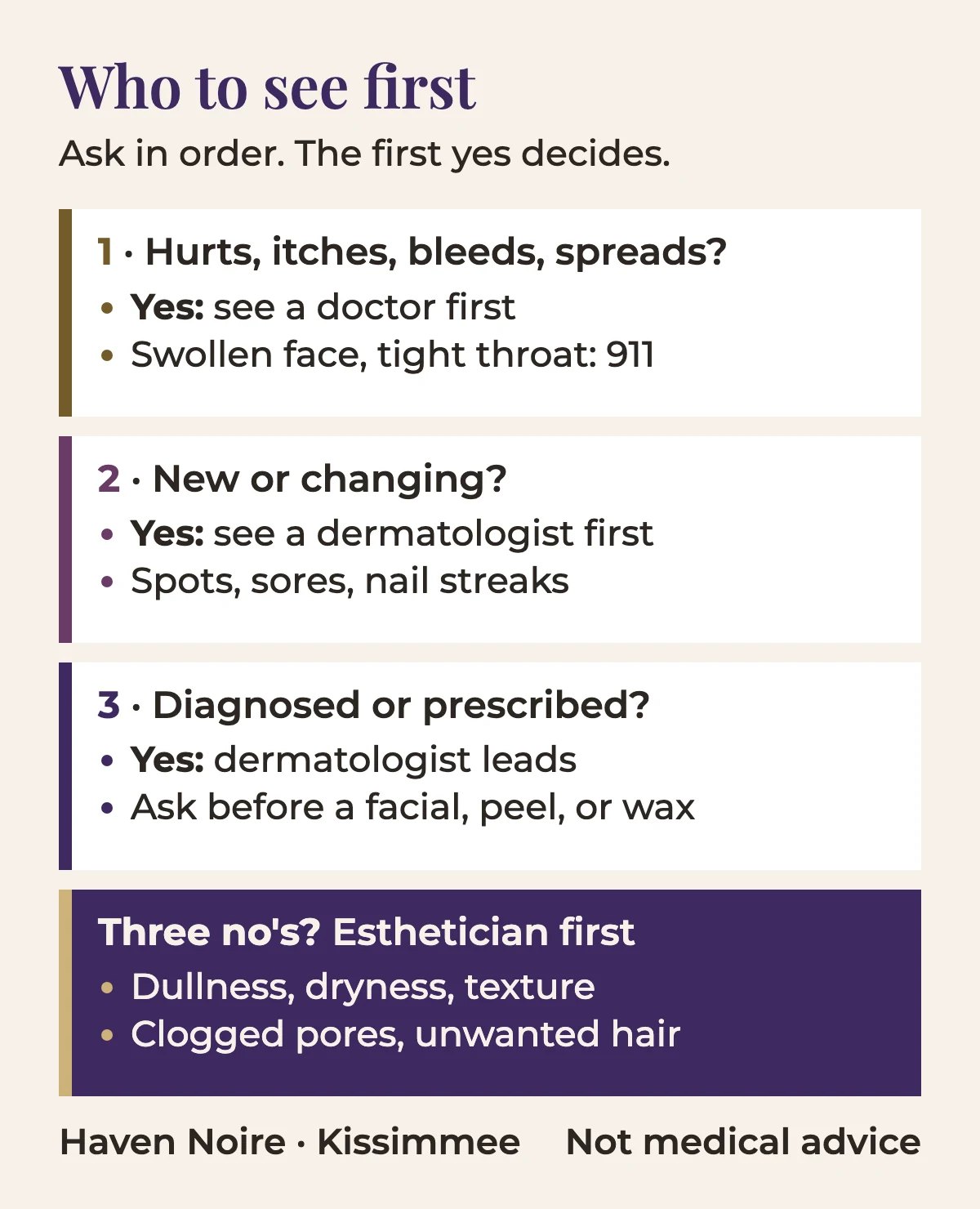
Most guides treat esthetician vs. dermatologist as a choice between two doors. In practice, it's a question of order. These three questions are built on AAD and MedlinePlus guidance; how we sort the answers is our own judgment, not a medical rule. Ask them in order. The first yes decides who you see first.
Question 1: Does it hurt, itch, bleed, or spread?
Symptoms point to a doctor. MedlinePlus says to contact your health care provider if a rash comes with joint pain, fever, or a sore throat, or if you notice streaks of redness, swelling, or very tender areas, since these may indicate an infection. It says to call 911 if you're short of breath, your throat is tight, or your face is swollen.
A doctor first doesn't always mean a dermatologist first. The same page says many primary care providers are comfortable dealing with common rashes, and that more complicated skin disorders may need a referral to a dermatologist. For a mole or spot that itches or bleeds, though, the AAD says to see a board-certified dermatologist.
Question 2: Is it new, or is it changing?
Change points to a dermatologist. The AAD's skin cancer guidance says to see a board-certified dermatologist for new spots, spots that look different from your others, or spots that are changing, itching, or bleeding. An esthetician may notice a spot during a facial, but noticing isn't diagnosing.
Question 3: Is it diagnosed, prescribed, or under treatment?
If a doctor already treats your skin, your dermatologist leads and the spa follows. That covers prescriptions such as tretinoin or isotretinoin, and eczema, rosacea, psoriasis, or keloid-prone skin. Ask your dermatologist which spa treatments are safe, and tell us what you use when you book. Retinoid users, see the AAD's waxing rules in our face waxing guide.
Pregnant? Check with your obstetrician or dermatologist before you start or change any skin treatment. The AAD says some acne medicines, isotretinoin among them, can cause serious birth defects.
Three no's: start with an esthetician
If nothing hurts, nothing's changing, and nothing's prescribed, your concern is likely about how your skin looks and feels. That's where an esthetician comes in: dullness, dryness, texture, clogged pores, unwanted hair, a routine that isn't working, or an hour of care. Not sure where your skin fits? Start with our guide to skin types.
| Concern | Start with | Why |
|---|---|---|
| A mole or spot that's new, changing, itching, or bleeding | Dermatologist | AAD skin cancer guidance |
| Deep acne cysts or nodules | Dermatologist | AAD: they can leave scars |
| Acne that store-bought products haven't cleared | Dermatologist | AAD lists it as a reason to go |
| New patches of uneven color on your face | Dermatologist | AAD: a dermatologist can tell if it's melasma |
| Eczema, rosacea, or psoriasis | Dermatologist leads, spa supports | We don't diagnose or medically treat these |
| Dullness, dryness, or rough texture | Esthetician | No symptoms, no changes |
| Occasional clogged pores | Esthetician | Extractions as needed in every Signature Facial |
| Unwanted facial or body hair | Esthetician | New or fast-growing hair: ask your doctor first |
When You Need Both an Esthetician and a Dermatologist
Plenty of concerns land in between. Acne, dark marks, melasma, and sensitive skin can call for a dermatologist's diagnosis plus steady upkeep. Once your dermatologist is on board, see how we approach acne facials.
An esthetician can flag a concern, not diagnose it
The U.S. Bureau of Labor Statistics lists referring clients to another skincare specialist, such as a dermatologist, for serious skin problems among the duties of skincare specialists. In a 2023 study that surveyed 504 estheticians before and after a skin cancer course, most rated the "extremely concerning" spots at the right level of concern, and the authors suggest estheticians may serve as a screening partner for dermatologists.
A partner isn't a skin check. A 2021 review in the Journal of Cosmetic Dermatology calls a total body skin exam by a physician, especially a dermatologist, the gold standard for finding suspicious spots. Skin cancer screening isn't on our menu, and a facial looks at your face, not the rest of your skin.

What to bring to a dermatologist
The AAD's guide to choosing and preparing for a dermatologist suggests bringing:
- A notebook with your questions written down.
- A list of every medicine, vitamin, and supplement you take, including nonprescription acne products.
- Copies of lab results from another doctor.
It also asks you to skip makeup and nail polish so your skin and nails can be seen. We'd add one line: spa treatments from the past few months, such as peels, dermaplaning, or waxing.
What to tell your esthetician
- Your diagnosis, if you have one, and who's treating it.
- Every prescription you use on your skin or take by mouth, plus retinol and exfoliating acids.
- Whether your dermatologist has cleared you for facials, peels, or waxing.
- Whether your skin darkens after irritation, such as a bug bite or a breakout.
Three questions to ask your dermatologist about spa care
- Can I keep getting facials during this treatment, and should any step wait?
- Do I need to pause anything before a wax or a peel, and for how long?
- Which signs mean I should stop and call you?
Bring the answers to your next facial so we can plan around them.
Esthetician vs. Dermatologist Credentials in Florida
What Florida law calls an esthetician
We read the 2026 text of Chapter 477, Florida's cosmetology law, in November 2026, and the word esthetician doesn't appear in it. The law registers facial specialists instead. Under section 477.0201, that takes a certificate for 220 hours of training, which the law says "shall focus primarily on sanitation and safety." The state's Board of Cosmetology defines a facial specialist as "a person registered to do facials in the State of Florida" and says these services must be performed in a licensed salon.
Treat 220 hours as the floor. Ask any esthetician, us included, what training they've done since. Tiffany, our founder, is a Florida-licensed esthetician and a licensed permanent makeup artist, and her facial specialist license number is on our About page.
What board-certified dermatologist means
The AAD says board certification means finishing medical school and a dermatology residency, then passing the board exam. Look for FAAD (Fellow of the American Academy of Dermatology) after the name, or certification from the American Board of Dermatology, the American Osteopathic Board of Dermatology, or the Royal College of Physicians and Surgeons of Canada.
How to check either one
- Esthetician: search the name or license number in the Florida Department of Business and Professional Regulation's online license search at myfloridalicense.com.
- Dermatologist: use the AAD's Find a Dermatologist tool and look for FAAD after the name.
Where a med spa fits
A medical spa offers medical procedures, such as injectables or lasers, in a spa setting. If you book one, ask who the supervising physician is, what their specialty is, and whether you'll see them. Considering a salmon DNA injection there? Read what PDRN injections have shown so far. A 2024 ethics article in Clinics in Dermatology warns that some medical spas advertise physician oversight when there is none. Haven Noire is an esthetics spa, not a medical office: injectables, lasers, and microneedling aren't on our menu. Our guide to types of facials shows which treatments belong with a doctor.
Esthetician or Dermatologist for Melanin-Rich Skin
If your skin is brown or Black, two things shift the order.
Dark marks raise the stakes
The AAD's acne advice for darker skin tones says to see a dermatologist before using any chemical peel, microdermabrasion, or laser therapy to treat acne, because even at-home versions can cause permanent dark marks and light spots. It also suggests asking how many people with skin of color the doctor has treated. Peels and microdermabrasion are both on our menu, and for acne on darker skin, the AAD's order is dermatologist first.
With a dermatologist's help, the same page says, virtually every case of acne and most dark spots can be treated successfully. For new uneven patches, the AAD's melasma guidance says a dermatologist can tell you whether it's melasma or another condition. Then see our melasma care and fading dark marks on melanin-rich skin. Choosing an esthetician? Use the six questions in facials for Black skin.
Skin cancer can show up where a facial never looks
The AAD's guide to skin cancer in darker skin tones says it may develop in places that get little sun: palms, soles, fingers and toes, nails, the mouth or lips, the buttocks, and the genitals. It can also appear on sun-exposed skin, like the face and neck. The same guide says that when someone with a darker skin tone develops skin cancer, it's often advanced by the time it's diagnosed.

Its warning signs include a bump, spot, or mole that's growing, bleeding, itching, or changing; a color change, especially darkening; a sore that doesn't heal, or heals and comes back; a dark line or streak in a nail; and a scaly or rough patch that doesn't go away. A facial isn't built to look for these. Dermatologists recommend checking your own skin, and the AAD says that if you find a sign, make an appointment with a board-certified dermatologist right away and say so when you book.
While You Wait to See a Dermatologist
The AAD says there can be a wait to see a dermatologist, and suggests scheduling routine visits several weeks or even months ahead. If something is changing, say so when you call: the AAD says to mention a mole that's itching, bleeding, or changing, because dermatologists try to fit in urgent patients as soon as possible. It also suggests asking about a waitlist for cancellations.
Keep your routine boring
- Don't switch products every few days. The AAD's advice for acne that won't clear says that can irritate skin and cause new breakouts, and that a treatment that works should show some improvement in 4 to 6 weeks.
- Don't pick, pop, or scrub. The same page says picking and popping can worsen acne, and that scrubbing irritates acne-prone skin.
- Cleanse gently, moisturize, and wear sunscreen daily. Our morning skincare routine keeps it simple.
- If products suddenly sting, calm a stressed skin barrier before you add anything new.
Should you book a facial in the meantime?
Our advice: if your concern calls for a doctor first, hold off on peels and resurfacing until you've been seen. If you need both, a gentle facial may still fit; ask your dermatologist, and tell us what's going on. First visit? Here's what to tell your esthetician at a first facial. A facial won't replace the appointment.
When to See a Dermatologist Instead of an Esthetician
We'd rather refer you than treat the wrong thing. Here's our checklist, drawn from the AAD and MedlinePlus pages above: see a dermatologist or your doctor before a spa visit if:
- A spot is new, changing, itching, or bleeding, a sore won't heal, or a nail shows a dark line or streak.
- Acne forms deep cysts or nodules or hasn't cleared with nonprescription treatment, or you want a peel or microdermabrasion for acne on darker skin.
- A rash started after a new medicine. Don't stop or change a medicine without asking your provider.
- A rash comes with fever, joint pain, red streaks, swelling, or very tender skin.
- Uneven patches of color appear on your face.
- You're pregnant, or you use isotretinoin, tretinoin, or another prescription skin medicine, and you want a facial, peel, or wax.
- You have eczema, rosacea, psoriasis, or skin that forms keloids.
Call 911 for a swollen face, a tight throat, or trouble breathing. For redness that keeps coming back, see how we approach sensitive and redness-prone skin alongside your doctor's care.
Frequently Asked Questions About Estheticians and Dermatologists
Should I see an esthetician or a dermatologist for acne?
The AAD says a dermatologist can help when acne causes cysts and nodules, hasn't cleared with nonprescription treatment, or makes you uncomfortable. For clogged pores with no red flags, a facial with extractions as needed can help skin look clearer, though it isn't acne treatment. On darker skin, see a dermatologist before peels or microdermabrasion for acne.
Can an esthetician diagnose skin conditions?
No. Diagnosing a skin condition is a medical provider's job, and Florida's cosmetology law, which covers facials, defines cosmetology as treatment for aesthetic rather than medical purposes. An esthetician can notice that something looks off and suggest you see a doctor. At Haven Noire, we're estheticians, not doctors: when in doubt, we'd rather point you to a dermatologist.
Do estheticians need a license in Florida?
Yes. Chapter 477 of the Florida Statutes makes it unlawful to practice a specialty such as facials without an active cosmetologist license or specialist registration. Facial specialists register after a certificate for 220 hours of training. You can look anyone up in the state's online license search, and Tiffany's license number is listed on our About page.
What is a medical esthetician?
It's a job title. We read the 2026 text of Chapter 477, Florida's cosmetology law, in November 2026 and found no separate medical esthetician license in it. The Bureau of Labor Statistics notes that some skincare specialists work in medical offices. Whatever the title says, ask which Florida license the person holds and who supervises their work.
Does insurance cover a dermatologist visit?
It depends on your plan and the reason for your visit. The AAD suggests calling your insurance provider, who can tell you whether a dermatologist is in your network and whether treatment for a particular condition is covered. It notes that cosmetic procedures, such as treatment for wrinkles, usually aren't covered.
Can I get facials while I'm seeing a dermatologist?
That's your dermatologist's call, so start there. Ask whether any step, such as exfoliation, extractions, peels, or waxing, should wait while you're on treatment. Then tell your esthetician your diagnosis and everything you use on your skin. When the two plans disagree, our rule is simple: follow your dermatologist's plan.
What should I do if my esthetician tells me to see a dermatologist?
Book the appointment, and tell the scheduler what was noticed. The AAD says to mention a mole that's itching, bleeding, or changing, since dermatologists try to fit in urgent concerns. Ask your esthetician where the spot is and what they saw, and skip treatments on that area until a doctor has looked at it.
How much does it cost to see an esthetician in Kissimmee?
At Haven Noire, a Signature Facial is $95 for 60 minutes or $110 for 90 minutes, and a Corrective Facial is $135. A Lip Wax or a Chin Wax is $10, and a 10% deposit is required when you book a wax. For packages, memberships, and per-visit math, see what a facial costs in Kissimmee.
More from the Journal

About the author
Tiffany · Licensed Esthetician · Licensed PMU Artist
Tiffany is a Florida-licensed esthetician and permanent makeup artist and the founder of Haven Noire. She specializes in customized facials, corrective skincare, and waxing for melanin-rich and all skin types, and is known for a calm, education-first approach that puts first-time clients instantly at ease.
Meet Tiffany →