

Skin cycling is a nighttime routine that takes turns: an exfoliant one night, a retinoid the next, then two nights of just cleanser and moisturizer, repeated. Vogue reports that it rose to popularity on TikTok in 2022, and as of November 2026, dermatology clinics and skincare brands still publish guides to it.
Does it work? The ingredients have research behind them. The four-night schedule is another story: we searched PubMed in November 2026 and found no study that tested it. What holds up is the logic. The American Academy of Dermatology (AAD) says exfoliating while you use a retinoid may worsen dry skin or cause breakouts, and a dermatologist on its retinoid page advises easing in slowly. Rest nights do both.
Here's the part that gets lost in the trend: the four nights aren't fixed. Ohio State's dermatology explainer describes a three-to-five-night cycle and sets the rest nights by skin type. So the real question is how many rest nights your skin needs, and when to pause altogether: in pregnancy, on isotretinoin, or around a peel or face wax.
What Is a Skin Cycling Routine?
A skin cycling routine rotates two active nights with recovery nights. You exfoliate on night one, apply a retinoid on night two, then use only a gentle cleanser and moisturizer on nights three and four before starting again.
Ohio State's Wexner Medical Center credits dermatologist Dr. Whitney Bowe with coining the term.
Here's the classic four-night version:
- Night 1, exfoliate. Cleanse, pat dry, then apply a chemical exfoliant. Ohio State's explainer calls chemical exfoliants the most helpful choice and names alpha hydroxy acids such as glycolic acid and beta hydroxy acids such as salicylic acid.
- Night 2, retinoid. Cleanse and dry, then apply an over-the-counter retinol or a prescription retinoid. The explainer says a pea-sized amount covers your whole face, and that a moisturizer can help if your skin is dry or sensitive.
- Nights 3 and 4, recover. Cleanse, pat dry, and moisturize. No acids, no retinoid.
- Night 5, start again at night 1.
Mornings stay simple: a gentle cleanse and sunscreen. Ohio State's explainer says to use a daily SPF sunscreen, and on the AAD's guide to retinoids and retinol, a dermatologist advises using retinoids only at night because they can make skin more sensitive to the sun.
Choosing the retinoid is its own decision; our sibling guide on how to use retinol covers how to start. For night one, our mandelic acid guide covers one gentler acid. If a scrub, toner, or brush already exfoliates you, count how often with our exfoliation guide before adding an acid night.
Does Skin Cycling Work? What the Evidence Says
What's Studied: Retinoids, Acids, and Irritation
Retinoids and exfoliating acids both do real work, and both can irritate. The AAD's guide to exfoliating at home says retinol and prescription retinoid creams may make your skin more sensitive or peel, and that exfoliating while you use them may worsen dry skin or even cause acne breakouts. Keeping the two on separate nights is the core idea of the routine.
Pacing is the other idea. On the AAD's retinoid page, dermatologist Tina Alster says she advises patients to use the least-intense retinoid they can find, every other night to start, building up slowly, because otherwise they end up irritating their skin.
What Isn't Studied: The Four-Night Schedule
We searched PubMed in November 2026 for "skin cycling" and for studies alternating a retinoid and an exfoliating acid on separate nights. We found no study that tested the routine. So treat the four nights as a habit, not a medical rule; even Ohio State's explainer uses three to five.
Where Skin Cycling Falls Short
The routine is a pacing tool, not an acne treatment. Ohio State's dermatologist writes that inflammatory, nodulocystic acne needs more consistent, frequent use of topical retinoids than once every four days. If that's you, a dermatologist's plan beats a cycle.
Notice the math, too. The AAD dermatologist's starting pace is a retinoid every other night. The classic cycle uses one every fourth night. So the cycle isn't a faster way into retinoids; it's a slower one. If new bumps appear in the first weeks, our sibling guide to skin purging helps you tell purging from a reaction.
How to Adjust Your Skin Cycling Routine
Our approach builds on Ohio State's three-to-five-night range and the AAD guidance in this article. Its numbers are our suggestions, not medical rules. The idea: don't change your actives first. Change how many rest nights sit between them.
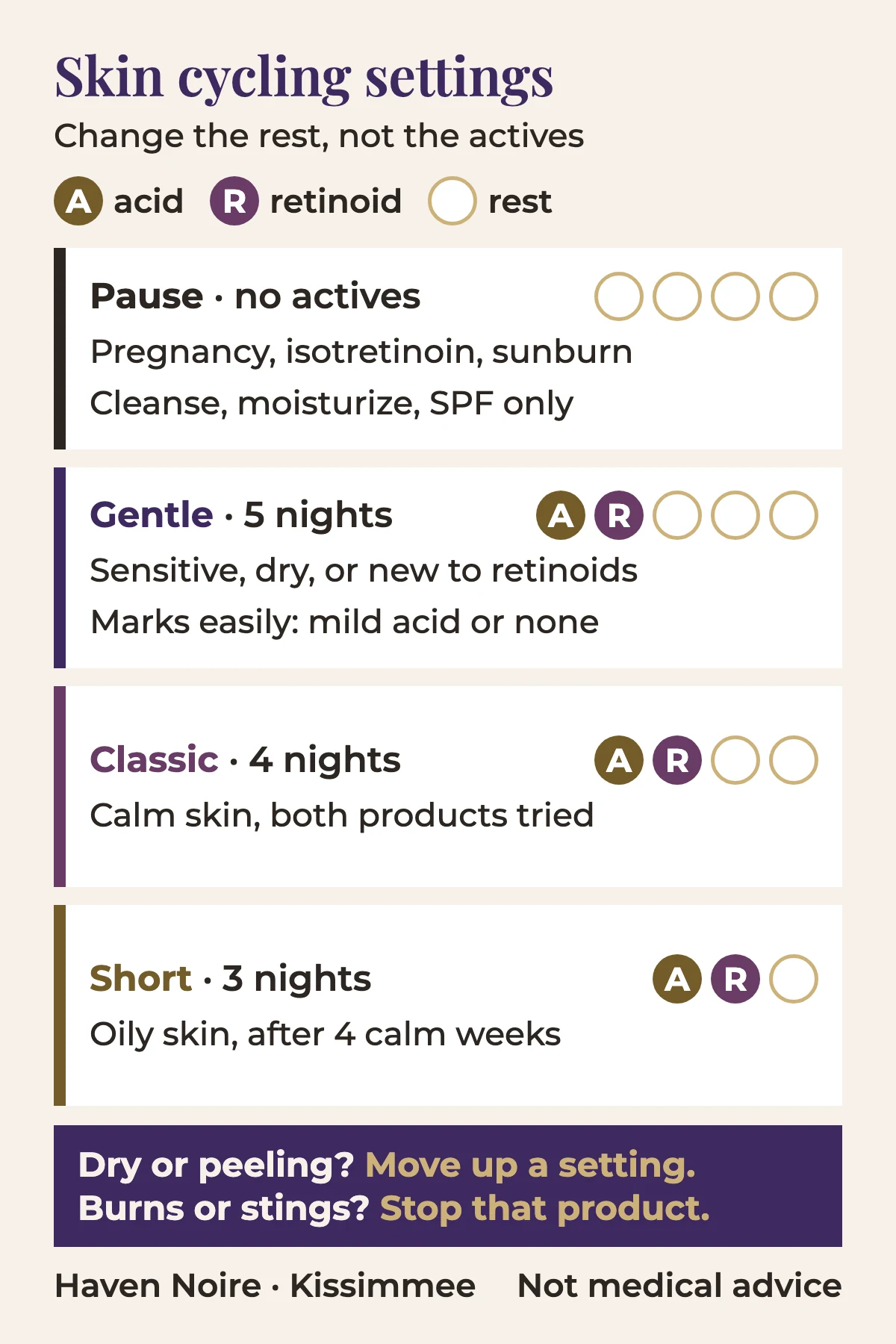
Pick the setting that fits your skin today, then use the rules below to move up, toward more rest, or down.
Setting 1: Pause, No Active Nights
Cleanse, moisturize, and wear sunscreen, with no acid or retinoid nights. This setting is for anyone the sources tell to skip retinoids or exfoliants, such as in pregnancy or on isotretinoin; the full list is in the dermatologist section below. The AAD also says never to exfoliate sunburned skin or open cuts.
Setting 2: Gentle, a Five-Night Cycle
Exfoliate, retinoid, then three rest nights. Ohio State's explainer suggests two or three hydration nights for sensitive, dry, or easily irritated skin. We'd put three more groups here: anyone new to retinoids, anyone whose skin marks easily, and melanin-rich skin. On this setting, keep the acid mild, or skip the acid night and cycle the retinoid alone.
Setting 3: Classic, a Four-Night Cycle
Exfoliate, retinoid, rest, rest: the routine as it's usually taught. Our advice: start here only if your skin is usually calm and you've already used both products without trouble.
Setting 4: Short, a Three-Night Cycle
Exfoliate, retinoid, one rest night. Ohio State's explainer suggests a single hydration night for oily or acne-prone skin. Our advice: earn this setting with about four calm weeks on the four-night cycle, and step back up at the first sign of dryness or peeling.
How to Move Between Settings
- Start on the gentle five-night cycle if you're new to either product, sensitive, or prone to dark marks. Otherwise, start on the classic four-night cycle.
- Hold a setting for about four weeks before moving down a setting.
- Move up a setting the same week you notice peeling or new dryness. If a product burns or stings when you apply it, stop using it, as the AAD's dark spot guide (covered below) advises.
- Change one thing at a time: the setting, the acid, or the retinoid, never two at once.
- If irritation lasts after a week of rest nights, stop the actives and follow our skin barrier repair steps.
Pregnant, breastfeeding, or using isotretinoin, tretinoin, or another prescription skin medicine? Ask your doctor or dermatologist before you start any active nights. The same goes for eczema, rosacea, and skin that forms keloids.
Skin Cycling on Melanin-Rich Skin
If your skin is brown or Black, both active nights carry an extra risk worth planning for: dark marks.
On the AAD's retinoid page, dermatologist Sonia Badreshia-Bansal says people with darker skin need to be especially vigilant about whether a product is causing irritation, because with skin of color, irritation can trigger dark marks. She adds that starting slowly and using moisturizer helps.
The acid night needs the most care. The AAD's exfoliation guide says to avoid strong chemical or mechanical exfoliation if you have a darker skin tone, or if you notice dark spots after burns, bug bites, or acne breakouts.
Here's the catch most guides skip. The AAD's guide to fading dark spots in darker skin tones lists glycolic acid and retinoids among the ingredients that can fade them: the same kinds of ingredients you use on your two active nights. The same guide says a skin care product that irritates your skin can cause dark spots, and that a spot a few shades darker than your skin usually fades within 6 to 12 months once the cause stops. So the goal is a cycle your skin barely notices.
Three habits that help (our suggestions):
- Start on the gentle five-night cycle, with a mild acid or none.
- Moisturize every night, active or not.
- Wear sunscreen every morning. The AAD's dark spot guide recommends a tinted sunscreen with iron oxide.
Already have marks? Start with how to fade hyperpigmentation on melanin-rich skin.
Florida Sun and Your Active Nights
Central Florida sun makes the morning after matter. The FDA says alpha hydroxy acids may increase your skin's sensitivity to the sun, and its suggested label warning tells you to use sunscreen, wear protective clothing, and limit sun exposure while using the product and for a week afterward. Retinoids go on at night for a similar reason. Our guide to sunscreen for dark skin helps you choose one without a white cast.
Skin Cycling Around Facials, Peels, and Face Waxing
Most guides stop at your bathroom door. We count a professional exfoliation as an acid night, and some services need your actives paused first. Here's how our published prep and aftercare fit into your cycle.
| Visit | Before | After | Your cycle (our suggestion) |
|---|---|---|---|
| Signature Facial: $95 for 60 minutes, $110 for 90 | Tell us what's in your cycle | Skip harsh actives and heat for 24 hours | Counts as that cycle's acid night |
| Corrective Facial: $135 | Dermaplane option: avoid retinoids, AHAs, BHAs, or active treatments for 3 to 5 days | Avoid sun and active exfoliants for a few days; after dermaplaning, no retinoids or active acids for 3 to 5 days | Replaces the acid night; rest nights until the wait ends |
| Chemical peel, after a skin consultation | Stop retinoids, vitamin A, prescription actives, AHAs, BHAs, and exfoliating acids 5 to 7 days before | No retinoids, AHAs, or active treatments during recovery, usually 5 to 7 days | Pause the cycle from a week before until recovery ends |
| Brow, lip, or chin wax: $10 to $20 | AAD: avoid retinol and prescription retinoids 2 to 5 days before | Avoid heat, friction, sweat, and direct sun for 24 to 48 hours | Book it after your rest nights |
Every peel on our chemical peels menu requires a skin consultation first and isn't offered on a first visit. If you're cycling to treat acne on brown or Black skin, the AAD's acne tips for skin of color say to see a dermatologist before using any chemical peel, microdermabrasion, or laser therapy to treat it. For day-by-day detail, see our chemical peel aftercare guide and our dermaplaning page.
Face Waxing and Your Retinoid Night
The AAD's waxing guide says to avoid retinol and prescription retinoids for two to five days before waxing your face, and not to wax if you've taken isotretinoin in the last six months. A second AAD page, 6 ways to remove unwanted hair, says waxing isn't recommended while you're applying tretinoin or using an antibiotic. Our face waxing guide has the full check.
In a four-night cycle, a wax booked the day after your second rest night lands a little over two days after your retinoid, near the short end of the AAD's range. Our advice: sensitive skin adds rest nights toward five days, and an acid night that leaves you peeling or stinging counts like a retinoid night. Afterward, our waxing aftercare says to exfoliate gently only after a few days. No source we checked sets a retinoid restart date, so ask us at your appointment.
Where a Haven Facial Fits
A facial can anchor your cycle: one professional exfoliation, then rest nights at home. Our corrective facials range from Radiance Brightening to Hydrofacial, a hydrodermabrasion treatment, and each finishes with serums, moisturizer, and SPF, plus a home-care plan.
Bring your products, prescriptions included, to your skin analysis, and we'll help you place the visit in your cycle. Tiffany, our founder, is a Florida-licensed esthetician. Haven Noire is an esthetics spa, not a medical office, so we don't diagnose skin conditions or set prescription schedules.
Many clients start corrective facials every two to three weeks, then taper to maintenance. The Corrective Membership ($109.99 a month) includes one Corrective Facial of your choice each month, with a three-month minimum and 10% off extra services and in-spa products. Compare our monthly memberships, and ask about the professional skincare lines we offer for home care.
Who Should Skip Skin Cycling, and When to See a Dermatologist
Skin cycling is home skin care, not treatment. If any of these fit, see a board-certified dermatologist, or your doctor where noted, before you start. Already cycling? Pause the actives and book that visit.
- You're pregnant or planning a pregnancy. The AAD says retinoids should not be used during pregnancy. Ask your OB-GYN about the rest of your routine.
- You take isotretinoin. The AAD's isotretinoin guide lists retinol and exfoliants such as glycolic, lactic, and salicylic acid among the products to avoid while you take it.
- You use tretinoin, tazarotene, trifarotene, or prescription adapalene. The AAD lists these as prescription retinoids, so let your dermatologist set how often you use them.
- Your skin has a lot of redness or inflammation. An AAD dermatologist says to avoid retinoids and ask a dermatologist about therapies aimed at rosacea.
- You have moderate or severe acne scarring, or acne tied to your period or other hormonal changes. The same AAD page says to see a board-certified dermatologist before you try a retinoid.
- You have inflammatory, nodulocystic acne, eczema, psoriasis, or seborrheic dermatitis. Ohio State's dermatologist says these can need more frequent retinoid use or other medicines.
- Acne on your brown or Black skin is getting worse. The AAD says that when acne becomes moderate to severe before treatment, people with skin of color have a higher risk of dark spots and keloids, a type of raised scar.
- Dark spots keep appearing or won't fade. The AAD says that if your treatment fails to deliver the results you want, you may want to see a dermatologist.
If your skin flushes or stings easily, our page on sensitive and redness-prone skin explains what a facial can and can't do. Not sure which side of the line you're on? Contact us before you book.
Frequently Asked Questions About Skin Cycling
How long should you try a skin cycling routine?
We found no study of the routine itself in our November 2026 PubMed search, so there's no tested timeline. Our advice: hold one setting for about four weeks before you shorten the cycle, add rest nights if your skin turns dry or peels, and stop any product that burns or stings.
Can you do skin cycling with tretinoin?
Ask your dermatologist first. Tretinoin is a prescription retinoid, and Ohio State's dermatologist says some acne needs more frequent retinoid use than once every four days. If you're cleared to cycle, keep the exfoliant and tretinoin on separate nights, since the AAD says exfoliating while using retinoids may worsen dry skin or cause breakouts.
Is skin cycling safe during pregnancy?
Not in its usual form. The American Academy of Dermatology says retinoids should not be used during pregnancy, and Ohio State's explainer tells pregnant readers to stick to cleansing and moisturizing. Ask your OB-GYN or midwife before adding any active ingredient, including an exfoliating acid, while you're pregnant or breastfeeding.
What do you put on your skin on rest nights?
A gentle cleanser and a moisturizer, and nothing active. Ohio State's explainer says emollients with hyaluronic acid and ceramides can help repair and replenish your skin's natural barrier, and it recommends fragrance-free products as a rule of thumb. If your skin feels tight, our advice is a richer cream, not another serum.
Does skin cycling help acne?
It can suit mild breakouts: the AAD calls a retinoid product a good option for mild acne. But Ohio State's dermatologist says inflammatory, nodulocystic acne needs more frequent retinoid use than once every four days. Deep, painful, or scarring acne needs a dermatologist. Our acne facials can work alongside a dermatologist's plan.
Can you skin cycle if you have dark skin?
Yes, if you go slowly. On the AAD's retinoid page, a dermatologist says irritation can trigger dark marks on skin of color, and the AAD advises against strong exfoliation on darker skin tones. Our advice: start on a five-night cycle with a mild acid or none, moisturize nightly, and wear sunscreen every morning.
Can you get a facial while skin cycling?
Yes. We count the facial as that cycle's acid night. After our Signature Facial, skip harsh actives and heat for 24 hours. After a corrective facial, avoid active exfoliants for a few days. Peels and dermaplaning need longer pauses before and after, so tell us about your cycle when you book.
More from the Journal

About the author
Tiffany · Licensed Esthetician · Licensed PMU Artist
Tiffany is a Florida-licensed esthetician and permanent makeup artist and the founder of Haven Noire. She specializes in customized facials, corrective skincare, and waxing for melanin-rich and all skin types, and is known for a calm, education-first approach that puts first-time clients instantly at ease.
Meet Tiffany →