

Puffy eyes in the morning often come from fluid that settles around your eyes while you sleep. Salty food, alcohol, short sleep, and allergies can all add to it, according to the American Academy of Ophthalmology (AAO).
The quickest fixes are simple: sleep with your head raised slightly, go easy on salt and fluids before bed, and rest a washcloth wet with cool water around your eyes for a few minutes while you sit upright. All three come from the same AAO guide.
Most guides stop there. But not all puffiness is the same problem, so below you'll find three questions that tell overnight fluid from allergies, true under-eye bags, and swelling that needs a doctor, plus allergy steps for Central Florida homes.
Why Are My Eyes Puffy in the Morning?
Puffy eyes in the morning are soft swelling around your eyes that's most noticeable when you wake up, often from fluid. The AAO says fluid can pool in the weakened tissues under the eye, and names retaining fluid, often after waking up or after salty food, as a contributor.
What Makes Morning Puffiness Worse
| Contributor | What the AAO says |
|---|---|
| Sleeping flat | Raising your head slightly can keep fluid from settling around your eyes |
| Salt and late drinks | Avoiding fluids before bed and limiting salt can help reduce fluid retention overnight |
| Dehydration | Not drinking enough water is a contributor |
| Short sleep | Lack of sleep is a contributor; most experts recommend seven to nine hours |
| Alcohol and smoking | Both are contributors; smoking can speed collagen loss, thinning under-eye skin |
| Allergies | A contributor; see the allergy section below |
| Age and family | These features can be inherited and often worsen with age |
Short sleep shows to other people, too. In a small 2013 study in the journal Sleep, 40 observers rated photos of 10 people after normal sleep and after a five-hour night followed by 31 hours awake. The sleep-deprived faces were rated as having more swollen eyes and darker circles.
Puffy Eyes vs. Under-Eye Bags
Fluid puffiness comes and goes. Bags are about structure. The AAO explains that over time, tissues around the eye weaken and sag, letting fat shift forward into the lower lids so they look puffy. It adds that these features can be inherited and seen in youth, and often worsen with age.
That's why the same habits can help one person and do nothing for another. If fine lines around your eyes bother you more than puffiness, our guide to how to prevent wrinkles covers what slows them.
Sort Your Puffy Eyes in Three Questions
Sort your puffy eyes before you spend money on them. These three questions are built on the AAO's eye bag guide, MedlinePlus, and the NHS. They're a tool for you, not a medical screening, and any cutoff that isn't from those sources is our rule of thumb, not a medical rule.
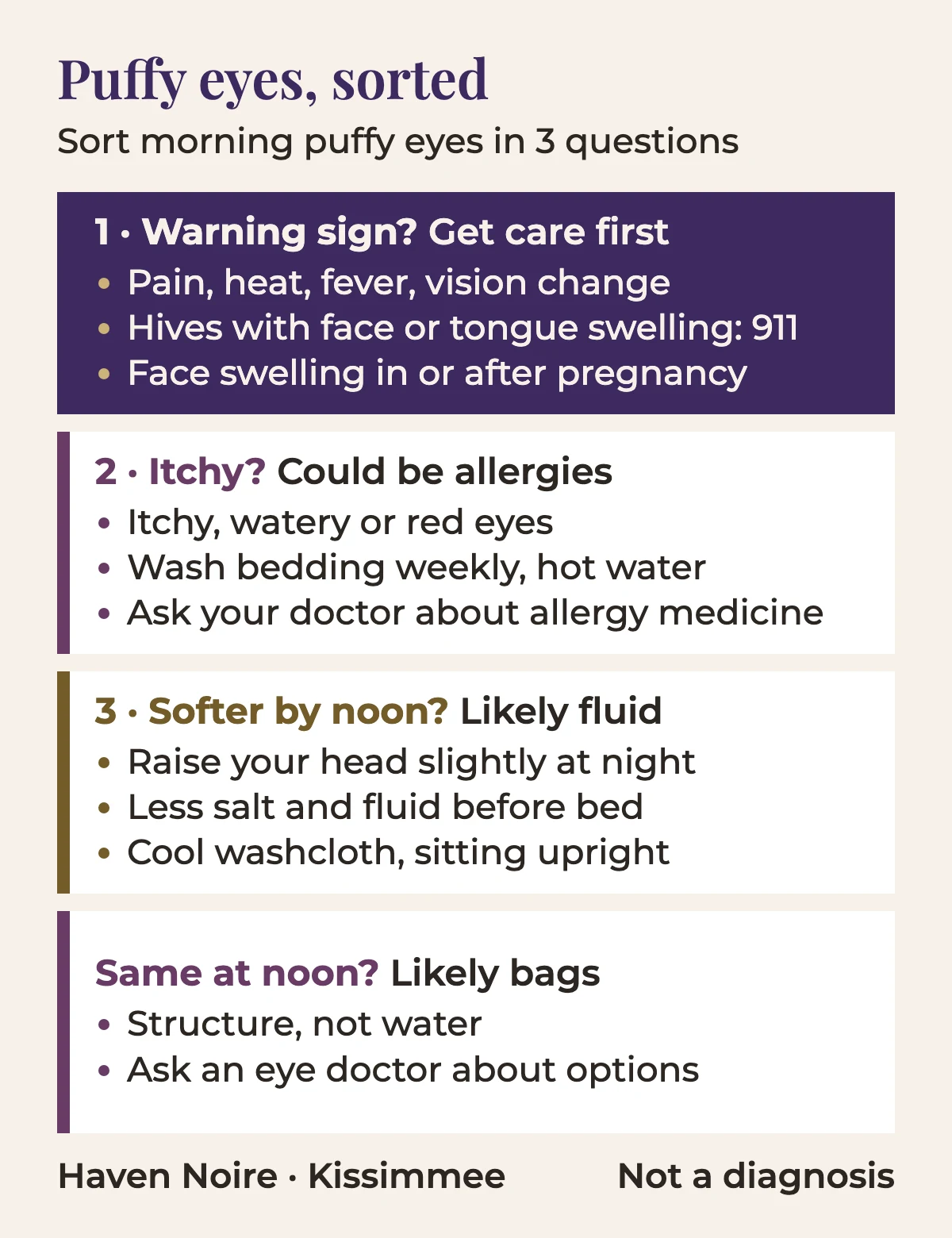
Question 1: Is There a Warning Sign?
Check this first, every time. Puffiness with pain, heat, fever, a vision change, or an eye you can't open isn't a skincare problem. Neither is swelling of your face, hands, or around your eyes in pregnancy or the 6 weeks after delivery. Hives with face or tongue swelling, a tight throat, or trouble breathing means 911. The doctor section below has the rest.
Question 2: Does It Itch?
Itchy, watery, or red eyes with puffy lids can point to allergies. MedlinePlus lists puffy eyelids, "most often in the morning," among the symptoms of allergic eye inflammation, along with itching and tearing. The NHS adds that itchy, swollen lids can also come from blepharitis or conjunctivitis, so don't self-diagnose.
Question 3: Is It Softer by Noon?
Look again around midday. Softer or gone points to overnight fluid. The same at noon as at 7 a.m., most days, points to under-eye bags: structure, not water. Noon is our rule of thumb, not a medical cutoff. The AAO links fluid retention to waking up, so a few hours upright is a fair test.
| What it may be | What you notice | Your next step |
|---|---|---|
| Warning sign | Pain, heat, fever, vision change, hives with face or tongue swelling, face swelling in or after pregnancy | Get medical care first; call 911 for hives with face or tongue swelling or trouble breathing |
| Possible allergies | Itchy, watery, or red eyes with puffy lids | Hunt bedroom triggers; ask your doctor about allergy medicine |
| Overnight fluid | Puffy on waking, softer by noon, no pain | Head up, less salt late, a cool compress |
| Under-eye bags | The same all day, most days, sometimes like a parent's eyes | Habits won't flatten it; ask an ophthalmologist about options |
How to Get Rid of Puffy Eyes in the Morning From Fluid
If your puffy eyes in the morning soften by noon, they answer to small changes at night and a gentle start to the day. Every step below comes from the AAO unless noted.
Tonight
- Add an extra pillow or prop up the head of your bed a few inches.
- Drink enough water during the day, but avoid fluids right before bed.
- Go easy on salt at dinner.
- Keep alcohol light.
- Aim for seven to nine hours of sleep.
Tomorrow Morning
- Sit up first.
- Wet a clean washcloth with cool water and place it around your eyes for a few minutes, with very gentle pressure.
- Keep it cool, not frozen. Our rule: never put ice or anything frozen directly on bare eyelid skin; wrap it in a clean cloth first.
- Tap, don't rub, when you apply eye products, as that explainer suggests.
Curious about face dunks, ice rollers, and frozen spoons? Our sibling guide to face icing covers cold therapy and how to keep it safe.
Do Eye Creams Help Puffy Eyes?
The evidence is thin. A 2024 review in the International Journal of Women's Dermatology looked at common eye cream ingredients, including caffeine and peptides. It found some promise for wrinkles, pigment, and hydration, but called the lack of clinical trials on eye cream formulations a notable limitation.
Our advice: choose a fragrance-free eye cream, tap it on gently, and expect comfort, not a new eye shape. If you're pregnant, or use tretinoin, isotretinoin, or another prescription skin medicine, ask your doctor or dermatologist before adding an active eye cream.
Puffy Eyes From Allergies in Central Florida
If puffy eyes itch, allergies are worth a look. MedlinePlus says allergic conjunctivitis, an allergic inflammation of the lining of the eye and eyelids, can be triggered by pollen, dust mites, pet dander, or mold.
Florida gives allergies a long runway. UF/IFAS Extension says Florida has more frequent and longer pollen seasons than most of the country, with February to May the peak for the state's 11 oak species.
Start With Your Bed
Itchy puffiness on waking often points back to where you slept. MedlinePlus's guide to dust allergies says most dust mites in your home live in bedding, mattresses, and box springs, and that they thrive in moist air.
- Wash bedding and pillows weekly in hot water, 130°F to 140°F, as MedlinePlus advises.
- Wrap your mattress and pillows in mite-proof covers.
- Run a dehumidifier; MedlinePlus says 30% to 50% indoor humidity keeps mold spores down.
- Check your pillow: the AAO names feather pillows, pets on the bed, and bedtime skin care as possible triggers.
- During peak pollen hours, 10 a.m. to 4 p.m., UF/IFAS suggests staying inside.

Treat the Itch, Don't Rub It
MedlinePlus lists lubricating eye drops and cool compresses among the steps that ease allergic eye symptoms. It adds that over-the-counter antihistamine pills, or eye drops with an antihistamine or decongestant, can offer more relief but can sometimes make your eyes dry. Before you start any allergy medicine, ask your doctor, as the AAO also suggests.
Two cautions from MedlinePlus: do not use those eye drops if you have contact lenses in, and do not use decongestant eye drops for more than 5 days, as rebound congestion can occur. Contact a provider if symptoms don't respond to self-care and over-the-counter treatment, your vision is affected, eye pain is severe or getting worse, or your eyelids or the skin around your eyes turn swollen or red.
Then keep your hands off: the AAO advises avoiding excessive eyelid rubbing. If the itch started after a new night cream, simplify; our guide to repairing a stressed skin barrier walks through how.
Under-Eye Bags That Don't Budge
If your eyes look the same at noon as at sunrise, day after day, habits can only do so much. The AAO says home remedies can lessen puffiness from fluid and the look of shadows. Fat that has shifted forward isn't fluid, so a pillow won't move it.
The AAO lists the treatment options: laser resurfacing, chemical peels, fillers, and an eyelid surgery called blepharoplasty, which may help depending on the cause. It says to talk with your ophthalmologist about them. Lasers, fillers, and surgery aren't on our menu, and our chemical peels aren't an under-eye bag treatment. For treatments that sit outside a spa, see the off-menu section of our types of facials guide.
Puffiness, Shadows, or Dark Circles on Melanin-Rich Skin
On brown and Black skin, it helps to tell puffiness from darkness. The AAO says the dark circles you see after a sleepless night are likely shadows cast by puffy eyelids, and that shadows aren't the same as true dark circles.
True dark circles are often inherited, a pattern called periorbital hyperpigmentation. The AAO says people with darker skin tones are more likely to have them, and that allergies, and for some people sun exposure, can cause them too.
Our rule of thumb: if the darkness lifts when the puffiness does, it was mostly shadow. If it stays all day, it's more likely pigment, and pigment calls for gentleness. The AAD's guide to dark spots in darker skin tones says a product that irritates your skin can cause dark spots, and suggests gentler products labeled "for sensitive skin" or "fragrance-free." In our judgment, the same caution applies to rubbing itchy eyes.
For daily protection, see sunscreen for dark skin. For marks that have already formed, read how to fade hyperpigmentation on melanin-rich skin.
Where a Facial Fits for Puffy Eyes
We're estheticians, not doctors, so here's the honest version. A facial can't treat allergies, diagnose swelling, or move fat under your eyes. It can offer an unhurried visit, a trained look at your skin, and gentle care for an area most of us rub too much.
Our 90-minute Signature Facial ($110, or 3 for $285) includes facial massage, a hand and arm massage, and an added eye treatment. Like every Signature Facial, it begins with a double cleanse and a customized skin analysis and finishes with serums, moisturizer, and SPF. The 60-minute version is $95.
Our menu also invites you to ask about lymphatic facial massage, so ask us at your visit. We searched PubMed in November 2026 for studies of lymphatic drainage or facial massage and under-eye puffiness or eye bags, outside of surgery, and found none showing it reduces either. So we won't promise it de-puffs your eyes.
Want that visit monthly? The Ritual Membership is $94.99 a month for one 90-minute Signature Facial, with a three-month minimum, and members get 10% off extra services and in-spa products. Compare tiers on our memberships page.
At your skin analysis, tell us about allergies, eye creams, and any prescription you use near your eyes. First time with us? Here's what happens at each step of a first facial.
When to See a Doctor About Puffy Eyes
The AAO says bags and shadows are usually harmless, but to see an ophthalmologist if swelling around your eyes is painful, itchy, red, or doesn't go away. Here's the rest, sorted by urgency. If you're unsure which group fits, choose the more urgent one.
Call 911
- Hives with face or tongue swelling, throat tightness, wheezing, shortness of breath, or fainting. MedlinePlus lists these as reasons to call 911 in its page on hives.
Get Care Right Away
- A swollen eyelid that's red, hot, painful, tender, or blistered, a lid that droops suddenly, or an eye you can't open. The NHS lists these, along with eyesight changes and a very high temperature, as reasons for an urgent appointment.
- Eyelid swelling with fever, bulging, pain when you move your eye, double vision, or a shiny red or purple eyelid. MedlinePlus calls orbital cellulitis, an infection of the fat and muscles around the eye, a medical emergency that needs treatment right away.
- Swelling of your face, hands, or around your eyes while you're pregnant or in the 6 weeks after delivery. MedlinePlus lists it among preeclampsia symptoms and says the risk lasts up to 6 weeks after delivery. ACOG says to call your ob-gyn right away if you have symptoms like these.
- Puffy or red eyelids with bulging eyes or double vision. The American Thyroid Association lists these among the symptoms of thyroid eye disease and says to contact your doctor immediately if you notice them.
Book an Appointment
- Puffiness that doesn't go away, or comes with itching or redness: the AAO's line for seeing an ophthalmologist.
- Puffy lids with no clear cause. In the AAO's Ask an Ophthalmologist series, an ophthalmologist lists sinus infection, allergies, thyroid eye disease, long-term steroid use, renal failure, age, and genetics as causes.
- Swelling around your eyes plus swelling in your belly, legs, or feet. MedlinePlus says swelling, including around the eyes, is the most common symptom of nephrotic syndrome, a kidney disorder, and to contact your provider if you notice these signs.
See a Dermatologist
- Itchy, red, swollen eyelids that keep coming back. The AAD says atopic dermatitis, the most common type of eczema, can develop on your eyelids and cause itchy skin and red, swollen eyes.
- Redness or stinging around your eyes and cheeks that keeps returning. We can't diagnose rosacea; see how we approach sensitive and redness-prone skin alongside your doctor's care.
- Tretinoin, isotretinoin, or another prescription used near your eyes. Ask your dermatologist before adding anything new to the area.
Frequently Asked Questions About Puffy Eyes
How long do puffy eyes from sleeping last?
It varies. The AAO links fluid retention to waking up and says sleeping with your head raised slightly can keep fluid from settling around your eyes. Our tip: look again at noon. If it looks the same most days, it may be structural bags. If swelling hurts, itches, turns red, or doesn't go away, see an ophthalmologist.
Does drinking more water help puffy eyes?
It can help when dehydration is part of the picture, since the AAO lists not drinking enough water as a contributor. The same guide suggests avoiding fluids right before bed and limiting salt to reduce fluid retention overnight. Our tip: drink steadily, then ease off after dinner. Tight skin too? See dry vs. dehydrated skin.
Why do my eyes look puffy and dark at the same time?
It may be shadow. The AAO says the dark circles you see after a sleepless night are likely shadows cast by puffy eyelids. True dark circles are often inherited, and the AAO says they're more common in people with darker skin tones. Our rule of thumb: if the darkness fades when the puffiness does, it was mostly shadow, not pigment.
Can allergies cause puffy eyes in the morning?
Yes. MedlinePlus lists puffy eyelids, most often in the morning, among the symptoms of allergic conjunctivitis, along with itching, red eyes, and tearing. Common triggers include pollen, dust mites, pet dander, and mold. Washing bedding weekly in hot water and asking your doctor about allergy medicine are sensible first steps.
Can a facial get rid of under-eye bags?
No facial can move fat that has shifted under your eyes. For bags, the AAO lists laser resurfacing, chemical peels, fillers, and eyelid surgery, and says to talk with your ophthalmologist about them. Our 90-minute Signature Facial ($110) includes an added eye treatment: a restful extra step, not a fix for structure.
Are puffy eyes a sign of a health problem?
Usually not. The AAO calls bags and shadows usually harmless. But an AAO ophthalmologist lists sinus infection, thyroid eye disease, long-term steroid use, and renal failure among possible causes of puffy lids. See a doctor for puffiness that lasts, hurts, itches, or turns red, or that comes with fever, vision changes, or swelling elsewhere.
More from the Journal

About the author
Tiffany · Licensed Esthetician · Licensed PMU Artist
Tiffany is a Florida-licensed esthetician and permanent makeup artist and the founder of Haven Noire. She specializes in customized facials, corrective skincare, and waxing for melanin-rich and all skin types, and is known for a calm, education-first approach that puts first-time clients instantly at ease.
Meet Tiffany →