
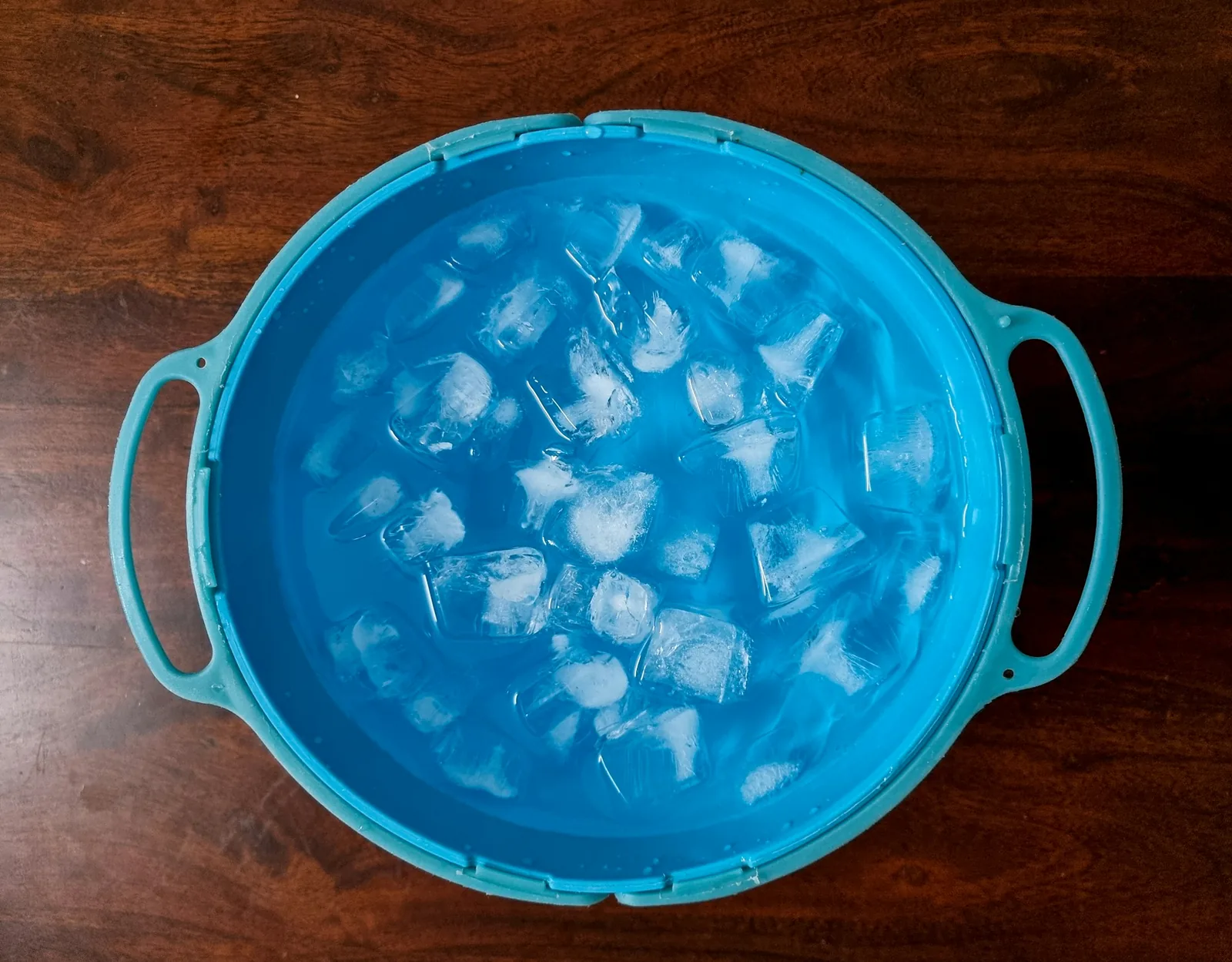
As of November 2026, the ice bath for your face is still a fixture on beauty feeds: you dunk your face in a bowl of ice water for a few seconds, or rub it with ice or a chilled roller, to look less puffy and more awake. NBC News Select reported in February 2026 that its writer's feed was full of people giving themselves ice bath facials, including influencers and celebrities de-puffing before big events.
Here's the short answer. Cold narrows blood vessels, which can briefly calm puffiness and redness, and the experts NBC interviewed agreed the benefits last for a few hours. One dermatologist told NBC there's no strong evidence that regular facial ice baths create lasting anti-aging changes like boosting collagen. So it's a morning wake-up, not a treatment.
The better question is how to do it safely. Most guides skip three things: a cold dunk also slows your heart, the redness of a cold injury is harder to see on brown and Black skin, and some conditions make icing a bad idea. Below you'll find a way to pick the mildest method that does the job, plus who should skip it and gentler routes to the same goal.
What Is an Ice Bath for Your Face?
An ice bath for your face is a short dunk into a bowl of cold water and ice cubes, a few seconds at a time. Face icing is the wider trend: ice, chilled rollers, or cold spoons moved over the skin.
- The dunk: a bowl of cold water and a few ice cubes.
- The wrapped cube: ice in a thin cloth, moved in small circles.
- Chilled tools: a roller, metal globes, or spoons kept cold.
- The cool splash: cold tap water or a damp washcloth.
A 2021 Cleveland Clinic article on facial icing quoted an aesthetician who called it "a temporary way to get a little wake-up for your skin after a long night or a hard day." That's still the most honest description we've found.
If your main goal is calmer eyes on waking, our sibling guide to puffy eyes in the morning covers causes, allergies, and the cool washcloth compress. This guide covers cold for the rest of your face.
What Face Icing Actually Does, and How Long It Lasts
A New York dermatologist told NBC that ice water causes rapid constriction of blood vessels, which "can temporarily reduce inflammation, puffiness, and redness." She said it may also minimize the appearance of pores and decrease surface oiliness, and that many people report an immediate awakening effect.
The key word is temporarily. Our guide to making large pores look smaller explains why the pore effect fades. For changes that last, our sibling guide on how to prevent wrinkles ranks what has evidence, with daily sunscreen first.
What Research Has Tested
We searched PubMed in November 2026 for "facial icing," "face icing," "ice roller," "ice facial," and "cold water facial," and for facial cooling or face immersion studies that measured puffiness, redness, oil, or swelling. We found no trial of icing as a skin care routine. The studies we found looked at heart rate, breathing, and exercise.
One first-person test points the same way. A Healthline writer who dunked her face in ice water every morning for a week wrote that she looked the same before and after, though the cold helped her wake up.
What a Cold Dunk Does Beyond Your Skin
Cold water on your face sets off the diving response, a reflex that slows your heart. A 2011 review in the Journal of Cardiovascular Medicine says it's triggered by holding your breath and accentuated by immersing your face in cold water. In people, it adds, the drop in heart rate varies a lot from person to person and generally ranges from 15% to 40%.
The reflex is strong enough that MedlinePlus lists splashing ice water on your face among the techniques for interrupting a fast heartbeat during PSVT, a heart rhythm problem. That shows how strong the reflex is; it isn't something to test at home. A 2001 review of scuba diving risks in Swiss Medical Weekly notes that when the face is immersed in icy water, the slowing can be so pronounced that fainting results. And in a small 2018 study, a bag of ice water on the forehead, eyes, and cheeks for 3 minutes slowed heart rate and raised blood pressure in 10 healthy young adults.
For most healthy people, it's a normal reflex. In our view, it's the reason to dunk sitting down, and the reason anyone with a heart condition, high blood pressure, or a history of fainting should ask a doctor first.
Start With the Mildest Face Icing Method
Here are five common at-home face icing methods, sorted from mildest to harshest, using the Cleveland Clinic article, the dermatologists NBC interviewed, and first-aid advice from MedlinePlus and the NHS. Any timing or rule that isn't from those sources is our own suggestion, not a medical rule.
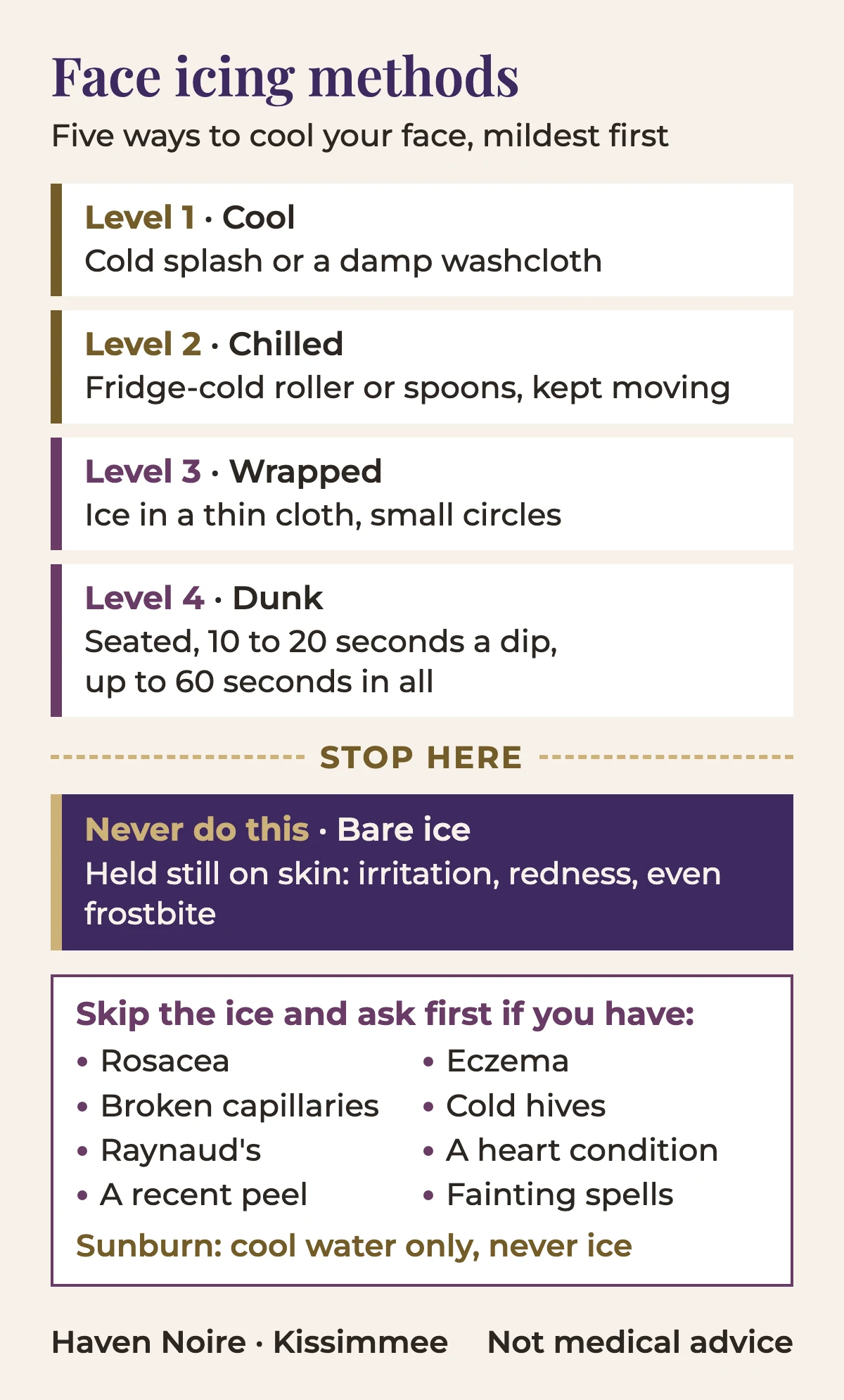
The wake-up fades within hours at every level, but the risk climbs as the cold gets more direct. So if nothing on the skip list below applies to you, start at the top, and move down a level only if you liked it.
| Level | Method | How to do it | Watch for |
|---|---|---|---|
| 1. Cool | Cold tap water splashed on, or a damp washcloth | A few splashes, or the cloth for a minute | Nothing extra for most people |
| 2. Chilled | A roller or spoons kept in the fridge | Keep it moving for a minute or two | Fridge, not freezer |
| 3. Wrapped | An ice cube in a thin cloth | Small circles, never parked in one spot | Stinging, numbness, pale skin |
| 4. Dunk | A bowl of cold water and a few ice cubes | 10 to 20 seconds a dip, 30 to 60 seconds in all, seated | Pain, dizziness, a headache |
| Never | Bare ice held still on skin | Don't | Irritation, redness, even frostbite |
Why Colder Isn't Better
None of the sources we read for this guide says colder or longer works better. The aesthetician in the Cleveland Clinic article warns that leaving ice in one spot too long could cause irritation and redness, "and even frostbite." MedlinePlus's first-aid advice for sprains puts it plainly: wrap the ice in cloth, and do not place ice directly on the skin.
On Brown and Black Skin, Don't Wait for Redness
The usual warning sign is redness, and on melanin-rich skin you may not see it. The NHS says early frostbite can leave skin red or pale, and that redness may be harder to see on black or brown skin. It says frostbite can happen at 32°F (0°C) or below, and ice from the freezer starts out colder than that.
So go by feel. MedlinePlus lists a pins and needles feeling followed by numbness, and hard, pale, cold skin, among frostbite symptoms. Stop at stinging, burning, or numbness, not at a color change.
Why it matters: the AAD lists a burn or other injury among the things that leave dark spots on darker skin tones as they heal. It doesn't name ice. In our view, a cold burn still counts. Our guide to skin care for Black skin covers the other everyday causes of dark marks.
How to Do an Ice Bath for Your Face Safely
Still want to try Level 4 after reading the skip list below? The timing and stop signs come from NBC's dermatologist; other sources are named in each step.
- Read the skip list first. If anything on it applies, don't dunk; ask your doctor or dermatologist what's safe for you.
- Fill a clean bowl with cold water and add a few ice cubes.
- Sit at a table or counter. Given the diving response, our advice is not to dunk standing up.
- Take a breath and lower your face in for 10 to 20 seconds.
- Lift, rest a few seconds, and repeat, for 30 to 60 seconds in all.
- Stop right away for pain, burning, numbness, dizziness, or a headache coming on.
- Pat dry and moisturize, which the Cleveland Clinic article says keeps your skin from drying out.
- Keep it to once a day at most, as that article's aesthetician advises.
Using a Wrapped Cube or a Chilled Roller
- Wrap an ice cube in a thin cloth. The Cleveland Clinic article says this protects the skin on your face and your hands.
- Move it in small circles over your forehead, cheeks, nose, chin, and jaw. Don't let it rest in one spot.
- Our tip: keep rollers and spoons in the fridge, not the freezer. If it hurts to hold, it's too cold for your face.
- Wash chilled tools between uses, and don't share them.
- Leave your eyelids to the cool washcloth method in our puffy eyes guide.
Just had a facial? Our Signature Facial aftercare says to skip harsh actives and heat for 24 hours, so ask us before adding cold. Our first facial guide covers the rest of aftercare.
Who Should Skip Face Icing
Skip the ice, and ask your doctor or dermatologist before any cold routine, if one of these applies. Each line names its source, or says when it's our own advice.
- Rosacea. The AAD says cold can trigger rosacea. See how we approach sensitive and redness-prone skin.
- Broken capillaries. If you can see a spider web of little red lines under your skin, the Cleveland Clinic article says to avoid ice.
- Sensitive skin, eczema, or another chronic inflammatory skin condition. NBC's dermatologist says to avoid ice baths or proceed with extreme caution, since extreme cold can worsen redness and compromise the skin barrier.
- Welts or an itchy rash after cold. The AAD says this may be cold urticaria, hives triggered by cold. One test dermatologists use for it is an ice cube in a plastic bag on your forearm.
- Raynaud phenomenon. MedlinePlus says cold can cause blood vessel spasms, most often in the fingers, though the lips or nose can change color too. It advises avoiding cold in any form and wearing gloves when handling ice.
- A heart rhythm condition, high blood pressure, or fainting spells. This one is our own advice, given the diving response above.
- Diabetes, or a beta-blocker medicine. MedlinePlus lists both, along with smoking and Raynaud phenomenon, among the things that make frostbite more likely.
- A sunburn. The NHS says not to put ice or ice packs on sunburned skin; use a cool shower, bath, or damp towel instead. See what sunburn looks like on Black and brown skin.
- A recent peel, laser treatment, or other procedure. The Cleveland Clinic article says to skip facial icing while you recover. In our view, that includes dermaplaning and microdermabrasion; ask whoever did your treatment when it's safe to add cold.
- Pregnancy, or isotretinoin, tretinoin, or another prescription skin medicine. We found no source on icing for these, so this one is our own advice: check with your doctor or dermatologist first.
Safer Ways to Get What You Wanted From the Cold
Here's a gentler first move for each reason people reach for ice.
| If you wanted | Try this first | Where it comes from |
|---|---|---|
| Less puffiness on waking | A cool compress, or a clean, damp washcloth kept in the fridge | A dermatologist NBC interviewed, who says these carry less irritation risk than a dunk |
| To cool down after a hot workout | A towel dipped in cold water and draped around your neck | The AAD's rosacea flare tips |
| Relief for a sore, deep pimple | Wrapped ice, briefly, hands off; a pimple patch once it has a head | The AAD's pimple-popping guide: "Ice reduces the inflammation" |
| A fresh look before makeup | A gentle cleanse, then moisturizer and sunscreen in the right order | Our morning skincare routine |
| Relief from a sunburn | A cool shower, bath, or damp towel, never ice | The NHS |
| Firmer-looking skin over time | Daily sunscreen first | Our wrinkle prevention guide |
Cooling Down in Florida Heat
In Central Florida, a midday walk or workout can leave your face flushed most of the year. The AAD's rosacea advice suggests exercising somewhere cool, like an air-conditioned gym or a shaded path during the coolest part of the day, and keeping a cold, wet towel handy for your neck.

Our take: that works for skin without rosacea too, and it keeps the cold off your face. If sweat leaves your skin stinging, our guide to repairing a stressed skin barrier covers the rinse-and-moisturize routine.
Where a Facial Fits
We're estheticians, not doctors, so here's the honest version. A facial won't do what a cold dunk does, and it isn't trying to. It's an unhurried visit with a trained look at your skin.
Our Signature Facial begins with a double cleanse and a customized skin analysis, then exfoliation and extractions as needed, a custom mask with facial massage, and serums, moisturizer, and SPF. The 60-minute facial is $95 (3 for $210). The 90-minute facial is $110 (3 for $285) and adds a hand and arm massage and an added eye treatment.
We won't promise to de-puff you, and our menu doesn't list a cold step; ask us when you book if that matters. At your skin analysis, tell us if you ice at home, flush easily, or get welts from cold.
Want a regular visit? The Glow Membership ($74.99 a month) covers a 60-minute Signature Facial and the Ritual Membership ($94.99) the 90-minute one, each with a three-month minimum. Compare them on our memberships page.
When to See a Doctor or Dermatologist
Haven Noire is an esthetics spa, not a medical office. Stop icing and get help for any of these.
Call 911
- Trouble breathing, wheezing, throat tightness, tongue or face swelling, or fainting after cold exposure. MedlinePlus lists these as reasons to call 911 with hives.
- Hard, frozen skin, swelling with loss of feeling, or blisters after cold. The NHS lists these frostbite signs as reasons to get emergency care.
Get Care Promptly
- Skin that stays pale or numb after icing. MedlinePlus says to contact your provider if normal feeling and color don't return promptly after home treatment for mild frostbite.
- A heartbeat that feels too fast, too slow, or irregular during or after a dunk. In our view, that's a question for a doctor, not an esthetician.
Book an Appointment
- Welts, itching, or burning on skin exposed to cold. The AAD says a board-certified dermatologist can help find out whether it's cold urticaria.
- Fingers that turn white or blue in the cold and don't return to their usual color. That's MedlinePlus's line for contacting a provider about Raynaud phenomenon.
- Redness or swelling that keeps coming back, so you find yourself icing every day. A dermatologist NBC interviewed says that's worth addressing the underlying cause instead. Not sure who to see first? Our esthetician vs. dermatologist guide helps you sort it.
Frequently Asked Questions About Face Icing
How long should you put your face in ice water?
A dermatologist NBC interviewed suggests 10 to 20 seconds per dip, a few seconds of rest, then repeating, for 30 to 60 seconds in total. Stop right away if you feel pain, burning, numbness, dizziness, or a headache coming on. Our advice: sit down while you dunk, since cold water on your face slows your heart.
Does ice really reduce facial puffiness?
Briefly, yes. Cold narrows blood vessels, and the experts NBC interviewed agreed the benefits of an ice bath facial last for a few hours. If you're icing every morning for swelling that keeps coming back, one of those dermatologists says it's worth addressing the underlying cause instead, so ask a doctor or dermatologist.
Can you put ice directly on your face?
We don't recommend it. A Cleveland Clinic article warns that leaving ice in one spot can cause irritation, redness, and even frostbite, and MedlinePlus's first-aid advice is not to place ice directly on the skin. Wrap a cube in a thin cloth, keep it moving, and stop at stinging or numbness.
Is face icing safe for Black skin?
It can be, with care. The NHS says redness from early frostbite may be harder to see on black or brown skin, so go by feel and stop at stinging, burning, or numbness. The AAD lists burns and other injuries among the causes of dark spots on darker skin tones, so gentle beats colder.
Does icing your face shrink pores?
Not for good. A dermatologist NBC interviewed said cold may minimize the appearance of pores, and our pores guide notes that the effect fades once your skin warms back up. Pores look larger for reasons like oil, clogs, and lost firmness, which that guide covers. Cold changes how pores look briefly, not their size.
Is it OK to ice your face every day?
For most healthy skin, a brief session is fine, but the aesthetician quoted by Cleveland Clinic says not to do it more than once a day. Skip it if you have rosacea, broken capillaries, cold hives, or Raynaud phenomenon, ask a doctor first if you have a heart rhythm condition, and moisturize afterward so your skin doesn't dry out.
Is ice good for acne?
It can ease a sore pimple, but it won't clear acne. The American Academy of Dermatology says ice reduces the inflammation of painful acne such as nodules and cysts. Wrap the ice and keep it brief. Clearing acne takes treatment, and the AAD says a dermatologist can help if you don't see results in 4 to 6 weeks.
Keep exploring
More from the Journal

About the author
Tiffany · Licensed Esthetician · Licensed PMU Artist
Tiffany is a Florida-licensed esthetician and permanent makeup artist and the founder of Haven Noire. She specializes in customized facials, corrective skincare, and waxing for melanin-rich and all skin types, and is known for a calm, education-first approach that puts first-time clients instantly at ease.
Meet Tiffany →