

As of November 2026, the idea that sunscreen does more harm than good is still spreading online: an American Academy of Dermatology (AAD) survey released May 1, 2026 found that more than 16 million U.S. adults have cut back on or stopped using sunscreen because of online claims. Among Gen Z adults, 64% said they'd run into sunscreen misinformation online.
So, is sunscreen bad for you? The evidence so far says no. Some filters do absorb into the body, some spray sunscreens were recalled in 2021 for benzene contamination, and some formulas irritate some skin. None of that adds up to a reason to go without. Each concern has a fix that keeps you protected.
Below: what regulators and researchers say, a simple sort for any claim you see online, and what skipping sunscreen costs.
Is Sunscreen Bad for You? What the Evidence Says
No. Sunscreen is regulated as an over-the-counter drug, and the AAD says the science doesn't show that any sunscreen ingredient sold in the U.S. is harmful to human health. Used well, it helps protect you from sunburn, early skin aging, and skin cancer.
That line comes from the AAD's 2023 warning about unsafe skin care trends, where a dermatologist described a huge rise in anti-sunscreen sentiment on social media, with people posting that most sunscreens lead to cancer or contain cancer-causing ingredients. The academy's verdict: those claims aren't backed by science.
The FDA agrees. Its consumer sunscreen page, current as of October 2026, says consumers should continue to use sunscreen, along with other sun protection measures, to reduce risks from sun exposure.
What's still under review
The online worry gets one thing half right: the FDA is still collecting safety data on 12 sunscreen filters, including oxybenzone, avobenzone, octocrylene, and homosalate. The AAD's sunscreen FAQ is clear about what that means: the FDA does not say these ingredients are unsafe, and it does not ask the public to stop using sunscreens that contain them.
Two filters aren't waiting on that review. On its sunscreen regulation page, current as of September 2026, the FDA says it found sufficient safety data on zinc oxide and titanium dioxide, the mineral filters, to support proposing them as generally recognized as safe and effective. Some sunscreens leave a white film on deeper skin, so our guide to sunscreen for dark skin shows how to find a tinted one that blends.
Sorting Sunscreen Myths Into Four Types
The doubt is widespread. A spring 2026 survey of 2,000 U.S. adults for the nonprofit Melanoma Research Alliance found 53% had seen claims that sunscreen ingredients may be harmful. In our reading, those claims often blend four different worries into one headline.
To pull them apart, ask what the claim is really about: the ingredients, a batch, your skin, or the sun itself. This sorting is our own, not a medical rule, and it doesn't replace your doctor or dermatologist. Notice the pattern: two types end in switching products, one in tossing a recalled product, one in a talk with your doctor, and none in going without.
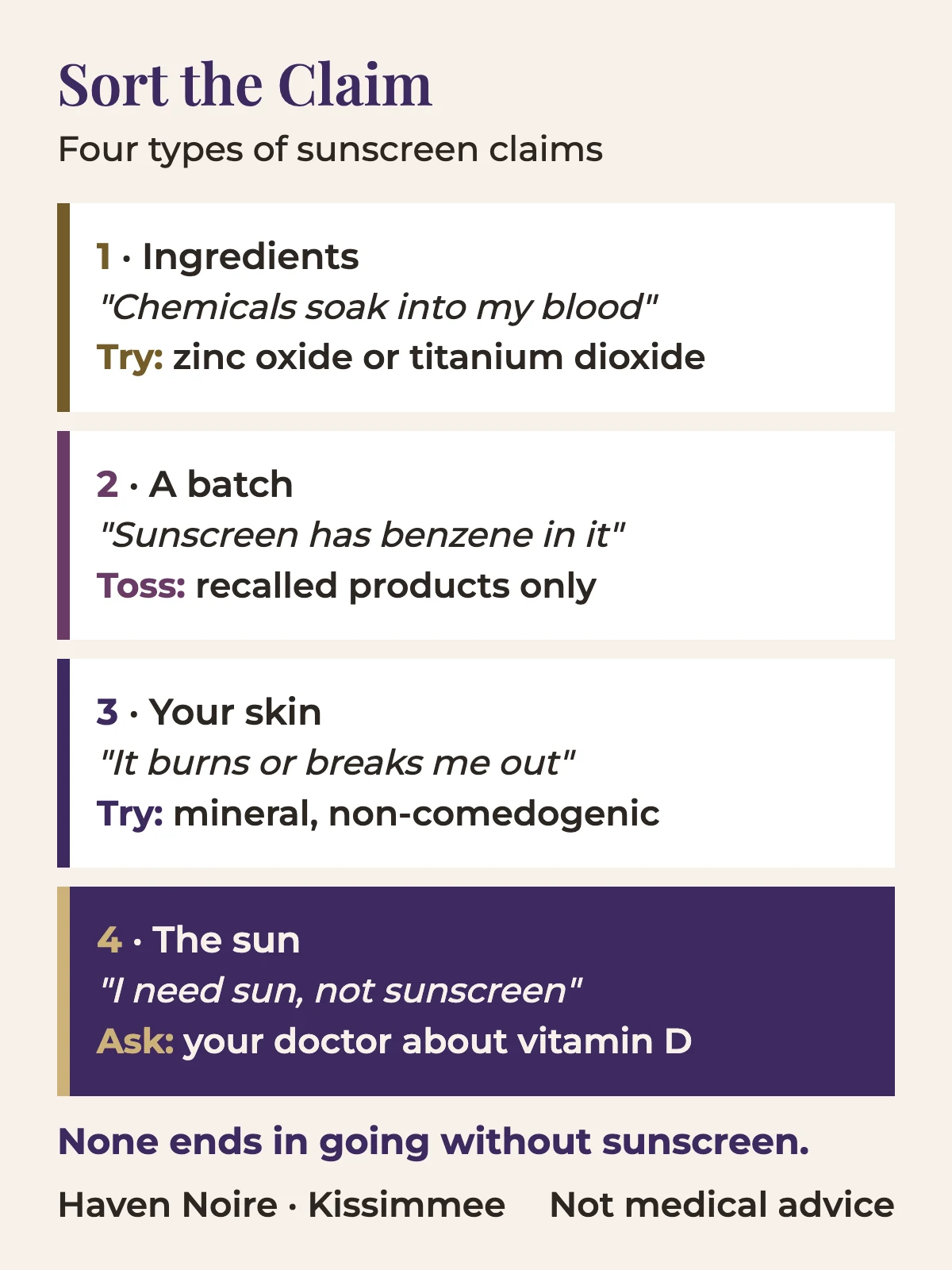
1. Ingredient claims ("chemicals soak into your blood")
This claim starts from a real finding. In a 2020 FDA randomized trial published in JAMA, 48 healthy adults, nearly half of them African American, applied sunscreen to three-quarters of their body once on day one, then four times a day for three days. All six filters tested, oxybenzone and avobenzone among them, reached blood levels above 0.5 ng/mL, the FDA's cutoff for possibly waiving some extra safety studies.
Crossing that line is a trigger for more safety studies, not a finding of harm. The researchers wrote that their findings do not indicate that people should stop using sunscreen. A 2024 review in the Journal of the American Academy of Dermatology agrees: chemical filters are absorbed during routine use, but to date there is no evidence of associated negative health effects.
Then there's oxybenzone and hormones. A 2020 systematic review of 29 studies in the International Journal of Dermatology found reported associations between oxybenzone levels and thyroid hormone, testosterone, kidney function, and timing of puberty. The authors said those associations prompt further investigation, and concluded the evidence doesn't support a causal link between oxybenzone levels and health harms.
What to do: switch filters if you'd rather
- Choose a mineral sunscreen, with zinc oxide, titanium dioxide, or both as the only active ingredients.
- Nanoparticle worry? In a 2019 study in the Journal of Investigative Dermatology, zinc oxide nanoparticles applied to volunteers' skin for five days collected on the surface and in fine furrows, and didn't enter the living layer of skin.
- Watch for bemotrizinol, which the FDA added in June 2026 and the AAD calls the first new U.S. sunscreen ingredient in more than 20 years. The AMA reports the FDA found it caused little irritation or absorption into the skin.
2. Batch claims ("sunscreen has benzene in it")
Benzene is a known human carcinogen, and it turned up in certain batches of sunscreen, as a 2022 paper in the Journal of Drugs in Dermatology summarized. The FDA says certain spray sunscreens were recalled because of benzene contamination, and Poison Control says several sunscreen products were recalled in 2021.
Benzene isn't a sunscreen ingredient: a 2025 risk assessment in Toxicology Reports notes it isn't intentionally added to cosmetics but may be present in trace amounts as a contaminant. And Poison Control says the levels found were low enough that they're not likely to cause any acute health effects. Its advice: sunscreen use is still strongly recommended, but avoid contaminated products.
What to do: toss the product, keep the habit
The FDA recommends that consumers not use recalled sunscreens, and its consumer sunscreen page shows how to find out if yours was recalled. If it was, toss it and keep protecting your skin with another sunscreen.
3. Skin claims ("it burns or breaks me out")
These are the downsides that are real. Rash was the most common side effect in that FDA absorption trial, reported in 14 of 48 people using sunscreen up to four times a day on most of the body. Poison Control says sunscreens can sometimes cause skin irritation, rash, and allergic contact dermatitis, and that if a reaction occurs, you should switch to a sunscreen with a different active ingredient.
A dermatologist interviewed by the American Medical Association says a sunscreen rash is most likely caused by a chemical formula, and that chemical sunscreens can be sensitizing, especially for people with rosacea. The AAD's FAQ adds that dermatologists recommend mineral sunscreens for people with sensitive skin.
What to do: switch formulas
- Rash or stinging: switch active ingredients, often to a mineral formula. Here's how we approach sensitive and redness-prone skin.
- Breakouts: if your skin is oily, the AAD's dark-spot guide says to choose a non-comedogenic formula, meaning it won't clog pores.
- Sprays: the AAD's spray sunscreen tips say never to inhale it or spray it near your face. Spray your hands, then apply it to your face.
- Stinging eyes: Poison Control suggests a sunscreen stick for your face.
4. Sun claims ("I need sun, not sunscreen")
These are the claims that a tan, melanin, or vitamin D makes sun protection unnecessary. The AAD's 2026 survey found 19% of adults believe a base tan can prevent sunburn or reduce cancer risk, and 29% believe tanning is safe if you don't burn. Its president's answer: there is no such thing as a safe tan.
Melanin gives some protection against UV rays, the NHS says, but people of all skin tones can get skin cancer. Our guide to whether Black people can get sunburn shows what a burn looks like on deeper skin.
Vitamin D is the other big one. The AAD says sun protection may lower how much vitamin D your skin makes, and recommends that healthy adults get it from foods naturally rich in it or fortified with it. In a 2024 letter, its president wrote that no level of sun exposure lets the body make ample vitamin D without raising skin cancer risk.
What to do: ask your doctor, don't guess
If vitamin D worries you, the AAD's advice is to talk with your doctor about your options for getting it. Our suggestion: ask about supplements in that same conversation rather than starting one, or dropping your sun protection, on your own.
| Type | Sounds like | What the evidence says | What to do |
|---|---|---|---|
| Ingredients | "Chemicals soak into your blood" | Absorbed, yes; harm not shown; FDA wants more data on 12 filters | Switch to zinc oxide or titanium dioxide if you prefer |
| Batch | "Sunscreen has benzene" | A contaminant in certain batches; products recalled in 2021 | Skip recalled products, not sunscreen |
| Your skin | "It burns or breaks me out" | Rash and irritation happen, more often with chemical filters | Switch formulas: mineral, non-comedogenic |
| The sun | "I need sun, not sunscreen" | No safe tan; get vitamin D from food, per the AAD | Keep protecting; ask your doctor about vitamin D |
What Skipping Sunscreen Costs: Melanoma, Dark Marks and Florida Sun
Asking whether sunscreen is bad for you is half the question. The other half is what it does for you.
Fewer melanomas in a long-term trial
In a trial in Nambour, Queensland, Australia, 1,621 adults were randomly assigned from 1992 to 1996 to put sunscreen on their head and arms daily, or to use it as they chose. By 10 years after the trial ended, 11 new melanomas had been found in the daily group and 22 in the comparison group. The authors concluded melanoma may be preventable by regular sunscreen use in adults.
Read that at its real strength. The hazard ratio was 0.50 with a P value of .051, just short of the usual .05 line for statistical significance, and it's one trial in one Australian town, so it can't speak for every skin tone. The authors open the paper by noting that regular sunscreen use prevents squamous cell carcinoma of the skin long term.
Fewer dark marks, and protection for treatments you already use
On deeper skin tones, a faster cost can be pigment. The AAD's guide to fading dark spots says sunscreen applied to all skin clothing won't cover can prevent new dark spots and patches and help clear existing ones. Yet its 2026 survey found 26% of adults didn't realize sunscreen helps prevent dark spots. Already working on marks? Our guide to fading hyperpigmentation on melanin-rich skin covers the rest of the plan.
Prescription skin medicines raise the stakes. MedlinePlus advises people using tretinoin to avoid unnecessary or prolonged sun exposure and to wear protective clothing, sunglasses, and sunscreen, especially over treated areas. Its isotretinoin page says that drug may make your skin sensitive to sunlight.
The Kissimmee shadow test
The AAD's rule of thumb: if your shadow is shorter than you are, seek shade. Try it on a Kissimmee lunch break before you decide you don't need protection. As the AAD's president put it in the 2026 release, no amount of sun exposure is necessary or completely safe.
Natural and DIY Sunscreen Swaps: What Works Instead
If you're unsure whether sunscreen is bad for you, a homemade recipe can look like the safer answer. The AAD says it's aware of reports of people making their own, and warned in July 2024 that most homemade sunscreens lack effective sun protection. They skip the FDA testing required of commercial sunscreens, so their SPF, water resistance, and shelf life can't be guaranteed, and protection can vary from batch to batch.
A plain oil or butter has the same gap: the jar carries no tested SPF on its label. If coconut oil or shea butter is already in your routine, our guides to coconut oil on your face and shea butter for skin cover what they can and can't do.
Swaps the AAD recommends
- Clothing: a lightweight long-sleeved shirt, pants, a wide-brimmed hat, and sunglasses with UV protection.
- UPF labels: for more effective protection, the AAD suggests clothing with an ultraviolet protection factor (UPF) number on the label.
- Self-tanner for a bronzed look: the AAD calls self-tanner applied to your skin a safe way to look tan, and says to keep using sunscreen with it. A Wexner dermatologist says it can also camouflage cellulite, though not cure it.

Our tip: the AAD's advice is sunscreen on all skin clothing won't cover, so the more you cover, the less bottle you need.
Where SPF Fits Into a Facial at Haven Noire
We're estheticians, not doctors, so we don't diagnose reactions or recommend prescriptions. What we can do is build sun protection into every visit.
- Every Signature Facial ends with serums, moisturizer, and SPF. Afterward, keep skin hydrated, skip harsh actives and heat for 24 hours, and wear SPF daily.
- Every Corrective Facial ($135, or $360 for three) ends the same way, plus a home-care plan. Avoid sun exposure and active exfoliants for a few days afterward.
- Stronger chemical peels are best scheduled in lower-UV months with diligent SPF, and every peel starts with a skin consultation.
- After any wax, our aftercare asks you to avoid direct sun, heat, friction, and sweat for 24 to 48 hours.
Your esthetician will recommend home-care products at your visit, and you can browse the professional skincare lines we use in treatments before you come in. Glow members ($74.99 a month) get a 60-minute Signature Facial every month, finished with SPF matched to their skin that day, plus 10% off in-spa products. See our monthly memberships.
When to See a Dermatologist or Doctor Instead
Haven Noire is an esthetics spa, not a medical office. Check with your doctor or dermatologist first if:
- You're pregnant and unsure about a product. Poison Control says sunscreens are generally safe on the skin during pregnancy, and to ask your health care practitioner, or call 1-800-222-1222, about a specific one.
- Your baby is under 6 months. The FDA says to ask a doctor before applying sunscreen that young, and the AAD advises shade and clothing first.
- You take isotretinoin, tretinoin, or another prescription skin medicine, or you have eczema or rosacea. Ask which sun protection fits your treatment.
- A condition or medicine makes your skin sensitive to light. Your doctor's sun plan comes first.
- The ingredients still worry you. The AAD's FAQ says a board-certified dermatologist can build a sun-protection plan that works for you.
See a dermatologist or get care if
- A sunburn blisters or keeps getting worse. The AAD says blistering means a second-degree sunburn, not to pop the blisters, and to see a board-certified dermatologist if a sunburn gets worse.
- A spot is new, changing, itching, or bleeding. The AAD's 2026 release says to consult a board-certified dermatologist.
- A rash doesn't settle after you switch active ingredients. That one is our own advice.
- You inhaled spray sunscreen and have trouble breathing. Poison Control says to seek medical attention.
If a reaction left your skin tight and stinging, our guide to calming a stressed skin barrier covers gentle care while it settles.
Frequently Asked Questions About Sunscreen Safety
Is it bad to wear sunscreen every day?
No. The AAD says to apply sunscreen every day to skin not covered by clothing if you'll be outside, and the FDA says to use broad-spectrum sunscreen regularly and as directed, along with other sun protection. If daily use irritates your skin, switch to a different active ingredient instead of stopping.
Is mineral sunscreen safer than chemical sunscreen?
The FDA found enough safety data on zinc oxide and titanium dioxide to propose them as safe and effective, and it's still collecting data on 12 chemical filters. It says that isn't a conclusion those filters are unsafe. The AAD says any type protects well if it's broad spectrum, water resistant, and SPF 30 or higher.
Can sunscreen give you cancer?
Poison Control says sunscreens are not classified as known human carcinogens. Much of the cancer worry traces to benzene, a contaminant in certain batches, not an ingredient; the FDA says some spray sunscreens were recalled for it and not to use recalled products. An Australian trial found fewer melanomas with daily use, a borderline result.
Is sunscreen safe to use while pregnant?
Poison Control says sunscreens are generally safe when applied to the skin during pregnancy. If you have a question about a specific product, ask your OB or health care practitioner, or call Poison Control at 1-800-222-1222. Shade, a wide-brimmed hat, and long sleeves also cut how much skin needs covering.
Why does sunscreen make my skin sting or break out?
Some formulas irritate some skin. Poison Control lists irritation, rash, and allergic contact dermatitis, and a dermatologist interviewed by the AMA says a sunscreen rash most likely comes from a chemical formula. Switch to a different active ingredient, try a mineral sunscreen, and choose a non-comedogenic formula if your skin is oily.
Is homemade or natural sunscreen safer?
Not by the evidence. The AAD says most homemade sunscreens lack effective sun protection, and because they skip the FDA testing commercial sunscreens go through, their SPF, water resistance, and shelf life can't be guaranteed. For sensitive skin, dermatologists recommend a mineral sunscreen with zinc oxide, titanium dioxide, or both.
Does Haven Noire use SPF at the end of a facial?
Yes. Our Signature and Corrective Facials both end with serums, moisturizer, and SPF, and our aftercare asks you to wear SPF daily. A 60-minute Signature Facial is $95, a Corrective Facial is $135, and Glow members get a monthly Signature Facial for $74.99. Bring your sunscreen questions with you.
Keep exploring
More from the Journal

About the author
Tiffany · Licensed Esthetician · Licensed PMU Artist
Tiffany is a Florida-licensed esthetician and permanent makeup artist and the founder of Haven Noire. She specializes in customized facials, corrective skincare, and waxing for melanin-rich and all skin types, and is known for a calm, education-first approach that puts first-time clients instantly at ease.
Meet Tiffany →