

Cellulite is the dimpled, orange-peel texture that shows up on the thighs, hips, and buttocks. It appears where tight connective bands under your skin tug it down while the fat between them pushes up. A 2023 review in Aesthetic Surgery Journal Open Forum says an estimated 80% to 90% of women have it after puberty.
Here's the honest headline. That same review says there is no effective treatment for cellulite and that improvements in its look are short lived, though it notes progress with newer treatments. The American Academy of Dermatology (AAD) says research shows some treatments can make it less noticeable, at least for a while, and its guide lists a few medical procedures with longer-lasting results.
What changes its look sorts into three layers: the bands underneath, the skin on top, and the light you see it in. Pregnant, taking isotretinoin, using tretinoin or another prescription skin medicine, or living with eczema, rosacea, or keloid-prone skin? Check with your doctor or dermatologist before you try a new cream or treatment.
What Is Cellulite?
Cellulite is a harmless change in how skin looks: dimples, dents, or bumps, mostly on the thighs, hips, and buttocks. Fat pushes up against the skin while fibrous bands tug it down, leaving an uneven surface people compare to orange peel or cottage cheese.
A dermatologist at Ohio State's Wexner Medical Center writes that it isn't a serious medical condition and doesn't cause pain. It isn't a measure of obesity or a sign of excess fat either: it affects people at an ideal body weight too. The AAD puts it plainly: most women, even very fit women, have it.
Why women get it and men rarely do
Structure is the leading explanation, though the review says the cause isn't fully understood yet. In women, the fibrous bands (called septa) run straight up toward the skin. In men they crisscross at about a 45 degree angle and are more numerous and more stable, which helps hold fat in place. That's why men, even at a higher body weight, rarely show dimpling.
Hormones play a part too. The review says estrogen likely plays a pivotal role, and that pregnancy, nursing, long-term birth control pill use, and hormone replacement therapy after menopause appear to make it worse. Its risk factors also include age, genetics, diet, and a sedentary lifestyle.
Cellulite on thighs, hips, and buttocks
The review places it mainly where the body stores more fat: the thighs, buttocks, and hips. The Wexner dermatologist adds that it can also appear on the abdomen, breasts, and upper arms. The review says it can start any time after puberty and mostly appears between ages 20 and 30, so if you first noticed it in your twenties, you're right on schedule.
Dimples are one thing; dots and pimples are another. Dark dots on shaved legs are often strawberry legs, and pimples on your seat are covered in our guide to butt acne.
Cellulite on brown and Black skin
Women of all races and ethnicities get it, the review says. It also notes that Caucasian women are more susceptible than Asian or African American women, while admitting that solid data on who gets it are scarce. The Wexner dermatologist says it's more noticeable on lighter skin than on darker skin. Those are patterns across groups, not a forecast for your body.

On melanin-rich skin, the bigger risk is often the routine, not the dimples. The AAD's exfoliation guide warns that more aggressive exfoliation may lead to dark spots, and advises avoiding strong chemical or mechanical exfoliation if you have a darker skin tone. A scrub that leaves your thighs raw can trade dimples for a dark patch that lingers. Our guide to skin care for Black skin shows how irritation opens the door to dark marks.
Three Layers That Change How Cellulite Looks
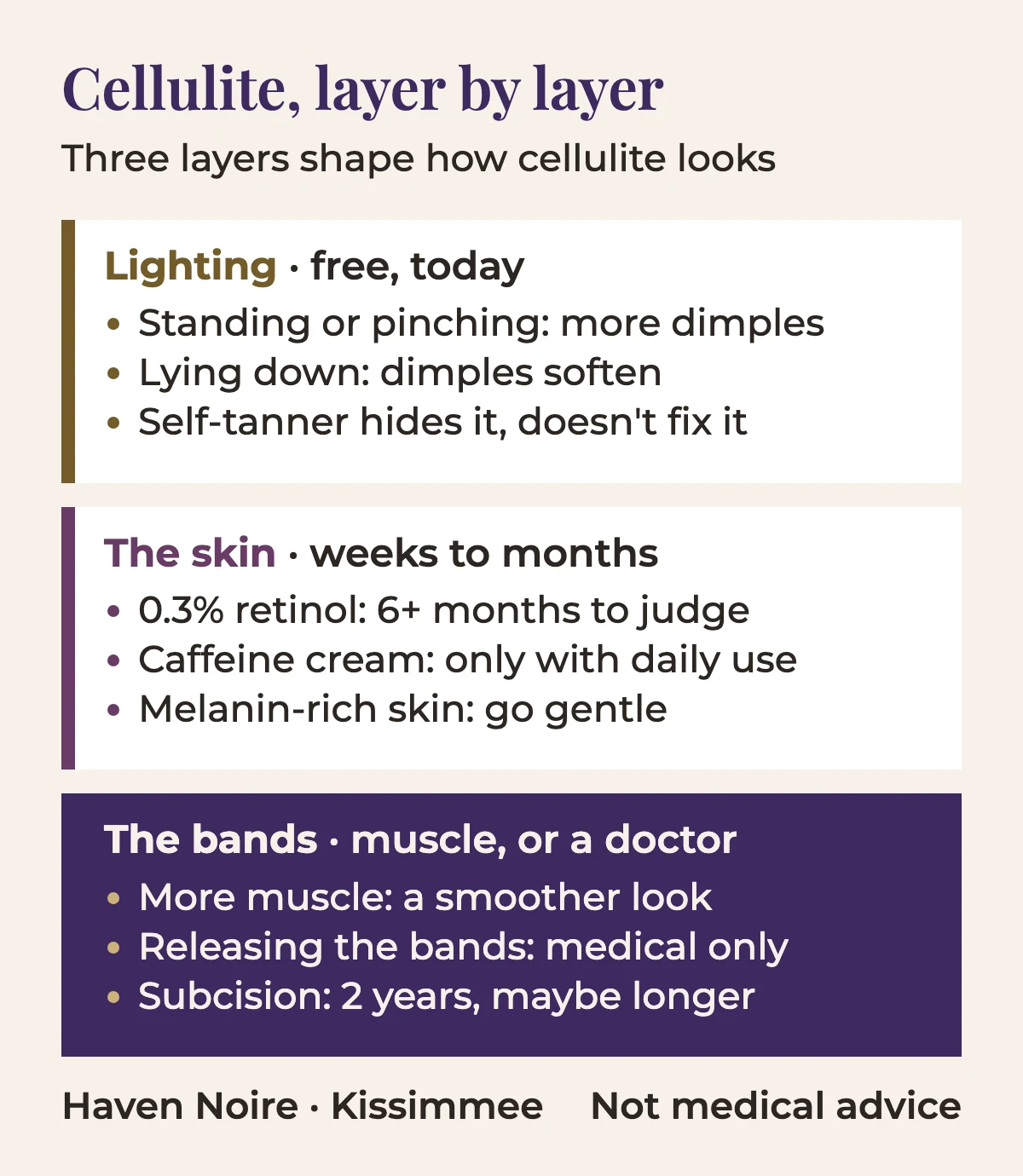
Most guides hand you a list of treatments. We think the better question is which layer a fix works on, because that tells you how much it can change and how long it lasts. The three layers below are built on the AAD's treatment guide and the 2023 review. They're a way to sort your options, not a medical rule.
How pose and light change what you see
This layer changes the most and costs nothing. The review explains that doctors examine patients standing because standing puts more tension on the bands; lying down, the dimples tend to disappear. Tightening the muscle or pinching the skin makes them more visible. So the squeeze-and-stare in a fitting-room mirror shows your dimples at their most visible, not how your skin looks at rest.
The review also notes that handheld lights help doctors see dimples. Our own observation: light from directly above throws each dip into shadow, while soft light from the front fills them in.
Then there's color contrast. Because dimpling shows more on lighter skin, the Wexner dermatologist says self-tanners or bronzers can camouflage it but not cure it. Get that glow from a bottle, not the sun, and keep up the protection in our guide to sunscreen for dark skin.
The skin on top
This is where creams and everyday body care work. The AAD says skin often thins where cellulite forms, and that thickening the skin can help reduce its look; the review explains that retinoids work partly by thickening the skin. The review names two ingredients as the most studied:
- Retinol. The AAD says a product with 0.3% retinol may have some effect, but you'll need 6 months or longer to know.
- Caffeine. The AAD says caffeine products may make dimpling less obvious, but you have to apply them every day to keep the results.
The review adds the fine print: trials of these creams reported improvement but were small and short, and no topical product is approved by the FDA for cellulite.
Everyday care belongs here too. In our view, moisturized, gently exfoliated skin looks and feels smoother on the surface, while the dimples underneath stay put. Our guide to how to get smooth skin covers body exfoliation.
The structure underneath
The bands and the fat between them set the pattern, and only two things reach them. The first is your body. The AAD says more muscle makes skin look smoother and firmer, and that losing extra weight reduces what some people see. Loose skin after weight loss can make dimpling more noticeable, though; the review explains that the bands stretch as weight goes up but don't shrink back when it comes down.
The second is a medical procedure that releases the bands, such as subcision. That's a dermatologist's work, and it isn't on our menu. Not sure who handles what? Our guide to estheticians vs. dermatologists sorts it out.
| Layer | What it is | What can change its look | How long it lasts | Who handles it |
|---|---|---|---|---|
| Light and pose | Pose, muscle tension, lighting, color contrast | Standing relaxed, soft front light, self-tanner | As long as the pose, light, or tan | You |
| Skin on top | Thickness, dryness, texture | 0.3% retinol and caffeine creams, per the AAD | Caffeine: only with daily use. Retinol: judge at 6 months or later | You (body care helps surface dryness and texture, not the dimples) |
| Bands underneath | Fibrous bands and fat under the skin | Muscle, weight changes, procedures that release the bands | Subcision: 2 years and possibly longer, per the AAD | You (muscle) and a dermatologist (procedures) |
How to Get Rid of Cellulite: What the Evidence Says
Short answer: nothing available today removes it for good. The 2023 review calls the efficacy of most treatments unpredictable, and the Wexner dermatologist says there's no long-term effective treatment. Here's how the AAD's guide rates the main options.
| Option | What the AAD says |
|---|---|
| Caffeine creams | May make it less obvious; apply every day to keep results |
| 0.3% retinol creams | May have some effect; use 6 months or longer to know |
| Supplements | No evidence that any supplement can reduce it |
| Vacuum massage device | Results vary and are temporary; dimpling tends to return within 1 month of stopping |
| Spa wraps with electrodes | No independent published studies; any results last about 12 to 18 hours |
| Radiofrequency | A little less in some patients; short lived |
| Laser treatments | Some see less, for 6 months or longer; a bit of dimpling usually returns |
| Subcision | Shown to reduce dimpling; can last 2 years and possibly longer |
| Liposuction | Not recommended; it can make dimpling more obvious |
| Fat freezing | Removes small pockets of fat but cannot get rid of cellulite |
One AAD line explains most of that table: cellulite differs from fat, and treatment that removes fat often has no effect on it.
Massage, brushing, and supplements
If a product or ritual promises to flush dimples away, ask which layer it reaches. The Wexner dermatologist says any improvement from massage would be temporary and related to fluid shifts. Massage isn't on our menu, and our dry brushing guide looks at what a brush can and can't do, cellulite included.

Medical procedures: a dermatologist's call
Subcision, lasers, and radiofrequency are medical treatments, and none of them are on our menu. If you're weighing one, see a board-certified dermatologist; the AAD notes that results depend on the skill and experience of the person doing it.
Ask about bruising and color changes, especially if your skin marks easily. In one large study of manual subcision for advanced cellulite, described in the 2023 review, painful bruising lasted up to 4 months in 90% of people, and staining from the bruising (hemosiderin pigmentation) lasted up to 10 months in all of them before fading on its own. A newer device in the review caused milder bruising. The review also notes that the maker of an injectable cellulite drug the FDA approved in 2020 stopped making and selling it in December 2022, citing concerns about bruising and possible prolonged skin discoloration.
Keloid-prone, or does every scrape leave a dark mark? Our advice: tell your dermatologist before any procedure that breaks the skin. For marks that have already formed, see our page on hyperpigmentation and dark spots.
Spa Body Care and Cellulite: Where Haven Noire Fits
We'll be straight with you: no body treatment, ours included, has been shown to remove cellulite. We're estheticians, not doctors, and Haven Noire is an esthetics spa, not a medical office, so our work stays on the surface of your skin. Here's what our body treatments menu lists for the back of the body:
- Firming Back + Booty: $135 for 60 minutes, for the back, the backs of the legs, and the booty.
- What's in it: an enzyme polish and a peptide-rich firming mask.
- Who it's for: all skin types, per our menu.
- How it starts: a consultation about your goals and your skin.
Releasing the bands underneath takes a medical procedure, so if you book it, judge it by how your skin feels, not by a dimple count.
Our body treatment aftercare asks you to avoid heat, friction, and sun for 24 to 48 hours, exfoliate gently after a few days, and keep skin moisturized. Pregnant, using a prescription retinoid, or taking isotretinoin? Ask your doctor or dermatologist before an exfoliating body treatment, and tell us when you book.
Members get 10% off extra services, body treatments included; see our monthly memberships. We're across from Lakefront Park in downtown Kissimmee, Monday to Saturday, 10 AM to 7 PM.
How to Test a Cellulite Cream Fairly at Home
The next problem: you use a cream for a few weeks and can't tell whether anything changed. The 2023 review says clinicians compare photos taken in the same position and without outside light, since time of day affects lighting. Borrow that method. Steps 1, 2, and 4 come from the AAD; the rest are our suggestions.
- Read the label. If you use an asthma inhaler, the AAD says to avoid any product that contains aminophylline.
- Patch test. The AAD suggests a small area first, using more only if your skin doesn't react within 48 hours.
- Take a baseline photo: same spot, standing relaxed, same room, same time of day, lamp light instead of window light.
- Use one product as directed: caffeine daily, and 0.3% retinol for 6 months or longer, per the AAD.
- Watch for stinging, peeling, a rash, or darkening, and stop if you see any of them.
- Retake the photo once a month under the same conditions and compare side by side.
Pregnant or trying to be? The AAD's retinoid guide says retinoids should not be used during pregnancy, so skip retinol creams and ask your OB-GYN or midwife what's safe. The same guide quotes a dermatologist who warns that with skin of color, irritation can trigger dark marks. New to retinol? Start with our beginner's plan for using retinol.
Cellulite or Something Else? When to See a Doctor
The dimples themselves don't hurt, and a Cleveland Clinic health library article says it isn't necessary to see a provider about them. But a few conditions can look similar, and the 2023 review warns that treatments meant for cellulite may make some of them worse. See a doctor if:
- Skin is red, warm, and tender, and the redness is spreading, especially with fever or chills. MedlinePlus lists those among the symptoms of cellulitis, a common bacterial skin infection, and says to contact your provider right away.
- Your bottom, thighs, and lower legs look out of proportion with the rest of your body while your feet don't, and they feel painful, tender, or heavy, or bruise easily. The NHS describes those as signs of lipoedema, notes its skin can look dimpled like orange peel, and says to see a doctor, urgently if a leg becomes swollen, red, hot, and painful with flu-like symptoms.
- Skin on your breast newly looks red, dimpled, or puckered like the skin of an orange. MedlinePlus lists that change among breast cancer symptoms, so see a doctor promptly to have it checked.
- You see hollows or widespread puffiness rather than small dimples. The review lists lipoatrophy (fat loss), edema, and lymphedema among conditions that can look like cellulite.
- You're a man with new dimpling. The review says it's rare in men and, when it appears, may be linked to low androgen (male hormone) levels, so mention it to your doctor.
See a dermatologist, not a spa, if a cream or scrub leaves a rash or dark patches that don't fade. Thighs sore from rubbing rather than dimpled? Our guide to thigh chafing covers that.
Frequently Asked Questions About Cellulite
Can you get rid of cellulite completely?
Not with anything available today. A 2023 review says there is no effective treatment and that improvements are usually short lived, though procedures that release the bands appear to last longer. The AAD says subcision results can last 2 years and possibly longer. Creams and skin care change how the skin looks, not the structure underneath.
Does losing weight smooth out dimpled thighs?
Sometimes. The AAD says losing extra weight reduces the dimpling some people see, but loose skin after weight loss can make it more noticeable. It also shows up at an ideal body weight. Building muscle helps too: the AAD says more muscle makes skin look smoother and firmer, and can make dimpling less noticeable.
Why do I have dimples on my thighs if I'm thin and fit?
It's mostly about structure, not body size. In women, the connective bands run straight up toward the skin, so fat can push up between them at an ideal weight too. The AAD says most women, even very fit women, have it, and a Wexner Medical Center dermatologist calls it neither a measure of obesity nor a sign of excess fat.
Do caffeine and retinol creams actually work?
Some may help a little while you use them. The AAD says caffeine products may make dimpling less obvious with daily use, and 0.3% retinol may have some effect after 6 months or longer. A 2023 review notes the trials were small and short, and no topical product is FDA approved for cellulite. Patch test first.
Why did my cellulite get worse after pregnancy?
A 2023 review says high-estrogen times, including pregnancy and nursing, appear to make it worse, and that the connective bands stretched by weight gain don't shrink back afterward. Skip retinol creams while pregnant, as the AAD advises, and ask your OB-GYN or midwife before starting any such product or body treatment while nursing.
Is cellulite less noticeable on Black skin?
It can be. A Wexner Medical Center dermatologist says it's more noticeable on lighter skin than on darker skin, and a 2023 review notes Caucasian women are more susceptible than Asian or African American women, though it says solid data are scarce. Women of every race get it. On melanin-rich skin, keep exfoliation gentle.
Do spa body treatments help with cellulite?
None has been shown to remove it, ours included, and we won't promise otherwise. Our Firming Back + Booty ($135, 60 minutes) is an enzyme polish and a peptide-rich firming mask for the back, the backs of the legs, and the booty. It's care for the skin on top; releasing the bands underneath takes a medical procedure.
More from the Journal

About the author
Tiffany · Licensed Esthetician · Licensed PMU Artist
Tiffany is a Florida-licensed esthetician and permanent makeup artist and the founder of Haven Noire. She specializes in customized facials, corrective skincare, and waxing for melanin-rich and all skin types, and is known for a calm, education-first approach that puts first-time clients instantly at ease.
Meet Tiffany →