
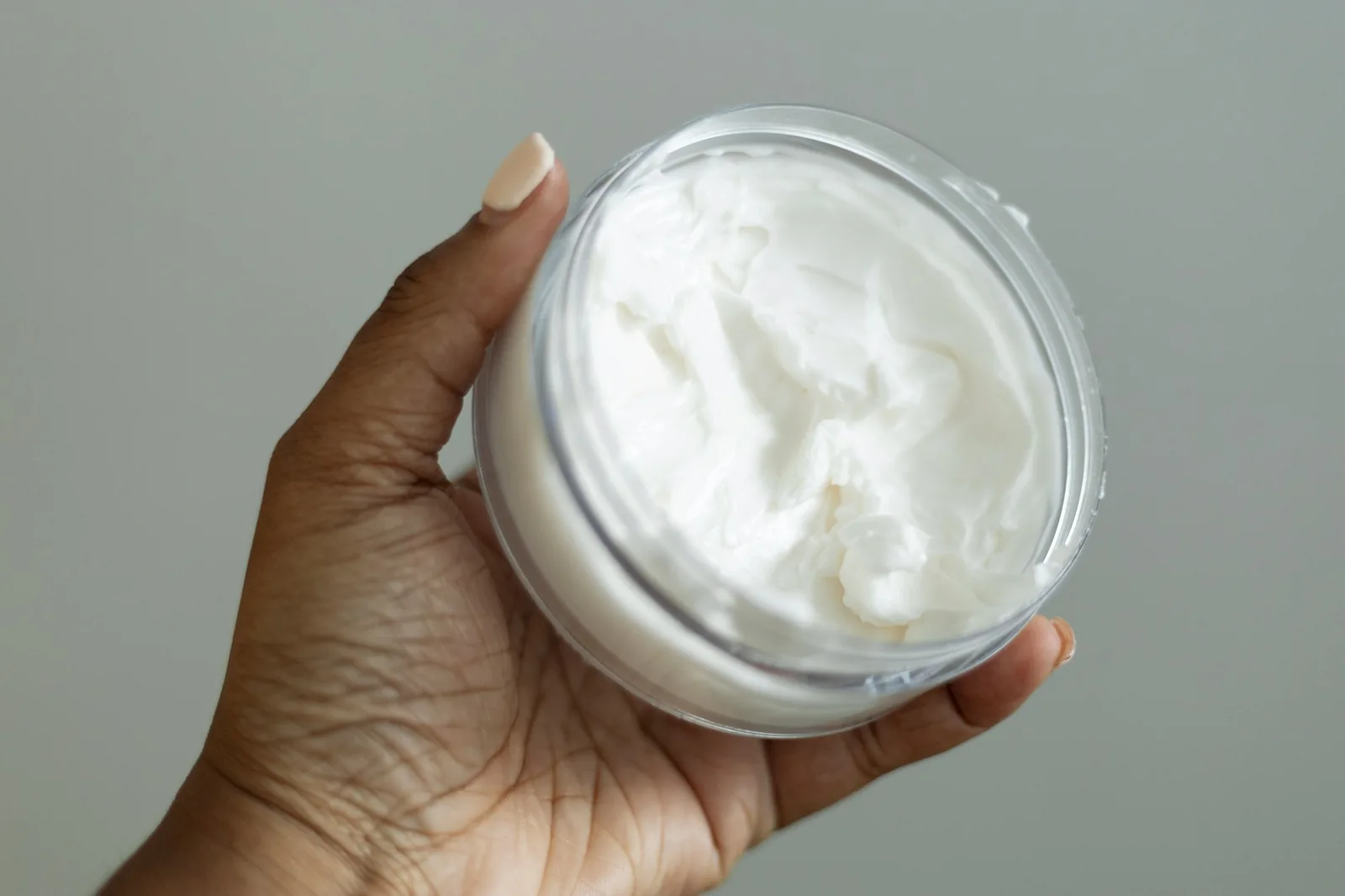
Shea butter is the fat from the nut of the shea tree, and for skin it does one job well: it softens and seals dry skin. The American Academy of Dermatology (AAD) lists it among the ingredients to look for in a dry skin cream and in products for chapped lips. On your face, back, or chest, though, the AAD says it can clog your pores.
The short answer: shea butter for skin works best on your body, hands, feet, and lips. If your face breaks out, keep it off your face.
Here's what most guides miss. The AAD says three different things about shea butter, depending on form and place. Inside a cream, it's a recommended ingredient. Straight from the jar, butters tend to liquefy on the skin, so the AAD's dry skin guide for darker skin tones calls them less effective as moisturizers. On breakout-prone skin, it can clog pores. So the useful question isn't whether shea butter is good. It's where it goes, and in what form.
What Is Shea Butter?
Shea butter is a natural fat extracted from the nuts of the shea tree. It's solid in the jar, softens on warm skin, and appears in body butters, creams, lip balms, and hair products.
A Cleveland Clinic explainer describes it as a creamy fat from nuts that grow on shea trees in African countries. On ingredient lists, look for shea butter or its botanical name, Butyrospermum parkii. Skin care sorts it as an emollient; our guide to dry vs. dehydrated skin shows where emollients fit next to humectants and occlusives.
If you grew up with a jar on the dresser for elbows, knees, and hair, you're in wide company. A 2026 survey of dermatologists in 16 African countries, published in the Journal of Investigative Dermatology, found shea butter and coconut oil widely available there as traditional emollients for eczema care, though their quality and consistency vary.
Raw vs. Refined Shea Butter
Many brand blogs say raw, unrefined shea butter beats refined. Refining does change it in the lab: a 2023 study in the journal Foods found a refined shea fraction had less vitamin E (tocopherols) and fewer plant sterols than crude butter. But we searched PubMed in November 2026 for studies of raw or refined shea butter on skin and found none comparing them on people. Our take: choose the one you'll use, without added fragrance, which the AAD's dry skin tips advise against.
Shea Butter Benefits for Skin: What the Evidence Supports
Shea butter's strongest support comes from dermatologists recommending it as an ingredient. The clinical trials behind the bigger promises are thin.
Where Dermatologists List It
- Dry skin creams. The AAD's top tips for relieving dry skin say to look for a cream or ointment with one or more ingredients from a short list. Shea butter is on it, next to glycerin, hyaluronic acid, lanolin, and petrolatum.
- Lip balm. The AAD's tips for healing dry, chapped lips list shea butter among the ingredients to look for, along with petrolatum, ceramides, and dimethicone.
Read the wording closely. The AAD recommends a cream, ointment, or balm that contains shea butter: a finished product, not a scoop of raw butter. That difference shapes our advice below.
What the Research Shows
A 2022 review in Frontiers in Pharmacology looked at 27 clinical studies of 17 plant butters and oils. Only one included shea butter: a 1996 study that held it, with other oils, against the forearms of 21 adults for 48 hours and found no significant differences on healthy skin.
Eczema research is small, too. In a 2015 Hong Kong study of 34 young patients with eczema, a cream with a shea butter extract showed no statistical difference in efficacy or acceptability from a ceramide-precursor moisturizer tested in an earlier study. Our view: a reasonable emollient with a thin clinical record.
Shea Butter Claims to Skip
| Claim | What we found | Our take |
|---|---|---|
| It works as sunscreen | A Cleveland Clinic explainer says shea butter has an SPF of about three or four. A 2026 lab study measured plant oils on plastic plates, not skin, found shea butter's SPF negligible, and concluded plant oils can't replace conventional UV filters. | Wear broad-spectrum sunscreen with SPF 30 or higher, as the AAD advises. |
| It erases stretch marks | The NHS says there's very little evidence that creams and lotions prevent, reduce, or remove stretch marks. Our PubMed search found no clinical study of shea butter for them. | Use it for comfort, not to erase marks. |
| It fades dark spots | Our PubMed search found no clinical study of shea butter for dark spots. The AAD says there's no scientific evidence that cocoa butter evens out skin tone, and that it can cause acne. | See how we approach hyperpigmentation and dark spots. |
| It's non-comedogenic | Pore-clogging lists began with animal tests of raw ingredients, a 2006 study in the Journal of the American Academy of Dermatology explains. Testing finished products on six people, it found comedogenic ingredients don't necessarily make a product comedogenic. The AAD says oils such as shea butter can clog pores on your face, back, or chest. | A rating isn't a promise either way. On your face, choose products labeled non-comedogenic. |
| It's safe with a nut allergy | A 2010 letter in an allergy journal is titled "Shea butter contains no IgE-binding soluble proteins." A 2023 case report's title describes contact allergy to shea butter. | Neither title answers it for you. Ask your allergist first. |
Where to Use Shea Butter, and Where to Skip It
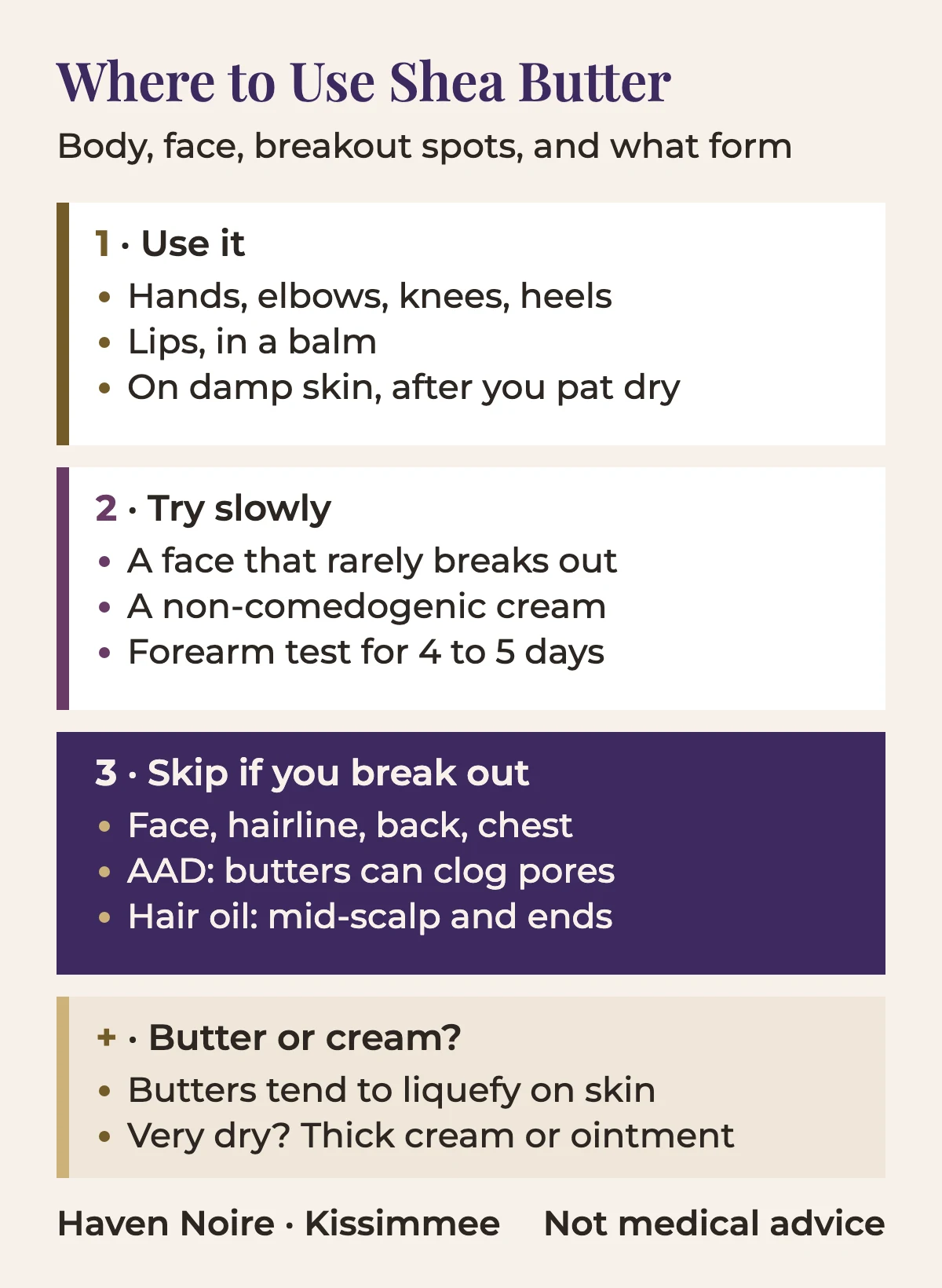
Using the AAD guidance above, here's where the jar goes: places shea butter works well, places to try it slowly, and places to skip it. Then comes the form, raw butter or a finished cream. Anything here not credited to the AAD is our own advice, not a medical rule.
Use It Here: Body, Hands, Feet, and Lips
This is shea butter's home turf: elbows, knees, shins, heels, hands, and lips. The AAD's dry skin and lip lists point here, and none of these spots are on its pore-clogging list of face, back, and chest. Apply it to still-damp skin right after you pat dry, as the AAD advises. For very dry, cracked lips, the AAD suggests a thick ointment such as white petroleum jelly, because ointment seals in water longer than waxes or oils.
Try It Slowly: A Face That Rarely Breaks Out
Our advice: if your face almost never breaks out, a face cream that lists shea butter and is labeled non-comedogenic is a fair thing to try, and a gentler first step than raw butter. Why a finished cream? The 2006 study in our table put finished products on the upper backs of six people prone to clogged pores and concluded that products made with comedogenic ingredients aren't necessarily comedogenic. Its abstract doesn't say whether any product contained shea butter, and six people can't predict your face. It doesn't cancel the AAD's warning, but it does suggest a jar of butter and a finished cream may not behave alike.
Test it first. The AAD's advice for trying a new product is to apply a small amount to your inner forearm twice a day for four to five days, and to use it on your face only if that skin stays free of redness, itch, and other reactions.
Skip It If You Break Out: Face, Hairline, Back, and Chest
The AAD's tips for clearing acne in darker skin tones are direct. If you apply a product that contains oil, such as cocoa butter or shea butter, to your face, back, or chest, it can clog your pores, and clogged pores can lead to acne. Your hairline belongs here too: the same page says breakouts only on your forehead and temples may come from hair oil, a pattern common enough to have a name, pomade acne.
Raw Butter or a Cream?
Where it goes is half the answer; the form is the other half. For very dry or ashy skin, the AAD's guide to dry skin in darker skin tones says butters and oils tend to liquefy on the skin, so they're less effective as moisturizers. It recommends an ointment like petroleum jelly or a thick cream instead.
That doesn't rule shea out: a thick cream that lists shea butter fits both AAD pages. Our suggestion: keep raw butter for everyday softness, and reach for a thick cream or ointment when skin is truly dry. Curious about sealing skin with petroleum jelly overnight? See our guide to slugging.
Shea Butter for Face: How to Try It Without Guessing
If your face rarely breaks out and you want to try shea butter for face care, go slowly enough to tell what it's doing.
- Check your history. Breakouts on your face, back, or chest mean you should skip it there. Stop here.
- Pick a finished product. The AAD's acne advice is to use only products labeled non-comedogenic or "won't clog pores."
- Run the forearm test: twice a day for four to five days.
- Start small (our suggestion): at night, on dry patches only, for two weeks.
- Stop anything that stings, burns, or tingles. The AAD says those sensations mean a product irritates your skin.
- Wear sunscreen every morning. Shea butter isn't one.
New bumps after a week or two? Drop it. Our guide on how to get rid of blackheads covers clogged pores, and our glass skin guide builds a glow without rich butters on breakout-prone skin. Using other kitchen-shelf favorites? Read our take on coconut oil on your face and castor oil for skin first.
Shea Butter on Melanin-Rich Skin: Dark Marks and Edges
For many Black and brown families, shea butter is part of the routine. For ashy skin, the butter or cream question above is the shea part of the answer; our guide to ashy skin covers the rest. Two more things matter on deeper skin.
A Clogged Pore Costs More
On brown and Black skin, a breakout can leave a dark spot. The AAD's acne guide for darker skin tones says those spots can last much longer than the acne, and that picking, popping, or squeezing raises your risk of a scar. That's why keeping shea off breakout-prone skin matters more for us. If marks have already formed, start with how to fade hyperpigmentation on melanin-rich skin.
Butters, Hair Oils, and Your Edges
For breakouts only on your forehead and temples, the AAD suggests a hair product made with water or glycerin instead of oil, or hair oil only in the middle of your scalp and on the ends. In our judgment, a shea-rich hair butter counts as a hair oil, so keep it off your edges if your hairline breaks out. For the whole routine, see our guide to skin care for Black skin.
How to Use Shea Butter for Skin on Your Body in Florida Heat
This body routine follows the AAD's dry skin advice, with Central Florida in mind.
- Keep showers to 5 to 10 minutes in warm water, not hot.
- Pat dry gently and moisturize right away, while your skin is still damp.
- Use shea butter, or a cream with it, on your elbows, knees, shins, heels, and hands.
- For very dry or ashy patches, switch to a thick cream or petroleum jelly.
- Choose fragrance-free. A whipped butter with added scent misses the AAD's advice.
- On skin the sun will see, finish with broad-spectrum sunscreen, SPF 30 or higher.
A Florida note from us: on humid days a thin layer is usually plenty; save thicker layers for night and air-conditioned hours. Wondering whether deeper skin needs sunscreen at all? Read can Black people get sunburn.
Want someone else to handle your back and legs? Our Firming Back + Booty treatment ($135, 60 minutes) uses an enzyme polish and a peptide-rich firming mask on the back, back of legs, and booty.
Who Should Check With a Doctor First
Nut and Latex Allergies
Shea butter comes from a nut. A short 2010 letter in The Journal of Allergy and Clinical Immunology is titled "Shea butter contains no IgE-binding soluble proteins." IgE is the antibody your immune system makes during an allergic reaction, as MedlinePlus explains. A 2023 case report in the journal Contact Dermatitis is titled "Contact allergy to Butyrospermum parkii butter in a patient with cheilitis": that's shea butter, and cheilitis means inflamed lips. A title can't tell you whether shea butter is right for you, and neither can a blog post. If you have a tree nut allergy or a latex allergy, ask your allergist before you use shea butter, and follow their advice on testing it.
Eczema, Rosacea, Pregnancy, and Prescriptions
Dry skin that nothing fixes can be a condition; the AAD names eczema, ichthyosis, and psoriasis. With eczema or rosacea, ask your dermatologist which moisturizer to use, and see how we care for sensitive and redness-prone skin alongside a physician. Pregnant, or using isotretinoin, tretinoin, or another prescription skin medicine? Check with your doctor or dermatologist before you change products, butters included.
Where Haven Noire Fits
We're estheticians, not doctors, so we don't diagnose skin conditions. What a facial can give you is a trained second look at where shea butter fits on your skin.
Every Signature Facial begins with a double cleanse and a customized skin analysis. It's $95 for 60 minutes (3 for $210) or $110 for 90 minutes (3 for $285). Tell us what's in your routine, butters and hair products included.
We treat with professional lines, Circadia by Dr. Pugliese, Dermalogica, and Skin Script, plus our own handcrafted products. Ask us what's in them, or see our professional skincare lines before your visit. Members get 10% off in-spa products, our handcrafted skincare included; compare our monthly memberships.
When to See a Dermatologist Instead
See a board-certified dermatologist if:
- Dry or ashy skin hasn't improved after two weeks of good care, the point by which the AAD says you should see some improvement. It says persistent dry skin can be an undiagnosed condition such as eczema, ichthyosis, or psoriasis.
- Chapped lips haven't healed after 2 to 3 weeks of self-care, when the AAD's lip guide says to see a dermatologist.
- Breakouts keep coming after you've moved butters and hair oils off your face and hairline, or they leave dark marks. The AAD says that with a dermatologist's help, virtually every case of acne and most dark spots can be successfully treated.
- A product leaves a rash, or stings or burns every time. Stop using it, and get it checked if the reaction doesn't settle.
Unsure which side of the line you're on? Contact us before you book.
Frequently Asked Questions About Shea Butter
Is shea butter good for your face?
It depends on your skin. If your face breaks out, the American Academy of Dermatology says shea butter on your face can clog pores, so skip it. If you rarely break out, a non-comedogenic face cream that lists shea butter is a reasonable try. Test it on your inner forearm for four to five days first.
Does shea butter clog pores?
It can. The American Academy of Dermatology says products with oils such as shea butter can clog pores on your face, back, or chest, which can lead to acne. Online pore-clogging ratings began with animal tests of raw ingredients, and a small 2006 study found finished products don't always match their ingredients. So choose products labeled non-comedogenic.
Is shea butter good for ashy skin?
It can help, but it isn't the strongest option. The AAD's guide to dry skin in darker skin tones says butters and oils tend to liquefy on the skin, so they're less effective moisturizers. For very dry or ashy skin, it recommends a thick cream or petroleum jelly, and a ceramide moisturizer for the grayish cast.
Can shea butter get rid of stretch marks or dark spots?
We found no good evidence that it does. The NHS says there's very little evidence that creams and lotions remove stretch marks, and our November 2026 PubMed search found no clinical study of shea butter for stretch marks or dark spots. Use it to keep skin soft, and see a dermatologist about marks.
Can I use shea butter if I have a nut allergy?
Ask your allergist; we can't answer that for you. A 2010 letter in an allergy journal is titled "Shea butter contains no IgE-binding soluble proteins," and a 2023 case report's title describes contact allergy to shea butter in a patient with inflamed lips. Neither title settles your case. If you have a latex allergy, ask your allergist too.
Is raw or refined shea butter better for skin?
No one has shown which works better on skin. A 2023 lab study found that one refined shea fraction had less vitamin E and fewer plant sterols than crude butter. But our November 2026 PubMed search found no study comparing raw and refined shea butter on people. Choose the one you'll use, fragrance-free if possible.
Does shea butter have SPF?
Not enough to count. A Cleveland Clinic explainer says it has an SPF of about three or four, and a 2026 lab study, done on plastic plates rather than skin, found shea butter's SPF negligible. The American Academy of Dermatology recommends a broad-spectrum, water-resistant sunscreen with SPF 30 or higher. Treat shea butter as a moisturizer, not sun protection.
More from the Journal

About the author
Tiffany · Licensed Esthetician · Licensed PMU Artist
Tiffany is a Florida-licensed esthetician and permanent makeup artist and the founder of Haven Noire. She specializes in customized facials, corrective skincare, and waxing for melanin-rich and all skin types, and is known for a calm, education-first approach that puts first-time clients instantly at ease.
Meet Tiffany →