
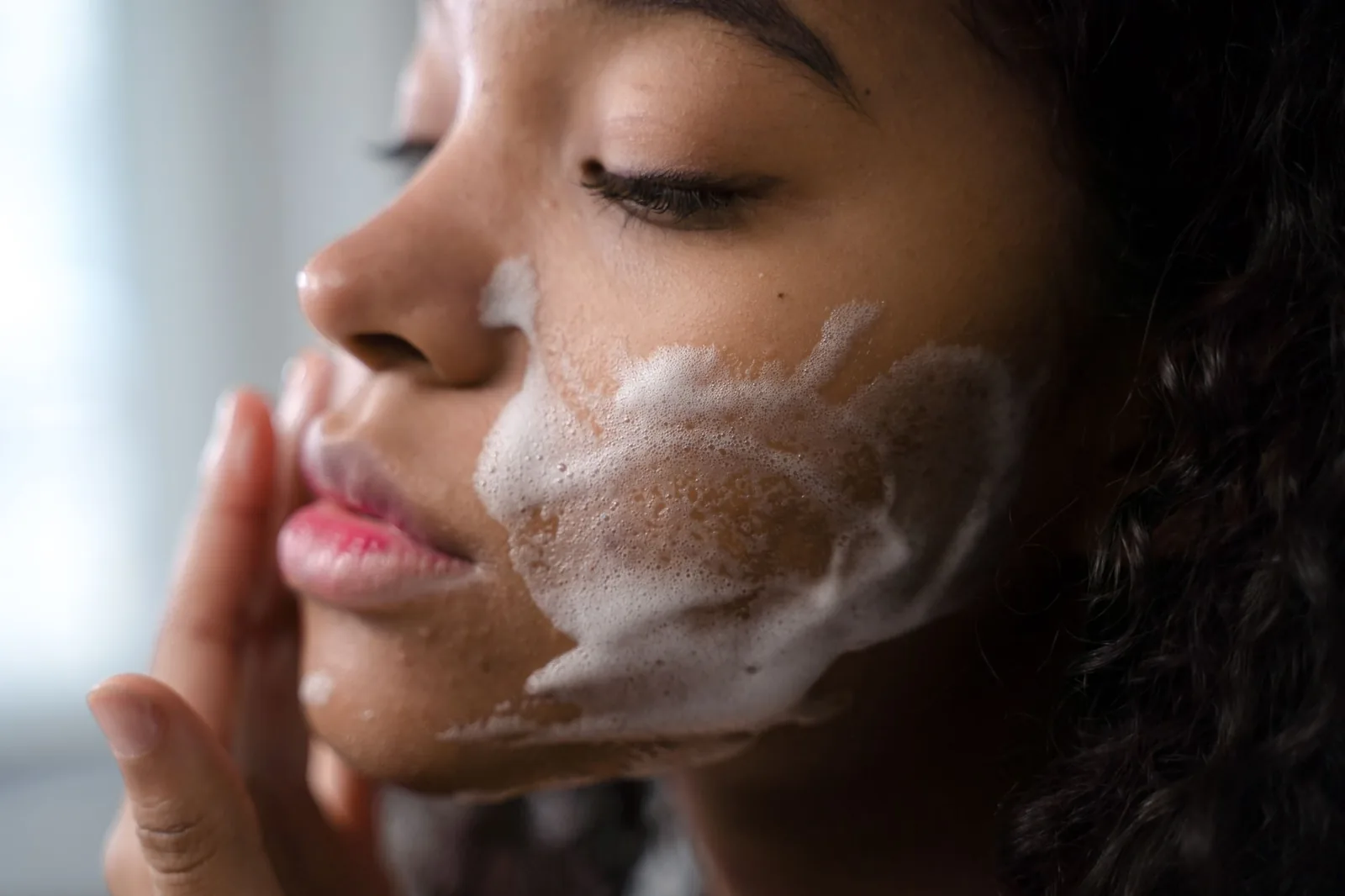
Double cleansing means washing your face twice in one sitting: first with a cleanser or remover that loosens sunscreen and makeup, then with a gentle water-based cleanser that washes your skin. It helps most when you've worn something built to stay on, like water-resistant sunscreen or long-wear makeup. On a bare-faced day, one gentle cleanse is usually enough.
Here's what most guides leave out. Several brand guides recommend it for oily skin, starting with an oil or balm, while the American Academy of Dermatology (AAD) tells people with oily skin not to use oil-based cleansers. And when we searched PubMed in November 2026, we found no study that tested the routine itself. So treat it as a removal tool, chosen for what you wore and the skin you have, not as a treatment.
Below: what the research shows, a three-question check for your routine, the steps, what changes in Florida heat and on melanin-rich skin, and when to see a dermatologist instead.
What Is Double Cleansing?
Double cleansing is a two-step wash. Step one breaks down sunscreen and makeup with a cleansing oil, balm, micellar water, or makeup remover. Step two washes your skin with a gentle water-based cleanser. Brand guides usually place it in the evening.
| Step | Common choices | Its job |
|---|---|---|
| Step one | Cleansing oil or balm, micellar water, or an oil-free makeup remover | Loosens sunscreen, makeup, and oil so they rinse away |
| Step two | A gentle gel, cream, or foaming cleanser | Washes the skin itself, plus anything step one left behind |
Dermatology sources are more cautious than brand guides. In a 2022 Cleveland Clinic article, dermatologist Jane Wu, MD, says double cleansing isn't a step most dermatologists recommend, and that for most people one thorough wash with a gentle cleanser is more than adequate. She also says it can help people who wear makeup, especially waterproof makeup or waterproof sunscreen.

On our menu, it does that same removal job. Every Signature Facial at Haven Noire begins with a double cleanse: we discuss your skin and gently remove makeup, then comes the skin analysis. It's a cleansing step, not a treatment for a skin condition.
Does Double Cleansing Work? What the Research Shows
Less is known than brand guides suggest. We searched PubMed in November 2026 for "double cleansing" and "double cleanse" in article titles and abstracts. The only match was a hospital study of antiseptic skin prep before surgery in newborns. We found no study that tested the two-cleanser facial routine itself.
The closest evidence is about sunscreen. In a 2019 study in the Journal of Cosmetic Dermatology, researchers used a facial imaging camera to photograph 20 volunteers before and after applying sunscreen, then again after washing with water alone, a foaming cleanser, or a cleansing oil. They measured how much sunscreen still showed in the photos and asked volunteers how their skin felt. Here's what they reported:
- Water alone left more than half of either sunscreen behind.
- With a regular sunscreen, neither the foaming cleanser nor the cleansing oil left significantly more than the bare-skin reading.
- With a waterproof sunscreen, the foaming cleanser left about 37% behind. The cleansing oil left about 6%, close to the bare-skin reading of about 3%.
- Eight participants reported dry skin after the foaming cleanser, compared with one after the oil.
That's one small study of 20 people, with one sunscreen of each type, and it tested each product alone, not an oil followed by a cleanser. Its authors say future studies are needed on other sunscreens and washing products. Still, it points to the question that matters most: what's on your face?
For our readers, the answer is often water-resistant sunscreen. Our guide to sunscreen for dark skin follows the AAD's advice: tinted, broad spectrum, SPF 30 or higher, and water resistant.
Do You Need to Double Cleanse? Three Questions to Ask
Instead of asking whether the trend is good or bad, ask three questions about tonight's wash. They're built on AAD guidance, the Cleveland Clinic article, and the sunscreen study above. This is a check for your bathroom sink, not a medical rule or a diagnosis.
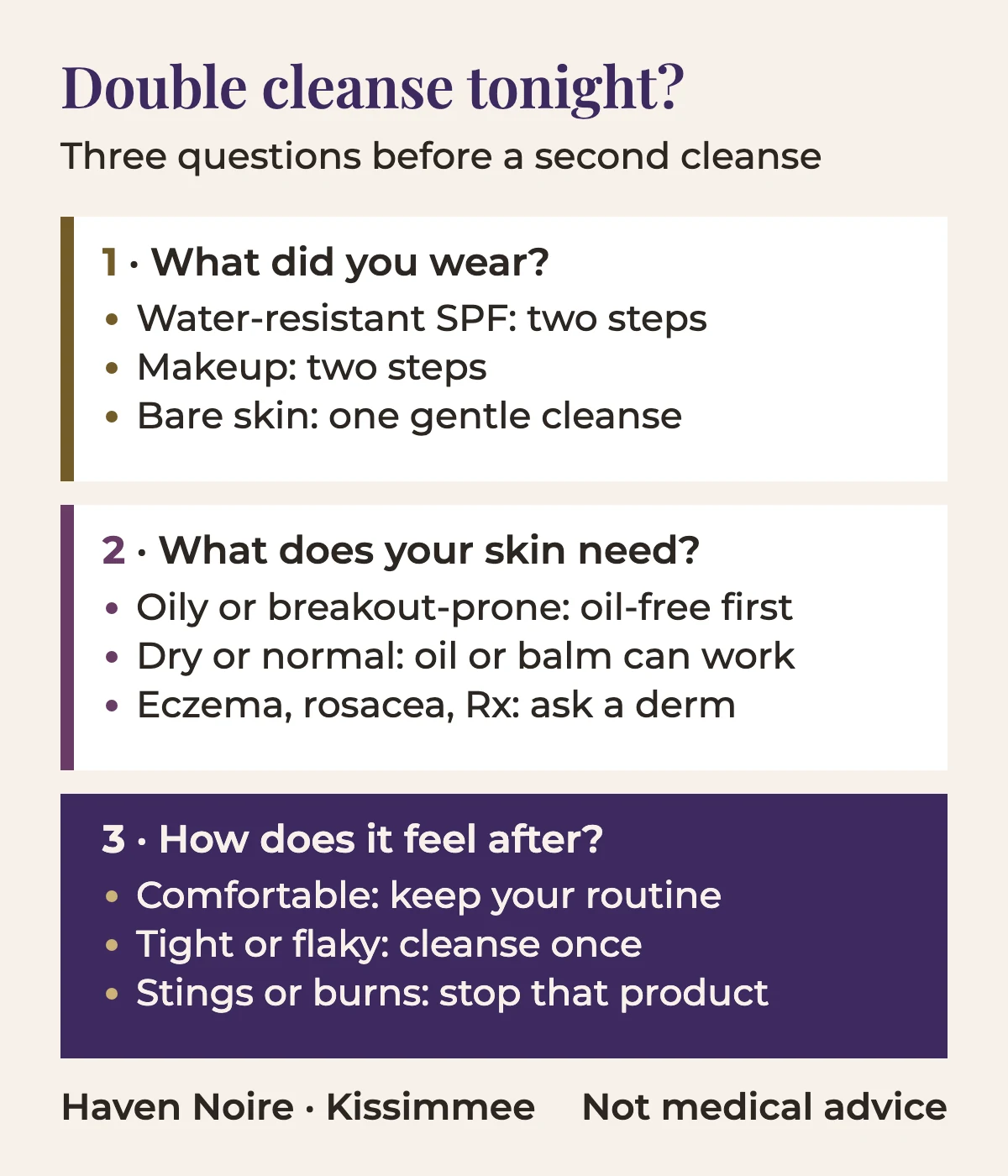
Question 1: What did you wear today?
Start with the labels on what you put on this morning.
- Water-resistant sunscreen. The AAD's sunscreen guide says the words "water resistant" mean it stays on wet or sweaty skin for a while, either 40 or 80 minutes, before you need to reapply. In the small study above, a foaming cleanser alone left far more of the waterproof sunscreen it tested behind. Our advice: plan a first cleanse tonight.
- Makeup, especially long-wear or waterproof. The Cleveland Clinic article says double cleansing can help people who wear makeup, especially waterproof makeup. Plan a first cleanse, and let Question 2 pick the product.
- A regular sunscreen, a moisturizer, or nothing. In our view, one gentle cleanse is likely enough; in the study, a foaming cleanser removed the regular sunscreen about as well as the oil did.
Not sure? Check the bottle. The AAD notes that not all sunscreens offer water resistance.
Question 2: What does your skin need from step one?
The first cleanse is where brand advice and dermatology advice split.
If your skin is oily or breaks out easily
Choose an oil-free first step. The AAD's oily skin tips say not to use oil-based or alcohol-based cleansers, because they can irritate your skin. Its advice on makeup and acne reads like a double cleanse in plain words: use an oil-free makeup remover, then wash your face with a gentle cleanser.
The Cleveland Clinic dermatologist says an oil-based cleanser can cause breakouts in acne-prone skin, especially if used alone, and calls micellar water before a water-based cleanser a great alternative. Look for oil-free and non-comedogenic on its label.
If your skin is dry or normal
We think an oil or balm is a reasonable first step if it doesn't clog your pores. In the 2019 study, fewer people reported dryness after the cleansing oil than after the foaming cleanser. For step two, the Cleveland Clinic article suggests a gentle, unscented water-based cleanser for dry, sensitive skin. Reaching for coconut oil as your first step? See when coconut oil works as a makeup remover.
If you're pregnant, use a prescription, or have eczema or rosacea
Ask your dermatologist or doctor before you change cleansers. That includes isotretinoin, tretinoin, and other prescription skin medicines, and any medicated cleanser you're thinking of adding while pregnant. The AAD's rosacea skin care tips also say to ask your dermatologist if you have trouble finding gentle products.
Question 3: How does your face feel afterward?
After you rinse and moisturize, notice how your face feels.
- Comfortable and clean: your routine fits. Keep it.
- Tight, dry, or flaky: cut back to one gentle cleanse and moisturize. The AAD's list of habits that can worsen acne puts it simply: "Dry skin is irritated skin."
- Stinging or burning: stop using that product. The AAD gives that advice for any product that burns or stings when you apply it.
Tightness after cleansing is one of the signs in our guide to dry vs. dehydrated skin. The Cleveland Clinic dermatologist says overwashing can lead to dryness, irritation, and the breakdown of the skin barrier; our skin barrier guide covers what a stressed one looks like.
| Question | If your answer is | Tonight's wash |
|---|---|---|
| What you wore | Water-resistant sunscreen, or makeup (especially long-wear) | Two steps: a first cleanse, then a gentle cleanser |
| What you wore | Regular sunscreen, moisturizer, or nothing | One gentle cleanse |
| Your skin | Oily or breakout-prone | Oil-free makeup remover or micellar water first |
| Your skin | Dry or normal | An oil or balm can work, then a gentle, unscented cleanser |
| Your skin | Eczema, rosacea, a prescription, or pregnancy | Ask your dermatologist or doctor first |
| How it feels | Tight, flaky, or stinging | Drop to one cleanse, or stop the product that stings |
How to Double Cleanse, Step by Step
Here's how to double cleanse with the AAD's face washing basics built in. Your product labels cover the details.
- Start step one with the product Question 2 pointed you to, oil-free if your skin is oily or breaks out easily. Follow its label directions; brand guides apply an oil or balm to a dry face.
- Massage gently with your fingertips. The AAD says to remove eye makeup before bed too, and to avoid scrubbing, even when removing makeup.
- Rinse with lukewarm water, and take your time. The AAD's rosacea tips note that cleanser left on your skin can cause irritation.
- Wet your face and apply a gentle, non-abrasive cleanser that doesn't contain alcohol, using only your fingertips.
- Rinse with lukewarm water and pat dry with a soft towel.
- Apply moisturizer. The AAD's oily skin tips say to moisturize after cleansing even when your skin is oily.
Morning or night?
Night. The AAD advises washing once in the morning and once at night, plus after heavy sweating. Sunscreen and makeup build up by day, so in our view the two-step cleanse belongs in the evening and one gentle cleanse covers the morning.
What to skip
- Washcloths, mesh sponges, and anything other than your fingertips. The AAD says they can irritate your skin.
- Hot water. The Cleveland Clinic article warns it can dry out your skin.
- Abrasive cleansers in either step. Exfoliating is its own step with its own schedule; see how often you should exfoliate.
- Cleansers that contain alcohol.
Too tired for two steps?
Don't sleep in your makeup. The AAD's acne habits page says to remove makeup before bed, "No exceptions," and if you're too tired to wash your face, to use a makeup remover towelette that's non-comedogenic. Planning a longer bedtime ritual? See which bedtime layers are worth keeping first.
Florida Heat and the Double Cleanse: Sunscreen, Sweat, Midday Washes
A Central Florida day stacks up reasons for a second cleanse. The AAD's tips for applying sunscreen say to reapply every two hours outdoors, and right after swimming or sweating. In our view, each layer of water-resistant sunscreen is one more reason for a first cleanse that night.
After a workout or a sweaty walk
The AAD's face washing tips say perspiration irritates the skin, especially under a hat or helmet, and to wash as soon as possible after sweating. Until you reach a sink, pat sweat away with a clean towel instead of rubbing, as its acne tips advise. If breakouts follow your workouts, our guide to sweat pimples shows what to change.
We'd make that midday wash one gentle cleanse, not a double. The AAD says to limit washing to twice a day and after sweating, and its acne tips warn that washing several times a day can further irritate your skin and lead to more breakouts. Heading back outside? Reapply your sunscreen.
If shine and clogged pores are why you double cleanse
Our guides to making pores look smaller and how to get rid of blackheads cover what helps there, so your cleanse can stay gentle.
Melanin-Rich Skin: Why a Gentle Double Cleanse Wins
If your skin is brown or Black, we think the case for a first cleanse and the case for a gentle one both get stronger.
First, the sunscreen. The AAD's guide to fading dark spots in darker skin tones recommends tinted sunscreen with iron oxide that's SPF 30 or higher, broad spectrum, and water resistant. In the small 2019 study, the waterproof sunscreen it tested was the one a foaming cleanser alone struggled to wash off.
Second, irritation. The same AAD guide says that when a skin or hair care product irritates your skin, it can cause dark spots. It suggests gentler products, often labeled "for sensitive skin" or "fragrance-free," and says to stop using a product that burns or stings when you apply it.
Our takeaway: on melanin-rich skin, squeaky clean isn't the goal. A cleanse that leaves your face tight or stinging every night isn't a deeper clean. It's irritation you can skip.
For more, read our guide to facials for Black skin. If dark marks are already there, start with how to fade hyperpigmentation on melanin-rich skin.
The Double Cleanse at a Haven Noire Facial
If you've had a Signature Facial with us, you've already had one. Step one on our menu is a consultation and double cleanse: we discuss your skin and gently remove makeup. Then come a skin analysis, exfoliation and extractions as needed, a custom mask and facial massage, and serums, moisturizer, and SPF. Our Corrective Facials list a double cleanse and prep before the targeted step, too.

So there's no need to arrive bare-faced. Bring your answers to the three questions instead. Every facial includes a skin analysis, and our first facial guide walks through each step.
| Service | What's included | Price |
|---|---|---|
| Signature Facial, 60 minutes | The five steps above | $95, or 3 for $210 |
| Signature Facial, 90 minutes | Adds a hand and arm massage and an eye treatment | $110, or 3 for $285 |
| Corrective Facial, 60 minutes | A targeted treatment, such as our Hydrofacial | $135, or a 3-pack for $360 |
| Glow Membership | One 60-minute Signature Facial every month | $74.99 a month |
Members also get 10% off extra services and in-spa products; see the terms on our memberships page. After a Signature Facial, keep skin hydrated, skip harsh actives and heat for 24 hours, and wear SPF daily. Your esthetician will recommend home-care products, and you can see the professional skincare lines we work with before you come in.
When to See a Dermatologist Instead of Switching Cleansers
No cleansing routine treats a skin condition. Haven Noire is an esthetics spa, not a medical office, and we don't diagnose. See a board-certified dermatologist if:
- You have deep or painful acne. The AAD says seeing a dermatologist is necessary to help clear it.
- Breakouts continue after you've given gentle cleansing and over-the-counter care a fair chance. The AAD says a dermatologist can help, and that some people need prescription-strength acne treatment.
- You have trouble finding gentle products, or nearly everything you apply stings. The AAD's rosacea tips say to ask your dermatologist to recommend products.
- Dark spots aren't fading with gentle care and daily sunscreen. The AAD says a dermatologist can help when your treatment isn't delivering, and that some spots need prescription-strength treatment.
Already working with a dermatologist on rosacea or reactive skin? See how we approach sensitive and redness-prone skin alongside a physician's care.
Frequently Asked Questions About Double Cleansing
Is double cleansing necessary?
Not for everyone. A Cleveland Clinic dermatologist says that for most people, one thorough wash with a gentle cleanser is more than adequate. A second step earns its place when you've worn water-resistant sunscreen or makeup, especially long-wear. If you went bare-faced, one gentle cleanse at night is usually enough.
Should you double cleanse if you have oily skin?
You can, with an oil-free first step. The American Academy of Dermatology tells people with oily skin not to use oil-based cleansers, and to cleanse up to twice daily and after sweating. Start with a makeup remover or micellar water labeled oil-free and non-comedogenic, then use a gentle foaming wash, and skip the scrubbing.
Can you double cleanse with micellar water?
Yes, in effect. A Cleveland Clinic dermatologist calls using micellar water to remove makeup before a water-based cleanser a great alternative to double cleansing. It's the same two-step idea without the oil. If you break out easily, check its label for oil-free and non-comedogenic, then rinse with lukewarm water.
Should you double cleanse in the morning?
Usually not. The American Academy of Dermatology advises washing once in the morning and once at night. Overnight there's no sunscreen or makeup to break down, so we think one gentle cleanse covers the morning. Save the two-step cleanse for evenings after water-resistant sunscreen or long-wear makeup.
Can a double cleanse cause breakouts?
It can if the first step doesn't suit your skin. A Cleveland Clinic dermatologist warns that an oil-based cleanser can cause breakouts in acne-prone skin, especially if used alone, and the AAD advises an oil-free makeup remover for acne. The AAD also warns that washing several times a day can irritate skin and lead to more breakouts.
Do you need to double cleanse if you only wear sunscreen?
Check the label. In a 2019 study of 20 volunteers, a foaming cleanser removed a regular sunscreen about as well as a cleansing oil, but left far more of a waterproof sunscreen behind. If yours says water resistant, we think a first cleanse at night makes sense. If not, one gentle cleanse is likely enough.
Can double cleansing damage your skin barrier?
It doesn't have to, but over-washing is the real risk. A Cleveland Clinic dermatologist says overwashing can lead to dryness, irritation, and the breakdown of the skin barrier. If your face feels tight or flaky, or it stings after cleansing, drop back to one gentle cleanse, moisturize, and stop any product that stings.
Is a double cleanse the same as washing your face twice a day?
No. A double cleanse uses two different cleansers in one sitting, usually at night. Washing twice a day means one wash in the morning and one at night, which the American Academy of Dermatology recommends, plus a wash after heavy sweating. The way we see it, a double cleanse is your night wash, not an extra one.
More from the Journal

About the author
Tiffany · Licensed Esthetician · Licensed PMU Artist
Tiffany is a Florida-licensed esthetician and permanent makeup artist and the founder of Haven Noire. She specializes in customized facials, corrective skincare, and waxing for melanin-rich and all skin types, and is known for a calm, education-first approach that puts first-time clients instantly at ease.
Meet Tiffany →