

Yes, Black people can get sunburn. Melanin gives deeper skin real protection, not complete protection, and MedlinePlus, the National Library of Medicine's health site, says even dark and black skin can burn. What changes is how a burn shows up. On brown and Black skin, it often isn't red.
You're more likely to feel it: skin that's hot to the touch, sore, or itchy. Over the next few days, it may look darker than your usual tone, then peel. What to do now: get indoors, take a cool shower, smooth on a moisturizer with aloe vera or soy, drink extra water, and leave blisters alone. Blisters, swelling, fever, chills, dizziness, or any sunburn on a baby or young child mean a call to your doctor.
We're Haven Noire, a Black-owned facial spa in downtown Kissimmee. We're estheticians, not doctors, so every medical point below comes from the sources we link.
Can Black People Get Sunburn? Yes, Less Often but Not Never
Yes. A sunburn happens when the sun's ultraviolet light outpaces what your melanin can protect against. More melanin raises that threshold, so deeper skin burns less often. It doesn't remove the threshold, so long, unprotected hours in strong sun can still burn it.
MedlinePlus puts the difference in time: a very light-skinned person may burn in less than 15 minutes of midday sun, while a dark-skinned person may tolerate the same exposure for hours. Hours, not forever. A Central Florida Saturday at a theme park or a lake can run longer than that.
In a CDC-led analysis of a 2015 national survey of 31,162 U.S. adults, 13.2% of Black respondents reported a sunburn that year, against 34.2% of all adults. The authors call sunburn prevalent among Black and Hispanic adults, groups often considered to be at low risk of skin cancer.
Why the usual sunburn descriptions miss deeper skin
Most sunburn definitions start with color. MedlinePlus defines a sunburn as reddening of the skin. If you were taught to look for red, it's easy to decide you've never burned. The researchers behind a 2026 survey note that the Fitzpatrick skin-type scale and traditional sunburn descriptions perform poorly in people with skin of color. For a full daily routine, see our guide to skin care for Black skin.
What Sunburn on Black Skin Looks and Feels Like
The NHS says sunburned skin may feel hot to the touch, feel sore or painful, and flake or peel, usually a few days later. A severe burn can blister. Then comes the line that matters most here: white skin usually turns red or pink, but on black or brown skin, you may not notice any change in color.
MedlinePlus adds that the first signs may not appear for a few hours, and pain is worst between 6 and 48 hours after sun exposure. Skin that felt fine on the drive home can feel tender the next morning.
What people with deeper skin actually report
A 2026 survey by Northwestern University medical researchers, published in the International Journal of Dermatology, asked 1,069 U.S. adults about sunburn and symptoms after sun. Of the 372 who identified as people of color, 15% said they had never had a sunburn yet reported symptoms after sun exposure. Among other respondents, it was 0.5%.
Symptoms shifted with skin tone. Among people of color with the deepest tones on the Monk Skin Tone scale (7 to 10), only 19% reported redness, against 69% of those with the lightest tones. Of the symptoms compared by tone, darker skin was the deepest group's most common report, at 69%. About half (49%) noticed warm skin.
It's one survey, with self-reported answers and small subgroups, and the authors note that warm skin or a headache may come from heat or dehydration rather than the burn itself. Our take: the pattern still changes how you check. On deeper skin, stop waiting for red.

Darkening after sun is a signal, not a free pass
Many of us grew up hearing that getting darker in the sun is just a tan. In a May 2025 sun survey release from the American Academy of Dermatology (AAD), a board-certified dermatologist explains that a tan is a sign of skin damage: when skin darkens, it's responding to DNA injury from ultraviolet radiation. A tan isn't a burn, but the same release says every tan and burn adds up to sun damage.
Gray, chalky skin with no sun involved is a different issue; our guide to ashy skin covers it.
How to Check for Sunburn on Dark Skin
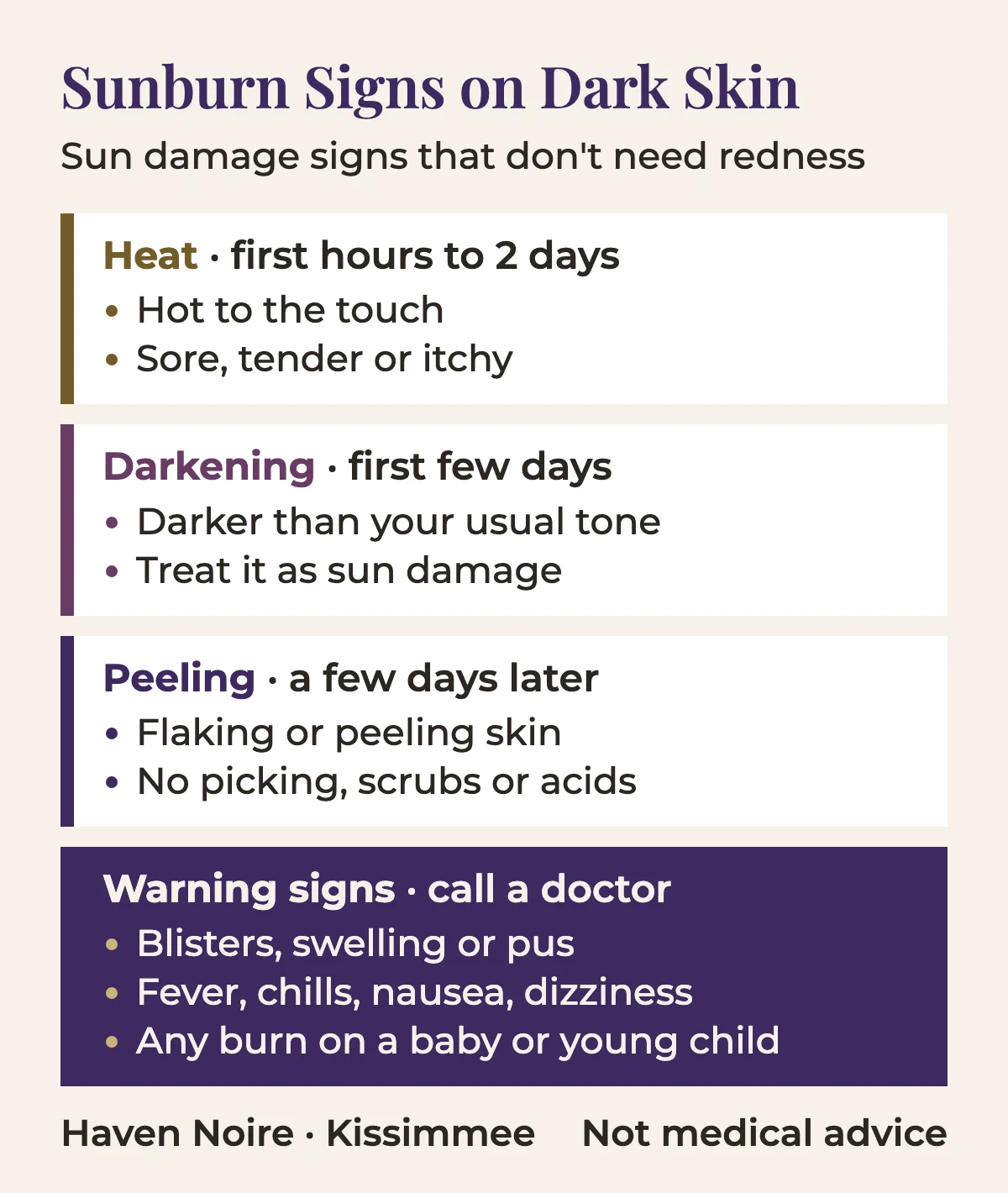
Because redness is an unreliable signal on melanin-rich skin, look for three signs that don't depend on it: heat, darkening, and peeling. They're drawn from the NHS, MedlinePlus, the AAD, and the 2026 survey. This helps you notice a burn; it isn't a diagnosis, and the timings are rough guides, not medical rules.
Heat and soreness: the first hours to two days
Once you've cooled down indoors, run the back of your hand over skin that saw sun, like your forehead, nose, cheekbones, and shoulders, then over skin that stayed covered. Exposed spots that stay warmer, sore, or itchy are the first sign, and so is a shower that stings. Warmth right after time outside can just be heat, which is why we wait.
Darkening: the first few days
Check in daylight by a window, not under bathroom light, against a covered area like your inner arm. A new, darker band across your cheekbones, nose, or shoulders is what deep-toned respondents in the 2026 survey reported more often than redness. That's one small, self-reported survey, and darkening alone doesn't prove a burn. The AAD calls a tan a sign of skin damage, so whether it's a tan or a burn, treat it as sun damage.
Peeling: a few days later
Peeling is a sunburn sign in every skin tone. Let it shed. The NHS says not to scratch or try to remove peeling skin, and the AAD's exfoliation guide says never to exfoliate sunburned skin.
Run the check in four steps
- Get indoors. The AAD says to treat a sunburn as soon as you notice it.
- That evening, feel for heat and soreness.
- The next morning, check for darkening in daylight, then watch for peeling.
- At any point, a warning sign in the table below means a call to your doctor.
| Sign | When it tends to show | What to do |
|---|---|---|
| Hot, sore, or itchy | Hours after sun; pain peaks at 6 to 48 hours | Cool shower, aloe or soy moisturizer, extra water |
| Darker than your usual tone | The first few days | Keep it covered and out of direct sun until healed |
| Flaking skin | A few days after the burn | Let it shed; no picking, scrubs, or acids |
| Warning signs: blisters, swelling, pus, fever, chills, nausea, dizziness, or a burned baby or young child | Any time | Call your doctor |
How to Treat Sunburn on Black Skin at Home
Care is the same for every skin tone. Once you're out of the sun, preferably indoors, the AAD's sunburn guide recommends:
- Take frequent cool baths or showers, then gently pat your skin dry.
- While skin is still damp, apply a moisturizer that contains aloe vera or soy. Calamine lotion, a cool, damp washcloth, or a colloidal oatmeal bath can also help.
- Consider aspirin or ibuprofen for swelling and discomfort. MedlinePlus says not to give aspirin to children. If you're pregnant, ask your OB-GYN or midwife which pain reliever is right for you.
- Drink extra water, since a sunburn draws fluid to the skin's surface.
- Leave blisters alone. The AAD says blistering means a second-degree sunburn, and blisters help protect you from infection. The NHS lists blistered or swollen skin among the reasons to get an urgent doctor's appointment.
What to skip on a fresh burn
- Benzocaine or lidocaine sprays and creams. MedlinePlus says these can cause allergies in some people and make the burn worse.
- Ice packs and tight clothes, both on the NHS list of don'ts. That rules out a face dunk too; see who should skip face icing.
- Scrubs, peels, and exfoliating acids. The AAD says never to exfoliate sunburned skin.
- Retinoids on the burned area. MedlinePlus's tretinoin guide says not to apply it to sunburned skin. Ask your dermatologist when to start again.
The shea butter, coconut oil, and petroleum jelly question
Here the sources split. MedlinePlus says not to use butter, petroleum jelly, or other oil-based products on a sunburn, because they can block pores so heat and sweat can't escape, and suggests dry bandages over blisters. The NHS also says not to use petroleum jelly on sunburned skin. The AAD's sunburn guide goes the other way on blisters: keep them clean and apply petroleum jelly to protect them while they heal.
Our view: shea butter, cocoa butter, and coconut oil are oil-based too, so save them for healed skin. Since the sources disagree on blisters, ask your doctor how to cover yours. Then our guides to shea butter for skin, coconut oil on your face, and slugging cover where each one helps.
After it heals: keep a burn from becoming a dark mark
The AAD's guide to dark spots in darker skin tones lists a burn among the injuries that can leave a dark spot as skin heals. A spot a few shades darker than your natural color usually fades within 6 to 12 months if you don't re-injure the skin; color deep in the skin, often slate blue to gray, can take years.
Protect healed skin with sunscreen, which the AAD says can prevent new dark spots, and skip strong exfoliation, which it warns may lead to more dark spots in darker skin tones. If a mark has formed, start with how to fade hyperpigmentation on melanin-rich skin or our page on hyperpigmentation and dark spots.
Who Burns Faster: Medicines, Lupus, Kids, and Florida Days
Melanin sets your baseline for sunburn on dark skin. These four things can move it.
Medicines that make skin burn sooner
MedlinePlus says some medicines, such as the antibiotics doxycycline and tetracycline, can make your skin easier to sunburn. The AAD says isotretinoin can make you sunburn more quickly and unexpectedly. Don't stop a prescription on your own; ask your prescriber how to plan time outdoors.
Lupus and sun sensitivity
MedlinePlus names lupus as a condition that can make you more sensitive to the sun. The AAD's page on lupus causes says systemic lupus is more common in Black Americans than white Americans, with Black American women at greatest risk. Its lupus overview adds that a lupus flare can look like a sunburn. If you burn after very little sun, see a doctor rather than guessing at the cause.
Babies and kids
MedlinePlus says infants and children are very sensitive to the sun's burning effects, and the NHS says to get urgent medical advice if a baby or young child has sunburn. For older kids, our tip: teach them to feel for heat. Shoulders that stay hot and sore after they've cooled off indoors can be a burn, red or not.
Florida days and the base tan myth
MedlinePlus says the sun's rays are stronger closer to the equator, strongest from 10 a.m. to 2 p.m., and stronger still off water or sand. That's an ordinary Central Florida weekend.
Then there's the base tan. In the AAD's May 2025 survey, 57% of Gen Z adults believed tanning myths such as a base tan protecting against sunburn. MedlinePlus is blunt: there's no such thing as a healthy tan. For sunscreen claims going around online, see whether sunscreen is bad for you.
Just had a wax? The aftercare for our waxing services in Kissimmee asks you to avoid heat, friction, sweat, and direct sun for 24 to 48 hours, so book waxes away from beach days.
Sunburn and Skin Cancer on Darker Skin
The NHS says sunburn usually gets better within 7 days. The damage outlasts the soreness: the AAD says sunburn can cause long-lasting damage to the skin that increases your risk of skin cancer.
The AAD's guide to skin cancer in darker skin tones calls it a common misbelief that only people with light skin get skin cancer. In darker skin, it says, the cancer is often advanced by the time it's diagnosed, and it may show up where the sun rarely reaches: palms, soles, nails, the mouth, and the genitals. In the 2026 survey, 40% of people of color had never been examined by a dermatologist, against 21% of other respondents.
Our guide to sunscreen for dark skin lists the AAD's warning signs and how to choose a formula for deeper skin.
Sunburn and Your Spa Calendar
- Waxing: reschedule. The AAD's waxing guide says never to wax sunburned or very sensitive skin. Our waxing aftercare guide covers the 48 hours after a wax.
- Facials: tell us. Our acne facial guide lists a sunburn in the treatment area among the reasons a facial may need to be modified or postponed.
- Chemical peels: tell us, and plan to reschedule until you've healed. Every chemical peel starts with a skin consultation, and stronger corrective peels are best scheduled in lower-UV months.
- Dark marks after healing: Radiance Brightening, one option in our $135 Corrective Facial, targets discoloration.
Not sure your skin is ready? Call (321) 900-1144 or email info@havennoire.com as soon as you notice a burn. Rescheduling at least 24 hours ahead gets your deposit refunded.
When to See a Doctor or Dermatologist Instead
Haven Noire is an esthetics spa, not a medical office. The AAD's 2024 release on treating sunburn names a high fever, chills, nausea, and pus or swelling of the skin as signs of a worsening burn that needs medical attention. The NHS and MedlinePlus add:
- Blisters, especially severe or painful ones
- Feeling faint, dizzy, or very tired, a headache, or muscle cramps
- A rapid pulse or breathing, extreme thirst, no urine, or sunken eyes
- Any sunburn on a baby or young child
The NHS warns that severe sunburn can lead to heat exhaustion and heatstroke. In an emergency, call 911.
Also see a doctor or dermatologist if
- You burn after very little sun, or a rash appears across your nose and cheeks after time outdoors. The AAD notes lupus can cause rashes like these.
- A dark mark isn't fading with sun protection and gentle care. The AAD says some dark spots need prescription-strength treatment.
- You find a spot that's new, changing, or won't heal, or a dark streak in a nail.
- You're pregnant, take isotretinoin, tretinoin, or another prescription skin medicine, or manage eczema or rosacea. Ask your doctor or dermatologist before home care.
If your skin stays reactive after a burn heals, see how we approach sensitive and redness-prone skin.
Frequently Asked Questions About Sunburn on Dark Skin
How long does it take for Black skin to sunburn?
There's no fixed number. MedlinePlus says a very light-skinned person may burn in under 15 minutes of midday sun, while a dark-skinned person may tolerate the same exposure for hours. Some medicines, reflections off water or sand, and midday sun all shorten that window. Long, unprotected outdoor days are when deeper skin is most likely to burn.
Does sunburn make dark skin darker?
It can. In one small 2026 survey of U.S. adults, people of color with the deepest skin tones reported darker skin after sun far more often than redness. The AAD also says a burn can leave a dark spot as it heals, and a spot a few shades darker than your skin usually fades within 6 to 12 months.
How long does sunburn last on Black skin?
The NHS says sunburn usually gets better within 7 days, and peeling often starts a few days after the burn. On melanin-rich skin, a dark mark it leaves can last longer. The AAD says marks a few shades darker than your skin usually fade within 6 to 12 months, and deeper discoloration can take years.
What should I put on a sunburn on dark skin?
The AAD suggests cool showers, then a moisturizer with aloe vera or soy on damp skin, plus calamine lotion or a cool, damp washcloth. MedlinePlus says to skip benzocaine, lidocaine, butter, and petroleum jelly. The sources split on petroleum jelly over blisters: the AAD suggests it, MedlinePlus suggests dry bandages. Ask your doctor which suits you.
Does a base tan protect darker skin from sunburn?
No. The AAD counts that idea among the tanning myths 57% of Gen Z adults believed in its 2025 survey, and its dermatologist explains that a tan is a sign of skin damage. MedlinePlus says there's no such thing as a healthy tan. The AAD recommends shade, sun-protective clothing, and sunscreen instead.
Can I get waxed or have a facial with a sunburn?
Skip the wax. The AAD says never to wax sunburned skin, so reschedule, and answer the three questions to ask before a face wax ahead of the new date. For a facial, tell us: a sunburn in the treatment area can mean a facial needs to be modified or postponed. Call (321) 900-1144 as early as you can.
Can Black people get skin cancer from sunburn?
The AAD says sunburn damage increases a person's risk of skin cancer, and its guidance for darker skin tones says skin cancer is often found late. It can also appear where the sun rarely reaches, such as the palms, soles, and nails. Check your skin regularly, and see a board-certified dermatologist about anything new or changing.
More from the Journal

About the author
Tiffany · Licensed Esthetician · Licensed PMU Artist
Tiffany is a Florida-licensed esthetician and permanent makeup artist and the founder of Haven Noire. She specializes in customized facials, corrective skincare, and waxing for melanin-rich and all skin types, and is known for a calm, education-first approach that puts first-time clients instantly at ease.
Meet Tiffany →