

Glass skin is a beauty look from Korean skin care: skin so smooth, clear, and hydrated that it seems to glow like glass. An October 2024 American Academy of Dermatology (AAD) news release quoting a board-certified dermatologist describes it as skin that looks smooth and clear, "with the appearance of being pore-less." The routine is simpler than social media suggests.
Here's the short answer to how to get glowing skin:
- Wash gently twice a day, and again after you sweat.
- Moisturize while your skin is still damp.
- Add one hydrating serum if you like, with glycerin or hyaluronic acid. Not sure you need one? Read what a serum does first.
- Exfoliate gently, or not at all, especially if your skin is brown or Black or marks easily.
- Wear broad-spectrum, water-resistant sunscreen with SPF 30 or higher every morning.
Here's what most guides skip. That dermatologist says the look "might not be realistic for everyone," and that some people risk using too many products, which can lead to clogged pores, irritation, and breakouts. If it's your tween asking for the routine, start with our guide to skincare for tweens. On melanin-rich skin, irritation can also leave dark marks that outlast any trend. Below: the three things that make skin glow and how to build them gently, a routine for Florida heat, and when to see a dermatologist instead.
What Is Glass Skin?
Glass skin is a skin care trend, not a skin type or a medical result. It describes skin that looks smooth, clear, well hydrated, and evenly luminous. Dr. Samantha Karlin, the dermatologist quoted in that release, says the trend originated in Korea.
The release lists the steps behind the look: a gentle cleanser, a hydrating serum, a moisturizer, and exfoliating, with sunscreen to protect your skin. Dr. Karlin calls moisturizing and broad-spectrum, water-resistant SPF 30 or higher "positive steps toward better skin care habits," and advises moderation.
We searched PubMed in November 2026 for the trend's name in article titles and abstracts and found no study that uses it, so there's no clinical standard to measure yourself against.
Most routines for the look start with two cleanses. Wondering whether you need both? Our guide to double cleansing covers what's studied and what isn't.
Can You Really Get Glass Skin? Pores, Texture, and Real Life
You can get the glow. You can't get a face without pores. Every face has them, and our guide on how to shrink pores explains why their size is mostly inherited and what makes them look larger.
Here's the twist: chasing a poreless finish can backfire. The AAD's guide to large pores says scrubbing can irritate skin, and that when skin is inflamed, pores tend to be more noticeable. A routine that stings in pursuit of glass works against the glass.

Our view: visible pores and a few small bumps are part of healthy skin. If bumps bother you, sort them with our guide to textured skin before you buy an exfoliant.
Many photos of the look are lit, edited, or made up. Our advice: compare your skin with your own skin last month, not with a filtered screen.
What Makes Glass Skin Glow: Moisture, a Smooth Surface, and Even Tone
Most glass skin advice counts steps. We'd rather look at what light does when it meets your skin. What follows is our reading of AAD guidance and radiance research, not a medical test.
In a 2019 study in Skin Research and Technology, researchers at L'Oreal USA built an image library from the bare faces of 20 panelists to rate radiance. They note that shine, light bouncing straight off the skin, doesn't always match how radiant skin looks to people. How shine is spread across the face, and how even the skin's color is, shape that impression too.
So glow isn't just shine. It's moisture, a calm surface, and even color working together. Those are the three things to check.
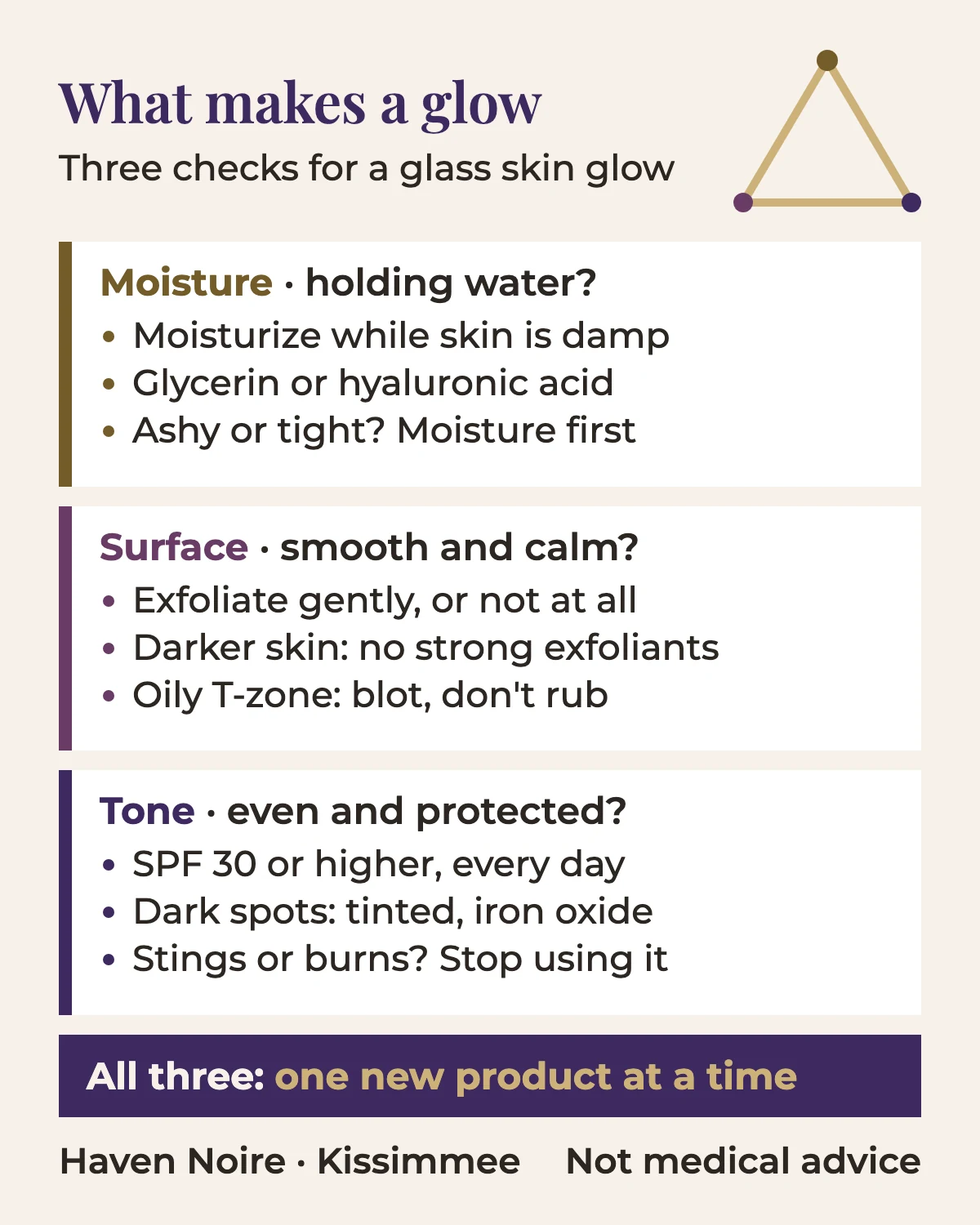
Is your skin holding moisture?
The AAD's tips for getting results from anti-aging skin care products say moisturizer traps water in your skin, and that this extra moisture can help reduce the appearance of fine lines and brighten your complexion.
Signs your skin needs more moisture: skin that feels tight after washing, looks dull by afternoon, or flakes. On deeper skin tones, dryness is often visible as an ashy cast. The AAD's guide to dry skin in darker skin tones says a moisturizer with ceramides can reduce that whitish or grayish-white look.
What helps: moisturize while your skin is still damp. The AAD's general dry skin tips list glycerin and hyaluronic acid among the ingredients to look for in a cream. Tight in the air conditioning but shiny outdoors? Our guide to dry vs. dehydrated skin sorts that out, and our skin barrier guide covers what to do when skin stings or flakes.
Is your skin smooth and calm?
This is the part trend routines push hardest, usually with exfoliation. The AAD's guide to exfoliating at home says exfoliation is not for everyone and, if not done properly, could do more harm than good. It sets no schedule, only a principle: generally, the more aggressive the exfoliation, the less often it's needed.
For brown and Black skin, the AAD is direct: avoid strong chemical or mechanical exfoliation if you have a darker skin tone or notice dark spots after burns, bug bites, or breakouts. For a frequency that fits your skin, read how often you should exfoliate.
Oil belongs here too. Our read: a T-zone that shines by noon isn't the glow the trend describes, since the radiance study counts how shine is spread. The AAD's oily skin tips suggest pressing blotting papers on for a few seconds, never rubbing, and choosing products labeled oil free and noncomedogenic.
Is your color even and protected?
Tone is the part most guides forget, and on melanin-rich skin it's the one that lasts. The AAD's guide to dark spots in darker skin tones lists a skin or hair care product that irritates your skin among the causes. Once the cause stops, it says, a spot a few shades darker than your natural color usually fades within 6 to 12 months.
To protect tone, the AAD recommends tinted sunscreen with iron oxide and SPF 30 or higher, plus gentler products, often labeled for sensitive skin or fragrance-free. Our guide to sunscreen for dark skin shows how to read the label.
The rule for all three: calm beats more
Irritation weakens all three at once. The AAD's guide to applying skin care in the right order warns that using too many products may irritate the skin, which often makes signs of aging more noticeable. Our advice, not a medical rule: add one new product at a time.
| Check | Ask yourself | What the sources say | Start here |
|---|---|---|---|
| Moisture | Tight, flaky, dull, or ashy? | AAD: moisturizer traps water and can help brighten skin | Moisturize on damp skin; ceramides if ashy |
| Surface | Rough, or shiny only in the T-zone? | AAD: no strong exfoliation on darker skin; blot, don't rub | Gentle exfoliation or none; noncomedogenic products |
| Tone | Dark marks after breakouts, bites, or products? | AAD: irritating products can cause dark spots, which often take 6 to 12 months or longer to fade | Tinted sunscreen with iron oxide, SPF 30 or higher |
| All three | Does anything sting, burn, or tingle? | AAD: stop using that product | Pause the newest product; add one at a time |
How to Get Glowing Skin: A Gentle Routine for Florida Heat
This routine follows AAD guidance step by step, built for a Central Florida day: humid outside, air-conditioned inside, sweaty in between.
Morning
- Cleanse with a gentle, non-abrasive cleanser without alcohol. The AAD's face washing tips say to use lukewarm water and your fingertips, because washcloths, sponges, and scrubbing irritate skin.
- Optional: a hydrating serum on still-damp skin (our tip). Look for glycerin or hyaluronic acid, both on the AAD's dry skin ingredient list.
- Moisturize. Oily or breakout-prone? Choose oil free and noncomedogenic. The AAD says even oily skin needs moisturizer to stay hydrated.
- Finish with broad-spectrum, water-resistant sunscreen with SPF 30 or higher. If you're fading dark marks, choose a tinted one with iron oxide.
Night
- Cleanse again, gently. The AAD's rule is to wash twice a day and after sweating heavily, so a sweaty Florida workout earns an extra wash, not a scrub.
- Apply any medicine or treatment right after cleansing, as the AAD's product-order guide advises.
- Moisturize. A richer cream is fine if you're dry; if you break out, keep butters and oils off your face.
Florida notes
Reapply sunscreen every two hours and after swimming or sweating, as the AAD's dark spot guide advises. Water resistance lasts 40 or 80 minutes, per the AAD's sunscreen guide.
Adding a new product: the six-week rule
The AAD's tips for anti-aging products say most products take at least six weeks to work, sometimes up to three months. They suggest starting with one product and testing it on your inner forearm twice a day for four to five days, then using it on your face only if that skin stays free of redness and itch.
Stop any product that stings, burns, or tingles, the AAD says, because that means it's irritating your skin. If it's a prescription, ask your dermatologist before you stop. Our rule of thumb: one new product every six weeks.
Steps you can skip
- Face oils and rich butters, if you break out. The AAD's tips for clearing acne in darker skin tones say cocoa butter or shea butter on your face can clog your pores.
- Petroleum jelly over your whole face, the trend called slugging, if you're acne-prone. The AAD's petroleum jelly tips say to keep it off your face then, since it may cause breakouts in some people. Very dry and not acne-prone? See who slugging suits and how to do it safely.
- Exfoliating on top of retinol. The AAD says prescription retinoids, retinol, and benzoyl peroxide may make skin more sensitive, and exfoliating while you use them may worsen dry skin or even cause breakouts.
Check with your doctor or dermatologist before you change your routine if you're pregnant or breastfeeding (the AAD's large pores guide says not to use retinol or retinyl palmitate then), if you take isotretinoin or use tretinoin or another prescription skin medicine, or if you have eczema or rosacea.
Want help choosing products? Ask us about the professional skincare lines we use.
Glowing Skin for Melanin-Rich Tones: Skip the Dark Marks
On brown and Black skin, start with tone: protect it first. The AAD's exfoliation guide says that for some people, especially those with darker skin tones, more aggressive exfoliation may lead to increased pigmentation, or dark spots. Its dark spot guide adds that discoloration deep in the skin can take years to fade.
The way we see it: an exfoliant that gives you a few smooth days can cost you months of uneven color. That's a poor trade for a trend.

Dull or ashy? Start with moisture
The AAD says flaking, discoloration, and rough texture show more in darker skin tones. Before you reach for an acid, follow its dry skin tips, like short, warm showers and moisturizer on damp skin. With them, it says, you should see some improvement within two weeks.
Glow isn't lightening
Our view: a glow on deep skin looks like deep skin, hydrated and even, not lighter. That matters when you shop. The AAD's dark spot guide says researchers have found steroids or mercury, not listed on the label, in skin care products imported from other countries. For fading dark spots, it recommends a product made in the United States or one your dermatologist recommends, and it says never to put liquid bleach on your skin.
Already have dark marks?
Start with how to fade hyperpigmentation on melanin-rich skin, and see how we approach hyperpigmentation and dark spots. For the bigger picture, read our guide to facials for Black skin.
What a Facial Can and Can't Do for Your Glow
No facial gives you glass skin, and we won't promise one will. What a facial can do in one visit is cleanse, exfoliate as needed, hydrate, and finish with SPF, with a trained second look at your skin. Haven Noire is an esthetics spa, not a medical office, so we don't diagnose or treat medical skin conditions.

Which facial fits your glow goal
Our Signature Facial covers moisture and surface gently. If your checks point to texture or tone, look at our corrective facials:
| Facial | What our menu says | Listed for | Price |
|---|---|---|---|
| Signature Facial | Double cleanse, skin analysis, exfoliation and extractions as needed, mask, massage, serums, moisturizer, SPF | All skin types | $95 for 60 minutes (3 for $210); $110 for 90 minutes (3 for $285) |
| Hydrofacial | A gentle, water-based hydrodermabrasion treatment that exfoliates while infusing nourishing serums | All skin types, including dull, dehydrated, congested, and uneven | $135 as a Corrective Facial (3-pack $360) |
| Radiance Brightening | Antioxidants and vitamin blends aimed at dullness, texture, and discoloration | Hyperpigmented, photodamaged, rough texture, loss of elasticity | $135 as a Corrective Facial (3-pack $360) |
Comparing our Hydrofacial with the branded version? Read hydrodermabrasion vs. HydraFacial.
After your facial, and between visits
After a Signature Facial, keep skin hydrated, skip harsh actives and heat for 24 hours, and wear SPF daily. After a corrective facial, avoid sun and active exfoliants for a few days, hydrate well, and use SPF daily.
Our general guidance is a facial about every four weeks for most skin. The Glow Membership ($74.99 a month) includes a 60-minute Signature Facial, and the Corrective Membership ($109.99 a month) a corrective facial of your choice, Hydrofacial included. See our memberships.
When to See a Dermatologist Instead
We're estheticians, not doctors, and a glass skin routine doesn't treat skin conditions. See a board-certified dermatologist if:
- Products burn or sting, or your face feels warm most of the time. For darker skin tones, the AAD's rosacea guide lists both as reasons to see a dermatologist, along with a dusky brown discoloration and breakouts that acne treatment won't clear.
- Dry or ashy skin hasn't improved after two weeks of good care. The AAD says dryness that nothing relieves may be an undiagnosed condition such as eczema, ichthyosis, or psoriasis.
- Dark spots aren't fading with the treatment you're using. The AAD says some spots need a prescription-strength treatment.
- Breakouts or blackheads keep coming after you simplify. The AAD's oily skin guide suggests a board-certified dermatologist if you're struggling with blackheads or acne.
- You think a medicine is darkening your skin. The AAD says not to stop taking it; ask the doctor who prescribed it.
Already working with a doctor? See how we approach sensitive and redness-prone skin alongside a physician's care.
Frequently Asked Questions About Glass Skin
What does glass skin mean?
It's a beauty trend that started in Korea. It describes skin that looks smooth, clear, hydrated, and so even that it seems to glow like glass. It isn't a skin type or a medical result. A dermatologist quoted in an American Academy of Dermatology news release calls its moisturizing and sunscreen steps positive habits.
Can you have glowing skin with large pores?
You can get the glow, not a poreless face. Pores are a normal part of skin, and no routine removes them. The American Academy of Dermatology says pores tend to look more noticeable when skin is inflamed, so a gentle, calm routine keeps them less noticeable than one that scrubs or stings.
How long does it take to get glass skin?
Think in weeks, not days. In its tips on anti-aging products, the American Academy of Dermatology says a moisturizer can plump up fine lines in a few days, but most products take at least six weeks to work, and sometimes up to three months. Add one new product at a time so you can tell what's actually helping.
Is glass skin safe for dark skin?
Its basics, gentle cleansing, moisturizer, and daily sunscreen, are habits the American Academy of Dermatology recommends. The risky part is aggressive exfoliation: the AAD advises avoiding strong chemical or mechanical exfoliation if you have a darker skin tone, since for some people it may lead to dark spots. Protect even tone first with tinted sunscreen containing iron oxide.
Can a facial give you glass skin?
Not in one visit, and we won't promise it. A facial can cleanse, exfoliate as needed, hydrate, and give you a skin analysis to guide your routine. At Haven Noire in Kissimmee, a 60-minute Signature Facial is $95, and a Corrective Facial, including our Hydrofacial or Radiance Brightening, is $135.
Do you need a 10-step routine for glowing skin?
No. A dermatologist quoted in an American Academy of Dermatology news release warns that some people risk using too many products, which can lead to clogged pores, irritation, and breakouts, and she advises moderation. The AAD's own product-order guide has four steps: cleanse, medicine or treatment, moisturizer and sunscreen, then makeup if you want it.
Does drinking water give you glowing skin?
Not on its own. A 2018 systematic review in Skin Research and Technology included only six studies on drinking water and skin, and called the evidence weak. Extra water may slightly raise hydration in the skin's outer layer, especially in people who drank little before. Drink water for your health, and give your skin moisturizer and sunscreen.
More from the Journal

About the author
Tiffany · Licensed Esthetician · Licensed PMU Artist
Tiffany is a Florida-licensed esthetician and permanent makeup artist and the founder of Haven Noire. She specializes in customized facials, corrective skincare, and waxing for melanin-rich and all skin types, and is known for a calm, education-first approach that puts first-time clients instantly at ease.
Meet Tiffany →