

Coconut oil is a decent moisturizer for dry skin on your body. On your face, it's a gamble. The American Academy of Dermatology (AAD) warns that products containing oil can clog your pores, and on brown and Black skin a breakout can leave a dark mark that lasts for months.
Our answer at Haven Noire, a facial spa in downtown Kissimmee: if you break out easily, keep coconut oil off your face. If your skin is dry and almost never breaks out, it's a lower-stakes experiment, but there are better choices.
The longer answer is more interesting. Most coconut oil claims were tested somewhere other than a face: on rabbit ears, in lab dishes, on dry legs, and on children with eczema. Below, we sort them by where they were tested.
One note: any timeline or step here without a linked source is our own advice, not a medical rule. We're estheticians, not doctors.
Is Coconut Oil Good for Your Face? The Short Answer
Coconut oil moisturizes dry skin, but it isn't a good everyday face product for most people. It can clog pores, the evidence that it helps acne is thin, and dermatologists recommend more effective moisturizers. Keep it for your body.
| Your skin | Coconut oil on your face? | Why |
|---|---|---|
| Breaks out easily, or oily | Skip it | AAD: products containing oil can clog your pores |
| Brown or Black, and marks easily | Skip it | AAD: acne in skin of color often leaves dark spots |
| Prone to milia around the eyes | Keep it away from your eyes | Cleveland Clinic: a risk of milia, more likely under the eyes |
| Dry, and rarely breaks out | Maybe, as a careful experiment | Its dry skin trial was done on legs, not faces |
| Eczema, rosacea, pregnant, or on a prescription | Ask first | Your dermatologist or doctor knows your treatment plan |
Melanin-rich and acne-prone at once? That's two reasons in one face. Our sister guide to skin care for Black skin builds the full routine. This guide stays on the oil.
Where Coconut Oil Claims Were Actually Tested
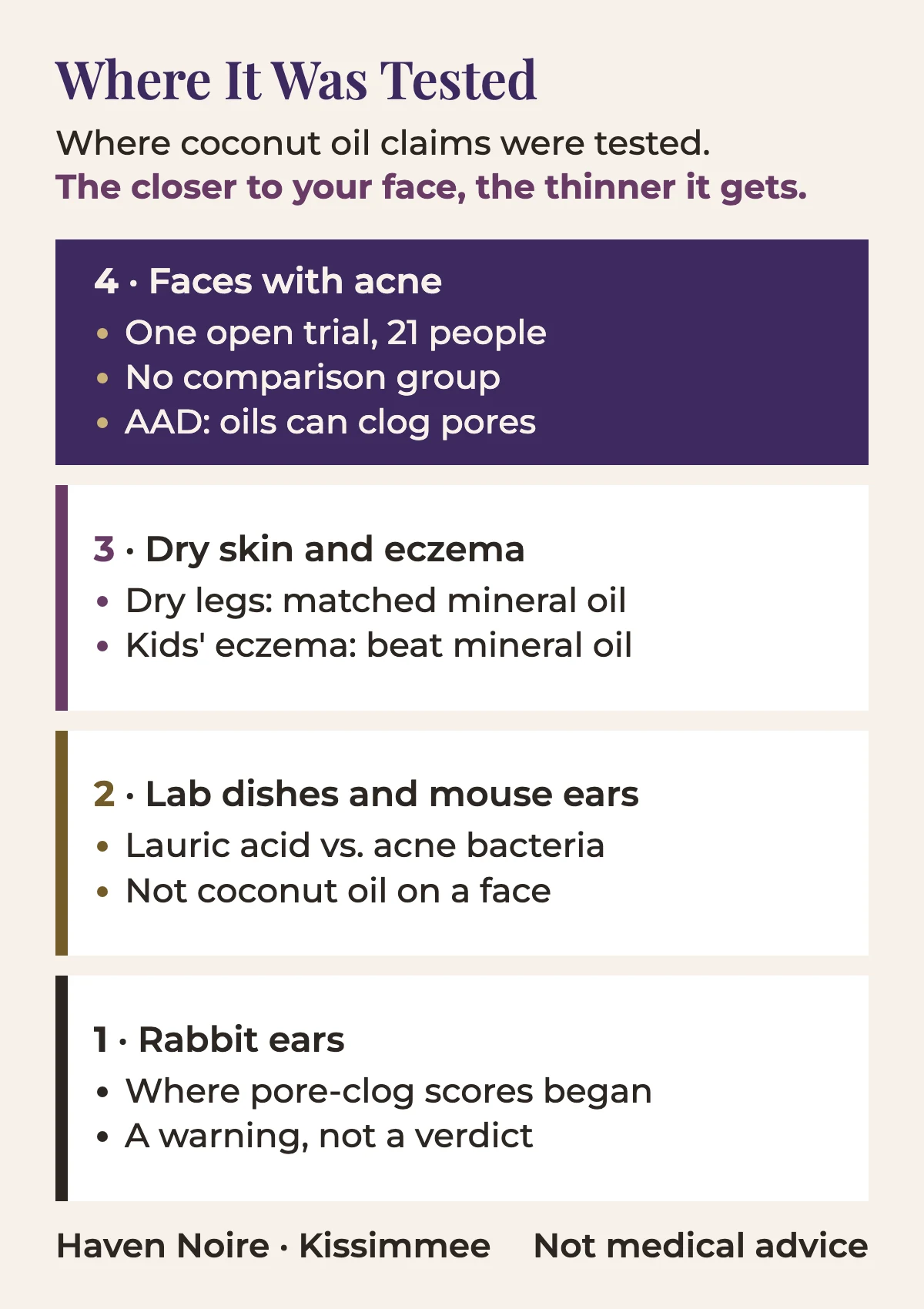
Here's what most coconut oil articles skip: where each claim was tested. Below, those test sites run from farthest to closest to your face. The closer a test gets to an acne-prone face, the thinner the evidence.
1. Rabbit ears, where pore-clogging scores began
Comedogenic scores rate how likely an ingredient is to clog pores and start blackheads and whiteheads. A May 2026 guide from Advanced Dermatology, P.C., a dermatology practice, rates coconut oil 4 out of 5 on that scale and notes that the original ratings were based on animal models. One was the rabbit ear: a 1984 paper in the Journal of the American Academy of Dermatology drew its ingredient data from that test and said it "is not an ideal animal model but is the best we have."
A 2006 study in the same journal tested finished products on six people's backs and concluded that products using comedogenic ingredients are not necessarily comedogenic.
What it means for your face: a score is a warning, not a verdict, and not a universal fact about your skin. The AAD tells people with acne to use products labeled "non-comedogenic" or "won't clog pores." A jar of cooking oil isn't labeled either way.
2. Lab dishes and mouse ears, where the acne-fighting claim began
Coconut oil's acne-fighting reputation leans on lauric acid, which a Cleveland Clinic article says makes up 49% of coconut oil and has antimicrobial properties. In a 2009 study in the Journal of Investigative Dermatology, purified lauric acid stopped the growth of acne bacteria in lab dishes and reduced them on the ears of mice.
What it means for your face: that study tested one isolated fatty acid, not the oil in your pantry, and not on a human face. It doesn't show that coconut oil treats acne in people, and the acne review below found the evidence for that insufficient. It's a reason to keep studying, not a reason to slather.
3. People with dry skin or eczema, where the real trials are
This is where coconut oil's best evidence sits. In a 2004 randomized trial, 34 people with mild to moderate dry skin applied extra virgin coconut oil or mineral oil to their legs twice a day for two weeks. The authors concluded that coconut oil is as effective and safe as mineral oil as a moisturizer. A 2014 trial in the International Journal of Dermatology followed 117 children with mild to moderate eczema for eight weeks, and virgin coconut oil did better than mineral oil.
What it means for your face: both trials compared coconut oil with mineral oil, which is on the AAD's dry skin ingredient list. Coconut oil isn't, and neither trial looked at acne-prone faces.
4. Faces with acne, the thinnest evidence
A 2020 systematic review and meta-analysis in JAAD International looked at natural remedies, coconut oil among them, for acne, eczema, and psoriasis. For acne, it found only one coconut oil study: an open trial of a virgin coconut oil treatment in 21 people. That trial reported fewer papules and pustules, but it had no comparison group to measure the change against. The review's overall conclusion: insufficient evidence to support these remedies for acne, eczema, or psoriasis.
What it means for your face: with this little evidence on faces, we lean on dermatologists' guidance, and the AAD says products containing oil can clog your pores. That's the guidance we build on.
| # | Where it was tested | What it found | What it means for your face |
|---|---|---|---|
| 1 | Rabbit ears | The animal test behind comedogenic scores | A warning, not a verdict on your skin |
| 2 | Lab dishes and mouse ears | Purified lauric acid stopped acne bacteria | Not tested as coconut oil on a face |
| 3 | Dry legs; children with eczema | As good as, or better than, mineral oil | Good news for dry skin on your body |
| 4 | Faces with acne | One open trial, 21 people, no comparison group | Too thin to trust; follow the AAD's oil warning |
Coconut Oil on Melanin-Rich, Acne-Prone Skin: The Dark-Mark Risk
In many homes, one jar of coconut oil handles hair, elbows, and dry hands. Moving it to your face is where the stakes change, especially on brown and Black skin.
The AAD's tips for clearing acne in darker skin tones explain why. For people with skin of color, acne is often accompanied by dark spots called hyperpigmentation, and those spots can last much longer than the acne. The same page says a product containing oil, such as cocoa butter or shea butter, can clog your pores on your face, back, or chest. It doesn't name coconut oil, but a jar of coconut oil is nothing but oil.
The AAD's guide to fading dark spots in darker skin tones adds the timeline: a spot a few shades darker than your natural color usually fades within 6 to 12 months, and deeper color can take years. It also says a product that irritates your skin can cause dark spots.

Our math: a few weeks of soft cheeks isn't worth months of marks. If marks have already formed, start with how to fade hyperpigmentation on melanin-rich skin.
Watch your hairline, too
Coconut oil can reach your face from your hair, too. The same AAD acne page says that if breakouts appear only on your forehead and temples, your hair oil may be the cause, a pattern called pomade acne. It suggests a hair product with water or glycerin instead of oil, or using hair oil only in the middle of your scalp and on the ends of your hair.
That doesn't make it bad for hair. A 2022 systematic review in the Journal of Drugs in Dermatology, focused on patients with skin of color, reported that coconut oil has been shown to treat brittle hair. Our take: let your ends have it, and keep it off your edges and forehead.
Coconut Oil on Your Face Overnight: Who Should Skip It
Overnight gives the oil its longest stay on your pores. A Cleveland Clinic article calls coconut oil highly comedogenic and says it can increase blackheads and whiteheads. The article also warns of a risk of milia, which it says is more likely where skin is thinner, like under your eyes. MedlinePlus describes milia as tiny white bumps or small cysts on the skin.

Skip it overnight if any of these fit:
- You break out easily, or your skin is oily.
- You've had milia, especially around your eyes.
- Your skin is brown or Black and marks easily after breakouts.
- You use a prescription acne treatment or isotretinoin, or you have eczema or rosacea. Ask your dermatologist first.
- You're allergic to coconut.
Tight at night? A thick cream may do the job better. Our sister guide to slugging covers the overnight petroleum jelly trend, and our skin barrier guide shows how to calm skin that stings.
If your skin is dry and rarely breaks out
Still want to try it? Here's how to do it carefully:
- Test it on your arm first. The AAD's guide to testing skin care products suggests a quarter-sized spot, such as your inner arm, twice a day for seven to 10 days. Watch for red, itchy, or swollen skin.
- Know that test's limit. It screens for irritation, it doesn't mention breakouts, and your arm isn't your face.
- Start with a thin layer on one dry area, such as your cheeks, well away from your eyes.
- Use it at night only, and wash your face in the morning before sunscreen.
- Stop at the first new blackhead, whitehead, or hard white bump.
Our advice: give it two weeks, the length of the dry leg trial above, stop sooner if anything changes, and keep watching after that.
Better Places for Coconut Oil: Body Skin and Makeup Removal
Coconut oil doesn't have to leave your bathroom. It just does better at other jobs.
Dry skin on your body
This is where the best trials point: the 2004 trial tested coconut oil on dry legs. Even here, the AAD's dry skin remedies for darker skin tones add a dermatologist's caution: butters and oils tend to liquefy on the skin, so they're less effective as moisturizers. For very dry skin, the page recommends petroleum jelly or a thick cream.
Our advice: if you love coconut oil on your arms and legs, keep it there, and switch to a thick cream when skin looks gray or cracked. Our sister guide to ashy skin covers that look.
Removing makeup
A dermatologist quoted in a Cleveland Clinic article says you can use a bit of coconut oil as a makeup remover, and recommends double cleansing afterward with a water-based cleanser to reduce the risk of clogged pores and milia. If your skin is oily or breaks out easily, skip the oil for this job too. The AAD's oily skin tips say not to use oil-based cleansers, because they can irritate your skin. Our double cleansing guide walks through an oil-free first step.
Other jars from the pantry
Coconut oil isn't the only kitchen favorite headed for faces. Our sister guides cover shea butter for skin, which the AAD's pore warning names directly, and castor oil for skin, the brow and lash trend.
What to Use Instead of Coconut Oil on Your Face
Choose by the job you wanted coconut oil to do.
| If you wanted it to | Try instead | Why |
|---|---|---|
| Moisturize dry skin | A cream with glycerin, hyaluronic acid, dimethicone, or petrolatum | All four are on the AAD's dry skin list |
| Moisturize oily or acne-prone skin | A moisturizer labeled oil free and noncomedogenic | The AAD says even oily skin needs moisturizer |
| Remove makeup on oily skin | An oil-free remover, then a gentle cleanser | The AAD says not to use oil-based cleansers on oily skin |
| Fade dark marks | Azelaic acid, glycolic acid, kojic acid, a retinoid, or vitamin C | The AAD's dark spot list; coconut oil isn't on it |
| Protect from sun | A tinted, broad-spectrum, water-resistant sunscreen, SPF 30 or higher. See sunscreen for dark skin. | The AAD's dark spot advice for darker skin tones |
Pregnant, or using a prescription? Ask your doctor or dermatologist before you add a retinoid or any other active.
Not sure which problem you're solving? Our dry vs. dehydrated skin guide helps you tell them apart, and you can see the professional skincare lines we use before your visit.
Where a Facial Fits After a Coconut Oil Experiment
If coconut oil left you with bumps or dark marks, or you just want to know what your skin needs, start with a skin analysis. Haven Noire is an esthetics spa, not a medical office. Our Signature Facial menu lists five steps:
- Consultation and double cleanse. Tell us everything you put on your face, kitchen oils included.
- Skin analysis, so every product and technique is chosen for your skin that day.
- Exfoliation and extractions as needed.
- A custom mask and facial massage.
- Serums, moisturizer, and SPF.
Breakouts your main concern? Our acne facials page covers congestion and post-acne marks, including the Acne Oxygen Rx, a Corrective Facial option ($135, 60 minutes) built around oxygen therapy and a purifying charcoal mask. New to facials? Read what to expect at your first facial.
When to See a Dermatologist Instead
Some results of a coconut oil experiment call for a medical opinion. See a board-certified dermatologist, or your doctor, when:
- Breakouts continue after you've stopped the oil, or they leave dark marks. The AAD says many people seek a dermatologist's help for dark spots, which can outlast the acne.
- Your skin turns red, itchy, or swollen, and a cool compress or petroleum jelly doesn't calm it. The AAD's testing guide says a severe reaction may need a dermatologist.
- You have eczema and want to try it. The dry skin and eczema trials above don't replace your treatment plan, and the 2020 review's overall verdict on natural remedies for eczema was insufficient evidence.
- Your skin flushes or stings with most products. See how we approach sensitive and redness-prone skin, and ask a dermatologist about rosacea.
- You find firm white bumps that don't go away, especially around your eyes. MedlinePlus notes that adults may have milia removed; our advice is to leave them alone at home and ask a dermatologist.
Check with your doctor or dermatologist before you add coconut oil or any new product to your face if you're pregnant or breastfeeding, if you take isotretinoin or use tretinoin or another prescription skin medicine, or if you have eczema, rosacea, or keloid-prone skin.
Frequently Asked Questions About Coconut Oil on Your Face
Does coconut oil clog pores?
It can. A Cleveland Clinic article calls coconut oil highly comedogenic, and the AAD says products containing oil can clog pores. One dermatology practice rates it 4 out of 5 on a scale first built on animal tests, and a small 2006 study found comedogenic ingredients don't always make a product comedogenic. Treat the number as a warning.
Will coconut oil fade dark spots on Black or brown skin?
We searched PubMed in November 2026 for coconut oil studies on hyperpigmentation, melasma, or dark spots and found no trial of plain coconut oil on human skin. It isn't on the AAD's list of ingredients that can fade dark spots. On acne-prone skin, it can clog pores, which the AAD says can lead to acne and new marks.
Can coconut oil cause milia under the eyes?
It may. A Cleveland Clinic article says coconut oil carries a risk of milia, and that milia are more likely where skin is thinner, like under your eyes. Keep coconut oil away from that area. If firm white bumps appear and don't go away, leave them alone and ask a dermatologist.
Is it okay to take off makeup with coconut oil?
A Cleveland Clinic dermatologist says you can use a bit of coconut oil as a makeup remover, then double cleanse with a water-based cleanser to reduce the risk of clogged pores and milia. If your skin is oily or breaks out easily, choose an oil-free remover instead; the AAD says not to use oil-based cleansers on oily skin.
Does coconut oil help with wrinkles?
We searched PubMed in November 2026 for coconut oil studies on wrinkles, skin aging, or photoaging and found no trial of plain coconut oil on human skin. The closest was a serum blending coconut oil with deer antler extract, tested on mice. If fine lines are your concern, see our anti-aging facials.
Can coconut oil replace sunscreen?
No. A jar of coconut oil carries no SPF on its label. To prevent dark spots on brown and Black skin, the AAD recommends a tinted sunscreen with iron oxide, SPF 30 or higher, with broad-spectrum protection and water resistance. If videos have you doubting sunscreen itself, read our guide to whether sunscreen is bad for you.
Is coconut oil safe for eczema on the face?
Ask your dermatologist first. A trial in 117 children with mild to moderate eczema found virgin coconut oil did better than mineral oil over eight weeks. A 2020 review listed coconut oil among the remedies with some support in eczema, but its overall verdict on natural remedies for eczema was insufficient evidence. It doesn't replace your treatment plan.
More from the Journal

About the author
Tiffany · Licensed Esthetician · Licensed PMU Artist
Tiffany is a Florida-licensed esthetician and permanent makeup artist and the founder of Haven Noire. She specializes in customized facials, corrective skincare, and waxing for melanin-rich and all skin types, and is known for a calm, education-first approach that puts first-time clients instantly at ease.
Meet Tiffany →