
Mandelic acid is an alpha hydroxy acid (AHA), a chemical exfoliant that helps clear dead cells from the surface of your skin. It has a reputation as the gentle acid for melanin-rich skin, and several small trials in India found peels containing it easier to tolerate than glycolic or salicylic peels. At home, we'd use it low, slow, and with sunscreen every morning.
Here's what most guides skip: how gentle any acid feels also depends on the dose. A professional peel and a mild toner can both say "mandelic" on the label. And in one recent trial of 70 patients in India, a mandelic peel caused irritation more often than a lactic peel did.
Below: what the studies found and who was in them, the four things that decide how gentle it feels on your skin, how it compares with glycolic acid, and when a dermatologist should come first. New to how deeper skin reacts to treatment? Start with our guide to facials for Black skin.
What Is Mandelic Acid?
Mandelic acid is an alpha hydroxy acid, a type of chemical exfoliant. Like other AHAs, it helps remove dead skin cells from the surface. You'll find it in home cleansers, toners, and serums, and in professional chemical peels.
The American Academy of Dermatology (AAD) describes chemical exfoliation as using chemicals, such as alpha and beta hydroxy acids, to dissolve dead skin cells. A 2018 review of chemical peels in the Journal of Clinical and Aesthetic Dermatology calls mandelic acid "essentially an aromatic glycolic acid": built like glycolic acid, with a ring-shaped phenyl group attached.
Its name comes from Mandel, the German word for almond.
Why Mandelic Acid Is Called the Gentle Acid
That ring makes the molecule heavier: PubChem, the National Library of Medicine's chemistry database, lists it at 152.15 grams per mole, about twice glycolic acid's 76.05. The 2018 review adds that its structure lets it dissolve in both water and some organic solvents, which results in more uniform penetration through the oil-rich areas of skin. The authors of the 2025 trial in the table below give the common explanation: because of its larger size, it penetrates the outer layer of skin more slowly, which makes it gentler.
The same review says mandelic peels give more subtle results than glycolic acid peels, with comparatively fewer side effects and less downtime. One honest note: we searched PubMed in November 2026 for a study that directly measured how fast mandelic and glycolic acid move into human skin, and didn't find one. The evidence for its gentleness comes from small clinical trials, which we cover next.
So mandelic earns its gentle reputation in several of those comparisons, and how gentle it feels on your face still depends on how much you use, for how long, and what else is in your routine. That's why every peel at Haven Noire starts with a skin consultation. For acids in professional peels on deeper tones, see Chemical Peels for Melanin-Rich Skin.
Mandelic Acid Benefits: What the Studies Actually Found
Most of the evidence comes from professional peels applied in dermatology clinics, not home serums. Here are the head-to-head trials we read.
| Study | Who and how many | What was compared | What it found |
|---|---|---|---|
| Garg and colleagues, 2009 | 44 patients with acne and post-acne marks, New Delhi | 35% glycolic peel vs. a 20% salicylic plus 10% mandelic peel, six sessions | The authors report the salicylic-mandelic peel did better on active acne and dark marks, with fewer side effects |
| Sarkar and colleagues, 2016 | 90 patients with melasma, New Delhi | 35% glycolic vs. the same salicylic-mandelic peel vs. a phytic acid peel, after 4 weeks of prescription hydroquinone and tretinoin | Glycolic and salicylic-mandelic worked about equally; salicylic-mandelic was better tolerated |
| Dayal and colleagues, 2019 | 50 patients with mild to moderate acne, Rohtak | 45% mandelic peel vs. 30% salicylic peel | About equal overall; mandelic better on inflamed bumps, salicylic on blackheads and whiteheads; fewer side effects with mandelic |
| Malviya and colleagues, 2025 | 70 patients with dark circles (61 finished), Dewas | 30% mandelic peel vs. 30% lactic peel around the eyes | Lactic scored better on the doctors' improvement scale and on satisfaction; irritation was more common with mandelic (28.6% vs. 14.3%), peeling with lactic (14.3% vs. 5.7%) |
For Breakouts
Two trials found that peels containing mandelic helped acne about as well as, or better than, the peel they were compared with. A 2020 Cochrane review urges caution: it rated the evidence comparing glycolic and salicylic-mandelic peels as low quality, with its main result resting on one 40-person study in Egypt, and was uncertain whether side effects differed in the 44-person Garg trial.
For acne on darker skin, the AAD's tips for clearing acne in darker skin tones list a retinoid paired with benzoyl peroxide among the products that work well for mild acne, and say to see a dermatologist before any chemical peel, microdermabrasion, or laser treatment for acne. For what a spa visit can add, read the best facial for acne in Kissimmee.
For Dark Marks and Melasma
In the Garg trial, the salicylic-mandelic peel improved post-acne dark marks more than glycolic did. The melasma trial is harder to read: every patient used prescription hydroquinone and tretinoin for four weeks first, so the peels weren't working alone.
Fading takes time with any ingredient. The AAD's guide to fading dark spots says a spot a few shades darker than your natural color usually fades within 6 to 12 months, and deeper color can take years. Its list of ingredients that can fade dark spots names azelaic acid, glycolic acid, kojic acid, retinoids, and vitamin C. Mandelic isn't named on that list; its evidence on dark marks comes mainly from peel trials like Garg's. For the full routine, read how to fade hyperpigmentation on melanin-rich skin.
Who Was in the Studies
All four trials ran in dermatology departments in India, and none of what we read breaks out results by Fitzpatrick skin type. If your skin is very deep, read these results as encouraging, not settled. Every trial also used professional peels of 10% to 45% mandelic in a clinic; a serum on your bathroom shelf is a different dose.
Mandelic Acid for Dark Skin: Why the Dose Matters
On melanin-rich skin, irritation isn't just uncomfortable. The AAD's dark-spot guide lists a skin care product that irritates your skin among common triggers of dark spots in darker skin tones. Its exfoliation guide says more aggressive exfoliation can lead to dark spots, and advises avoiding strong chemical or mechanical exfoliation if you have a darker skin tone, or if burns, bug bites, or breakouts leave you with dark spots.
So alongside "Is it gentle?", ask a second question: "How big a dose am I giving my skin?" Four things decide the answer.
Four Things That Decide How Gentle an Acid Feels
This is our reading of the sources, not a medical rule. It rests on the 2018 peel review, which says peel depth depends on the acid, its concentration, how it's applied and how many times, your skin type, and the condition being treated, plus the AAD's exfoliation guidance and the FDA's sun warning for AHAs. Use the four below to judge any mandelic product before it touches your face.
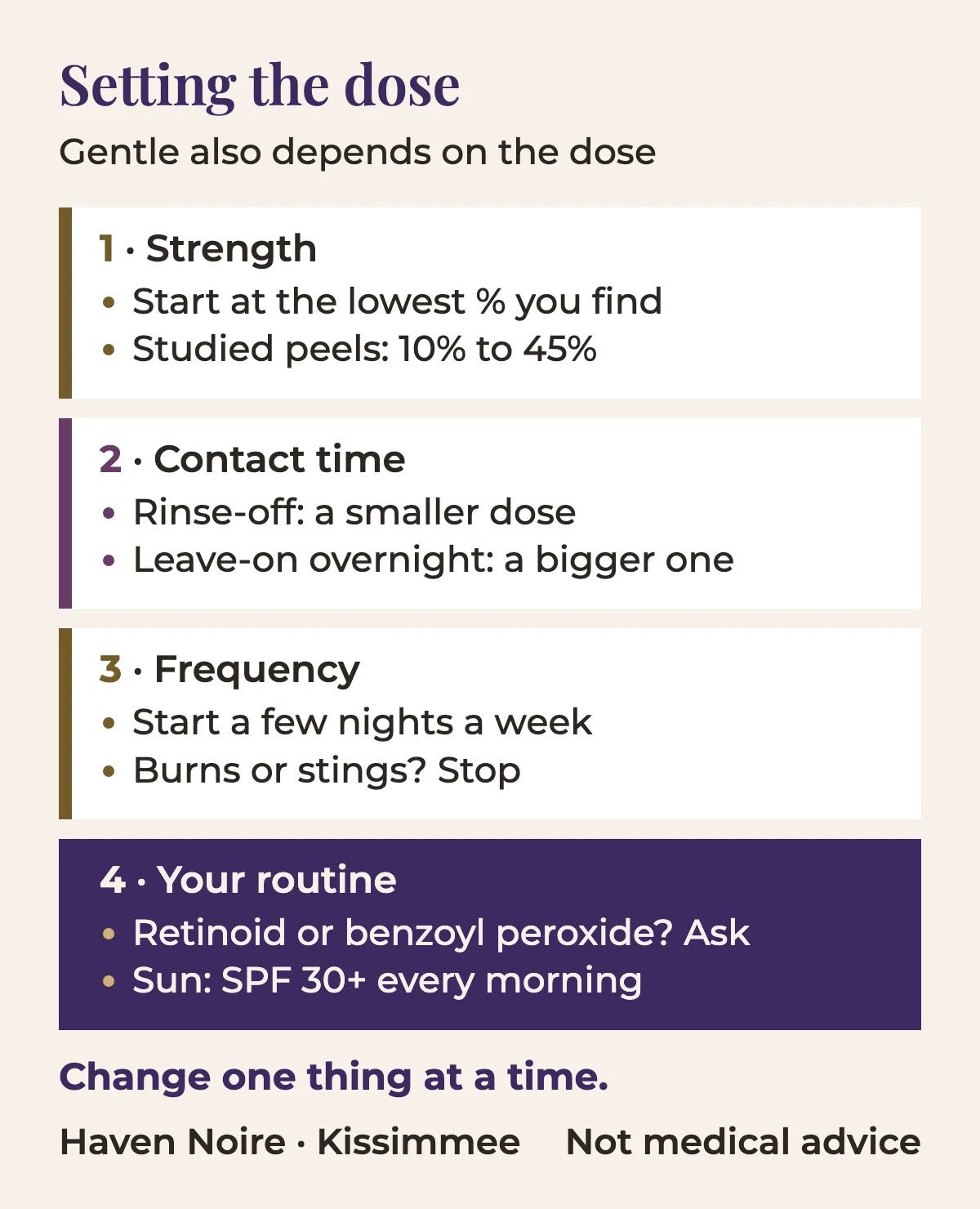
Strength
The percentage on the label. The peel review notes that, for the same contact time, a higher concentration of an acid exfoliates more deeply. The trials above used 10% to 45% in a clinic. At home, our advice is to start with the lowest strength you can find, especially if your skin marks easily.
Contact Time
How long the acid sits on your skin. The peel review calls peel depth "cumulative dose-dependent." Our reading: a cleanser you rinse off after a minute is a smaller dose than a serum you leave on overnight, even at the same percentage. Unsure? Start with a rinse-off product.
Frequency
How often you use it. The AAD says "the more aggressive the exfoliation, the less often it needs to be done," and warns that over-exfoliating can leave skin red and irritated. Our advice: start two or three nights a week, and add a night only after a couple of calm weeks. Our guide to how often you should exfoliate goes deeper.
The Rest of Your Routine
Everything else your skin is handling. The AAD says exfoliating while using a prescription retinoid, retinol, or benzoyl peroxide may worsen dry skin or even cause breakouts. New bumps since you started a retinoid? See how to tell purging from a breakout. Sun belongs here too: the FDA's page on alpha hydroxy acids says AHAs may increase your skin's sensitivity to the sun, and advises sunscreen, protective clothing, and limited sun exposure while you use them and for a week afterward. In Central Florida, plan on sunscreen every morning.
Two rules tie the four together, both our own advice: change only one at a time, and if your skin stings, reddens, or flakes, scale all four back. The AAD's dark-spot guide is blunter: "If a product burns or stings when you apply it, stop using it."
Mandelic Acid vs Glycolic Acid (and Lactic Acid)
All three are AHAs, so the FDA's sun warning applies to each. Here's how they compare on the points our sources cover.
| Compared on | Mandelic | Glycolic | Lactic |
|---|---|---|---|
| Molecular weight | 152.15 g/mol | 76.05 g/mol | 90.08 g/mol |
| What studies say | More subtle results than glycolic peels, with fewer side effects and less downtime (2018 review) | More visible results than mandelic peels, with more side effects and downtime (2018 review) | Improved dark circles more than a 30% mandelic peel, with less irritation but more peeling (2025 trial) |
| On the AAD's dark-spot ingredient list | No | Yes | No |
| On the Haven Noire menu | Part of the MandeliClear Peel, listed for Fitzpatrick I to V | Not named on our menu | Lactic Peel, listed for Fitzpatrick I to VI |
Our take: mandelic is a reasonable first acid for skin that marks easily, mainly because several small trials found it easier to tolerate than glycolic or salicylic peels. It isn't automatically the gentlest choice: in the 2025 trial, lactic acid scored better on results and caused less irritation, though more peeling. And glycolic is the acid the AAD names for fading dark spots, if your skin tolerates it. For how lactic behaves at home strength and in peels, see our guide to lactic acid for skin.
If rough texture bothers you more than dark marks, sort your bumps with our guide to textured skin before you pick an acid.
How to Use Mandelic Acid Safely at Home
Adding a mandelic product to your routine? Here's the order we'd follow. Steps marked AAD or FDA come from those sources; the rest is our own advice.
- Check what else you use. On isotretinoin, tretinoin, another prescription retinoid, or benzoyl peroxide? Ask your dermatologist before adding any acid.
- Pick one acid product at the lowest strength you can find. Don't layer it with another AHA, a BHA, or a scrub.
- Start two or three nights a week, on clean skin.
- Moisturize right after. Exfoliating can be drying, and the AAD says to apply moisturizer immediately afterward.
- Wear sunscreen every morning: broad-spectrum, SPF 30 or higher, and tinted with iron oxide if you're fading dark spots (AAD). Keep it up for a week after you stop the acid (FDA).
- Skip it on sunburned skin or open cuts. The AAD says never to exfoliate either.
- Stop if it burns or stings (AAD), and change only one thing at a time so you know what your skin is reacting to.
Pregnant or breastfeeding? Ask your OB-GYN or midwife before starting any acid product. Taking isotretinoin? The AAD's isotretinoin skin care guide lists AHAs such as glycolic and lactic acid among the exfoliants to avoid, because they can weaken and irritate skin, and mandelic is an AHA too. If you use tretinoin or another prescription skin medicine, or you have eczema, rosacea, or skin that forms keloids, check with your dermatologist first.
For the sunscreen step, our tinted sunscreen guide for dark skin shows how to read a label. If your skin already stings with everything, read our skin barrier guide before you add any acid.
In the Treatment Room: Our MandeliClear Peel
On our menu, mandelic is named in one service, the MandeliClear Peel. Our FAQ sums up the approach: we favor gentle, mandelic-based options for deeper skin tones.
Here's what the menu says about it:
- An AHA/BHA corrective peel with lactic, mandelic, and salicylic acids plus resorcinol, and a Vitamin A Accelerator.
- Designed for stubborn pigmentation and uneven tone in diverse skin.
- Listed for Fitzpatrick skin types I to V.
- Best performed October to March.
- A skin consultation is required first; peels aren't available on a first visit.
- Each peel includes a post-care home kit.
In terms of dose, it's a blend: mandelic works alongside lactic and salicylic acids and resorcinol rather than alone, and the trial peels used their own formulas. Our consultation reviews your history and current products so we can choose the right peel and strength. The October to March window follows our peel page's guidance that stronger corrective peels are best scheduled in lower-UV months.
If your skin is Fitzpatrick type VI, raise it at your consultation: MandeliClear is listed for types I to V, while our Lactic Peel is listed for I to VI. If acne is your reason and your skin is darker, the AAD advises seeing a dermatologist before any chemical peel. If melasma is your reason, the AAD says peels for melasma should be performed by a board-certified dermatologist, so start there. Already booked? Here's what to do after a chemical peel.
When to See a Dermatologist Before Any Acid
Haven Noire is an esthetics spa, not a medical office, so we can't diagnose acne, melasma, or any other skin condition. See a board-certified dermatologist first if:
- You have darker skin and you're considering a chemical peel, microdermabrasion, or laser for acne. The AAD says even at-home versions can cause permanent dark marks and light spots.
- You think you have melasma. The AAD's melasma treatment guide lists chemical peels among procedures a dermatologist performs, and says only a board-certified dermatologist should perform them.
- Your acne keeps leaving dark marks. The AAD says that with a dermatologist's help, virtually every case of acne and most dark spots can be successfully treated.
- A dark spot isn't fading with careful home care. The AAD suggests a dermatologist when your treatment isn't delivering.
- You're pregnant, breastfeeding, taking isotretinoin, or using any prescription skin medicine.
- Your skin still burns or stings after you stop an acid (our advice, not a medical rule).
Once a dermatologist has a plan, spa care can work alongside it. Our pages on melasma and acne facials show where it fits.
Frequently Asked Questions About Mandelic Acid
Is mandelic acid good for dark skin?
It can be a reasonable first acid for melanin-rich skin. In three small peel trials run in India, peels containing it were easier to tolerate than glycolic or salicylic peels, though a fourth found it more irritating than lactic acid. Strength, contact time, frequency, and the rest of your routine decide the dose, and irritation can leave dark marks.
Is mandelic acid better than glycolic acid for hyperpigmentation?
Not clearly. In a 90-patient melasma trial in India, a salicylic-mandelic peel and a glycolic peel worked about equally, and the mandelic blend was better tolerated. Glycolic is the acid the American Academy of Dermatology names among ingredients that fade dark spots. See our page on hyperpigmentation and dark spots for spa options.
Can you use mandelic acid every day?
Some people can, but we wouldn't start there. Our advice is two or three nights a week, adding a night only after a couple of calm weeks. The American Academy of Dermatology says the more aggressive the exfoliation, the less often you need it, and that over-exfoliating can leave skin red and irritated.
Can I use mandelic acid with retinol or tretinoin?
Ask your dermatologist first. The American Academy of Dermatology says exfoliating while using a prescription retinoid, retinol, or benzoyl peroxide may worsen dry skin or even cause breakouts. If you're cleared to use both, our advice is to use them on different nights rather than layering them, and to stop if anything stings.
Is mandelic acid safe during pregnancy?
Ask your OB-GYN or midwife before you start it. We're estheticians, not doctors, and pregnancy can change which products and treatments are right for you. If you're pregnant, tell us before any facial or peel at Haven Noire, and bring any guidance your provider gives you to your consultation.
Does mandelic acid help with acne?
In a 50-patient trial in India, a 45% mandelic peel improved mild to moderate acne about as well as a 30% salicylic peel, with fewer side effects. A Cochrane review still rated the evidence comparing glycolic and salicylic-mandelic peels as low quality. For acne on darker skin, the AAD points to a retinoid with benzoyl peroxide.
How long does mandelic acid take to fade dark spots?
We couldn't verify a timeline specific to this acid. The American Academy of Dermatology says a spot a few shades darker than your natural color usually fades within 6 to 12 months, and deeper color can take years. Its plan also includes a tinted sunscreen with iron oxide, SPF 30 or higher, every day.
Can I get a mandelic acid peel in Kissimmee?
Yes. Our MandeliClear Peel at 231 Ruby Avenue, Unit E, blends lactic, mandelic, and salicylic acids with resorcinol. It's listed for Fitzpatrick types I to V, is best performed October to March, and needs a skin consultation first, so it's never a first-visit service. Call (321) 900-1144 to start.
More from the Journal

About the author
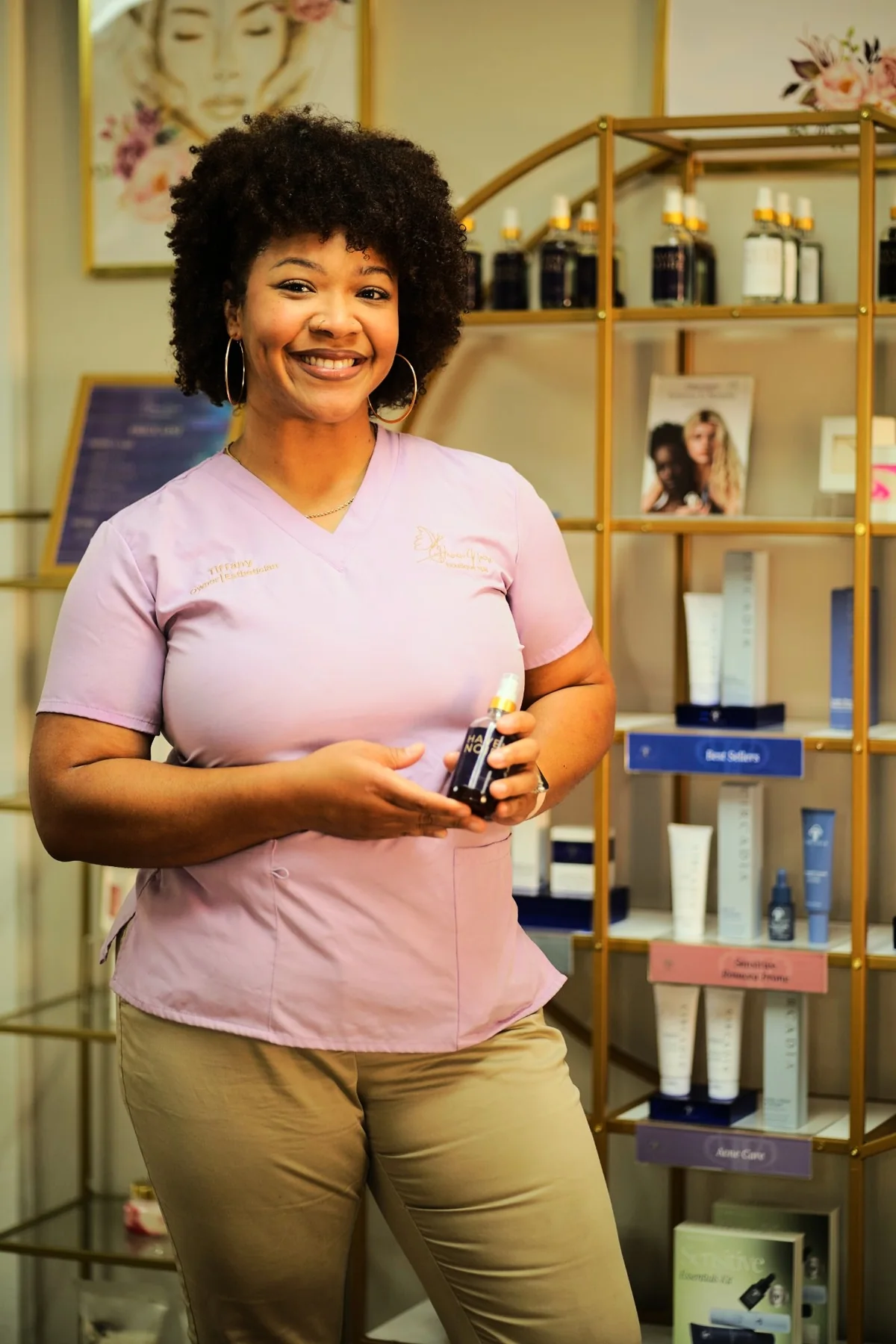
Tiffany · Licensed Esthetician · Licensed PMU Artist
Tiffany is a Florida-licensed esthetician and permanent makeup artist and the founder of Haven Noire. She specializes in customized facials, corrective skincare, and waxing for melanin-rich and all skin types, and is known for a calm, education-first approach that puts first-time clients instantly at ease.
Meet Tiffany →