
Tranexamic acid for skin is a brightening ingredient, studied mostly for melasma, the stubborn brown patches that often show up on the cheeks, forehead, and upper lip. In creams and serums, small trials found it well tolerated, with mixed results on pigment. Its strongest melasma results come from a prescription pill, not the bottle on your shelf, and that pill is a decision for you and your doctor.
Here's what most guides blur. The American Academy of Dermatology (AAD) describes tranexamic acid as a medicine a dermatologist may add when melasma is extremely difficult to treat, usually as a pill. The AAD's list of nonprescription ingredients that fade dark spots leaves it out. And in a 12-week trial in 23 women comparing a tranexamic acid gel with the same gel without it, both sides of the face lightened, and the tranexamic acid side did no better.
Below: what the studies found, four questions to ask of any claim, how to use it on melanin-rich skin, and when a dermatologist comes first.
What Is Tranexamic Acid for Skin?
Tranexamic acid (TXA) is a lab-made derivative of the amino acid lysine. Doctors use it as a medicine to reduce bleeding. Skin care products use it as a brightening ingredient aimed at melasma and other dark patches.
As a medicine, MedlinePlus says tranexamic acid tablets treat heavy menstrual bleeding, and that the drug is an antifibrinolytic, which works to improve blood clotting. Despite the name, it isn't an alpha hydroxy acid like the glycolic or mandelic acid in a peel.
How It Works on Pigment
A 2023 review in Acta Clinica Croatica describes the proposed mechanism: tranexamic acid blocks the plasminogen/plasmin system in skin cells, which cuts down on inflammatory substances that stimulate pigment cells after UV exposure. In plain terms, it targets one of the signals that prompts extra color.
A Pill, a Needle, or a Serum
The same molecule reaches skin three ways. A 2023 review of delivery routes in the Journal of Cosmetic Dermatology, by dermatologists at Montefiore Medical Center in New York compared them for melasma:
| Route | Who gives it | What the review found | On our menu? |
|---|---|---|---|
| Pill (oral) | A doctor prescribes it, off-label for melasma | Most effective, especially for stubborn melasma; stomach upset and period changes in many patients | No |
| Injection or microneedling | A doctor performs it | Effective alternatives to the pill | No |
| Cream, gel, or serum | You apply it at home | Least effective on its own, but better tolerated than hydroquinone | Not named in any service |
A 2024 meta-analysis of 22 randomized trials (1,280 patients) in the Journal of Dermatological Treatment ranked pills first, then injections, then topical use. Another 2024 meta-analysis, of 17 trials in Facial Plastic Surgery and Aesthetic Medicine, put injections and microneedling ahead of pills. Both ranked topical use last.
In microneedling with tranexamic acid, a device creates microscopic tears in the skin (the AAD's description) and tranexamic acid is applied during the session. The AAD lists microneedling among melasma procedures that only a board-certified dermatologist should perform. Neither microneedling nor injections are on the Haven Noire menu; our guide to types of facials explains what we offer instead.
What Studies Say About Topical Tranexamic Acid
Most research on tranexamic acid for skin is on melasma, and most of it is small. Here are the trials we read:
| Study | Who and how many | What was compared | What it found |
|---|---|---|---|
| Kanechorn Na Ayuthaya and colleagues, 2012 | 23 women with melasma, Thailand (21 finished) | 5% gel vs. the same gel without it, split face, 12 weeks, plus sunscreen | Both sides lightened; the tranexamic acid side did no better and was redder |
| Yasnova and colleagues, 2024 | 20 adults with melasma, Indonesia | 3% cream vs. 4% hydroquinone, split face, 8 weeks | Both improved; the authors say it's as effective and safe as hydroquinone |
| Sahu and colleagues (in the 2023 review) | 60 people with melasma | Pills vs. topical vs. a prescription hydroquinone, tretinoin, and steroid cream, 8 weeks | Scores fell 30% (prescription cream), 25% (pills), and 5% (topical) |
| Heidary and colleagues, 2025 | 50 women with melasma, Iran | 5% cream vs. pills, 12 weeks | Scores fell about 51% (cream) and 59% (pills), not a significant difference |
| Charoenwattanayothin and colleagues, 2022 | 18 people with mild to moderate acne, Thailand | 10% serum vs. placebo, split face, 8 weeks | Fewer inflamed pimples; the authors report less redness and fewer dark marks |
| Grimes and colleagues, 2026 | 30 women with melasma or post-acne marks; 57% Black or African American | A serum with tranexamic acid, niacinamide, and lotus sprout extract, 16 weeks, open-label, no comparison group | Overall hyperpigmentation fell 37% (melasma) and 31% (post-acne marks) |
For Melasma
Read together, the melasma trials disagree. Two small comparisons found a cream about as effective as hydroquinone or the pill; another found topical use barely moved scores. The trial against its own base found no edge, and everyone in it wore sunscreen each morning. Our take: sunscreen, time, or the gel base itself may explain much of the change on both sides.
Reviews agree: the route review ranks topical use last, and a 2022 review in the Journal of Clinical and Aesthetic Dermatology frames it as an add-on or maintenance option.
For Post-Acne Dark Marks
Dark marks left by pimples are post-inflammatory hyperpigmentation, and the evidence is thinner. The acne trial was designed to treat breakouts; fewer marks was an extra finding. The 2026 study enrolled mostly Black women, but it was open-label, with no comparison group and three actives, so it can't show what the tranexamic acid itself did, and the abstract we read doesn't say who funded it. A 2026 review in the Journal of Cutaneous Medicine and Surgery calls high-level evidence for dark-mark treatments, tranexamic acid included, limited.
The AAD's guide to fading dark spots says a spot a few shades darker than your skin usually fades within 6 to 12 months, and deeper color can take years. Its nonprescription list names azelaic acid, glycolic acid, kojic acid, retinoids, and vitamin C, not tranexamic acid. For the full routine, read how to fade hyperpigmentation on melanin-rich skin.
For Sun Spots
We searched PubMed in November 2026 for tranexamic acid and sun spots (solar lentigines or age spots) and found no trial of a cream or serum used alone. The studies paired it with lasers, pills, injections, or other ingredients, or were lab work.
Who Was in the Studies
Most of these trials ran in Thailand, Indonesia, or Iran, and the pill trial below enrolled mostly Hispanic women. Yet the AAD's melasma causes page says melasma develops more often in medium and dark skin tones, and names women of Latin, Asian, Black, or Native American heritage as more likely to get it.
We searched PubMed in November 2026 for tranexamic acid studies of melasma or dark marks naming Black, African American, Fitzpatrick type VI, or skin-of-color participants. The only clinical study we found with mostly Black participants was the 30-woman, open-label serum study. On deep brown skin, read these trials as encouraging, not settled.
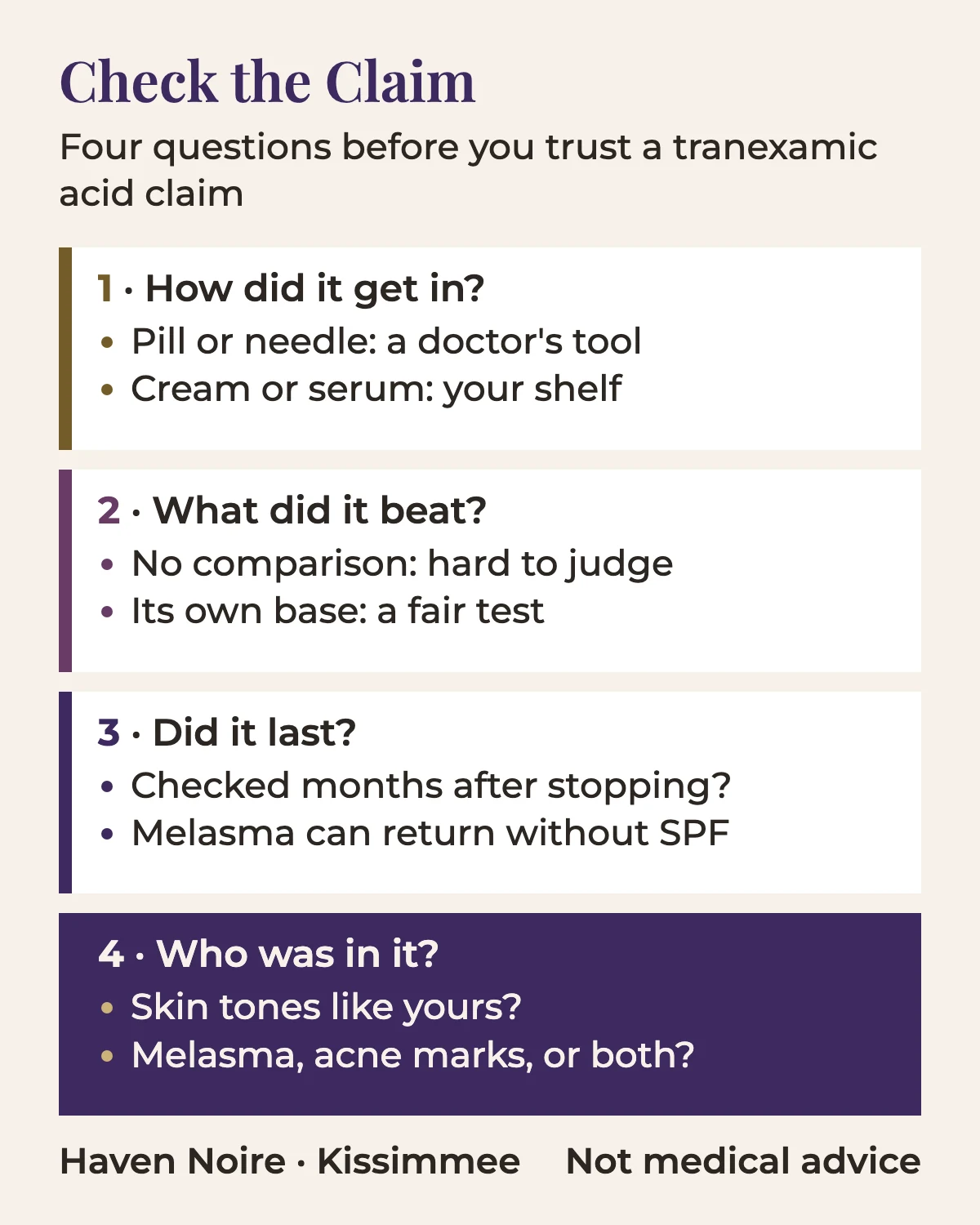
4 Questions Before You Trust a Tranexamic Acid Claim
Product pages and videos tend to quote the most exciting result they can find. These four questions, built on the reviews and trials above, help you sort any claim about tranexamic acid for skin. They're a reading tool, not a medical test.
Question 1: How Did It Get Into the Skin?
Did the result come from a pill, an injection, microneedling, or something applied to the skin? Every route comparison we read ranked topical use last for melasma. A headline number from a pill or a needle doesn't describe your serum.
Question 2: What Did It Beat?
With no comparison group, a study can't separate the product from sunscreen, the season, and time. A fair test pits it against its own base, as the 2012 gel trial did, or against a standard treatment like hydroquinone. Our view: "clinically shown" with no comparison is the weakest kind of claim.
Question 3: Did the Results Last?
Melasma tends to return, so ask what happened after people stopped. In a 2017 trial of tranexamic acid pills at UT Southwestern Medical Center, published in the Journal of the American Academy of Dermatology, 39 patients finished, mostly Hispanic women. Severity fell 49% on the pills and 18% on placebo at three months. Three months after stopping, the pill group's improvement had shrunk to 26%, against 19% for placebo. Both groups wore sunscreen throughout.
In a 561-patient study of the pill described in the Acta Clinica Croatica review, melasma returned in 27.2%, a median of seven months after stopping. The AAD's melasma overview says treatments such as creams can help fade melasma but can't make it go away forever, and that it commonly returns when you spend time outdoors without protecting your skin from the sun.
Question 4: Who Was in the Study?
Check skin tones, the condition treated, and how many people took part. Ask about irritation, too: the AAD's melasma self-care tips say a product that burns or stings is irritating your skin, and that this may darken dark spots. Our guide to facials for Black skin explains why irritation costs more on melanin-rich skin.
How to Use Tranexamic Acid on Dark Skin
Already bought a tranexamic acid product? Here's the order we'd follow. Steps marked AAD come from its guidance; the rest is our own advice, not a medical rule. For your whole routine, see skin care for Black skin.
- Pregnant, breastfeeding, on isotretinoin, or using tretinoin or another prescription skin medicine? Ask your doctor or dermatologist first.
- Start daily sunscreen first: broad-spectrum, SPF 30 or higher, and tinted with iron oxide (AAD).
- Add one new product at a time.
- Follow the label for how often. Most trials we read applied it twice a day.
- Moisturize. The Acta Clinica Croatica review calls topical side effects rare and mild, mostly redness and scaling that eased with a moisturizer.
- Stop if it burns or stings (AAD).
- Take photos in the same light every two weeks, and judge it at about 12 weeks. The trials ran 8 to 16 weeks.
- Keep up the sunscreen after you stop. The AAD says sun protection can help fade melasma and prevent it from returning.
Sunscreen Comes First
The AAD says effective treatment for dark spots begins with sunscreen, tinted with iron oxide to help protect against the sun's visible light. Its melasma self-care tips add that visible light has been shown to worsen melasma, especially for people with darker skin tones. It advises applying sunscreen 15 minutes before you go outside and reapplying at least every two hours.
To choose one, use the label tips in our sunscreen guide for dark skin.
What to Pair It With, and What to Space Out
Tranexamic acid sometimes shares a bottle with niacinamide, as it did in the 2026 serum study. Our guide to niacinamide for dark spots covers that ingredient's own evidence.
Already using a retinoid, glycolic acid, azelaic acid, or vitamin C? Our advice: keep that routine steady and add tranexamic acid after a few calm weeks. The AAD lists retinoids among sun-sensitizing medicines that may trigger melasma in some people, one more reason to stay on sunscreen. If your skin already stings, start with our skin barrier guide.
Where a Corrective Facial Fits
We're estheticians, not doctors. We can't diagnose melasma or prescribe tranexamic acid, and our menu doesn't name tranexamic acid in any service. What we can do is analyze your skin, map your concerns and goals, and send you home with a plan.
On our corrective facials menu, Radiance Brightening uses antioxidants and vitamin blends to target discoloration, refine texture, and resurface dull skin. It's one of six options inside the 60-minute Corrective Facial, which is $135, or $360 for a 3-pack. Using tranexamic acid for skin at home, or curious which actives Radiance Brightening uses? Ask us at your consultation.
After any Corrective Facial, our aftercare is to avoid sun exposure and active exfoliants for a few days, and to wear SPF daily.
Our menu notes that corrective skin care works best as a consistent series. The Corrective Membership is $109.99 a month for one corrective facial of your choice, Radiance Brightening included, plus 10% off extra services and in-spa products. Our professional skincare page shows the lines we work with.
Think it's melasma? See a dermatologist first for a diagnosis and a plan. Once you have one, our pages on melasma and hyperpigmentation and dark spots show the brightening-first spa care you can ask about alongside it.
When to See a Dermatologist or Doctor First
Haven Noire is an esthetics spa, not a medical office. See a board-certified dermatologist or your doctor before you start tranexamic acid if any of these apply.
Before Any Tranexamic Acid Product
- You're pregnant or trying to be. The AAD advises waiting until after your baby is born to treat melasma, and says it can be hard to know whether a nonprescription melasma product is safe in pregnancy. Ask your OB-GYN or midwife.
- You're breastfeeding, taking isotretinoin, or using tretinoin or another prescription skin medicine, or you have eczema, rosacea, or keloid-prone skin.
- You're not sure it's melasma. The AAD says a board-certified dermatologist can tell you whether melasma or another condition is the cause.
- A spot is raised or on only one side of your face. The AAD notes melasma typically feels flat and appears on both sides, one way it differs from skin cancer.
- The color looks slate blue or gray. The AAD says discoloration deep in the skin often looks that way, and can take years to fade.
- You want a peel for melasma. The AAD says only a board-certified dermatologist should perform melasma procedures such as chemical peels; our mandelic acid guide explains how that applies.
About Tranexamic Acid Pills
Pills are a prescription decision, not a skin care step. The AAD says to tell your dermatologist if you've had a blood clot, and MedlinePlus says your doctor will probably tell you not to take tranexamic acid if you've had a clot or have a clotting condition. The Acta Clinica Croatica review lists pregnancy, breastfeeding, hormonal birth control or hormone replacement, and smoking among reasons not to take the pill. Birth control pills are also on the AAD's list of possible melasma triggers, so mention them to your dermatologist either way.
If a dermatologist treats your melasma, the AAD suggests asking about cost, since most insurers won't cover melasma treatment.
While You're Using It
- It burns or stings. The AAD says to stop using the product.
- You've used a nonprescription melasma product for three to six months without the results you want. The AAD says dermatologists recommend using one no longer than that, then seeing a dermatologist.
- Your dark spots aren't fading. The AAD suggests a dermatologist when your treatment fails to deliver, and says some dark spots need prescription-strength treatment.
Frequently Asked Questions About Tranexamic Acid for Skin
Is tranexamic acid good for dark skin?
It may be a gentle option: a 2023 review calls topical side effects rare and mild, though the 2012 gel trial found more redness on the treated side. Most trials we read ran in Thailand, Indonesia, or Iran, and the one study with mostly Black women had no comparison group. Pair it with tinted sunscreen, and stop if it stings.
Can I use tranexamic acid with niacinamide or vitamin C?
Some serums combine tranexamic acid with niacinamide, and a 2026 study tested one. The sources we read set no rule about pairing it with vitamin C. Our advice is simple: add one new product at a time, wait a few calm weeks before the next, and stop anything that burns or stings.
How long does tranexamic acid take to work on dark spots?
The trials we read ran 8 to 16 weeks, so give a product about 12 weeks before judging it. For melasma, the American Academy of Dermatology says a treatment plan usually takes 3 to 12 months to show results, and longer if you've had melasma for a long time. Daily sunscreen protects whatever progress you make.
Is topical tranexamic acid safe during pregnancy?
Ask your OB-GYN or midwife first. The American Academy of Dermatology advises waiting until after the baby is born to treat melasma, and says it can be hard to know whether nonprescription melasma products are safe in pregnancy. ACOG says melasma usually fades after birth, and that daily sunscreen and a wide-brimmed hat help keep it from getting worse.
Is tranexamic acid better than hydroquinone?
Not clearly. In a small 2024 trial, a tranexamic acid cream lightened melasma about as well as hydroquinone, and a 2023 review found topical tranexamic acid better tolerated. A 2020 evidence review still ranks hydroquinone and triple-combination cream as the most effective, best-studied melasma treatments. Hydroquinone now needs a prescription, the AAD says, so ask a dermatologist.
Is oral tranexamic acid for melasma safe?
That's a prescription decision for you and your doctor. The AAD says to tell your dermatologist if you've had a blood clot, and a 2023 review lists pregnancy, hormonal birth control, and smoking among reasons not to take it. A review of pill studies reports stomach upset and period changes in many patients. Never take someone else's tablets.
Can tranexamic acid fade acne marks?
Maybe, for flat dark marks, but the evidence is thin: one 18-person acne trial and one open-label study without a comparison group. None of these studies treated raised or pitted acne scars; ask a dermatologist about those. The AAD says to treat the skin condition behind dark spots first. Our acne facials page shows where spa care fits.
Does Haven Noire use tranexamic acid in facials?
Our menu doesn't name tranexamic acid in any service. Radiance Brightening, inside our $135 Corrective Facial, uses antioxidants and vitamin blends to target discoloration. If you want to know which actives touch your skin, or you already use a tranexamic acid product at home, ask us at your consultation and we'll plan around it.
Keep exploring
More from the Journal

About the author
Tiffany · Licensed Esthetician · Licensed PMU Artist
Tiffany is a Florida-licensed esthetician and permanent makeup artist and the founder of Haven Noire. She specializes in customized facials, corrective skincare, and waxing for melanin-rich and all skin types, and is known for a calm, education-first approach that puts first-time clients instantly at ease.
Meet Tiffany →