

Lactic acid is an alpha hydroxy acid (AHA) that does two jobs on your skin. At low strength, it helps skin hold on to water. At higher strength, it loosens dead cells on the surface so skin feels smoother. Its best-supported uses are dry and rough skin, and like every AHA, it calls for sunscreen every morning.
Here's what most guides skip. Lactic acid is sold as the gentle acid, but the proof is thinner than the reputation: one 1996 report, cited in a 2018 review. At peel strength, gentle may also mean slower. In a small 2025 trial in India, a glycolic acid peel faded melasma more than a lactic acid peel. The lactic group reported no side effects, but the gap in side effects wasn't statistically significant.
What Is Lactic Acid?
Lactic acid is an alpha hydroxy acid, a chemical exfoliant that loosens dead cells from your skin's surface.
The American Academy of Dermatology (AAD) describes chemical exfoliation as using chemicals, such as alpha and beta hydroxy acids, to dissolve dead skin cells. A 2018 review in the journal Molecules calls lactic acid, as sodium lactate, "a well-known part of the skin's natural moisturizing complex" and an excellent moisturizer.
Search for lactic acid and you'll mostly find sore muscles. MedlinePlus, in its guide to the lactate blood test, explains that lactate, also called lactic acid, is mostly made in your muscles and red blood cells when they break down food for energy. Same name, different job: this guide covers the kind you put on your skin.
Lactic Acid for Skin: What the Evidence Supports
- Moisture. The AAD's tips for relieving dry skin list lactic acid among the ingredients to look for in a cream or ointment.
- Rough bumps. For keratosis pilaris, the AAD's self-care page lists lactic acid as both a moisturizer ingredient and a chemical exfoliator.
- A smoother surface. In a 1996 study in the Journal of the American Academy of Dermatology, people applied 5% or 12% lactic acid twice a day for three months. Both made skin smoother; only 12% also changed the deeper layer, the dermis.
- Dark spots: less proven. It isn't on the AAD's list of dark-spot faders. A 1996 trial in Archives of Dermatology found an 8% lactic acid cream reduced mottled pigment on sun-damaged forearms; the newer pigment studies we checked tested professional peels.
Tight skin isn't always dry skin. Our guide to dry vs. dehydrated skin helps you tell which you have before you add any acid.
How Strong Should Lactic Acid Be? Match the Strength to the Job
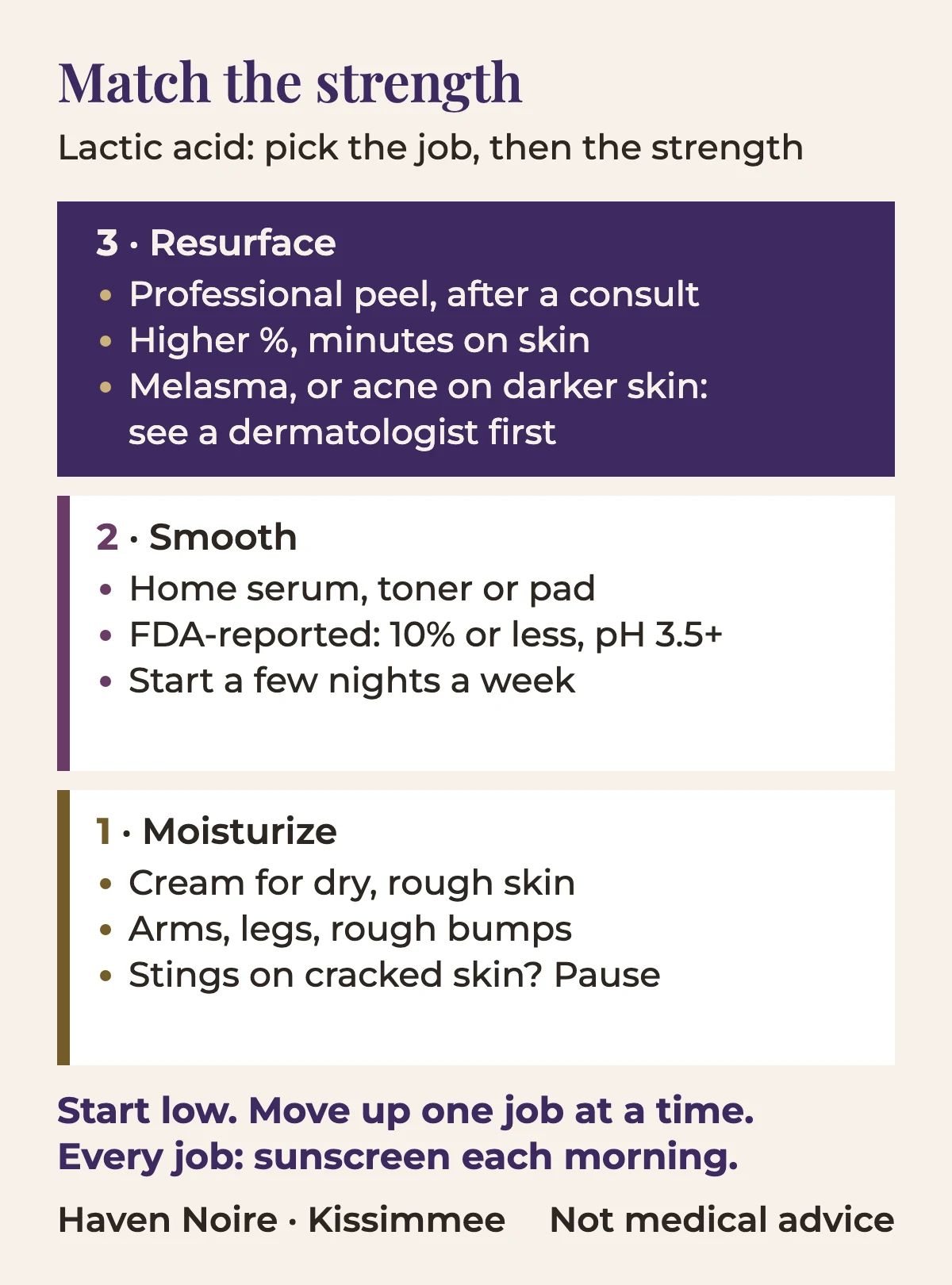
Most guides treat lactic acid for skin as one ingredient. In practice, it does three jobs depending on how strong it is and how long it stays on. Here's how we'd choose between them.
Our approach rests on the FDA-reported safety conditions for consumer AHA products, the 1996 study, AAD guidance, and the 2018 review, which concludes that whether an AHA is a friend or foe of skin depends on its concentration. Any number here not credited to a source is our suggestion, not a medical rule.
To Moisturize: Creams and Lotions
Where you'll find it: body lotions, creams, and some face moisturizers. The job: help dry, rough skin hold water and feel softer. This is the job the AAD points to for dry skin and keratosis pilaris.
There's a prescription version, too. MedlinePlus lists ammonium lactate, an alpha hydroxy acid that "works by increasing skin hydration," for dry or scaly skin. Its side effects include stinging, especially on cracked or broken skin, and it can make treated skin sensitive to sunlight.
Our advice: if your goal is softer, less flaky skin, start here. You may never need to move up.
To Smooth: Home Serums, Toners, and Pads
Where you'll find it: leave-on serums, toners, and pads you use at home. The job: loosen dead surface cells so skin feels smoother. Our guides to what toner does and what serum does show where each fits in a routine.
The FDA reports the conclusion of the Cosmetic Ingredient Review (CIR) Expert Panel: products with glycolic or lactic acid are safe for consumers when the AHA is 10 percent or less, the final product has a pH of 3.5 or greater, and the product either protects skin from increased sun sensitivity or tells you to use daily sun protection. That's a review panel's conclusion as the FDA reports it, a guide for consumer products rather than a promise about any one bottle.
You may not need the top of that range. In the 1996 study, 5% smoothed the surface much as 12% did. Our tip: choose the lowest strength you can find.
To Resurface: Professional Peels
Where you'll find it: professional chemical peels. The job: a stronger, controlled exfoliation for dullness, rough texture, and uneven tone. Peels use far higher concentrations for minutes, not hours; the 2018 review describes AHA peels left on at 35% for four minutes and at 70% for two.
The same review lists post-inflammatory hyperpigmentation, infections, and scarring among possible complications of chemical peeling. In our view, that's why this job belongs to a trained professional, after a consultation. On our menu, it's the Lactic Peel, covered below with the cases where a dermatologist comes first.
How to Choose a Strength
- Name the job: softer skin, smoother skin, or a professional reset.
- Start at the lowest strength that does that job.
- Move up one job at a time, after a few calm weeks on the one below.
- Don't do two jobs at once: home acids pause before a peel.
- Wear sunscreen at every strength. The FDA's recommended Sunburn Alert for AHA products says to use a sunscreen, wear protective clothing, and limit sun exposure while using the product and for a week afterward.
| Job | Where you find it | What it does | Watch for |
|---|---|---|---|
| 1. Moisturize | Body lotions and creams; prescription ammonium lactate | Help dry, rough skin hold water | Stinging on cracked skin; sun |
| 2. Smooth | Home serums, toners, and pads (FDA-reported condition: 10% or less, pH 3.5 or more) | Loosen dead surface cells | Overuse, stacked acids, sun |
| 3. Resurface | Professional peels, after a consultation | A stronger, controlled exfoliation | Acne on darker skin or melasma: dermatologist first |
Lactic Acid vs Glycolic Acid: Is Lactic Really Gentler?
Lactic acid's reputation is that it's gentler than glycolic acid, but the evidence is thinner than the reputation. In the sources we checked for this guide in November 2026, the main support is one line in the 2018 review: it cites a 1996 report by Smith and colleagues that found lactic acid less irritating than glycolic acid, without saying at what strengths. Read it as a reasonable expectation, not a guarantee.
At peel strength, the picture is mixed. In a 2025 randomized trial in India, 34 patients with melasma and Fitzpatrick skin types III to V finished four in-office sessions of an 80% lactic acid peel or a 50% glycolic acid peel at a hospital dermatology department. Both helped; glycolic helped significantly more. Four of 18 glycolic patients had side effects, one of them post-inflammatory hyperpigmentation, and none of the 16 lactic patients did, but the authors found that gap wasn't statistically significant. Everyone was primed with 4% hydroquinone and SPF 30 sunscreen for two weeks first, so the peels weren't working alone.
Those were melasma peels at many times the 10% the FDA reports for consumer products, so the trial can't tell you what a lactic serum or lotion will do at home. In a separate 2025 trial of 30% peels for dark circles, lactic did better than mandelic, with less irritation but more peeling. Our mandelic acid guide covers that study.
| Compared on | Lactic acid | Glycolic acid |
|---|---|---|
| Part of the skin's own moisturizing system | Yes, as sodium lactate (2018 review) | Not described that way in our sources |
| Consumer safety conditions the FDA reports | 10% or less, pH 3.5 or more | 10% or less, pH 3.5 or more |
| FDA sun warning for AHAs | Applies | Applies |
| On the AAD's dark-spot ingredient list | No | Yes |
| Irritation (one 1996 report, cited by the 2018 review) | Less | More |
| 2025 melasma peel trial (in-office) | 80% peel: smaller improvement; no side effects reported | 50% peel: larger improvement; side effects in 4 of 18 (gap not statistically significant) |
| On the Haven Noire menu | Lactic Peel, listed for Fitzpatrick I to VI | Not named on our menu |
Our take: lactic acid is a sensible first AHA for dry or easily irritated skin, and a gentler start can be worth a slower result. One exception: the AAD's rosacea skin care tips advise people with rosacea to avoid products that contain lactic acid or glycolic acid. If fading dark spots is your main goal, glycolic is the AHA the AAD names, if your skin tolerates it.
Lactic Acid on Melanin-Rich Skin
If your skin is brown or Black, irritation is the thing to plan around. The AAD's guide to fading dark spots says a product that irritates your skin can cause dark spots, and that once the cause is found and stopped, a spot a few shades darker than your natural color usually fades within 6 to 12 months. Its exfoliation guide advises avoiding strong chemical or mechanical exfoliation if you have a darker skin tone.
Lactic acid is only as gentle as its dose. Three habits help:
- Keep the strength low. A moisturizing cream, or a low-strength home exfoliant, is where we'd start for skin that marks easily.
- Stop if it burns or stings. That's the AAD's rule for any product, not just acids.
- Wear tinted sunscreen. The AAD recommends one with iron oxide, SPF 30 or higher, and broad-spectrum protection. Our sunscreen guide for dark skin shows how to read a label.
On our menu, the Lactic Peel is listed for Fitzpatrick types I to VI; our guide to skin types explains that scale. For peels on deeper tones, read Chemical Peels for Melanin-Rich Skin. Already have marks? Start with how to fade hyperpigmentation on melanin-rich skin.
How to Use Lactic Acid for Skin at Home
Adding a lactic acid product? Here's the order we'd follow. Steps credited to the AAD or FDA come from them; the rest is our own judgment.
- Check your stack. On isotretinoin, tretinoin, or another prescription skin medicine, or pregnant? Ask your doctor or dermatologist before adding any acid.
- Choose one product at the lowest strength that does your job. Don't layer it with another AHA, a BHA, or a scrub.
- Start two or three nights a week, and add a night only after a couple of calm weeks.
- Moisturize right after. The AAD says to apply moisturizer immediately after exfoliating.
- Wear sunscreen every morning, and for a week after you stop (FDA).
- Skip sunburned skin and open cuts. The AAD says never to exfoliate either.
- Stop if it burns or stings (AAD).
What Not to Mix With Lactic Acid
The AAD says exfoliating while you use a prescription retinoid, retinol, or benzoyl peroxide may worsen dry skin or even cause acne breakouts. If your dermatologist clears you for both, our advice is separate nights, never layered. To tally the exfoliants already in your week, see how often to exfoliate.
Taking isotretinoin? The AAD's isotretinoin skin care guide names lactic acid directly: it lists AHAs and BHAs like glycolic, lactic, and salicylic acid among the products dermatologists recommend avoiding while you take it, because they can weaken and irritate your skin.
Lactic Acid for Rough Legs, Arms, and Body Skin
Body skin is where a lactic acid moisturizer shines. For keratosis pilaris, the AAD suggests a moisturizer with urea or lactic acid, applied to damp skin within 5 minutes of bathing, and warns that scrubbing tends to irritate the skin and worsen the bumps. To fit it into a body routine, see our guide to smooth skin.

Dots and bumps on your legs have several possible causes, so sort them first with our strawberry legs guide. For bumps on your face, our textured skin guide shows which ones exfoliation can reach.
Lactic Acid Peel: What to Know Before You Book
At Haven Noire, resurfacing means our Lactic Peel. The menu describes it as "a gentle AHA gel peel that hydrates, brightens, and smooths while supporting natural moisture balance," exfoliating dull surface cells with minimal downtime.
- Listed for most skin types, ideal for aging and dry skin, and for Fitzpatrick types I to VI.
- A skin consultation is required first, and peels aren't available on a first visit.
- Each peel includes a post-care home kit.
- Your consultation covers when to pause home acids, such as AHAs and BHAs, before your peel.
Our consultation reviews your history and current products so we can choose the right peel and strength. Afterward, follow our chemical peel aftercare guide.
Two cases call for a dermatologist first. The AAD's tips for clearing acne in darker skin tones say to see a dermatologist before using any type of chemical peel, microdermabrasion, or laser therapy to treat acne, because even at-home versions can cause permanent dark marks and light spots. And the AAD's melasma treatment guide says only a board-certified dermatologist should perform procedures such as chemical peels for melasma, so if melasma is your reason, start there. Our melasma page explains why daily SPF matters so much for keeping it in check.
When to See a Dermatologist Before Using Lactic Acid
Haven Noire is an esthetics spa, not a medical office, and we can't diagnose a skin condition. See a board-certified dermatologist or your doctor first if:
- You take isotretinoin, use tretinoin or another prescription skin medicine, or you're pregnant or breastfeeding. Ask your prescriber or OB-GYN before any acid.
- You have eczema, rosacea, or skin that forms keloids. With rosacea, the AAD advises avoiding products that contain lactic acid.
- You have darker skin and want a peel to treat acne, or you think you have melasma.
- Your skin stays dry after you've tried the AAD's dry-skin tips. The AAD says overly dry skin may be due to an underlying medical condition.
- Rough bumps on your arms or legs remain despite home care. For keratosis pilaris, the AAD says a dermatologist can help.
- Anything you apply, even a moisturizer, burns, stings, or irritates. The AAD's dry-skin guide says to tell your dermatologist.
Not sure who to call? Our guide to esthetician vs dermatologist sorts which problems belong where. If your face flushes or stings with many products, see our page on sensitive and redness-prone skin.
Frequently Asked Questions About Lactic Acid
Is lactic acid good for sensitive skin?
In our view, it's a reasonable first acid. A 2018 review notes a 1996 report found it less irritating than glycolic acid. Rosacea is the exception: the AAD advises avoiding lactic acid. Start with a moisturizer or a low-strength product. If everything stings right now, read our skin barrier guide first.
Can you use lactic acid every day?
Some people can, but we wouldn't start there with a leave-on exfoliant. Our advice is two or three nights a week, adding a night only after a couple of calm weeks. The American Academy of Dermatology says the more aggressive the exfoliation, the less often it needs to be done.
Is lactic acid safe for Black or brown skin?
It can be, used gently, though no acid is risk-free on skin that marks easily. The AAD advises avoiding strong chemical exfoliation on darker skin tones, because aggressive exfoliation can lead to dark spots. Start low, stop if a product burns or stings, and wear tinted sunscreen with iron oxide, SPF 30 or higher.
Can I use lactic acid with retinol?
Ask your dermatologist first, especially if your retinoid is a prescription. The AAD says exfoliating while you use a retinoid, retinol, or benzoyl peroxide may worsen dry skin or even cause breakouts. If you're cleared for both, our advice is to use them on different nights and stop if anything stings.
Does lactic acid fade dark spots?
It's not on the AAD's list of ingredients that can fade dark spots, which names azelaic, glycolic, and kojic acids, retinoids, and vitamin C. A 1996 trial found an 8% lactic acid cream reduced mottled pigment on sun-damaged forearms; newer pigment studies we checked used professional peels. If a spot won't fade, the AAD suggests seeing a dermatologist.
Is lactic acid safe during pregnancy?
Ask your OB-GYN or midwife before you start it. We're estheticians, not doctors, and pregnancy can change which products and treatments are right for you. If you're pregnant, tell us before any facial or peel at Haven Noire, and bring any guidance from your provider to your consultation.
What's the difference between lactic acid and ammonium lactate?
Lactic acid is the AHA in many lotions, serums, and peels. Ammonium lactate is a medicated cream or lotion that MedlinePlus lists for dry, scaly skin and ichthyosis vulgaris, an inherited dry-skin condition, usually applied twice daily. It's in the same alpha hydroxy acid class and can make treated skin sensitive to sunlight.
Where can I get a lactic acid peel in Kissimmee?
At Haven Noire, 231 Ruby Avenue, Unit E, across from Lakefront Park in downtown Kissimmee. Our Lactic Peel is a gentle AHA gel peel listed for Fitzpatrick types I to VI. It needs a skin consultation first, so it's never a first-visit service. Call (321) 900-1144 to start.
More from the Journal

About the author
Tiffany · Licensed Esthetician · Licensed PMU Artist
Tiffany is a Florida-licensed esthetician and permanent makeup artist and the founder of Haven Noire. She specializes in customized facials, corrective skincare, and waxing for melanin-rich and all skin types, and is known for a calm, education-first approach that puts first-time clients instantly at ease.
Meet Tiffany →