

Skin purging is a short-term rise in breakouts after you start a product that speeds up skin cell turnover, most often a retinoid. Guides describe it as your usual kind of acne, in your usual places, easing within weeks. Bumps that itch, burn, or show up somewhere new usually point to irritation, a reaction, or a plain breakout instead.
How long it lasts depends on the product. MedlinePlus, from the U.S. National Library of Medicine, says acne will probably get worse during the first 7 to 10 days of tretinoin and should improve in 2 to 3 weeks, sometimes more than 6. For adapalene, it says acne may get worse in the first few weeks, and full benefit can take 8 to 12 weeks or longer.
Here's what most guides skip. The research on purging is less settled than the internet suggests. And on brown and Black skin, "just push through" has a cost: every extra pimple can leave a dark mark that outlasts the purge by months. Below: four questions that sort a purge from a breakout, a timeline by product, and when to stop and call a doctor.
What Is Skin Purging?
Skin purging is a temporary flare of breakouts that starts when an active ingredient speeds up how fast your skin renews itself, bringing clogs that were already forming to the surface sooner. The studies we read call it a flare or an initial worsening.
The idea comes from retinoids. The American Academy of Dermatology (AAD) says tretinoin spurs faster turnover of surface skin cells. MedlinePlus's adapalene page puts the purge in plain words: during the first weeks, adapalene may bring previously unseen pimples to the skin surface.
Is Purging Real? What the Research Shows
Sometimes. The drug labels say acne may get worse at the start, but the trial data is mixed:
- A 2010 summary of systematic reviews in Clinical and Experimental Dermatology reported no evidence that topical retinoids cause an initial worsening of acne severity, but did find skin irritation that typically settled by 8 to 12 weeks.
- A 2008 analysis of tretinoin trials in the journal Cutis found more flaring at two weeks in people with mild acne using tretinoin gel alone than in people using a gel with no medicine. Moderate to severe acne showed no such flare.
- A 2012 analysis of adapalene trials, also in Cutis, found no sign of a flare when lesions were counted after the first week of treatment.
Our read: a true purge can happen, especially with milder acne, but irritation is the better-documented part of starting a retinoid. The questions below screen for it first.
Which Products Can Cause Purging?
| Product | Can it purge? | What the source says |
|---|---|---|
| Retinoid medicines: tretinoin, adapalene | Yes, per the labels | MedlinePlus: acne may get worse in the first days or weeks |
| Retinol, over the counter | Possibly, by the same logic | AAD: retinol is a type of retinoid; use the lowest strength you can find |
| Exfoliating acids: glycolic, lactic, salicylic, mandelic | Often said, not measured | We searched PubMed in November 2026 and found no study that measured a purge after starting one of these acids |
| Benzoyl peroxide | Irritation is the documented risk | AAD: strengths above 2.5% can cause dryness and flaking, which can worsen acne |
| Moisturizer, sunscreen, makeup, hair oil | No | AAD: oily products such as cocoa butter or shea butter can clog pores |
| Isotretinoin (oral) | A flare at the start is reported | European Journal of Dermatology, 2008: common at the start, severe flares rare. Your dermatologist manages it |
So a breakout after a new moisturizer, sunscreen, or foundation isn't a purge. The AAD's guide to acne in darker skin tones recommends labels that say non-comedogenic or won't clog pores. Tiny bumps that linger for weeks? See closed comedones and how to get rid of milia.
Skin Purging vs Breakout: 4 Questions to Ask
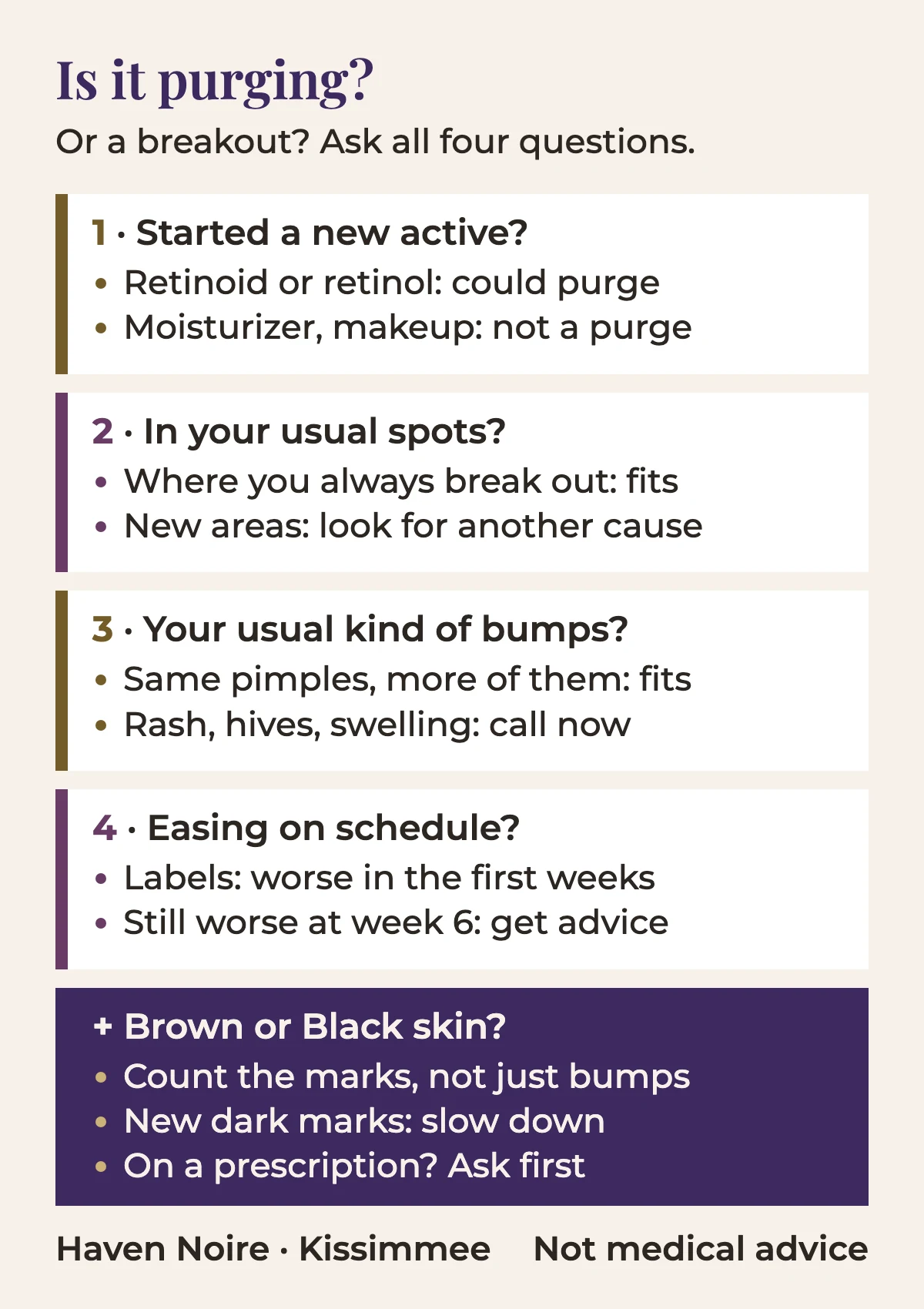
These four questions help you sort a new crop of bumps. They're built from MedlinePlus drug labels, AAD guidance, and the NHS, and they're a guide for you, not a diagnosis. The timings in them are our suggestions, not medical rules.
If every answer points to purging, give the product time and use the care steps below. If any one points away, treat it as a breakout or a reaction.
Did You Start Something New?
A purge needs a cause that speeds up turnover. A new retinoid counts, and so does a stronger strength or a jump from every other night to nightly (our judgment).
No new active? Then it isn't a purge. The AAD's acne tips also warn that trying new acne treatments too often can irritate your skin and cause breakouts.
Is It Where You Usually Break Out?
Purging brings up clogs that were already forming, so it should show up in your usual spots. That's a widely used rule of thumb, not something we found measured. Bumps in brand-new places point elsewhere. One pattern to know: if breakouts appear only on your forehead and temples, the AAD's darker-skin acne guide says hair oil may be the cause. If yours is coconut oil, see why it belongs on your ends, not your edges.
Do the Bumps Look Like Your Usual Acne?
A purge looks like your normal breakouts, just more of them, sooner. It shouldn't bring a different kind of reaction:
- Rash, hives, itching, or swelling of the eyes, face, lips, tongue, or throat. The MedlinePlus labels list these as serious side effects that need a call to your doctor immediately: see the urgent signs below.
- Itchy, blistered, dry, or cracked patches within hours or days of a new product. The NHS describes these as contact dermatitis, and says darker skin can turn dark brown, purple, or grey rather than red.
- Deep, painful lumps. In our judgment, that's beyond a purge: see a dermatologist.
Reactions can pass for purging: a 2017 case report in the journal Contact Dermatitis described an allergic reaction to clindamycin, an antibiotic applied to the skin for acne, that mimicked a retinoid flare. If stinging and flaking are the main story, see how to repair a stressed skin barrier.
Is It Easing on Schedule?
A purge has a shape: worse early, then better. The labels put the worse part in the first 7 to 10 days for tretinoin and the first few weeks for adapalene. Write down the date you started. Our rule of thumb: if you're past six weeks and the bumps are still multiplying, stop calling it a purge and ask your prescriber or a dermatologist.
How Long Does Skin Purging Last?
It depends on the product and on who's counting:
| Source | What it says |
|---|---|
| MedlinePlus, tretinoin | Acne probably gets worse in the first 7 to 10 days; sores should improve in 2 to 3 weeks, sometimes more than 6 |
| MedlinePlus, adapalene | Acne may get worse in the first few weeks; dryness or irritation in the first 2 to 4 weeks; full benefit in 8 to 12 weeks or longer |
| 2010 review summary | Irritation from topical retinoids typically settled by 8 to 12 weeks |
| AAD acne tips | Any acne treatment may take several weeks to a few months before you see a difference |
| Many skin care websites | 4 to 6 weeks, a figure we didn't find in the institutional sources above |
Our read: expect the worst of it in the first few weeks, improvement over the weeks after, and a fair verdict at around 8 to 12 weeks, the adapalene label's window for full benefit. In the sources above and a PubMed search in November 2026, we found no published purge timeline for acids, peels, or over-the-counter retinol.

How to Get Through a Purge Without Making It Worse
- Change nothing else. Keep the rest of your routine to a gentle cleanser, a moisturizer, and sunscreen (our suggestion).
- Start low and go slow. On the AAD's retinoid page, dermatologist Tina Alster advises the least intense retinoid you can find, every other night to start, slowly building up.
- Pause other exfoliants. The AAD's exfoliation guide says exfoliating while you use a retinoid, retinol, or benzoyl peroxide may worsen dry skin or even cause breakouts. See how often to exfoliate.
- Wash gently with your fingertips, up to twice a day and after sweating, as the AAD's acne tips advise.
- Keep your hands off. The AAD says picking or squeezing makes acne take longer to clear and raises your risk of scars and dark spots.
- Wear sunscreen daily. Both MedlinePlus pages advise sunscreen and protective clothing.
Booking a brow or lip wax while you use a retinoid? The AAD advises pausing retinoids before a face wax and doesn't recommend waxing at all while you're applying tretinoin, and MedlinePlus says no hot wax on skin you treat with adapalene: our face waxing guide has the details. Building a routine? See how to use retinol and our look at skin cycling, the trend of rotating actives with rest nights.
Purging on Melanin-Rich Skin: Count the Marks, Not Just the Bumps
The AAD's darker-skin acne guide says acne in skin of color is often accompanied by dark spots that can last much longer than the acne. Its guide to fading dark spots says a spot a few shades darker than your skin usually fades within 6 to 12 months once the cause stops, and deeper color can take years. It lists an irritating skin care product among the triggers.
So the math changes. A purge that eases in three weeks can leave marks that take 6 to 12 months to fade. On the AAD's retinoid page, dermatologist Sonia Badreshia-Bansal warns that with skin of color, irritation can trigger dark marks, and says starting slowly and using moisturizer will help.
When Dark Marks Appear, Slow Down
Our advice: on brown and Black skin, new dark marks during a purge are a reason to slow down, not to push harder. With an over-the-counter product, drop back to fewer nights a week. With a prescription, call your prescriber before you change anything.
- Wear tinted sunscreen. The AAD recommends a tinted sunscreen with iron oxide that's SPF 30 or higher, broad-spectrum, and water-resistant. Here's how to find iron oxide on a label.
- Skip strong exfoliation. The AAD's exfoliation guide says to avoid strong chemical or mechanical exfoliation if you have a darker skin tone or notice dark spots after breakouts.
- Treat the acne, not just the marks. The AAD recommends treating acne and dark spots at the same time.
Already have marks? Start with how to fade hyperpigmentation on melanin-rich skin, or read our guide to facials for Black skin.
Purging, Peels, and Facials: Where Haven Noire Fits
We're estheticians, not doctors, so we can't diagnose a reaction or adjust a prescription. We can look at your skin, hear your whole routine, and plan treatments that don't pile onto a purge.
Corrective Facials While You Adjust
A Corrective Facial is $135 for 60 minutes, or $360 for a 3-pack. Of its six options, our menu lists Acne Oxygen Rx for acne, sensitive, and congested skin. Our acne facials page shows how we approach breakouts.
Tell us every active and prescription you use. Our acne facial guide says an acne facial, or its exfoliation and extraction steps, may need to be modified or postponed if you use prescription retinoids and haven't paused them as directed, or if you take isotretinoin or stopped it within the last six months. Whether and when to pause a prescription is your prescriber's call.
Peels During a Purge
Every chemical peel at Haven Noire requires a skin consultation first, and peels aren't a first-visit service.
Two cautions. If you have darkly pigmented skin, the AAD's darker-skin acne guide says to see a dermatologist before using any type of chemical peel, microdermabrasion, or laser therapy to treat your acne. That includes the microdermabrasion option on our Corrective Facial menu when acne is the goal. And our advice: don't stack a peel series on a fresh retinoid purge. Let your skin settle, then bring your dermatologist's plan to your consultation.
Bumps After a Facial
A few bumps after a facial are a different question. Our first facial guide covers what to do, and why picking is the one thing to avoid.
When to Stop and See a Dermatologist or Doctor
Haven Noire is an esthetics spa, not a medical office. If what looks like skin purging fits any of these, get medical care first.
Get Help Right Away
- Swelling of your eyes, face, lips, tongue, or throat. The adapalene page says to call your doctor immediately or get emergency medical treatment. Trouble breathing? Call 911, as MedlinePlus advises for a severe allergic reaction.
- A rash, hives, or new itching after starting a prescription retinoid. Call your prescriber right away, as the tretinoin page advises.
Book a Dermatologist
- You're past about six weeks (our rule of thumb) and breakouts are still getting worse.
- Deep, painful lumps, or acne that leaves scars.
- New dark marks that aren't fading with sunscreen and gentle care. The AAD's dark spot guide says a dermatologist can help when your treatment isn't delivering.
- Acne tied to your period or to new hair growth. On the AAD's retinoid page, dermatologist Anne Chapas says to see a board-certified dermatologist before trying a retinoid.
- A lot of redness or inflammation. Dr. Chapas says to avoid retinoids and ask a dermatologist about rosacea therapies.
- Eczema. Both MedlinePlus labels say not to apply these medicines to skin affected by eczema.
Pregnant, or on a Prescription Skin Medicine
Pregnant or trying? The AAD says retinoids should not be used during pregnancy. The American College of Obstetricians and Gynecologists (ACOG) says it's generally recommended that topical retinoids be avoided, and that isotretinoin should not be taken during pregnancy or while trying to get pregnant. It suggests choosing acne products with your dermatologist and OB-GYN together.
On isotretinoin, tretinoin, adapalene, or another prescription? Your prescriber decides whether to keep going, not a blog or a spa, and the adapalene label says to talk to your doctor if your skin stings, burns, or becomes irritated at any time. Prone to keloids? The AAD says skin of color carries a higher keloid risk when acne turns moderate to severe before treatment, so raise it with your dermatologist early. Unsure? Contact us before you book.
Frequently Asked Questions About Skin Purging
How long does skin purging last?
It depends on the product. MedlinePlus says tretinoin may worsen acne for the first 7 to 10 days, with improvement in 2 to 3 weeks, sometimes more than 6. Adapalene may worsen it in the first few weeks, and full benefit can take 8 to 12 weeks or longer. Our advice: still worse past six weeks? Ask your prescriber.
What is the difference between purging and a breakout?
Purging follows a new active that speeds up skin cell turnover, such as a retinoid, and looks like your usual acne in your usual spots. A breakout has no such trigger, or shows up in new places. Itching, burning, a rash, or hives point to irritation or a reaction, not purging.
Does retinol cause purging?
It may, by the same logic as prescription retinoids, since the American Academy of Dermatology calls retinol a type of retinoid. We searched PubMed in November 2026 and found no published timeline for retinol purging. The AAD's advice is the lowest strength you can find, used every other night at first, with moisturizer and daily sunscreen.
Can a moisturizer or sunscreen make you purge?
No. Purging follows products that speed up skin cell turnover. If a moisturizer, sunscreen, or foundation breaks you out, it may be clogging your pores. The American Academy of Dermatology says oily products such as cocoa butter or shea butter can do that, and recommends labels that say non-comedogenic or won't clog pores.
Should I stop using a product if my skin is purging?
If it's a prescription, ask your prescriber before you stop. The MedlinePlus labels for tretinoin and adapalene say to keep using them through early worsening, but to call your doctor right away about a rash, hives, or swelling. If an over-the-counter product burns or stings when you apply it, the American Academy of Dermatology says to stop using it.
Can purging cause dark spots on Black or brown skin?
Yes, any pimple or irritation can. The AAD says acne in skin of color often comes with dark spots that can outlast the acne, and that a spot a few shades darker usually fades in 6 to 12 months. A slower start and tinted sunscreen help. See our page on hyperpigmentation and dark spots.
Can I get a facial while my skin is purging?
It depends on what you're using, so tell us every active and prescription. Our acne facial guide says an acne facial, or its exfoliation and extraction steps, may need to be modified or postponed if you use prescription retinoids you haven't paused as directed. Chemical peels need a skin consultation first and aren't offered on a first visit.
Is purging a sign that a product is working?
Not necessarily. A 2010 review summary found no evidence that topical retinoids cause an initial worsening of acne severity, though early irritation was common. A product can work without a purge, and a purge doesn't prove it's working. Give it a fair trial: the adapalene label puts full benefit at 8 to 12 weeks or longer.
More from the Journal

About the author
Tiffany · Licensed Esthetician · Licensed PMU Artist
Tiffany is a Florida-licensed esthetician and permanent makeup artist and the founder of Haven Noire. She specializes in customized facials, corrective skincare, and waxing for melanin-rich and all skin types, and is known for a calm, education-first approach that puts first-time clients instantly at ease.
Meet Tiffany →