

Sweat pimples are breakouts that show up after heat, a workout, or a long day outside, usually where sweat got trapped and rubbed by clothes or gear. Does sweat cause acne? Partly. The American Academy of Dermatology (AAD) says working out can cause excessive sweating and a buildup of oil, dirt, and bacteria on your skin, all of which can lead to acne.
The fixes are simple. Pat sweat off instead of rubbing it. Wash soon after with a mild, oil-free cleanser. Trade tight clothes for loose ones, and wash the caps and wraps you sweat in. Can't shower? The AAD suggests changing out of sweaty clothes and wiping breakout-prone skin with a salicylic acid pad.
Here's what most guides skip: not every bump after a hot day is a pimple. Heat rash and the yeast-driven bumps people call "fungal acne" also flare in heat and humidity, and each needs a different plan. Below: a three-question check for Central Florida days, how to sort the lookalikes, and what changes on melanin-rich skin.
What Are Sweat Pimples?
Sweat pimples are acne breakouts that heat, sweat, and friction set off. Dermatologists call the friction type acne mechanica, and the AAD's sports equipment page says it starts when equipment or clothing traps heat and sweat on your skin.
As that gear rubs your heated skin, the AAD explains, the irritation can cause new breakouts on acne-prone skin. The first sign is often small, rough bumps you can feel more easily than see, right where a helmet or strap rubs. If the rubbing goes on, they can turn into pimples and sometimes deep acne cysts.
Does sweat cause acne?
Not on its own. A Cleveland Clinic article quotes a dermatologist: "It's not the sweat specifically that causes tiny red bumps to form." The article points to the mix instead: heat, humidity, oil, bacteria, and friction working together to clog pores and inflame them.
Heat matters more for some people than others. In a 2018 study of 171 acne patients in Delhi, India, 40% said their acne got worse in summer, about half noticed no seasonal change, and the researchers linked the summer flares to monthly temperature and humidity. A much older study, from 1996, asked 139 patients in Munich, Germany: about a third got worse in summer, a third in winter, and a third saw no change.
Both relied on what patients reported, and neither was done in Florida. Our take: if your breakouts follow the heat, trust your own pattern.
Where they show up
Anywhere sweat sits and something rubs. This guide sticks to your face, hairline, and chest. For the rest of the body, see how to get rid of back acne and what's behind butt acne.
How to Stop Sweat Pimples: Three Questions to Ask
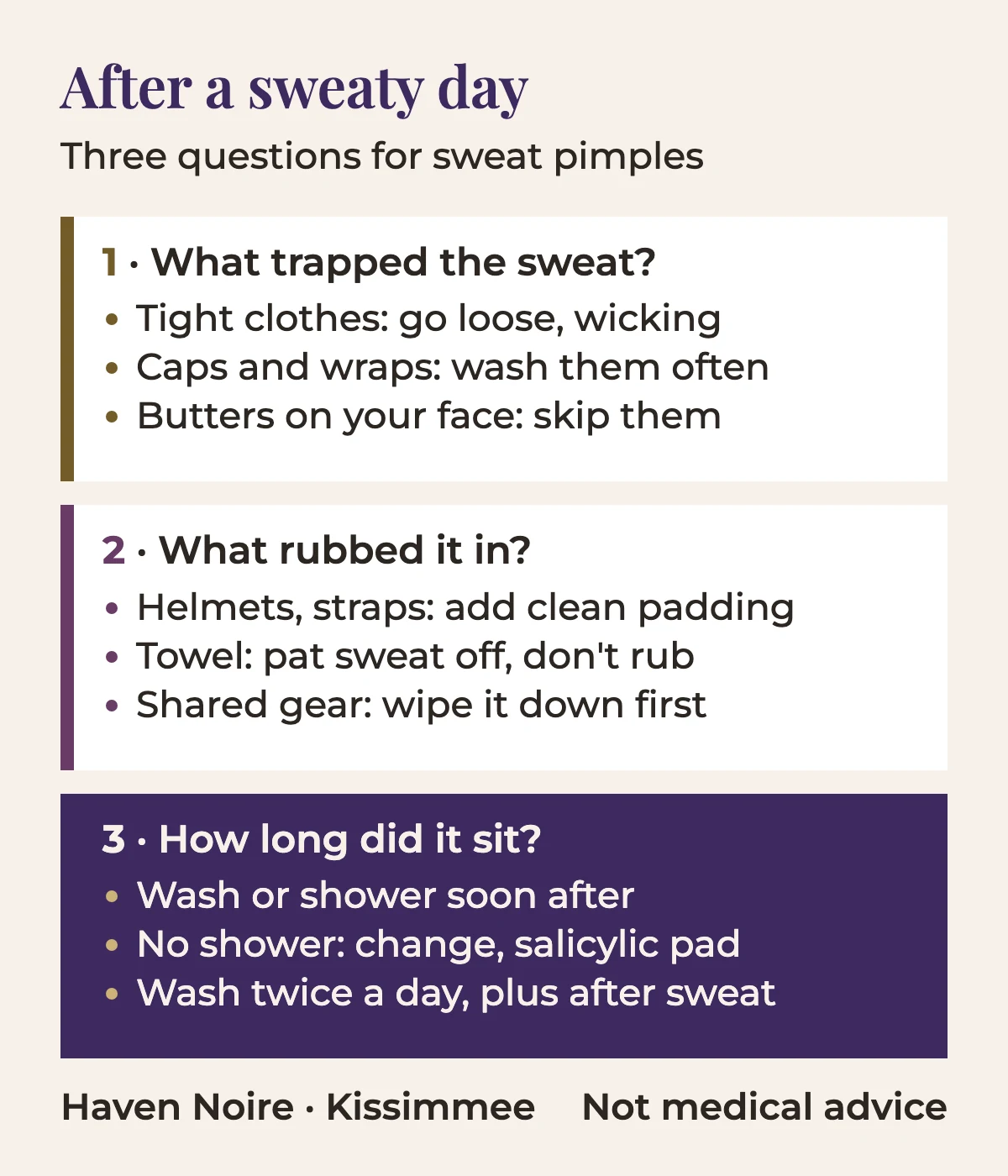
Most advice on this is a long list of tips. We find it easier to ask three questions after a sweaty day, because each AAD tip answers one of them. The questions come from the AAD acne and face washing pages linked in this section. They're a checklist, not a diagnosis, and where we add advice of our own, it's our view, not a medical rule.
1. What held the sweat against your skin?
The AAD's fixes for trapped heat and sweat are to wear moisture-wicking clothes next to your skin and to trade tight-fitting workout clothes for loose-fitting ones. The same swap helps when your thighs rub; see how to stop chub rub in the heat.
Caps, headwraps, and wig caps
Your hairline counts. The AAD's tips for acne in skin of color say that wearing a baseball cap, or anything else on your head, without washing it lets sweat, dirt, and oil build up, which can make acne flare. Its advice: wash caps and hats frequently.
We'd count a headwrap, durag, sweatband, or wig cap as "anything else on your head." Keep a clean one in rotation, and wash the one you sweated in before you wear it again.

Hair products ride along, too. The same AAD page says acne only on your forehead and temples may come from hair oil. Our blackheads guide covers keeping oils off your hairline.
Heavy products in the heat
The same page warns that a product with oil, such as cocoa butter or shea butter, can clog pores on your face, back, or chest. It recommends products labeled "non-comedogenic" or "won't clog pores."
That goes for sunscreen, too. Before you exercise outside, the AAD's workout page recommends an oil-free sunscreen with SPF 30 or higher, broad-spectrum protection, and water resistance. Our guide to sunscreen for dark skin walks you through the label.
2. What rubbed it in?
Friction is the other half of acne mechanica. The AAD's list of culprits includes cycling helmets, chin straps, and backpack straps. For Central Florida, we'd add hard hats and motorcycle helmets.
- Pad it. The AAD advises placing clean, soft padding between equipment and your skin.
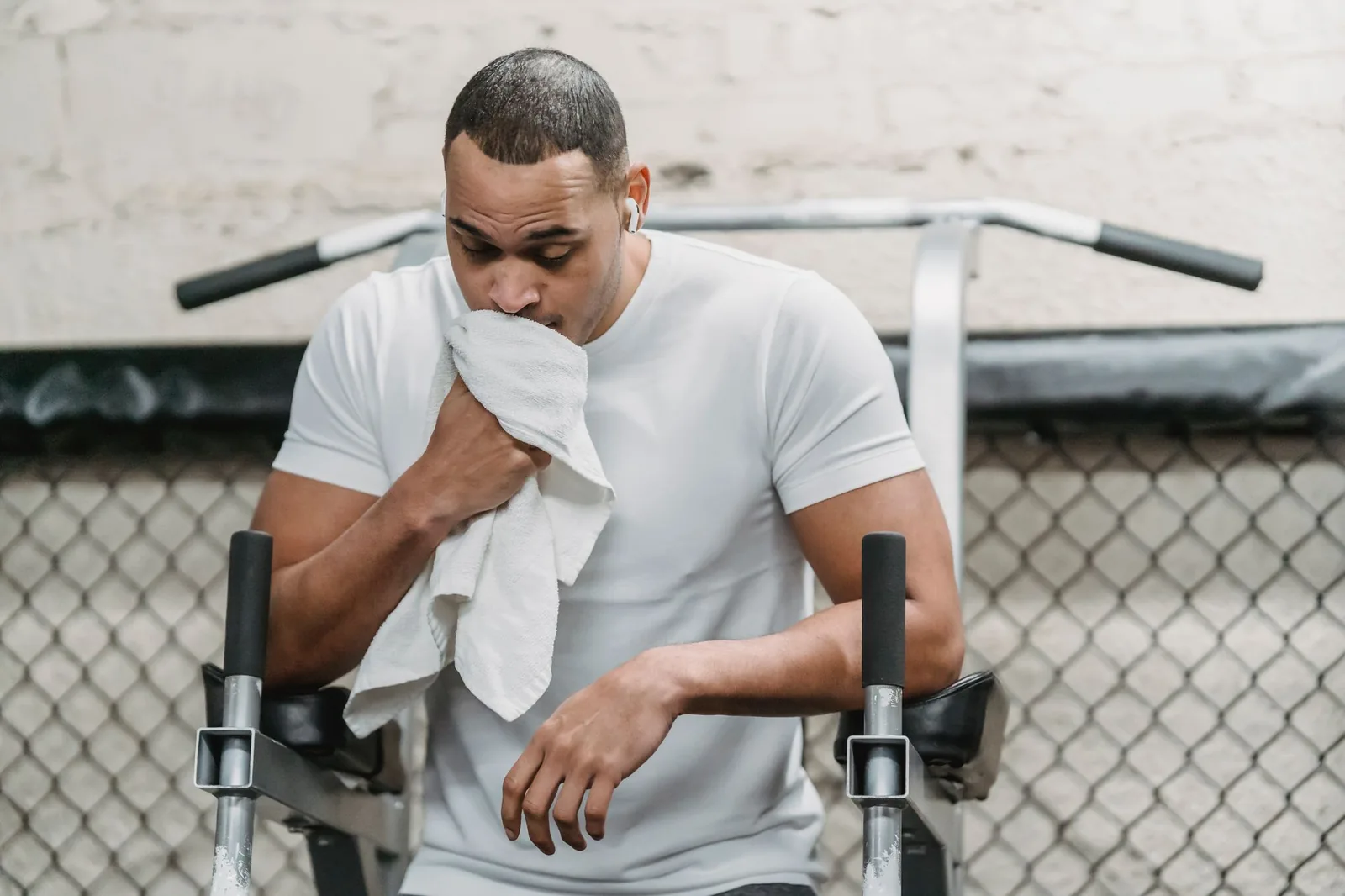
- Pat, don't rub. The AAD's list of habits that can worsen acne says rubbing sweat away with a towel can irritate your skin. Gently pat it off with a clean towel instead.
- Skip borrowed gear. The AAD suggests not sharing helmets and pads when you can avoid it, and wiping shared equipment before you use it.
- Keep your hands off your face. The AAD notes that wiping your forehead after touching shared equipment can move bacteria and oil onto your skin.
3. How long did the sweat sit?
The AAD's face washing tips say perspiration irritates the skin, especially when you wear a hat or helmet, and to wash as soon as possible after sweating. After a workout, the AAD's workout page suggests showering right away.
How to wash after a sweaty day, following the AAD:
- Choose a mild cleanser labeled oil-free, non-comedogenic, or "won't clog pores."
- Apply it with your fingertips. Washcloths and sponges can irritate your skin.
- Rinse gently with lukewarm water. Hot water and rubbing can make acne flare.
- Pat dry with a clean, soft towel.
- If your skin feels dry, apply a moisturizer made for acne-prone skin.
Can't shower? That's a normal day for anyone who works outside in Kissimmee heat. The AAD suggests changing out of your sweaty clothes and wiping breakout-prone skin with pads that contain salicylic acid, which can prevent clogged pores.
Then don't overcorrect. The AAD says washing several times a day can further irritate skin and lead to more breakouts; wash twice a day, plus after you sweat. In our view, that extra wash is one gentle cleanse, and our double cleansing guide explains when a second step helps.
| Question | Look for | What to change |
|---|---|---|
| What trapped the sweat? | Tight clothes, unwashed caps, headwraps or wig caps, heavy butters on your face | Loose, moisture-wicking clothes; wash headwear often; non-comedogenic products |
| What rubbed it in? | Helmets, chin straps, bag straps, a towel scrubbed across your face | Clean padding; pat sweat off; wipe shared gear first |
| How long did it sit? | Sweat left on your skin for the drive home or the rest of a shift | Wash soon after; if you can't, change clothes and use a salicylic acid pad |
Sweat Pimples, Heat Rash, or Fungal Acne? How to Tell Them Apart
Check what you're treating first. Three kinds of bumps flare in Florida heat, and each needs its own plan.
Heat rash (prickly heat)
Heat rash happens when sweat glands get blocked and trapped sweat leads to a rash, according to the NHS. It brings small, raised spots and an itchy, prickly feeling. On brown or black skin, the NHS says, it may be harder to see or look grey or white.
It usually gets better on its own after a few days. Meanwhile, the NHS says to keep your skin cool: loose cotton clothing, cool baths or showers. The Cleveland Clinic article draws the line this way: unlike sweat pimples, heat rash feels like a prickly, burning itch.
"Fungal acne" (Pityrosporum folliculitis)
In a May 27, 2025 news release, the AAD said "fungal acne," known medically as Pityrosporum folliculitis, is caused by an overgrowth of yeast in hair follicles. It appears as small bumps, typically on the forehead, chest, and upper back, and tends to get worse in hot, humid environments. The dermatologist quoted there says acne caused by yeast needs very different treatment from hormonal acne.
DermNet, a New Zealand dermatology reference, describes the bumps as small, uniform, and itchy, with no blackheads or whiteheads, which sets it apart from acne. Its risk factors include a hot, humid climate, heavy sweating, and moisturizers or sunscreens that seal the skin.
This one belongs with a dermatologist. We're estheticians, not doctors, and we don't recommend reaching for antifungal products on your own. A dermatologist can confirm it, sometimes with a skin scraping, as DermNet describes.
Why itch alone won't settle it
Itch is a clue, not proof. In a 2008 study of 120 acne patients at a skin clinic in Singapore, 70% said their acne itched, and sweat was the most common thing that made the itch worse. So the table below weighs the whole picture: how the bumps look, where they are, and how fast they come and go. Use it to decide what to ask a dermatologist, not to diagnose yourself.
| Clue | Sweat pimples | Heat rash | "Fungal acne" |
|---|---|---|---|
| What you see | Pimples, often with blackheads or whiteheads nearby; rough bumps first where gear rubs | Small, raised spots; may look grey or white on brown or black skin | Small, uniform bumps with no blackheads or whiteheads |
| How it feels | Can itch, especially with sweat and heat | Itchy and prickly | Itchy |
| Where | Where gear, straps, hats, or clothes rub | Anywhere on the body | Forehead, chest, upper back |
| Timing | The friction type tends to clear faster than regular acne, the AAD says | Usually better after a few days | Worse in hot, humid weather; often comes back |
| First move | Ask the three questions above | Cool down: loose cotton, cool shower | See a dermatologist |
Tiny, skin-colored bumps that never become pimples? See our guide to closed comedones.
Sweat Pimples on Melanin-Rich Skin: Stopping the Dark Marks
On brown and Black skin, the breakout is often the short part. The AAD's skin-of-color page says acne often brings dark spots that can last much longer than the acne itself. So on melanin-rich skin, those three questions are a dark-mark plan, too.
Three more habits from that AAD page:
- Treat early. The AAD says acne that worsens to moderate or severe before treatment raises the risk of darker spots and keloids in skin of color.
- Go gentle if you use benzoyl peroxide. For mild acne, the AAD suggests starting with a 2.5% product to avoid irritation, and it warns that benzoyl peroxide will bleach clothing, sheets, pillowcases, and towels.
- Don't pop. The AAD says picking, popping, or squeezing acne increases your risk of a scar.
Be careful with the fix, too. The AAD advises seeing a dermatologist before using any chemical peel, microdermabrasion, or laser therapy to treat acne on darkly pigmented skin, because even at-home versions can cause permanent dark marks and light spots.
If a mark has already formed, start with how to fade hyperpigmentation on melanin-rich skin.
Where a Facial Fits When Heat Breaks You Out
A facial won't change your commute, but it gives you a second set of eyes. Haven Noire is an esthetics spa, not a medical office: we don't diagnose heat rash or fungal acne, and a facial doesn't treat either.
Every Signature Facial begins with a double cleanse and a customized skin analysis. Then come exfoliation and extractions as needed, a custom mask and facial massage, and serums, moisturizer, and SPF. It's $95 for 60 minutes (3 for $210) or $110 for 90 minutes (3 for $285).
For breakouts and congestion, a Corrective Facial is $135, or $360 for a 3-pack. One option is our Acne Oxygen Rx, which pairs oxygen therapy with a purifying charcoal mask. Our guide to what oxygen facials can and can't do is honest about the evidence.
Want a steady rhythm? The Corrective Membership is $109.99 a month for one Corrective Facial, and the Glow Membership is $74.99 a month for a 60-minute Signature Facial. Our acne facials page shows how we approach breakouts.
Bring your answers to the three questions and every product you use, including anything prescribed. After a Signature Facial, our aftercare is to skip harsh actives and heat for 24 hours. After a Corrective Facial, it's to avoid sun exposure and active exfoliants for a few days. So our tip is to book on a rest day, not right before a hard workout or an outdoor shift.
When to See a Dermatologist or Doctor Instead
Start with the basics above, and see a board-certified dermatologist if:
- Breakouts from gear or clothing haven't cleared after 6 to 8 weeks of treatment. That's the AAD's point for acne mechanica, and it says a prescription acne medicine may be necessary.
- Your acne is deep or painful. The AAD says seeing a dermatologist is necessary to help clear it.
- You see small, uniform, itchy bumps on your forehead, chest, or upper back that don't act like your usual breakouts. A dermatologist in the AAD's release says acne caused by yeast needs very different treatment from hormonal acne.
- Dark marks or raised scars are forming. The AAD says a dermatologist can treat most dark spots, and that some people need prescription-strength medicine.
See a doctor if what looks like heat rash doesn't improve after a few days. That's the NHS's point for getting it checked.
Check with your doctor first if this is you
The benzoyl peroxide and salicylic acid tips in this guide are the AAD's general guidance, not a prescription from us, and they don't suit everyone.
- Pregnant: the AAD's page on acne treatment during pregnancy says to talk with your obstetrician or dermatologist before using benzoyl peroxide or salicylic acid. Ask before you start either.
- Taking isotretinoin, or using tretinoin or another prescription skin medicine: ask your dermatologist before you add a salicylic acid pad or a benzoyl peroxide product.
- Keloid-prone skin: see a dermatologist early rather than waiting out a flare.
- Eczema, rosacea, or very reactive skin: ask your dermatologist which cleanser suits you, and see how we approach sensitive and redness-prone skin.
Frequently Asked Questions About Sweat Pimples
Does sweat cause acne?
Partly. The American Academy of Dermatology says working out can cause excessive sweating and a buildup of oil, dirt, and bacteria, all of which can lead to acne. A Cleveland Clinic article says sweat alone isn't the whole story: heat, humidity, oil, bacteria, and friction work together. Fix what traps the sweat, rubs it in, and leaves it sitting.
How long do sweat pimples last?
It depends on what they are. The AAD says acne mechanica, the friction type, tends to clear more quickly than regular acne, and to see a dermatologist if it's still there after 6 to 8 weeks of treatment. Heat rash usually gets better on its own after a few days, according to the NHS.
Should you wash your face after every workout?
Yes, once. The AAD advises washing twice a day, plus after an activity that makes you sweat, with a mild, oil-free cleanser and your fingertips. It also warns that washing several times a day can irritate your skin and lead to more breakouts. Make it one gentle wash with lukewarm water, not a scrub.
How can you tell heat rash from acne?
Heat rash brings small, raised spots with an itchy, prickly feeling, and the NHS says it usually gets better on its own after a few days. On brown or black skin it may look grey or white. Bumps that last longer, especially with blackheads or whiteheads nearby, are more typical of acne. Not sure? Ask a dermatologist.
Can a hat or headwrap cause forehead acne?
It can. The AAD says wearing a baseball cap, or anything else on your head, without washing it lets sweat, dirt, and oil build up, which can make acne flare. Wash what you sweat in often. If breakouts sit only on your forehead and temples, the AAD says your hair oil may be the cause.
Can sunscreen cause breakouts when you sweat?
Choose it by the label instead of skipping it. For outdoor workouts, the AAD recommends an oil-free sunscreen labeled non-comedogenic or "won't clog pores," with SPF 30 or higher, broad-spectrum protection, and water resistance. It also says the sun can cause breakouts by drying your skin, which leads your body to produce more oil.
Can a facial help with breakouts from sweating?
A facial can clear congestion and give you a plan, but it doesn't replace daily habits, or a dermatologist for deep acne. At Haven Noire in Kissimmee, a Signature Facial is $95 for 60 minutes, and a Corrective Facial, including our Acne Oxygen Rx, is $135. Every facial starts with a skin analysis.
More from the Journal

About the author
Tiffany · Licensed Esthetician · Licensed PMU Artist
Tiffany is a Florida-licensed esthetician and permanent makeup artist and the founder of Haven Noire. She specializes in customized facials, corrective skincare, and waxing for melanin-rich and all skin types, and is known for a calm, education-first approach that puts first-time clients instantly at ease.
Meet Tiffany →