

An everything shower is one long session where you do every step of your body care at once: hair, face, a scrub, a shave, masks, and a full moisturizing finish. As of November 2026, the trend is still drawing interest. Google Trends showed US searches for the phrase at a 12-month high in mid-November 2026, and Real Simple reports that the hashtag has exploded on TikTok.
Here's the part most guides skip. The ritual can run as long as you like. The water shouldn't. In its tips for relieving dry skin, the American Academy of Dermatology (AAD) advises keeping baths and showers to five to ten minutes in warm water. The real risk isn't the candles or the hair mask: it's an hour of hot water plus a scrub, a dry brush, an acid, and a razor on the same skin.
Below: the evidence, a gentler way to plan the night, how often to do one, and when to see a dermatologist instead. Any number here that doesn't name a source is our suggestion, not a medical rule.
What Is an Everything Shower?
An everything shower is a long, once-in-a-while shower that bundles every grooming step into one session: washing and treating your hair, cleansing your face, exfoliating and shaving your body, then masking and moisturizing from head to toe.
Real Simple describes it as a once-a-week deep clean that typically takes one to four hours. Vogue's senior beauty and wellness editor writes that she spends about an hour and a half in and around the shower. Most published routines follow the same shape:
- Before: candles, makeup removal, a hair mask, often dry brushing.
- In the shower: shampoo, conditioner, face wash, body scrub, shave, body wash.
- After: body lotion or oil, face products, leave-in hair care.
The appeal is easy to understand: one unhurried night for yourself. What the trend isn't is studied. We searched PubMed in November 2026 for the phrase "everything shower" and found no study of the trend itself, so the evidence below covers its parts: water, exfoliation, and shaving. Our guide to dry brushing covers that pre-shower step.
What Dermatologists Say About Long, Hot Showers
Time and temperature
The AAD's top tips for relieving dry skin start here: limit baths and showers to five to ten minutes, using warm water. Its guide to dry skin in darker skin tones says hot water and spending too much time bathing tend to worsen dry skin. MedlinePlus, from the U.S. National Library of Medicine, lists bathing too often or too long among the causes of dry skin.
Even the trend's fans hedge. A board-certified dermatologist quoted by Women's Health says you generally don't want a shower to take more than ten minutes, and that because these showers run longer, it's key to use your time efficiently.

Too many rough steps in one night
Most published routines stack exfoliation. Real Simple's pairs dry brushing with a gritty scrub that combines chemical and physical exfoliants. Vogue's adds an exfoliating towel and a glycolic acid body spray to a hair removal cream.
The AAD's guide to exfoliating safely at home is clear: the more aggressive the exfoliation, the less often it needs to be done, and over-exfoliating can leave skin red and irritated. Exfoliating while you use a retinoid, retinol, or benzoyl peroxide may worsen dry skin or even cause breakouts.
To count every exfoliant in your week, see how often you should exfoliate.
The razor
If you shave, timing matters. The AAD's dry skin tips say to shave at the end of your shower or bath, because the water makes your skin and hair softer and less likely to get irritated. Its shaving tips add three habits: shave in the direction your hair grows, change the blade after 5 to 7 shaves, and store your razor somewhere dry, not in the shower.
The dermatologist quoted by Women's Health says exfoliating before you shave helps create a smoother shave. Our own view goes the other way, especially for sensitive, bump-prone, or darker skin: one rough step per patch of skin per night. Razor bumps? Our guide to waxing vs shaving explains why curly hair gets them.
A Gentler Everything Shower Routine
This routine is built on the AAD's dry skin, exfoliation, and shaving tips, and it rests on one idea: an everything shower is a ritual, not a long shower. Keep the ritual as long as you like. Keep the water short.
Sort every step into one of three places. It's a planning tool for home.
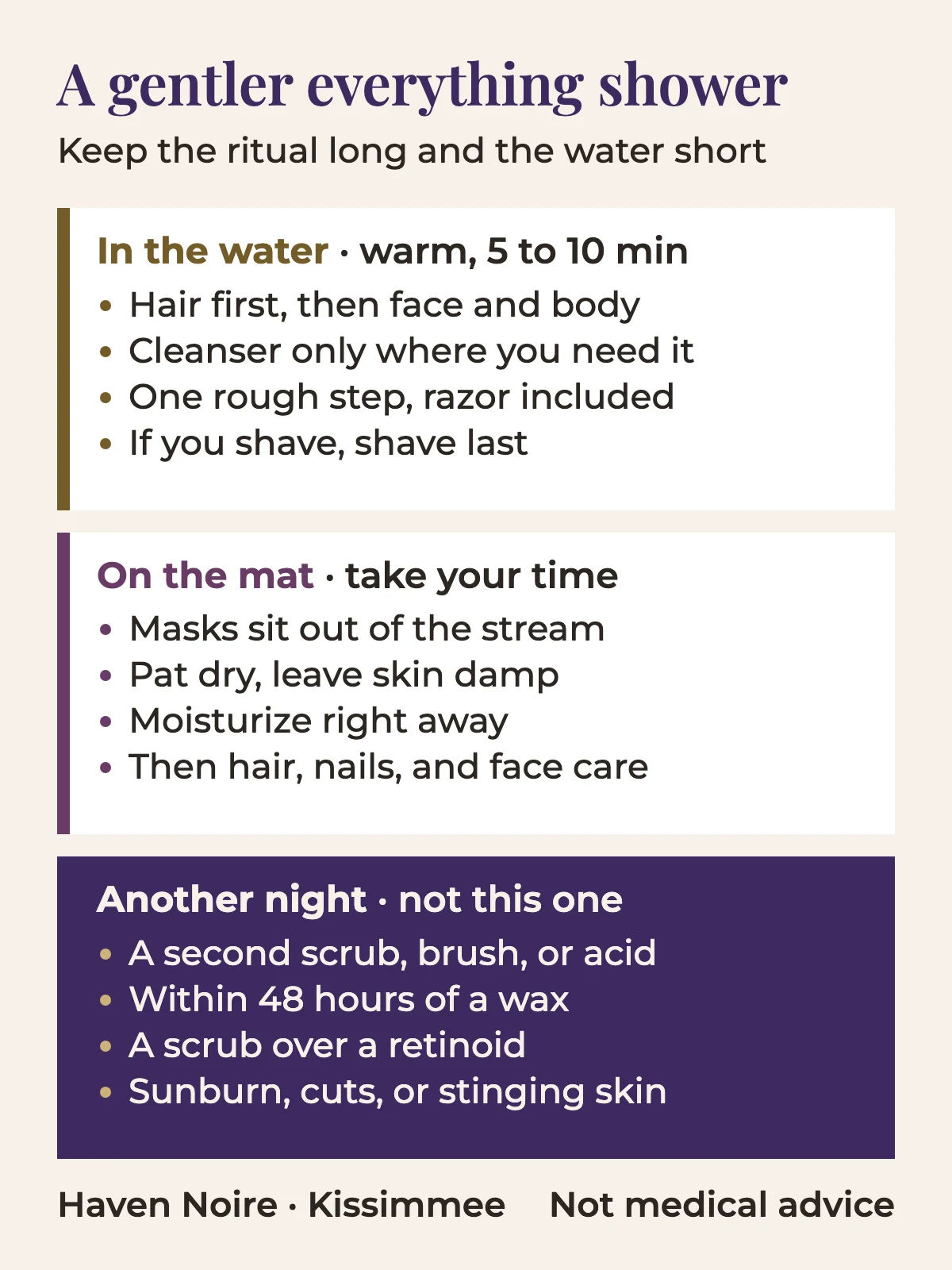
In the water: warm, for about ten minutes
Only steps that need running water go here, and the AAD's five to ten minutes is the target. Close the bathroom door, which the AAD says helps hydrate your skin.
- Hair first. The Women's Health dermatologist suggests washing hair before body, so conditioner residue doesn't stay on your skin. The AAD's page on hair care products and breakouts says shampoos and conditioners can cause breakouts along your hairline, forehead, and the back of your neck.
- Face. Our double cleansing guide covers whether you need a second wash.
- Body cleanser only where you need it. The AAD names your armpits and groin.
- One rough step at most: a gentle scrub in small circles for about 30 seconds, as the AAD advises, or your razor, which goes last.
On the bath mat: as long as you like
Anything that only needs time goes on the dry side of the curtain.
- Before: makeup removal, and a hair mask or oil that sits while you're out of the stream.
- Dry brushing, if it's tonight's rough step instead of a scrub.
- A face mask, after you step out. Trend guides say steam opens pores; our guide to shrinking pores explains why we don't repeat that.
- After: pat dry, leave skin a little damp, and apply a fragrance-free moisturizer right away, as the AAD advises.
- Then the slow parts: face routine, hair, and nails.
Long wash day? If your hair takes time to detangle and condition, our suggestion: let treatments sit on the mat with your hair wrapped, then step back in to rinse. Your hair gets its time; your skin isn't under the water for all of it.
Save for another night: steps that don't belong together
Some steps are fine alone and rough together. Our guide to smooth skin explains how to space scrubs and hair removal across a week. On a long shower night, these wait:
- A second rough step on the same skin: a scrub plus a dry brush, an acid, or a razor.
- Any scrub or acid on sunburn, open cuts, or wounds. The AAD says never to exfoliate them.
- Hot water or a scrub in the 24 to 48 hours after a wax.
- A scrub on top of a retinoid, retinol, or benzoyl peroxide, unless your dermatologist approves.
- Any product that burns or stings. If everything stings, check the signs of a damaged skin barrier.
A Weekly Body Care Routine, Step by Step
Here's the whole routine as one evening. Steps 4 to 7 happen in the water: aim for about ten minutes.
- Set the scene, with a clean towel and your moisturizer within reach.
- Remove makeup, and put on your hair mask or oil to sit.
- Dry brushing tonight? Do it now, gently, and skip the scrub.
- Turn the water to warm, not hot, and close the bathroom door.
- Wash your hair first, then your face.
- Use body cleanser where you need it.
- Scrub tonight? Small circles for about 30 seconds, then a lukewarm rinse. Razor tonight? Shave last, in the direction your hair grows.
- Step out, pat dry, and moisturize while your skin is still damp.
- Take your time with the rest: face mask, face routine, hair, and nails.
If your skin goes gray or dull again by lunchtime, our guide to ashy skin covers when to moisturize and what to seal it with.
Planning a whole night in, not just a shower? Our guide to a spa day at home builds out the rest of the evening.
How Often Should You Do the Full Ritual?
Real Simple and Women's Health both frame it as weekly. Our November 2026 PubMed search found no study of the trend, so there's no tested schedule we can point you to. Our advice: the full ritual once a week at most, with plain, short showers in between.
Let your rough step set the pace, not the candles. The AAD says the more aggressive the exfoliation, the less often it needs to be done. The dermatologist quoted by Women's Health says exfoliating once a week is fine for pretty normal skin, and suggests backing off to every other week if you're more sensitive or allergy-prone. That's one doctor's advice, not a rule. With eczema, ask your own dermatologist first.
Central Florida adds a wrinkle: on hot days, you may shower twice. Keep the extra one a short, warm rinse with no scrub. MedlinePlus advises not exposing your skin to water more often than needed, and lists dry indoor air from heating or cooling systems among causes of dry skin. If sweat breaks you out, our guide to sweat pimples helps you find the trigger. If your thighs rub raw on those days, see our guide to thigh chafing.
| Day | Shower | Rough step |
|---|---|---|
| Your ritual night, once a week at most | The full routine, water kept short | One, gently |
| Most days | Five to ten minutes, warm, cleanser where needed | None |
| A hot day's second shower | A short, warm rinse | None |
| The first 48 hours after a wax | Washing is fine; skip hot water | None |
Melanin-Rich Skin: Keep the Ritual Gentle
If your skin is brown or Black, gentle matters more. The AAD's exfoliation guide says to avoid strong chemical or mechanical exfoliation if you have a darker skin tone, or if you notice dark spots after burns, bug bites, or acne breakouts, because more aggressive exfoliation may lead to dark spots.
The AAD's guide to fading dark spots says a skin or hair care product that irritates your skin can cause dark spots, and that gentler products, often labeled "for sensitive skin" or "fragrance-free," are less likely to irritate. If a product burns or stings, it says, stop using it. Once the cause stops, a spot a few shades darker than your skin usually fades within 6 to 12 months.
Three more things that matter on deeper skin:
- Butters on breakout-prone skin. The AAD's acne advice for darker skin tones says a product with cocoa butter or shea butter can clog pores on your face, back, or chest. Our guide to shea butter for skin maps where it fits.
- Dark dots after shaving. Sort the cause first with our guide to strawberry legs.
- Back breakouts. Our guide to back acne explains how long a back acne wash should sit.
If You Wax: Fitting the Ritual Around Your Appointments
Put the razor away between waxes
Our waxing guidance asks you to avoid shaving between waxes, since it disrupts the growth cycle and can cause ingrown hairs. Come in with about a quarter inch of growth, roughly two to three weeks, and rebook every 3 to 4 weeks. Our guide to leg waxing explains how long a leg wax lasts.
Give a fresh wax two days
For 24 to 48 hours after a wax, our aftercare says to avoid heat, friction, sweat, and direct sun. The AAD's waxing tips include avoiding hot baths and showers afterward. A quick, warm wash is fine; a long, hot, scrubbing session isn't. Our advice: save the full ritual for day three or later, and keep the scrub gentle when it returns, since our aftercare says to exfoliate gently after a few days. Our waxing aftercare guide walks through the first two days.
Where Haven Noire fits
For the places you can't reach, our body treatments menu lists Firming Back + Booty, a 60-minute treatment for the back, the backs of the legs, and the booty, with an enzyme polish and a peptide-rich firming mask. Our tip: if you book it, count it as that week's rough step. Its aftercare is close to waxing's: avoid heat, friction, and sun for 24 to 48 hours.
| Service | Time | Price |
|---|---|---|
| Lower Legs Wax | 30 minutes | $40 |
| Upper Legs Wax | 30 minutes | $40 |
| Full Legs Wax | 45 minutes | $80 |
| Underarm Wax | 15 minutes | $15 |
| Firming Back + Booty | 60 minutes | $135 |
When to Skip It and See a Dermatologist
Haven Noire is an esthetics spa, not a medical office. A long shower night isn't a treatment, and some skin needs a doctor's plan first.
Check with your doctor or dermatologist first
- You're pregnant, or you take isotretinoin, use tretinoin, or use another prescription skin medicine. Ask before adding any scrub, acid, or new product, or booking a wax. The AAD's guide to removing unwanted hair says waxing isn't recommended while you apply tretinoin or use an antibiotic, and its waxing tips rule it out within six months of isotretinoin.
- You have eczema or psoriasis. Ask your dermatologist for a bathing routine first.
- Your skin scars or forms keloids easily. Ask before adding a scrub, a dry brush, or a new razor routine.
- You have rosacea, or hot water makes your face flush. Ask before adding a scrub, and see our page on sensitive and redness-prone skin.
See a dermatologist if
- Dry skin hangs on after you've followed the AAD's tips. The AAD says it may be due to a condition such as atopic dermatitis, psoriasis, or kidney disease.
- Tiny bumps along your hairline, forehead, or the back of your neck haven't cleared about 6 weeks after you stop a suspect hair product, the AAD's point for seeing a dermatologist.
- Redness or swelling after a wax lasts more than two days, which the AAD names as the time to see a board-certified dermatologist.
- Dark spots don't fade, or new ones keep appearing, even with gentler products. The AAD's dark spot guide suggests a dermatologist when what you're using isn't working.
Not sure who to call first? Our guide to esthetician vs. dermatologist helps you decide.
Frequently Asked Questions About the Everything Shower
What is an everything shower?
It's a long, usually weekly shower that bundles every step at once: hair wash and treatment, face cleanse, body scrub, shave, masks, and moisturizer. Real Simple says it typically takes one to four hours. We searched PubMed in November 2026 and found no study of the trend itself, so plan around dermatologists' advice on each step.
How long should an everything shower take?
As long as you like on the bath mat, but not under the water. The American Academy of Dermatology's dry skin tips limit baths and showers to five to ten minutes in warm water. Keep masks and slow steps out of the stream, so the ritual runs long while your skin's water time stays short.
How often should you take one?
Our advice: once a week at most, with short, warm showers in between. Let your rough step set the pace: the AAD says the more aggressive the exfoliation, the less often you need it. A dermatologist quoted by Women's Health suggests exfoliating every other week if your skin is more sensitive.
What order should you do things in the shower?
Hair first, then face, then body, with your razor last. A dermatologist quoted by Women's Health suggests washing your hair before your body so conditioner residue doesn't sit on your skin, and the AAD says to shave at the end, once water has softened your skin and hair. Moisturize while you're still damp.
Should you exfoliate before or after shaving?
Guides disagree. A dermatologist quoted by Women's Health says exfoliating first helps create a smoother shave. Our view, especially for sensitive, bump-prone, or darker skin: one rough step per patch of skin per night. The AAD says never to exfoliate open cuts or wounds, and a razor nick is one, so skip the scrub after a shave.
Can you do an everything shower after waxing?
Not in the first 24 to 48 hours. Our aftercare says to avoid heat, friction, sweat, and direct sun in that window, and the American Academy of Dermatology advises avoiding hot baths and showers after waxing. A quick, warm wash is fine. Save the full ritual for day three or later, and keep the scrub gentle.
Are long, hot showers bad for your skin?
They can dry it out. The American Academy of Dermatology says hot water and spending too much time bathing tend to worsen dry skin, and MedlinePlus lists bathing too often or too long among its causes. If you have eczema or psoriasis, ask your dermatologist for a bathing routine before you try the trend.
More from the Journal

About the author
Tiffany · Licensed Esthetician · Licensed PMU Artist
Tiffany is a Florida-licensed esthetician and permanent makeup artist and the founder of Haven Noire. She specializes in customized facials, corrective skincare, and waxing for melanin-rich and all skin types, and is known for a calm, education-first approach that puts first-time clients instantly at ease.
Meet Tiffany →