

Skin care for Black skin starts with the same basics every skin needs: a gentle cleanser, a moisturizer, and sunscreen. What changes is the goal. Melanin-rich skin often answers breakouts, bug bites, burns, and stinging products with dark marks. The American Academy of Dermatology (AAD) says a spot a few shades darker than your skin usually takes 6 to 12 months to fade once its cause stops, and color that sits deep can take years.
So the best routine isn't the longest one. It's the one that gives dark marks the fewest ways in. Here's the short version:
- Morning: a gentle cleanser, a moisturizer, and a tinted sunscreen with iron oxide, SPF 30 or higher.
- Night: cleanse, then moisturize. Add one active ingredient only when your skin is calm.
- Body: a short, warm shower, then a cream or ointment on damp skin. Planning a once-a-week shower night? See an everything shower routine that won't dry you out.
- Always: butters and hair oil stay off your face, and your hands stay off bumps.
Below: three myths to drop, the four causes of dark marks, the full routine, and when to see a dermatologist. Haven Noire is a Black-owned facial spa in Kissimmee, and this is the guide we'd hand a friend.
What Is Skin Care for Black Skin?
Skin care for Black skin is a routine planned around how melanin-rich skin reacts to trouble. It uses gentle, non-comedogenic products and daily tinted sunscreen to limit the breakouts, injuries, irritation, and light that leave lasting dark marks.
It isn't a special product line. The AAD's guide to clearing acne in darker skin tones says that near the top of the list of shared concerns for skin of color is acne and the dark spots that often appear when it clears.
What melanin-rich skin deals with most
The AAD's pages for darker skin tones keep returning to the same short list:
- Dark spots and patches, one of the most common reasons people with darker skin tones see a dermatologist.
- Acne, and dark spots that can last much longer than the acne.
- Ashy, dry skin, since flaking and rough texture are more noticeable on darker skin.
- Razor bumps, especially common in men with darker skin tones.
- Keloids. The AAD's keloid overview says studies suggest Black people have the greatest risk.
Three myths worth dropping
Myth 1: Black skin always has a stronger barrier. A 2019 review of facial skin-mapping studies in the International Journal of Cosmetic Science, whose lead author worked at an ingredient company, found that darkly pigmented people "do not necessarily have a better skin barrier function." Treat yours gently, and see our skin barrier guide when it's stressed.
Myth 2: Black don't crack, so the sun won't age you. Many of us grew up hearing the saying, and there's real pride in it. But the AAD's guide to skin cancer in darker skin tones is plain: "If you have brown or Black skin, the sun can speed up how quickly your skin ages." Our guide to how to prevent wrinkles ranks the habits that slow it, sunscreen first.
Myth 3: Melanin means you can skip sunscreen. The same guide says, "Dermatologists recommend sunscreen for everyone." Our guide answers whether Black people can get sunburn.
Why Dark Marks Start on Melanin-Rich Skin
The AAD's dark-spot guide lists the triggers. Dark spots often appear when a pimple clears, when an insect bite, cut, burn, or other injury heals, when a skin or hair care product irritates your skin, with certain medications, and with hormonal changes such as pregnancy. It also names the sun's visible light.
We sorted that list into four causes your daily routine can do something about: breakouts, injuries, irritation, and light. Medications and hormones belong with your doctor. Any tip below without a named source is our own advice, not a medical rule.
Here's the test for skin care for Black skin: every step in your routine should guard against one of these causes. If a step triggers one, it goes.
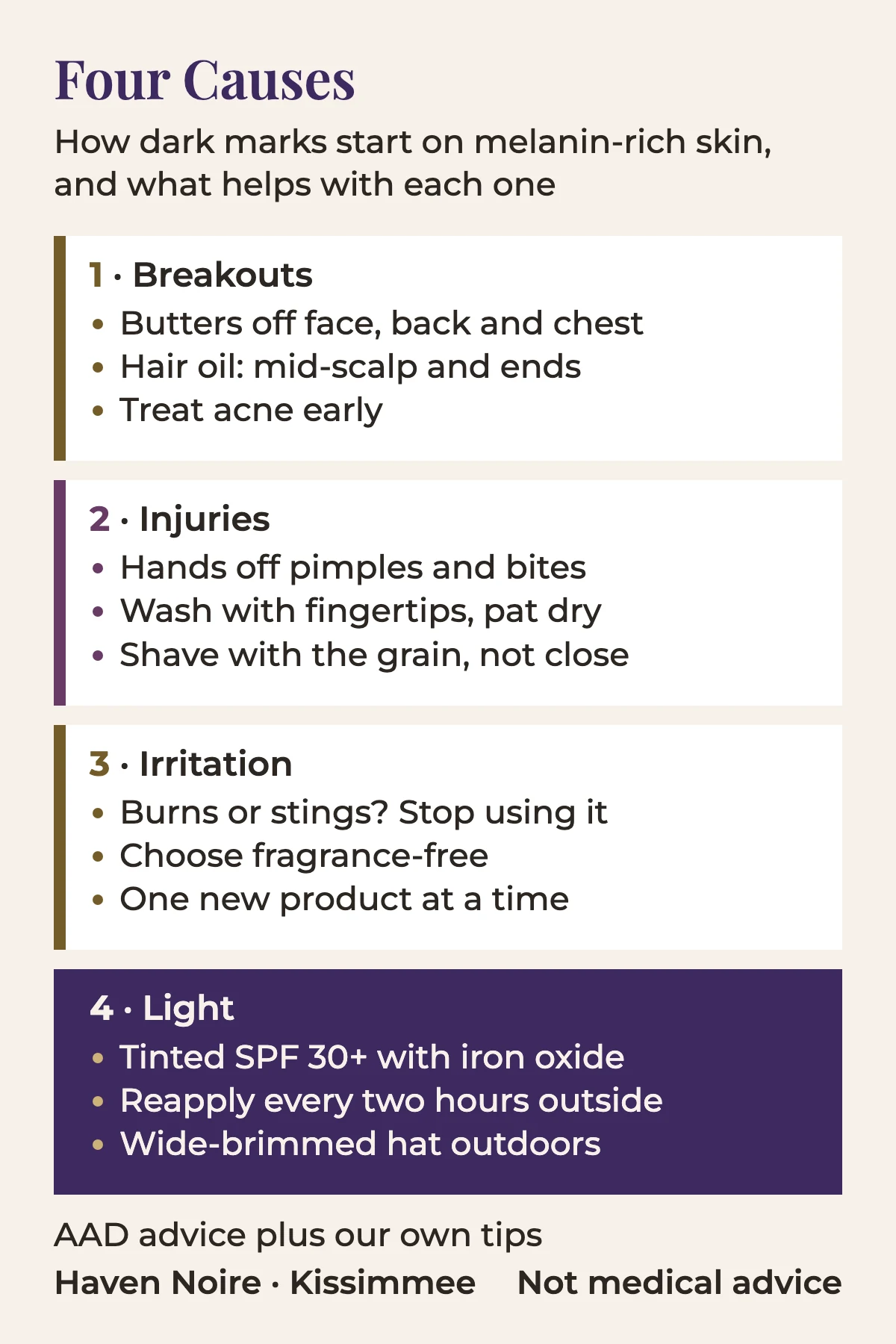
Breakouts
The AAD says that when you get rid of the acne, you eliminate what's causing the dark spots. If acne turns moderate to severe before treatment begins, it says people with skin of color have a higher risk of darker spots and patches, and of keloids.
- Butters on your face. The AAD says cocoa butter or shea butter on your face, back, or chest can clog pores. Our guides to shea butter for skin and coconut oil on your face go deeper.
- Hair oil along your hairline. Breakouts only on your forehead and temples may be pomade acne, the AAD says. It suggests hair oil only in the middle of your scalp and on the ends of your hair, or a product made with water or glycerin instead of oil.
- Heavy makeup over dark marks. The AAD says mineral makeup or makeup labeled non-comedogenic is fine.
One myth to retire: the AAD says benzoyl peroxide won't cause light spots on your skin. It will bleach towels and pillowcases, and the AAD suggests starting with a 2.5% product to avoid irritation.
Injuries
An injury doesn't have to be dramatic. The AAD lists insect bites, cuts, and burns, and says a dark spot from an injury fades in time "if you don't re-injure your skin." Picking re-injures it. So does scrubbing.
- Hands off. The AAD says picking, popping, or squeezing acne raises your risk of a scar.
- Fingertips only. Wash with your fingertips and pat dry with a clean towel. The AAD says scrubbing your face actually worsens acne.
- Treat the itch so you're not scratching. For itchy bug bites, the AAD's bite tips suggest an ice pack or an over-the-counter anti-itch cream.
- Mind the hot tools. Our note: a flat iron or hot comb that slips at your hairline leaves a burn, and burns are on the AAD's list.
Razor bumps
The AAD's razor bump remedies say bumps form when the razor cuts hairs short and coarse, curly hairs curve back into the skin. Its tips: shave slowly in the direction your hairs grow, don't shave closely or press hard, and use a single-blade or electric razor. Our guide to waxing vs. shaving weighs both for curly hair.
If your skin forms keloids
In keloid-prone skin, the AAD's page on what causes keloids says one can form after acne, a burn, a cut, scrape, or bug bite, a piercing, or a tattoo, and some people get one from shaving the beard area. Our advice: ask your dermatologist first, and tell your esthetician before any extractions, dermaplaning, or wax.
Irritation
The AAD says a skin or hair care product that irritates your skin can cause dark spots, and once your skin is no longer irritated, new dark spots tend to stop appearing. This is the quietest cause. It doesn't look like an injury. It feels like a sting.
- If a product burns or stings when you apply it, stop using it. That's the AAD's rule.
- Choose labels that say "for sensitive skin" or "fragrance-free," which the AAD says often mark gentler products.
- Our rule of thumb: add one new product at a time and give it two weeks, so you know which one to blame.
Dry skin counts here too: the AAD says it's easily irritated. If you exfoliate, our guide to how often to exfoliate helps keep the weekly count low.
Light
The AAD calls the sun's visible light a cause of dark spots and says effective treatment for dark spots begins with sunscreen. Its pick is a tinted sunscreen with iron oxide that is SPF 30 or higher, broad spectrum, and water resistant, blends with your skin tone, and is non-comedogenic if your skin is oily.
It also says to reapply every two hours and after swimming or sweating, and to wear a wide-brimmed hat outdoors. Our guide to sunscreen for dark skin shows how to read the label, and another asks whether sunscreen is bad for you.
| Cause | What triggers it | What helps |
|---|---|---|
| Breakouts | Butters on the face; hair oil at the hairline; heavy makeup | Non-comedogenic products; hair oil on mid-scalp and ends; treating acne early |
| Injuries | Picking, scrubbing, scratching bites, close shaves, hot tools | Fingertips and a pat dry; ice for itchy bites; shaving with the grain |
| Irritation | Products that burn or sting; several new products at once | Gentle, fragrance-free products, added one at a time |
| Light | Sun on unprotected skin, visible light included | Tinted SPF 30 or higher with iron oxide; reapplying; a wide-brimmed hat |
A Simple Black Skin Care Routine for Morning, Night, and Body
Here's the routine we'd build around those four causes. It's short on purpose: fewer products mean fewer chances for irritation.
Morning
- Wash with a mild cleanser labeled non-comedogenic, using only your fingertips.
- Moisturize. If your face looks ashy by midday, the AAD's dry skin remedies for darker skin tones say a moisturizer with ceramides can reduce the whitish or grayish-white look of dry skin.
- Before you go outside, apply tinted sunscreen with iron oxide, SPF 30 or higher, to all skin clothing won't cover.
Night
- Gently wash off sunscreen, sweat, and makeup. Wearing water-resistant sunscreen or full makeup? See when a second cleanse makes sense.
- Treat, but only if your skin is calm: one product for breakouts or dark spots, not three.
- Moisturize.
Choosing one active for dark spots
The AAD lists products you can buy without a prescription that contain azelaic acid, glycolic acid, kojic acid, a retinoid such as retinol or adapalene gel, or vitamin C. It says they tend to work better once you've stopped the cause and protected your skin from sunlight. Niacinamide and tranexamic acid aren't on that list; our guides to niacinamide for dark spots and tranexamic acid cover what the studies show.
Pregnant or nursing, or using isotretinoin, tretinoin, or another prescription skin medicine? Ask your doctor or dermatologist before adding any active ingredient. The same goes for eczema, rosacea, or skin that forms keloids. If a mark has already formed, our guide to fading hyperpigmentation on melanin-rich skin covers the longer plan.
Body: seal in moisture
On your body, ash is dry skin you can see: the AAD's dry-skin tips for darker skin tones start with short, warm showers and a fragrance-free cream on still-damp skin, and our guide to ashy skin has the full routine. Thinking of petroleum jelly on your face instead? Read about slugging first, especially if you break out.
Adjustments for Central Florida
- Wash caps and hats often. The AAD says an unwashed cap collects sweat, dirt, and oil, which can make acne flare.
- For dry, irritated skin, the AAD suggests loose clothes in a breathable fabric like cotton.
- Tight in the air conditioning but shiny outdoors? See dry vs. dehydrated skin.
Where a Facial Fits in Skin Care for Black Skin
In skin care for Black skin, your home routine does the daily work. A facial adds a trained look at your skin and extractions as needed, so you're not the one squeezing. Haven Noire is a Black-owned, woman-owned boutique facial spa in downtown Kissimmee, with treatments crafted for melanin-rich and all skin types.
- Signature Facial, 60 minutes, $95 (3 for $210): double cleanse, skin analysis, exfoliation and extractions as needed, a custom mask and facial massage, then serums, moisturizer, and SPF.
- Corrective Facial, 60 minutes, $135 (3-pack $360): options include Radiance Brightening for dull skin and discoloration, and the Hydrofacial.
- Monthly memberships: Glow is $74.99 a month for a 60-minute Signature Facial; Corrective is $109.99 for any corrective facial. Members get 10% off extra services and in-spa products.
Two honest limits. We're estheticians, not doctors, so we don't diagnose or treat medical conditions. And if you have acne on darker skin and want a chemical peel or microdermabrasion to treat it, the AAD advises seeing a dermatologist first, because on darkly pigmented skin even at-home versions can cause permanent dark marks and light spots.
For the treatment-room side, read facials for Black skin, and for marks you're fading, see hyperpigmentation and dark spots. Beard bumps? See facials for men. For home care, we'll recommend products at your visit from the professional skincare lines we treat with.
When to See a Dermatologist Instead
Haven Noire is an esthetics spa, not a medical office. When melanin-rich skin shows these signs, see a board-certified dermatologist:
- A raised scar that keeps growing. The AAD says keloids grow much larger than the wound that caused them and don't fade with time.
- Possible signs of skin cancer: a bump, spot, or mole that's growing, bleeding, itching, or changing; new color, especially darkening; a sore that doesn't heal, or heals and comes back; a dark line or streak in a nail; or a scaly, rough patch that doesn't go away. The AAD says skin cancer in darker skin may show up where the sun rarely reaches, like the palms, soles, nails, mouth, or genitals, and says to see a dermatologist right away if you find a sign.
- New, worsening, or unchanging light spots after a few weeks. The AAD's light-spot guide says they can signal a condition such as vitiligo or eczema.
- Dry skin that doesn't improve. The AAD expects some improvement within two weeks of its tips, and says some people with darker skin live for years with an undiagnosed condition like eczema.
- A dark patch that feels velvety and thicker than the skin around it, which the AAD lists as a sign of acanthosis nigricans. If it appears suddenly, the AAD says to see a dermatologist right away. Our dark underarms guide explains why it needs a doctor.
- Small, dark, raised spots across the cheeks that bother you. Our textured skin guide explains dermatosis papulosa nigra, which is benign, and why removing it is a dermatologist's job.
- Razor bumps that keep coming after you change how you shave, or dark spots that won't fade with your own care. The AAD names both as reasons to see a dermatologist.
Think a medicine is darkening your skin? The AAD says not to stop taking it on your own. Ask the doctor who prescribed it whether discolored skin is a possible side effect.
Want a dermatologist who focuses on deeper skin tones? The AAD suggests its Find a Dermatologist search, with "Skin of Color" chosen as the practice focus.
Frequently Asked Questions About Skin Care for Black Skin
What is a good skin care routine for Black skin?
Every morning, use a gentle, non-comedogenic cleanser, a moisturizer, and a tinted sunscreen with iron oxide, SPF 30 or higher. At night, cleanse, add one active ingredient only if your skin is calm, and moisturize. Keep butters and hair oil off your face, keep your hands off bumps and bites, and stop anything that stings.
Why does dark skin get dark spots so easily?
The AAD says something triggers the skin to make extra melanin: a pimple clearing, an insect bite, cut, or burn healing, a product that irritates, certain medications, or hormonal changes such as pregnancy. Once the cause stops, a spot a few shades darker than your skin usually fades within 6 to 12 months.
Does benzoyl peroxide cause light spots on dark skin?
No. The AAD calls that a myth: benzoyl peroxide won't cause light spots on your skin, though it will bleach clothing, sheets, pillowcases, and towels. To keep it from irritating your skin, the AAD suggests starting with a 2.5% product and, if that still irritates, using it every other day.
Does Black skin age slower?
The saying "Black don't crack" is a source of pride, but sun still matters. The AAD says that if you have brown or Black skin, the sun can speed up how quickly your skin ages, and that sun protection, including sunscreen, can reduce the likelihood. It recommends shade, sun-protective clothing, and tinted, broad-spectrum sunscreen with SPF 30 or higher.
Why am I breaking out along my hairline and forehead?
Breakouts only on your forehead and temples can come from hair oil, the AAD says, a pattern called pomade acne. It suggests using hair oil only in the middle of your scalp and on the ends of your hair, or a product made with water or glycerin. If breakouts continue, stopping that product is another option.
Are skin lightening creams safe for Black skin?
Some do more harm than good, the AAD says. Researchers have found steroids or mercury, not listed on the label, in products imported from other countries, and long-term steroid use can leave skin thin, fragile, or permanently discolored. To fade dark spots, choose a product made in the United States or one your dermatologist recommends. Never apply liquid bleach.
Are Black people more likely to get keloids?
People of all races get keloids, the AAD says, but findings from studies suggest Black people have the greatest risk. In keloid-prone skin, one may form after acne, a burn, a cut, scrape, or bug bite, a piercing, or a tattoo. A raised scar that keeps growing is a reason to see a board-certified dermatologist.
Keep exploring
More from the Journal

About the author
Tiffany · Licensed Esthetician · Licensed PMU Artist
Tiffany is a Florida-licensed esthetician and permanent makeup artist and the founder of Haven Noire. She specializes in customized facials, corrective skincare, and waxing for melanin-rich and all skin types, and is known for a calm, education-first approach that puts first-time clients instantly at ease.
Meet Tiffany →