

Niacinamide can help fade dark spots, slowly and modestly. In mostly small trials lasting 4 to 12 weeks, creams with 4% or 5% niacinamide lightened dark spots more than the same cream without it. It's usually well tolerated. It isn't on the American Academy of Dermatology's list of nonprescription ingredients that fade dark spots. That doesn't mean it fails; the list simply doesn't name it. Like any fader, it works best once the cause of your spots is under control.
Here's what most guides skip: niacinamide doesn't stop your skin from making pigment. In lab studies, it slowed the handoff of pigment to nearby skin cells, and the effect wore off once it was removed. If breakouts, sun, or a stinging product keep setting off new pigment, niacinamide is working downstream of a problem that's still running.
Below: what the trials found, the three stages of a dark mark, how to use niacinamide on melanin-rich skin, and when to see a dermatologist. For spa options, see our page on facials for hyperpigmentation and dark spots.
What Is Niacinamide?
Niacinamide is a form of vitamin B3 that you'll find in serums, moisturizers, and some sunscreens. Skin care uses it to even out tone, and researchers have tested it on dark spots, melasma, and darkened underarm skin.
Dark spots aren't its only claim. In a 2005 trial of 50 white women with sun-aged skin, run by Procter & Gamble researchers, 5% niacinamide also reduced the look of fine lines, red blotchiness, and sallowness. That's the range of niacinamide benefits brands advertise. This guide sticks to dark spots; for oil and pores, see our guide to shrinking pores.
Niacinamide Isn't Niacin
MedlinePlus, from the U.S. National Library of Medicine, says niacin (vitamin B3) supplements given to treat high cholesterol can cause flushing, "a feeling of warmth, redness, itching or tingling" of the face, neck, arms, or upper chest. Supplements in the nicotinamide or niacinamide form "do not appear to cause side effects." That line is about pills, not creams. So don't swap in niacin pills to fade spots; MedlinePlus advises talking to your provider before starting any supplement.
Does Niacinamide Work for Dark Spots? What the Trials Found
Yes, in small, short trials. Here are the ones we read, all on niacinamide applied to the skin.
| Study | Who | What was tested | What it found |
|---|---|---|---|
| Hakozaki and colleagues, 2002, Procter & Gamble | 18 women in Japan with dark spots, plus 120 people with tanned skin | 5% niacinamide moisturizer vs. the same without it; 2% niacinamide with sunscreen in the tanning trial | Less hyperpigmentation and lighter skin than without niacinamide after 4 weeks |
| Bissett and colleagues, 2005, Procter & Gamble | 50 white women with sun-aged skin | 5% niacinamide vs. plain cream, split face, 12 weeks | Fewer visible dark spots than the plain side |
| Kimball and colleagues, 2010, 7 of 8 authors at Procter & Gamble | 202 women aged 40 to 60 | 4% niacinamide plus 2% N-acetyl glucosamine in a morning SPF 15 lotion and a night cream vs. the same without them, 8 weeks | Less spot area than SPF 15 alone; niacinamide's share can't be separated |
| Navarrete-Solís and colleagues, 2011 | 27 women with melasma in Mexico; 25 had skin type IV or V | 4% niacinamide on one side of the face, 4% hydroquinone on the other, 8 weeks | Good to excellent results in 44% with niacinamide vs. 55% with hydroquinone, which worked faster |
| Castanedo-Cázares and colleagues, 2013 | 24 women with darkened underarms, skin types III to V | 4% niacinamide vs. 0.05% desonide, a corticosteroid cream, vs. placebo, 9 weeks | Good to excellent results in 24% with niacinamide, 30% with desonide, 6% with placebo |
Read together, niacinamide beat a plain cream or placebo and came out slightly behind hydroquinone and desonide in the two head-to-head trials. A 2021 systematic review of topical treatments for post-inflammatory hyperpigmentation, led by University of Ottawa dermatologists, counted niacinamide among agents with high-quality studies. Retinoids, hydroxy acids, and broad-spectrum sunscreen had the most.
Who Was in the Studies
Where the papers say, participants were Japanese, white, or Mexican women; the 2010 abstract doesn't give ethnicity. A 10-week trial in Mumbai, India, added 207 women, but its lotion combined niacinamide with panthenol and vitamin E. The underarm trial is a reminder that dark skin in folds has several causes; our guide to dark underarms sorts them.
For Black skin, the evidence on niacinamide for dark spots is thinner. We searched PubMed in November 2026 for niacinamide trials on dark spots or melasma that named Black or African American participants or type VI skin. The closest was a 2026 open-label study of 30 women, 57% of them Black or African American, using a serum that also held tranexamic acid and lotus sprout extract; with three ingredients and no comparison group, it can't isolate niacinamide.
Also worth knowing: the 2002, 2005, and 2010 trials in the table list authors at Procter & Gamble, a consumer-products company. Industry research isn't wrong by default, but independent trials on deeper skin are what's missing. Our view, not a medical rule: niacinamide is still reasonable to try on melanin-rich skin, with honest expectations.
The 10% Question
Plenty of serums sold as niacinamide for dark spots say 10%, but the single-ingredient trials we read used 2% to 5%. We searched PubMed in November 2026 for a trial of 10% niacinamide used alone on dark spots and didn't find one. A 2024 review in Antioxidants reports no stinging in clinical tests up to 10% and no irritation up to 5%; five of its nine authors worked for companies that develop or make products. Our advice: start in the 2% to 5% range. A higher number isn't proven to fade more.
Why Niacinamide Fades Dark Spots Slowly
Pigment cells called melanocytes make melanin, pack it into tiny packets called melanosomes, and pass them to the skin cells around them. A 2005 study in Experimental Dermatology describes that transfer as part of what produces skin color.
Niacinamide works on that handoff. In the 2002 lab work behind the Hakozaki trial, it didn't change melanin production, but it cut the transfer of pigment packets by 35% to 68% in cell cultures. That Experimental Dermatology study, two of whose authors also wrote the Procter & Gamble papers, found the effect reversible: cultures resumed normal transfer within 3 days of removing niacinamide, and in its split-face trial, the reduction in dark spots was reversible too.
Other faders work earlier. A 2010 review of post-inflammatory hyperpigmentation in skin of color groups hydroquinone, azelaic acid, and kojic acid as tyrosinase inhibitors and lists niacinamide separately; in the 2002 lab work, niacinamide had no effect on tyrosinase.
Three Places to Interrupt a Dark Mark
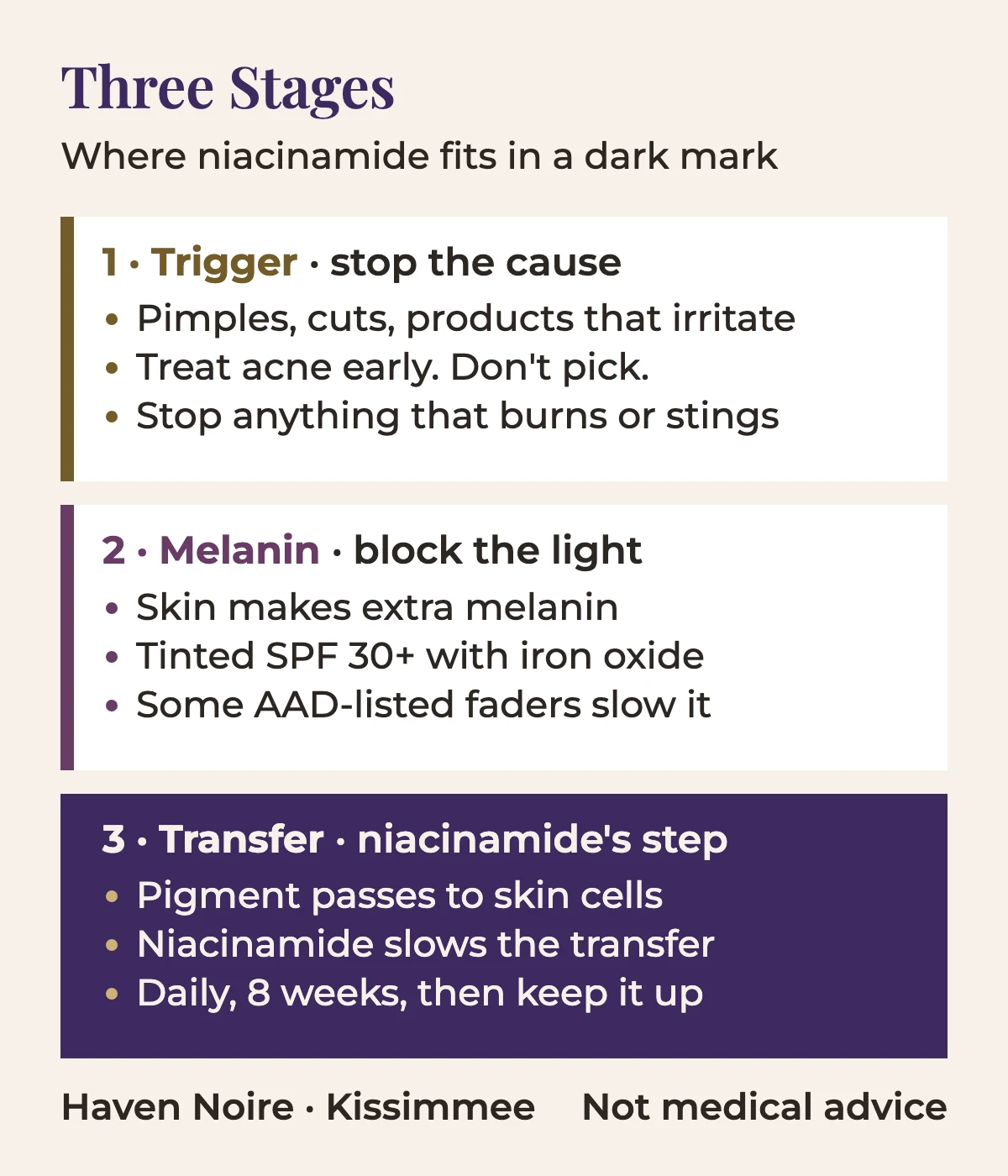
A dark mark forms in three stages, and you can step in at each one. The stages are our simplification, not a medical rule, built on guidance for darker skin tones from the American Academy of Dermatology (AAD) and the lab findings above.
Stage 1: Something Triggers Pigment
Something sets off extra pigment. The AAD's guide to fading dark spots in darker skin tones names a pimple clearing, a wound healing, certain medications, an irritating skin or hair product, and hormonal changes such as pregnancy. It's clear about order: "If you can eliminate the cause, many spots will clear on their own." Our guide to skin care for Black skin covers the daily habits that keep those triggers in check.
For post-acne marks, that means treating the acne. The AAD's acne tips for skin of color recommend treating acne and dark spots at the same time, and the fade guide says a mark fades "if you don't re-injure your skin." So hands off. For what a spa can add, read the best facial for acne in Kissimmee.
Stage 2: Skin Makes Extra Melanin
Once triggered, skin makes extra melanin, and light adds more. The AAD says effective treatment "begins with sunscreen": a tinted one with iron oxide, which helps block visible light, SPF 30 or higher. Our guide to sunscreen for dark skin covers the rest of the label. The AAD adds that its listed fading ingredients can, in some cases, "slow down production of melanin."
Stage 3: Pigment Moves to Skin Cells
This is niacinamide's stage, which makes it a teammate, not a solo act. Our rule of thumb: work from the top down. The AAD backs the order. Once you eliminate the cause and protect your skin from sunlight, it says, a product that can fade dark spots "tends to be more effective."
How to Use Niacinamide for Hyperpigmentation
Here's the order we'd follow. Steps marked AAD come from that source; the rest is our own advice, built on the trials above.
- Start at stage 1. If breakouts, picking, or a stinging product keep making new marks, deal with that first.
- Wear tinted sunscreen with iron oxide every morning, SPF 30 or higher (AAD).
- Choose one leave-on niacinamide product in the 2% to 5% range the trials tested.
- Apply it daily. The trials used it once or twice a day; follow your product's label.
- Add only one new product at a time, so you know what your skin is reacting to.
- Judge it at 8 weeks, not 8 days. Photograph your skin in the same light on day one and at week 8.
- Keep going if it's working. The lightening was reversible in the 2005 Experimental Dermatology study.
- Stop if it burns or stings (AAD).
The AAD calls sunscreen essential. Worried about what's in it? Read whether sunscreen is bad for you.

Pairing Niacinamide With Other Brighteners
Trials have tested niacinamide in blends. In a 2025 trial of 60 women with melasma in Brazil, most with skin types III to V, a serum with 5% niacinamide, 1% tranexamic acid, a stabilized vitamin C, and hydroxy acids worked about as well as 4% hydroquinone and was better tolerated. Vichy Laboratoires, a skin care brand, funded it, and two of its six authors are L'Oréal employees there.
| Ingredient | On the AAD's fade list? | What our sources say | Our note |
|---|---|---|---|
| Niacinamide | No | Slows pigment's handoff to skin cells (2002 lab work) | Needs daily use and weeks |
| Azelaic acid | Yes | A tyrosinase inhibitor (2010 review) | On the AAD's melasma list of gentler prescriptions |
| Kojic acid | Yes | A tyrosinase inhibitor (2010 review) | Also on that melasma list |
| Vitamin C | Yes | A depigmenting agent (2010 review) | Paired with niacinamide in the 2025 serum trial |
| Retinoids | Yes | The AAD says retinol can unclog pores and fade dark spots | Prescription ones: ask your dermatologist first |
| Glycolic acid | Yes | An exfoliating acid | Go slowly; see our mandelic acid guide |
| Tranexamic acid | No | Paired with 2% niacinamide in a company-led 2013 trial of 42 Korean women | See our tranexamic acid guide |
Our rule of thumb: add a second brightener only after a few calm weeks on the first. On melanin-rich skin, irritation from stacked actives can leave new marks, as our guide to facials for Black skin explains.
Is Niacinamide Gentle on Melanin-Rich Skin?
Usually, not always. In the melasma trial, 5 of 27 women (18%) had side effects on the niacinamide side, mostly mild redness, itching, or burning, versus 8 (29%) with hydroquinone. Since the AAD lists an irritating product among causes of dark spots, stop anything that stings. If everything stings right now, calm your skin first with our skin barrier guide.
Pregnant or breastfeeding? Ask your OB-GYN or midwife before starting any new skin product. Taking isotretinoin, using tretinoin or another prescription skin medicine, or managing eczema or rosacea? Check with your dermatologist before adding niacinamide.
Corrective Facials for Dark Spots at Haven Noire
Niacinamide for dark spots handles the daily part at home; a facial adds a trained look at your skin. We're estheticians, not doctors: we don't diagnose melasma or treat medical conditions, and no facial can guarantee a mark will fade.
On our corrective menu, the option aimed at discoloration is Radiance Brightening: antioxidants and vitamin blends that resurface dull skin, refine texture, and target discoloration, for hyperpigmented or sun-damaged skin. The menu doesn't list ingredients, so ask at your consultation whether niacinamide is part of your treatment.
- Price: a 60-minute Corrective Facial is $135, or $360 for a 3-pack.
- Pace: many clients start every two to three weeks, then taper to maintenance.
- Afterward: avoid sun and active exfoliants for a few days, and wear SPF daily.
- Members: the Corrective Membership covers one corrective facial a month for $109.99, three-month minimum, plus 10% off extra services and in-spa products.
We treat with professional lines from Circadia by Dr. Pugliese, Dermalogica, and Skin Script, and we'll recommend home care to match. For in-spa and home care together, read how to fade hyperpigmentation on melanin-rich skin.
When to See a Dermatologist Instead
Haven Noire is an esthetics spa, not a medical office, and niacinamide for dark spots is home care, not a diagnosis. See a board-certified dermatologist first if:
- You think it's melasma: tan, brown, or gray patches, often on the cheeks, forehead, chin, or upper lip, as the AAD describes it. Its melasma treatment guide says most patients get a prescription medicine, with a plan tailored to their skin tone, how deep the pigment sits, and their triggers.
- A spot is slate blue to gray. The AAD says color that deep can take years to fade.
- A bump, spot, or mole is growing, bleeding, itching, or changing, or a new dark spot appears on a palm or sole or as a dark streak in a nail. The AAD's guide to skin cancer in darker skin tones lists these as warning signs and says to book a board-certified dermatologist right away.
- Acne keeps leaving new marks, or a fading product isn't delivering. The AAD says some spots need prescription-strength treatment.
- You think a medicine is causing your spots. The AAD says not to stop it; ask the prescribing doctor.
- You're pregnant, breastfeeding, taking isotretinoin, or using any prescription skin medicine.
Once a dermatologist has a plan for melasma, our melasma page shows where spa care can fit alongside it.
Frequently Asked Questions About Niacinamide for Dark Spots
How long does niacinamide take to fade dark spots?
In the trials we read, changes showed at 4 to 8 weeks of daily use, and in one melasma trial niacinamide's effect appeared in the second month. The American Academy of Dermatology says a spot a few shades darker than your skin usually fades within 6 to 12 months once its cause stops. Plan on months, with daily sunscreen.
What percentage of niacinamide is best for hyperpigmentation?
The single-ingredient trials we read used 2% to 5%. We searched PubMed in November 2026 for a trial of 10% niacinamide used alone on dark spots and didn't find one, so a higher number isn't proven to fade more. Our advice: start in the tested range, especially if your skin marks easily.
Can you use niacinamide with vitamin C?
Brand guides disagree. One brand's blog advises against pairing niacinamide with direct vitamin C (L-ascorbic acid) in the same routine, while two other brands' guides call the two compatible. A 2025 melasma trial found one serum holding both better tolerated than hydroquinone. Our suggestion: start one, add the other after a few calm weeks.
Is niacinamide good for melasma?
It helped in one small trial: 27 women in Mexico, most with skin type IV or V, improved with 4% niacinamide, slightly less and more slowly than with 4% hydroquinone, with fewer side effects. Melasma needs a dermatologist's diagnosis and plan first, and the AAD says it often returns when skin goes unprotected in the sun.
Does niacinamide work on Black skin?
Our view: it's worth trying, but the evidence is thin. The melasma and underarm trials included skin types IV and V, and a 2026 study with mostly Black women used niacinamide inside a three-ingredient serum. In our November 2026 PubMed search, we found no single-ingredient niacinamide trial focused on Black skin.
Is niacinamide the same as niacin?
No. MedlinePlus describes niacin as vitamin B3 and says niacin supplements given for high cholesterol can cause flushing: warmth, redness, itching, or tingling. It says supplements in the nicotinamide or niacinamide form don't appear to cause side effects, a line about pills, not creams. Skin care uses niacinamide. Don't take niacin pills for dark spots without asking your provider.
Can niacinamide make dark spots worse?
It was usually well tolerated in the trials we read, but any product that irritates your skin can backfire. The American Academy of Dermatology lists an irritating skin care product among causes of dark spots in darker skin tones and says to stop anything that burns or stings. In one melasma trial, 18% had side effects with niacinamide, mostly mild.
Can I get a facial for dark spots in Kissimmee?
Yes. At Haven Noire, 231 Ruby Avenue, Unit E, in downtown Kissimmee, a Corrective Facial is $135, or $360 for a 3-pack, and Radiance Brightening is the option aimed at discoloration. Every facial starts with a skin analysis. We're estheticians, not doctors, so suspected melasma or a changing spot goes to a dermatologist first.
Keep exploring
More from the Journal

About the author
Tiffany · Licensed Esthetician · Licensed PMU Artist
Tiffany is a Florida-licensed esthetician and permanent makeup artist and the founder of Haven Noire. She specializes in customized facials, corrective skincare, and waxing for melanin-rich and all skin types, and is known for a calm, education-first approach that puts first-time clients instantly at ease.
Meet Tiffany →