

Strawberry legs is the nickname for small dark dots in the pores of your legs, the kind that look like the seeds on a strawberry. They often show up after shaving. The dots can be clogged follicles, keratosis pilaris, irritated follicles, or flat dark marks left behind by irritation, and each one clears a different way.
The short answer: figure out which kind you have, stop whatever is irritating the follicles, exfoliate gently instead of scrubbing, moisturize, and protect dark marks from the sun. Bumps that hurt, keep coming back, or won't settle belong with a doctor or dermatologist.
Here's the catch most guides skip: the usual fixes can clash. The American Academy of Dermatology (AAD) says scrubbing tends to worsen keratosis pilaris, and that shaving or waxing it can cause more bumps. So sort your dots before you treat them.
What Are Strawberry Legs?
Strawberry legs are dark, pitted-looking dots on the legs, centered on hair follicles or pores. The name describes a look, not a diagnosis: several different skin issues create the same seeded pattern.
We searched PubMed in November 2026 for that nickname and for "strawberry skin." The only dermatology result was a 2025 product study that used the term as another name for keratosis pilaris. The useful question is which condition sits behind your dots.
A Cleveland Clinic article describes the most familiar version: hair follicles or pores clogged with dead skin, bacteria, or oil. It says removing leg hair exposes that oil to the air, where it oxidizes and turns darker. MedlinePlus defines blackheads, also called open comedones, as tiny dark spots caused by a small plug in the opening of a follicle.
What causes the dark dots?
Four causes come up again and again in the sources we read, and they can overlap on the same legs:
- Clogged follicles. Oil and dead skin plug the follicle opening and darken, like a blackhead.
- Keratosis pilaris. The AAD describes these rough-feeling bumps as plugs of dead skin cells, most often on the upper arms and front of the thighs.
- Irritated or infected follicles. MedlinePlus says folliculitis starts when hair follicles are damaged or blocked, for example from rubbing against clothing or shaving.
- Dark marks left behind. A healed bump, nick, or patch of razor burn can leave a flat dark spot.
Shaving feeds several of these. The AAD's guide to removing unwanted hair says frequent shaving can irritate your skin, that cuts, nicks, and razor burns happen, and that some people develop ingrown hairs, which have their own prevention routine. Rough patches elsewhere? See our guide to textured skin.

Sort Your Strawberry Legs First
We sorted the dots using how the AAD, the NHS, and MedlinePlus describe each cause. There are four types: sore bumps, rough bumps, dark dots in the pores, and flat marks. This isn't a diagnosis, and it doesn't replace a dermatologist.
Check in good light on clean, dry legs, in order. The first type can rule out exfoliating and waxing for now.
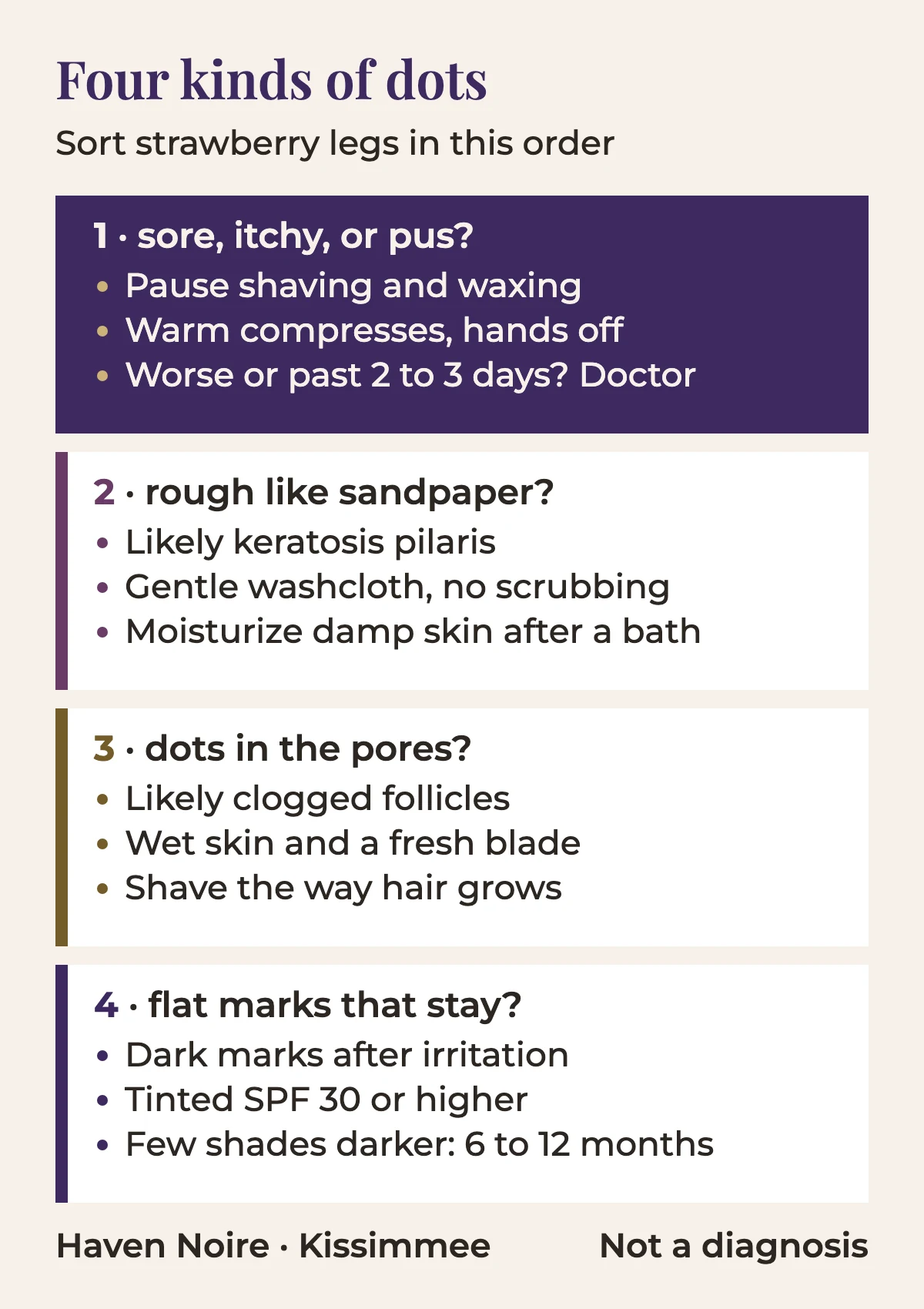
Sore, Itchy, or Pus-Topped Bumps
Check here first. MedlinePlus lists a rash, itching, and pimples or pustules near a hair follicle as common folliculitis symptoms. The AAD calls folliculitis a common skin infection in the hair follicles that usually looks like a sudden acne breakout. Its list of causes includes shaving, plucking, or waxing, tight clothing, and an improperly maintained hot tub.
Two clues point here: the bumps appeared soon after hair removal or a hot tub, and they hurt or itch. The same AAD page says most people see hot tub breakouts about 12 to 48 hours later. Pain isn't required: the AAD says you may not feel anything. Pus-topped spots belong here even when they don't hurt. Ingrown hairs belong here too: the NHS describes them as raised, itchy bumps and lists legs among the shaved areas where they're more likely.
Rough Bumps That Feel Like Sandpaper
Raised, dry, rough dots that don't hurt point to keratosis pilaris. The AAD's symptoms page says the bumps can feel like sandpaper and look brownish black on dark skin. For teens and adults, it lists the upper arms, front of the thighs, and buttocks, and says some people have so many bumps that they reach the lower legs. Sore or pus-topped bumps on your buttocks instead? Our guide to pimples on the buttocks traces the trigger.
The NHS calls keratosis pilaris a very common, harmless condition with small, painless bumps. It isn't infectious, and it may be better in summer and worse in winter.
Dark Dots Sitting in the Pores
Dark dots sitting right in the follicle openings, with no pain, itch, pus, or sandpaper feel, fit the classic clogged-follicle picture. If your dots sit only here, your plan starts with your razor.
Flat Dark Marks That Stay After the Bumps Go
Sometimes the bump is gone and a flat brown or dark spot is still there. That's usually a mark left by injury or inflammation, not a clog. The AAD's guide to dark spots in darker skin tones says spots often appear as a cut, burn, or other injury heals, or when a product irritates your skin. A razor nick is a cut. A broad dark patch where your thighs rub is a different problem, covered in our guide to dark inner thighs.
Skin tone matters here. The same AAD page says dark spots and patches rank among the most common reasons people with darker skin tones see a dermatologist, and that many everyday things can trigger extra melanin in darker skin.
| Type | What you notice | Likely behind it | First move |
|---|---|---|---|
| Sore bumps | Sore, itchy, or pus-topped bumps after hair removal or a hot tub | Folliculitis or an ingrown hair | Pause hair removal; a doctor if it lasts or worsens |
| Rough bumps | Rough, dry bumps, mostly on the thighs | Keratosis pilaris | Moisturizer; no scrubbing |
| Dark pores | Dark dots in the pores; no pain or itch | Clogged follicles | Better shaving, gentle exfoliation |
| Flat marks | Flat dark spots that stay after healing | Post-inflammatory hyperpigmentation | Tinted sunscreen and time |
How to Get Rid of Strawberry Legs, Type by Type
Many legs have more than one type, so start with the most urgent and work down.
Sore bumps: calm them first
- Stop the trigger. The AAD says that when shaving, plucking, or waxing causes folliculitis, you'll want to stop doing these things for 30 days.
- Use warm compresses, at least 3 to 4 times a day for 15 to 20 minutes, as the AAD suggests.
- Keep the area clean and reduce friction from clothing. Both are on MedlinePlus's prevention list.
- Hands off. The NHS warns that picking or squeezing ingrown hairs can damage skin and lead to infection.
- Save scrubs and acids for calm skin. That's our advice, not a medical rule.
If the bumps come back often, get worse, or last longer than 2 or 3 days, MedlinePlus says to contact your provider. Painful, hot, or spreading bumps: see the doctor list below.
Rough bumps: maintenance, not a cure
The AAD's self-care plan for keratosis pilaris starts from an honest line: you can't cure it, so you follow a maintenance plan.
- Exfoliate gently with a loofah, buff puff, or rough washcloth, and avoid scrubbing, which tends to worsen it. A dry brush isn't on that list; see what dry brushing can and can't do.
- Use a keratolytic, a chemical exfoliant such as lactic, salicylic, or glycolic acid, or urea, exactly as directed. If your skin gets too dry or irritated, stop it for a few days. Our guide to lactic acid explains when a lactic lotion is enough.
- Moisturize damp skin within 5 minutes of bathing. Keratosis pilaris often flares when skin gets dry.
- Keep showers and baths to 20 minutes or less, in warm rather than hot water.
- Skip self-tanner, which tends to make the bumps more obvious.
Hair removal is the catch: the AAD says shaving or waxing skin with keratosis pilaris can cause more bumps. It adds that laser hair removal can avoid a flare-up; ask a dermatologist, since laser isn't on our menu. Bumps where you'd wax? Tell us before you book.
Dark pores: shave smarter, exfoliate gently
Razor habits come first. The AAD's shaving tips, in order:
- Wet your skin and hair to soften it. Right after a shower is a good time.
- Apply a shaving cream or gel.
- Shave in the direction your hair grows, rinsing after each swipe.
- Change the blade, or toss a disposable razor, after 5 to 7 shaves.
- Store your razor somewhere dry, not in the shower.
Then exfoliate gently. The AAD's guide to exfoliating at home says to apply a scrub or chemical exfoliant gently for about 30 seconds, rinse with lukewarm water, and moisturize right after. The more aggressive the exfoliation, it adds, the less often you need it, and you should never exfoliate open cuts or sunburned skin, so skip any fresh nick. Our guide to how often you should exfoliate helps you set a schedule.
MedlinePlus says blackheads can be treated with creams containing salicylic acid or tretinoin, a prescription medicine; if you use tretinoin, read the waxing section first. Our blackheads guide goes deeper on clogs.
Flat marks: protect them and give them time
A dark mark won't scrub away. The AAD says a spot a few shades darker than your natural skin color usually fades within 6 to 12 months; deeper color can take years. Three habits help:
- Stop re-injuring the skin. The AAD says the mark will fade in time if you don't re-injure it.
- Wear tinted sunscreen with iron oxide, SPF 30 or higher, on bare legs. That's the AAD's advice for preventing and helping clear dark spots.
- Drop anything that burns or stings. The AAD says to stop using a product that does.
For fading routines, read how to fade hyperpigmentation on melanin-rich skin.
Before you add an acid or retinoid
The AAD's exfoliation guide warns that exfoliating while you use a retinoid, retinol, or benzoyl peroxide may worsen dry skin or even cause breakouts. Pregnant, or using isotretinoin, tretinoin, or another prescription skin medicine? Ask your doctor or dermatologist before adding an exfoliating acid. The same goes for eczema, rosacea, or keloid-prone skin. For home care, ask us about the professional skincare lines we use.
Does Waxing Get Rid of Strawberry Legs?
Sometimes it helps, and sometimes it adds bumps. Waxing pulls hair from the root, so the razor leaves your routine, along with the cuts, nicks, and razor burn the AAD links to shaving.
What it doesn't change: the AAD lists waxing among the causes of folliculitis, and says waxing skin with keratosis pilaris can cause more bumps. The NHS says waxing can also lead to ingrown hairs. And the Cleveland Clinic article says the dots most commonly develop after shaving or waxing. So a leg wax is a trial, not a cure.
When a leg wax is worth trying
In our view, a wax trial makes the most sense for flat marks, when razor nicks and burn keep leaving new marks. It won't fade old marks, and it won't unclog dark pores, since the Cleveland Clinic article says waxing exposes clogged pores too. With sore bumps, wait until skin is calm, and follow the AAD's 30-day pause if hair removal caused the infection. With rough bumps, talk to us first.
Before you book a leg wax
- Check your medications. The AAD's hair removal guide says waxing isn't recommended while you're applying tretinoin or using an antibiotic, or within 6 months of isotretinoin, because these thin your skin and it could tear.
- Know the face rule. The AAD's step-by-step waxing guide advises pausing retinol and prescription retinoids two to five days before waxing your face, and says never to wax sunburned or very sensitive skin.
- Retinol body lotion? That pause is written for the face. Tell us what you use, and ask your doctor or dermatologist what applies to your legs.
- Plan the next two days. Our aftercare asks you to avoid heat, friction, sweat, and direct sun for 24 to 48 hours; our waxing aftercare guide has the full plan.
Every service on our waxing menu in Kissimmee is performed by a licensed esthetician in a private, hygienic setting, and ends with calming post-wax care plus ingrown-prevention guidance. Our leg waxing guide covers hair length, timing, and how long results last; waxing vs shaving and does waxing hurt cover the rest.
Strawberry Skin on Brown and Black Legs
The Cleveland Clinic article says the lighter your skin, the more visible strawberry legs are. On brown and Black legs, strawberry skin deserves a closer read, because three things change:
- Rough bumps can look dark. The NHS says keratosis pilaris bumps can be darker on brown or black skin, so dark dots on rough thighs may be keratosis pilaris, not clogged pores.
- Dark marks form easily. The AAD says many everyday things, from a cut or insect bite to a product that irritates your skin, can trigger extra melanin in darker skin tones.
- Redness hides. The NHS notes that on black or brown skin, the redness of an ingrown hair may be harder to see. Go by feel: tender, itchy, or hot bumps belong with the sore ones.
That's why gentle wins. The AAD's exfoliation guide says to avoid strong chemical or mechanical exfoliation if you have a darker skin tone, because more aggressive exfoliation may lead to increased pigmentation.
Coarse or curly hair adds one more factor: the NHS says it makes ingrown hairs more likely. Our guide to sunscreen for dark skin helps you choose a tinted formula for bare legs, and our page on hyperpigmentation and dark spots explains how we approach marks on the face.
When to See a Dermatologist Instead
We're estheticians, not doctors. Tiffany, our founder, is a Florida-licensed esthetician, and we can't diagnose the bumps behind strawberry legs or treat a skin condition. See a board-certified dermatologist or your doctor when:
- Bumps come back often, get worse, or last longer than 2 or 3 days. That's MedlinePlus's line for folliculitis.
- An ingrown hair or the skin around it is very painful, hot, or swollen, or you have a high temperature or feel very unwell. The NHS says to see a doctor.
- You're not sure it's folliculitis. The AAD says infected follicles can look like acne, and a board-certified dermatologist can tell you which you have.
- You develop razor bumps and can't stop shaving, or keratosis pilaris stays despite home treatment. The AAD says a dermatologist can help with both.
- A dark mark isn't fading with careful care. The AAD says a dermatologist may help when your treatment isn't delivering.
- An itchy, bumpy rash shows up after a hot tub. MedlinePlus says to contact your provider if you develop symptoms of hot tub folliculitis.
- Bumps are spreading to new areas. MedlinePlus notes folliculitis can spread, and says to contact your provider when symptoms get worse. Skip waxing and exfoliants until you've been seen; that part is our advice, not a medical rule.
Not sure which type you have? Contact us before you book. If any sign above fits, see your doctor or dermatologist first.
Frequently Asked Questions About Strawberry Legs
What causes strawberry legs?
Strawberry legs usually come from one of four things: hair follicles clogged with oil and dead skin, keratosis pilaris, follicles irritated or infected by shaving or waxing, or flat dark marks left after irritation heals. They can overlap on the same legs. Sorting them first matters, because the fix for one can make another worse.
How do you get rid of strawberry legs fast?
Not overnight. Stop the irritation: shave wet skin with a fresh blade, with the grain, or pause hair removal if bumps are sore. Exfoliate gently and moisturize. A Cleveland Clinic article says most cases can be managed at home, but the AAD says a mark a few shades darker than your skin usually takes 6 to 12 months to fade.
Does waxing get rid of strawberry legs?
Not reliably. Waxing takes the razor away, so cuts, nicks, and razor burn drop out of the picture. But the American Academy of Dermatology lists waxing as a cause of folliculitis, and says waxing skin with keratosis pilaris can cause more bumps. Treat a leg wax as a trial, and tell us about your bumps when you book.
Are strawberry legs the same as keratosis pilaris?
Sometimes. Keratosis pilaris is one of the main look-alikes: rough bumps made of dead-skin plugs, most often on the upper arms and front of the thighs. Clogged pores show as dark dots in the openings, while keratosis pilaris feels rough, like sandpaper. The AAD says it can't be cured, only maintained with gentle exfoliation and moisturizer.
Why do I get strawberry legs after shaving?
The American Academy of Dermatology says frequent shaving can irritate skin, and that cuts, nicks, razor burns, and ingrown hairs happen. A Cleveland Clinic article adds that removing leg hair exposes the oil in clogged pores to air, where it darkens. Shaving wet skin with a fresh blade, in the direction hair grows, lowers the irritation.
Can strawberry legs cause dark spots on Black or brown skin?
They can leave them behind. The AAD says many everyday things can trigger extra melanin in darker skin, and that dark spots often appear as a cut or other injury heals. A spot a few shades darker than your skin usually fades within 6 to 12 months. Tinted sunscreen with iron oxide, SPF 30 or higher, helps.
Should you exfoliate strawberry legs?
Yes, gently, and only on calm skin. The AAD warns that scrubbing tends to worsen keratosis pilaris, and its exfoliation guide says darker skin tones should avoid strong exfoliation. Skip it on sore bumps, cuts, or sunburn. After a wax, our aftercare says to avoid friction for 24 to 48 hours, then exfoliate gently after a few days.
How much does a leg wax cost in Kissimmee?
At Haven Noire, a Lower Legs Wax or an Upper Legs Wax is $40 and takes about 30 minutes. A Full Legs Wax is $80 and takes about 45 minutes. A 10% deposit is required when you book, and we suggest rebooking every 3 to 4 weeks. Members get 10% off extra services, including leg waxing; see our memberships.
More from the Journal

About the author
Tiffany · Licensed Esthetician · Licensed PMU Artist
Tiffany is a Florida-licensed esthetician and permanent makeup artist and the founder of Haven Noire. She specializes in customized facials, corrective skincare, and waxing for melanin-rich and all skin types, and is known for a calm, education-first approach that puts first-time clients instantly at ease.
Meet Tiffany →