
Dry brushing benefits come down to one job a brush can actually do: sweep dead skin cells off the surface so your skin feels smoother and softer. The bigger promises, like lymphatic drainage, flushing out toxins, better circulation, and less cellulite, weren't measured in any study we found when we searched PubMed in November 2026.
That doesn't make your brush useless. It makes it an exfoliating tool, and the American Academy of Dermatology (AAD) has clear guidance for those, including a warning for brown and Black skin: aggressive exfoliation may lead to dark spots.
Below: what the evidence supports, four checks before you brush, a gentle method, timing around waxing and Florida sun, and who should skip it.
What Is Dry Brushing?
Dry brushing is sweeping a firm-bristled brush over dry skin, usually right before a shower, to lift away dead skin cells. It's a body routine for your arms, legs, and torso, not your face.
It's also a form of mechanical exfoliation. The AAD's guide to exfoliating at home says mechanical exfoliation "uses a tool, such as a brush, pad, or sponge, or a scrub to physically remove dead skin cells." So your brush follows the same rules on pressure and frequency as a body scrub or a loofah.
It's a popular ritual, but the evidence hasn't caught up with the promises made for it.
If smooth legs are your real goal, our guide to how to get smooth skin covers bumps, dryness, and hair in one place.
Dry Brushing Benefits: What the Evidence Supports
Here's every common claim about dry brushing benefits, sorted by what we found in November 2026. Throughout this guide, any number or verdict not quoted from a source is our own advice, not a medical rule.
| Claim | What we found | Our read |
|---|---|---|
| Smoother, softer-feeling skin | The AAD lists brushes among tools that physically remove dead skin cells | Real, at the surface |
| Lymphatic drainage | No study in our PubMed search measured lymph flow after dry brushing | Unproven |
| Flushing out toxins | No study in our search showed brushing removes toxins | Unproven |
| Better circulation | No study in our search measured skin blood flow before and after brushing | Unproven |
| Less cellulite | A Cleveland Clinic article says there's no proof | Not supported |
Smoother Skin: The Benefit With a Clear Mechanism
A brush removes dead surface cells the way any mechanical exfoliant does. A Cleveland Clinic article on dry brushing puts the payoff plainly: removing dead skin cells "can help make your skin smoother and softer."
Here's the catch most guides skip. The AAD says people with dry, sensitive, or acne-prone skin "may prefer just a washcloth and a mild chemical exfoliator, as mechanical exfoliation may be too irritating for this skin type." Dry, flaky skin is exactly who brushing gets sold to.
Lymph, Toxins, and Circulation: What's Missing
Your lymphatic system is real, and it matters. MedlinePlus says it "clears away infection and keeps your body fluids in balance," and that when it isn't working properly, fluid builds in your tissues and causes swelling called lymphedema.
For people with lymphedema, drainage is a clinical therapy. The NHS says manual lymphatic drainage, which stimulates the flow of fluid in the lymphatic system, is usually carried out by a specialist therapist. A brush at home isn't that.
We searched PubMed in November 2026 for "dry brushing," "skin brushing," and "dry skin brushing" and found no study that measured lymph flow, toxin removal, or skin circulation after brushing in people. The Cleveland Clinic article quotes a dermatologist who credits brushing with increasing blood circulation and promoting lymph flow; that's her view, and our search turned up no measurement behind it. So we don't promise any of the three.
Does Dry Brushing Help Cellulite?
Not in any way that's been shown. The same Cleveland Clinic article says there's no proof that dry brushing reduces cellulite or its appearance, and that what people read as cellulite reduction is "really just a temporary plumping up" of the skin. Cellulite has its own guide: read what cellulite is and what changes its look.
Four Checks Before You Dry Brush
If brushing is an exfoliation, the useful question isn't what it flushes out. It's whether your skin can take the friction this week.
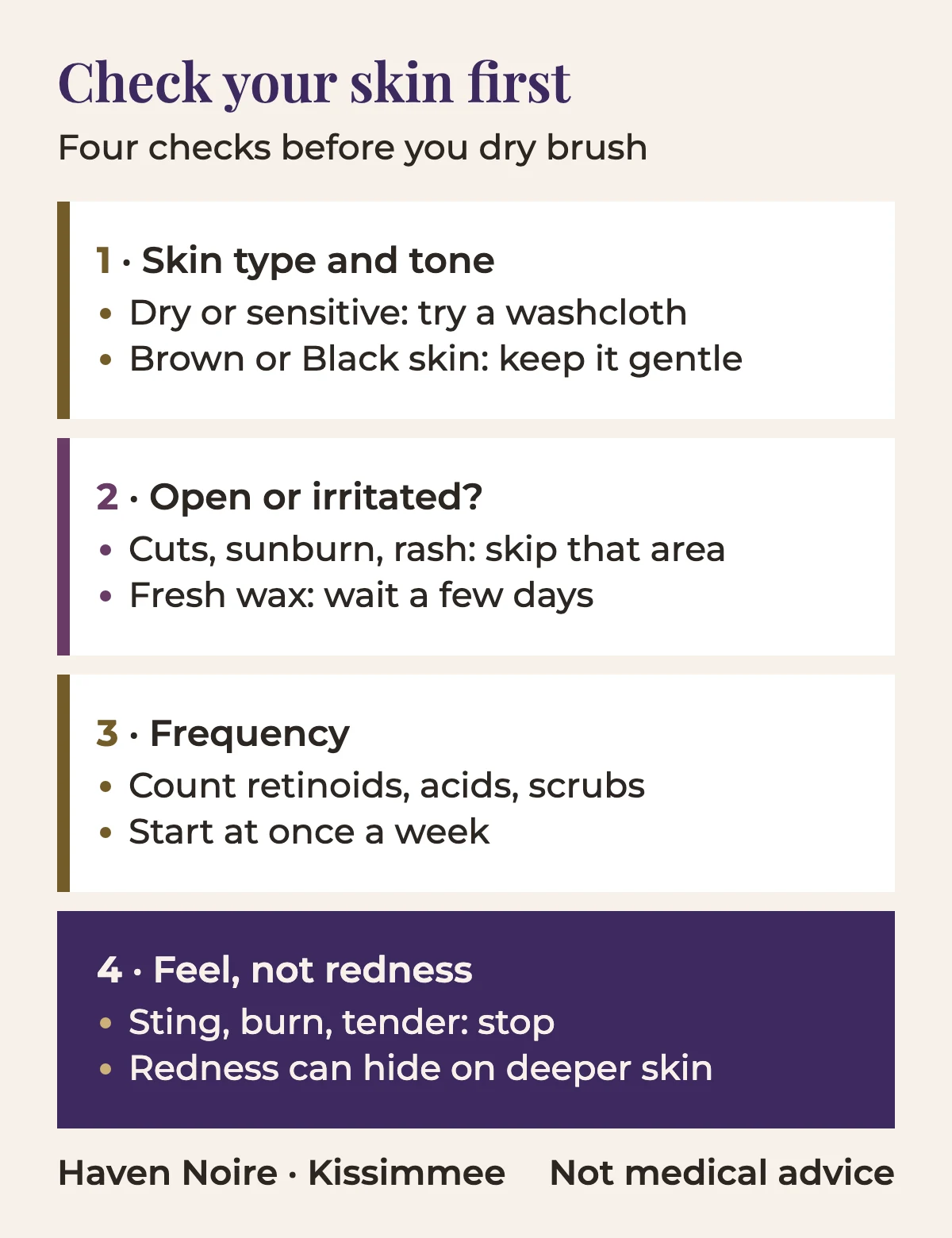
These four checks answer that question. They're built on AAD and NHS guidance and the aftercare Haven Noire publishes for waxing and body treatments. They're a tool for home, not a diagnosis, and they don't replace your dermatologist.
Skin Type and Tone
Start with whose skin it is. The AAD says to avoid strong mechanical exfoliation if you have a darker skin tone, or if you get dark spots after burns, bug bites, or breakouts. Dry, sensitive, or acne-prone? Mechanical exfoliation may be too irritating. Either way, go softer, or use a washcloth.
Open or Irritated Skin
Go around it, or skip the session, if you find:
- Cuts, wounds, or sunburn. The AAD says never to exfoliate them.
- Moles, warts, or raised bumps. The Cleveland Clinic article says never to brush over them.
- A rash, sore bumps, or anything that looks infected. Bumps after shaving? Our guide to strawberry legs helps you sort them.
- Chafed or raw skin, like inner thighs after a hot day. Our thigh chafing guide covers soothing it first.
- Skin you waxed in the last few days. See the timing section below.
Frequency, Counted Honestly
Your brush probably isn't your only exfoliant. Retinoids, retinol, and benzoyl peroxide count too: the AAD says exfoliating while you use them may worsen dry skin or even cause breakouts. Add scrubs, acid lotions, and loofahs, then count everything that exfoliates you in a week before you add the brush.
Judge by Feel, Not Just Redness
The Cleveland Clinic article says to stop right away if you notice redness, swelling, or inflammation. That's sound, but redness isn't always easy to see. In its page on the skin infection cellulitis, the NHS notes that redness "may be less obvious on brown or black skin."
So check by feel, too. Our advice: stinging, burning, tenderness, or itch that lingers after you rinse means too much pressure or too many sessions, so stop. A new dark patch in the weeks after is your sign to stop brushing that area.
How to Dry Brush Gently, Step by Step
Passed all four checks? Steps 3, 7, and 8 follow the AAD; the rest draw on the Cleveland Clinic article, plus our own judgment where noted.
- Brush dry skin, before you shower, so you can rinse and moisturize right after.
- Start soft. The Cleveland Clinic article suggests a natural, stiff-bristled brush. For dry, sensitive, brown, or Black skin, our advice is softer bristles, or the plain, dry washcloth that article offers for sensitive skin.
- Use short, light strokes, as the AAD advises for any brush or sponge.
- Work from your feet and ankles upward, and lighten the pressure on sensitive areas like the abdomen, breasts, and neck.
- Go around cuts, moles, warts, raised bumps, and irritated patches.
- Don't linger on one spot. The Cleveland Clinic article warns that going over one area for too long can cause irritation or bleeding.
- Rinse in a short, warm shower. The AAD's dry skin tips suggest five to ten minutes in warm water.
- Moisturize while your skin is still damp. The AAD says ointments and creams add more moisture than lotions.
How Often Should You Dry Brush?
Sources disagree. The Cleveland Clinic article suggests once a day. The AAD names no number: it says the more aggressive the exfoliation, the less often it needs to be done. Our suggestion: start at once a week and add a session only if your skin stays calm by feel. On brown, Black, or dry skin, once a week may be your ceiling.
Does Direction Matter?
Many guides say to brush toward your heart. We searched PubMed in November 2026 and found no study that compared brushing directions. Upward strokes are a fine habit, but in our view, pressure matters more than direction.
Keeping Your Brush Clean
None of the sources we read sets a cleaning schedule. Our tip: wash it with mild soap every week or two, let it dry fully, don't share it, and replace it when the bristles splay.
Not sure what to moisturize with? Ask us about the professional skincare lines we work with. Building a longer shower ritual? See our everything shower guide.
Dry Brushing on Brown and Black Skin
This is where most advice falls short. The AAD's exfoliation guide says that for some people, "especially those with darker skin tones, more aggressive forms of exfoliation" may lead to increased pigmentation, or dark spots.
The AAD's guide to dark spots in darker skin tones says many everyday things can trigger extra melanin in darker skin, and that a spot a few shades darker than your skin usually fades within 6 to 12 months. Color that sits deep in the skin can take years. None of the dry brushing benefits are worth that trade.
Three habits that help:
- Choose the soft end of every option: softer bristles, lighter pressure, fewer passes, or a washcloth.
- Judge by feel, not color. Stop at any sting, burn, or tenderness, even if nothing looks red.
- Protect bare arms and legs. For dark spots, the AAD's advice starts with sunscreen: a tinted one with iron oxide, SPF 30 or higher. Our guide to sunscreen for dark skin helps you choose one.
Keloids raise the stakes. The AAD says anything that causes skin to scar can cause a keloid, a cut, scrape, or bug bite included, and that keloids are more common in Black and Latin Americans than in people with lighter skin tones. If you've ever formed one, ask a dermatologist before you brush.
Already have marks? Start with how to fade hyperpigmentation on melanin-rich skin.
Dry Brushing Around Waxing, Shaving, and Florida Sun
None of the five top-ranking dry brushing guides we read in November 2026 addressed hair removal. Here's how brushing fits around it.
After a Wax
Our waxing aftercare says to avoid heat, friction, sweat, and direct sun for 24 to 48 hours, then exfoliate gently after a few days. A brush is friction and exfoliation at once, so in our view it waits those few days, then returns gently. Our waxing aftercare guide covers the first 48 hours.
Our aftercare sets no rule for the days before a wax. Our advice: skip brushing the area on appointment day, and tell us what you use. On our waxing menu, a Lower Legs or Upper Legs Wax is $40 (30 minutes) and a Full Legs Wax is $80 (45 minutes).
After Shaving
The AAD's guide to removing unwanted hair says cuts, nicks, and razor burns happen when you shave, and the AAD says never to exfoliate open cuts. Our advice, in step with our smooth skin and everything shower guides: brush and shave the same skin on different days, and skip any nicked or burning patch until it heals.
After a Day in the Sun
Sunburn is a hard stop: the AAD says never to exfoliate sunburned skin. On brown and Black skin a burn may not look red, and our guide to whether Black people can get sunburn explains how to spot one by feel. After a long day outdoors, our advice is to give your skin the evening off.

Who Should Skip Dry Brushing
For some readers, the risks outweigh the dry brushing benefits. Skip it, or get your doctor's or dermatologist's okay first, if any of these apply:
- You're pregnant, or you take isotretinoin, tretinoin, or another prescription skin medicine. The AAD's isotretinoin guide says to avoid abrasive scrubs or cleansers, such as ones with an exfoliant.
- You have eczema. Our advice: keep the brush off any patch, and ask your dermatologist first.
- You have psoriasis. The AAD's bathing tips for psoriasis say to skip loofahs, buff puffs, and washcloths, which can irritate skin and cause a flare.
- You have keratosis pilaris. A brush isn't on the list in the AAD's self-care advice: it suggests a loofah, buff puff, or rough washcloth, and says scrubbing tends to irritate skin and worsen the bumps. Our textured skin guide covers them.
- You've formed a keloid before.
- You have lymphedema, or you've had treatment to your lymph nodes. With lymphedema, the NHS says good skin care reduces the risk of an infection such as cellulitis. Ask your care team before using any brush.
- You have diabetes, or reduced feeling in your feet or legs. Ask your doctor first; that's our own advice, not a rule from a source.
When to See a Dermatologist or Doctor
Haven Noire is an esthetics spa, not a medical office. Tiffany, our founder, is a Florida-licensed esthetician, and we can't diagnose what's happening on your skin. Get medical advice when:
- An area you brushed becomes painful, hot, and swollen. The NHS lists those cellulitis signs as a reason for urgent advice; a very high temperature, or feeling hot, cold, or shivery, makes it an emergency.
- Irritation, itch, or bumps don't settle after you stop. The AAD notes a dermatologist can help you decide if exfoliation is beneficial for you.
- A dark mark keeps spreading, or isn't fading after several months.
- A mole, wart, or raised spot is new or changing.
- An arm or leg stays swollen.
Where Haven Noire Fits: Body Treatments in Kissimmee
Dry brushing isn't on our menu, and a brush and a body treatment aren't the same job. If you want a professional exfoliation step for your back and the backs of your legs, our body treatments are the closest fit.
Firming Back + Booty ($135, 60 minutes) is a triple-targeted treatment for the back, back of legs, and booty, with an enzyme polish and a peptide-rich firming mask. Like every body treatment, it starts with a consultation.
Afterward, our body treatment aftercare asks you to avoid heat, friction, and sun for 24 to 48 hours, exfoliate gently after a few days, and keep your skin moisturized. Your brush takes those days off, too.
Members get 10% off extra services, a body treatment included; see our memberships. Dry, gray-looking skin on your arms and legs? Our guide to ashy skin covers the moisturizing side.
Frequently Asked Questions About Dry Brushing
Is it OK to dry brush every day?
Sources disagree. A Cleveland Clinic article suggests once a day, while the American Academy of Dermatology says the more aggressive the exfoliation, the less often it needs to be done, and to avoid strong mechanical exfoliation on darker skin tones. Our suggestion: start once a week and add sessions only if your skin stays calm.
Should you dry brush before or after a shower?
Before, on dry skin. Then rinse in a short, warm shower and moisturize while your skin is still damp. The AAD says to apply moisturizer immediately after exfoliating, and its dry skin tips suggest five to ten minutes in warm water. It also says ointments and creams add more moisture than lotions.
Can you dry brush your face?
We don't recommend it. A Cleveland Clinic article advises against using a dry brush on your face, since facial skin is more sensitive than skin on the rest of your body. For face exfoliation, our Signature Facial ($95, 60 minutes) includes exfoliation and extractions as needed, chosen after a skin analysis.
Is dry brushing safe for Black skin?
It can be, if it stays gentle. The American Academy of Dermatology says to avoid strong mechanical exfoliation if you have a darker skin tone, because aggressive exfoliation may lead to dark spots. Use soft bristles and light pressure, judge by feel rather than redness, stop at any sting or burn, and wear sunscreen on bare skin.
Can I dry brush after waxing or shaving?
Not right away. Our waxing aftercare says to avoid heat, friction, sweat, and direct sun for 24 to 48 hours, then exfoliate gently after a few days. After shaving, wait until any nick or razor burn heals, since the AAD says never to exfoliate open cuts. Our advice: brush and shave on different days, about once a week.
Does dry brushing help keratosis pilaris?
Gently, maybe; hard, no. A brush isn't on the AAD's keratosis pilaris list: it suggests sloughing dead cells with a loofah, buff puff, or rough washcloth, and warns that scrubbing tends to irritate skin and worsen the bumps. It also says to moisturize damp skin within five minutes of bathing. If bumps stay despite home care, a dermatologist can help.
Does dry brushing remove toxins from your body?
We searched PubMed in November 2026 and found no study showing that brushing skin removes toxins, so we don't describe it that way. MedlinePlus says your lymphatic system clears away infection and keeps body fluids in balance. If you have swelling that won't go down, see a doctor rather than reaching for a brush.
More from the Journal

About the author
Tiffany · Licensed Esthetician · Licensed PMU Artist
Tiffany is a Florida-licensed esthetician and permanent makeup artist and the founder of Haven Noire. She specializes in customized facials, corrective skincare, and waxing for melanin-rich and all skin types, and is known for a calm, education-first approach that puts first-time clients instantly at ease.
Meet Tiffany →