

How to get smooth skin on your body comes down to three habits: moisturizing damp skin every day, exfoliating gently and not too often, and removing hair in a way that doesn't leave bumps. Add sunscreen on bare skin outdoors, then give the routine time.
Here's what many top guides miss. A daily scrub is the habit we'd drop first. The American Academy of Dermatology (AAD) says that, generally, the more aggressive the exfoliation, the less often it needs to be done. It also says scrubbing tends to worsen keratosis pilaris, and that aggressive exfoliation may lead to dark spots for some people, especially those with darker skin tones.
So this guide treats it as a routine, not a scrub: three jobs on three schedules, plus one rule for spacing them, written for your arms, legs, and body. For bumps on your face, start with our guide to textured skin.
What Makes Body Skin Rough? Flakes, Bumps, and Stubble
Rough body skin is usually one of three things you can feel: dry, flaky skin; small bumps around hair follicles; or hair growing back. Smooth skin takes a different fix for each, and a scrub suits only some.
Dryness is the most common. MedlinePlus says dry skin happens when your skin loses too much water and oil, and that the problem is usually worse on the arms and legs. Its causes include dry indoor air from heating or cooling systems, which in Central Florida means months of air conditioning, and bathing too often or too long.
Bumps come next. The AAD describes keratosis pilaris as tiny, rough-feeling bumps, most often on the upper arms and thighs. Dark dots in the pores of your legs have several possible causes, sorted in our guide to strawberry legs. Regrowth is the third kind of rough, and the hair removal section below covers it.
| What you feel | Likely behind it | Start with | Skip for now |
|---|---|---|---|
| Tight, flaky, or ashy skin, worst on arms and legs | Dryness | Daily moisture on damp skin | Long, hot showers |
| Tiny sandpaper bumps on the upper arms or thighs | Possibly keratosis pilaris | Moisturizer plus a gentle washcloth | Scrubbing |
| Prickly regrowth a few days after shaving | Stubble | A steadier hair removal plan | A scrub on a fresh shave |
| Sore, itchy, or pus-topped bumps | Possibly irritated follicles | A pause, and a provider if they last | Scrubs, wax, and razors |
If your skin looks gray or dull more than it feels rough, our guide to ashy skin goes deeper on when to moisturize and what to seal it with.
How to Get Smooth Skin: Three Jobs on Three Schedules
This plan is built on the AAD's guidance on dry skin, exfoliation, and keratosis pilaris, plus the waxing aftercare Haven Noire publishes. The schedules are our suggestions, not medical rules, and they don't replace a dermatologist.
The idea: gentle things done on a steady schedule beat hard things done all at once. Each job gets its own timing, and one rule keeps them from colliding.
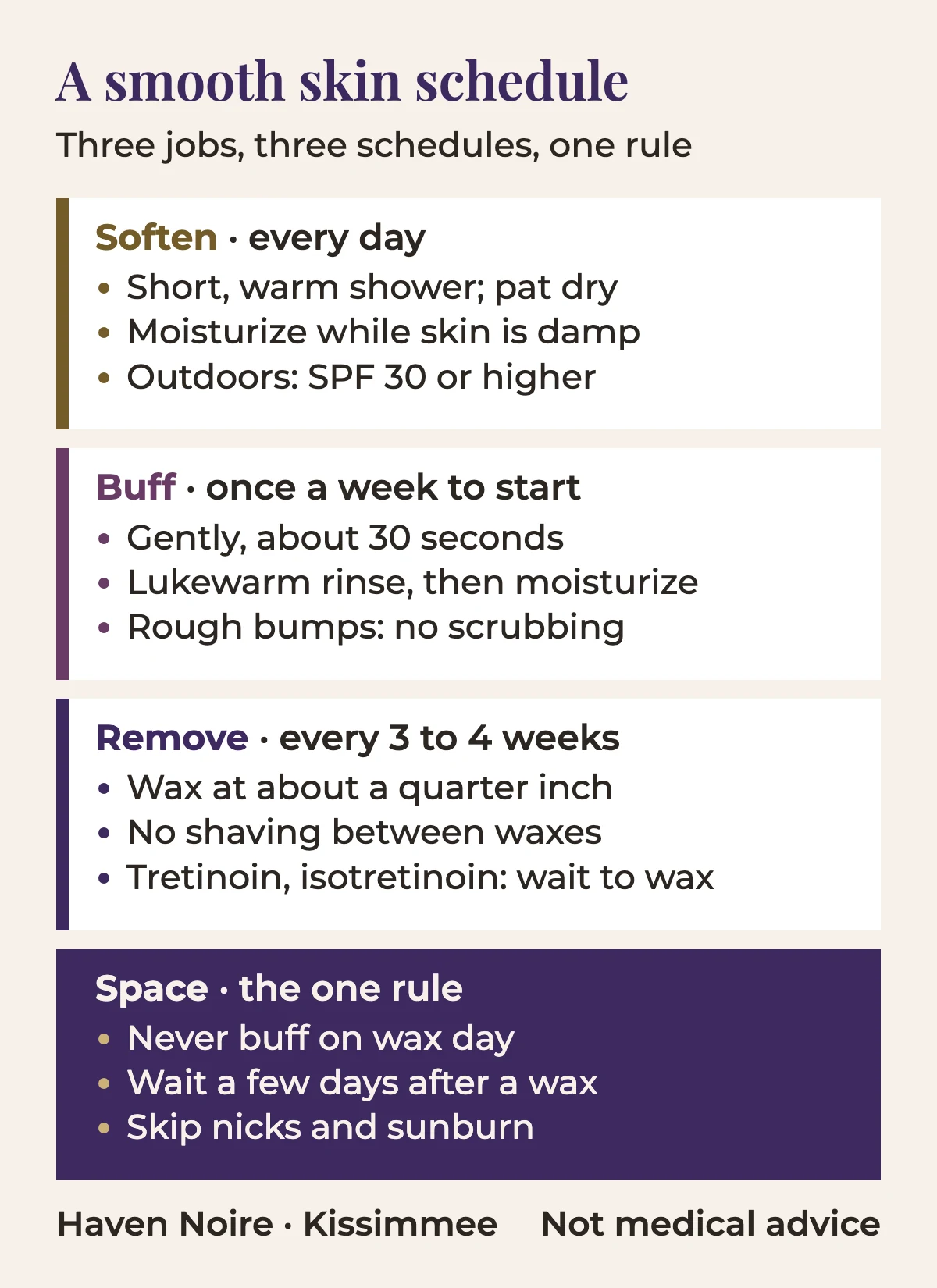
Every day: soften
Moisture is the job people skip, and it does the most for rough arms and legs. The AAD's tips for relieving dry skin include these five habits:
- Keep showers and baths to five to ten minutes, in warm water.
- Use a gentle cleanser only where you need it, such as your armpits and groin.
- Pat your skin dry with a clean towel instead of rubbing.
- Moisturize while your skin is still damp. The AAD says ointments and creams add more moisture than lotions.
- Wear loose cotton. The AAD says tight clothes, such as leggings and body-hugging jeans, rub against skin and can worsen dryness.
The same AAD page lists sunscreen among its tips, too: broad-spectrum, water-resistant, SPF 30 or higher. If your inner thighs rub and sting on hot days, our guide to thigh chafing covers how to prevent and soothe it. If you like doing every step in one long session, our guide to the everything shower covers that trend.
Once a week to start: buff
Exfoliating removes dead skin cells from the surface, either with a tool or scrub (mechanical) or with acids that dissolve them (chemical). Our suggestion for body skin: start with one gentle session a week, hold that pace for a few weeks, and add a day only if your skin stays calm.
Rough bumps show why gentle matters more than often. The AAD's keratosis pilaris plan pairs gentle exfoliation, with a loofah, buff puff, or rough washcloth, with a chemical exfoliant and a moisturizer, and names urea and lactic acid among the ingredients to look for. It suggests the plan every day until skin clears, then a few times a week, so for keratosis pilaris, follow the AAD's pace rather than our weekly start. What it rules out is force: scrubbing, it says, tends to irritate the skin and worsen the bumps.
Every 3 to 4 weeks: remove
A wax removes hair at the root. Our waxing menu suggests rebooking every 3 to 4 weeks, with about a quarter inch of growth, roughly two to three weeks, each time. If you shave instead, the AAD's dry skin guide says to shave at the end of your shower or bath, when the water has softened your skin and hair.
The spacing rule: one friction job at a time
This is where many routines go wrong: a scrub, a fresh shave, and a hot shower on the same night. Our rule of thumb: never stack exfoliating on top of hair removal:
- After a wax, wait. Our aftercare says to avoid heat, friction, sweat, and direct sun for 24 to 48 hours, then exfoliate gently after a few days. Our waxing aftercare guide covers the first two days.
- Before a wax, go gentle and early. Our first Brazilian wax prep guide suggests a gentle exfoliation the day before, not the day of.
- After a shave, skip the scrub that day. The AAD says never to exfoliate open cuts or sunburned skin, and nicks happen.
- Sunburned? Skip both. The AAD says never to wax sunburned skin, and never to exfoliate it.
How to Exfoliate Your Body Without Making It Rougher
Here's how to exfoliate your body safely, following the AAD's guide to exfoliating at home:
- Check what you already use. The AAD says retinoid creams and retinol may make skin more sensitive or peel, and that exfoliating on top may worsen dry skin.
- Match the method to your skin. For dry or sensitive skin, the AAD suggests a washcloth and a mild chemical exfoliator, since mechanical exfoliation may be too irritating.
- Apply a scrub or chemical exfoliator gently, in small circles, for about 30 seconds. With a brush or sponge, use short, light strokes.
- Rinse with lukewarm water, not hot.
- Moisturize right away, because exfoliating can dry your skin.
- Skip any area with open cuts, wounds, or sunburn.
Body scrub, washcloth, or acid lotion: which to use
A body scrub is mechanical exfoliation: grains in a cream or gel buff off dead cells. For oily, thicker skin it can work, since the AAD says that skin may want mechanical exfoliation. For dry skin, rough bumps, or a darker skin tone, its guidance points to gentler choices.
| Option | What it is | Best match | Watch for |
|---|---|---|---|
| Body scrub | Grains that physically buff off dead cells | Oily, thicker skin | Hard scrubbing, rough bumps, darker skin tones |
| Washcloth or exfoliating mitt | Gentle mechanical exfoliation | Dry or sensitive skin, and keratosis pilaris | Rubbing too hard |
| Cream with lactic acid or urea | A chemical exfoliant inside a moisturizer | Dry, rough skin and keratosis pilaris | Stinging, and sun on bare skin |
The NHS page on keratosis pilaris agrees: it suggests gently scrubbing with a washcloth or exfoliating mitt, and warns that harsh scrubs can make the bumps worse. For the moisturizing end of that range, see our guide to lactic acid for skin. Curious about brushing dry skin instead? Our dry brushing guide covers what it does and doesn't do.
Acid lotions, bare legs, and Florida sun
Acid lotions carry one more rule in Central Florida. The FDA says alpha hydroxy acids, the family that includes glycolic and lactic acid, may increase your skin's sensitivity to the sun. The label warning it recommends tells you to use sunscreen, wear protective clothing, and limit sun exposure while you use the product and for a week afterward. On legs you show off most of the year, that matters.
For a schedule that won't overdo it, our guide to how often you should exfoliate helps you count every exfoliant in your week.
Smooth Legs: Hair Removal Without the Bumps
For many readers, smooth skin means smooth legs, and hair is the part that comes back fastest.
Shaving has trade-offs. The AAD's guide to removing unwanted hair lists them: frequent shaving can irritate your skin, cuts, nicks, and razor burns happen, and some people develop ingrown hairs.
Waxing takes the razor out of the routine. Our menu describes a Full Legs Wax as smoothness that lasts for weeks. Our waxing FAQ asks for two habits: come in with about a quarter inch of growth, and avoid shaving between waxes, since it disrupts the cycle and can cause ingrown hairs.
Three checks before you wax your legs
- Your prescriptions. The AAD's hair removal guide says waxing isn't recommended while you're applying tretinoin or using an antibiotic, or within six months of isotretinoin, because these medications thin your skin and it could tear.
- Your retinol. The AAD's step-by-step waxing guide advises pausing retinol and prescription retinoids two to five days before waxing your face. Using a retinol body lotion? Tell us, and ask your dermatologist what applies to your legs.
- Your bumps and burns. The AAD says never to wax sunburned or very sensitive skin, and its keratosis pilaris plan warns that shaving or waxing that skin can cause more bumps. Rough bumps on your thighs? Tell us before you book an upper leg wax.
Weighing the switch? Our guide to waxing vs shaving covers regrowth and razor bumps, and our leg waxing guide covers full vs half legs and how to time a wax before a beach day.
How to Get Smooth Skin on Melanin-Rich Skin: Gentle Wins
If your skin is brown or Black, the routine matters more, because rough handling may trade bumps for dark marks. The AAD's exfoliation guide says to avoid strong chemical or mechanical exfoliation if you have a darker skin tone or notice dark spots after burns, bug bites, or acne breakouts. For some people, especially those with darker skin tones, it says more aggressive exfoliation may lead to dark spots. Three things to keep in mind:
- Bumps can pass for dots. The NHS says keratosis pilaris bumps can look darker on brown or black skin, so rough, dark specks on your thighs may need softening, not scrubbing.
- Gentle beats gritty. In our view, a soft washcloth and a cream with lactic acid or urea fit the AAD's advice better than a coarse scrub.
- Sunscreen protects what you smooth. Our guide to sunscreen for dark skin helps you read a label and choose a tint that avoids a white cast.
Already have marks from old bumps or razor nicks? Start with how to fade hyperpigmentation on melanin-rich skin.
Leg Waxing and Body Treatments in Kissimmee
Haven Noire is an esthetics spa, not a medical office. For smooth skin, we can take hair removal off your plate and polish the places that are hard to reach, but we can't treat a skin condition.
| Service | Time | Price |
|---|---|---|
| Lower Legs Wax | 30 minutes | $40 |
| Upper Legs Wax | 30 minutes | $40 |
| Full Legs Wax | 45 minutes | $80 |
| Underarm Wax | 15 minutes | $15 |
| Firming Back + Booty | 60 minutes | $135 |
Every service on our waxing menu in Kissimmee is performed by a licensed esthetician in a private, hygienic setting, and ends with calming post-wax care plus ingrown-prevention guidance.
Firming Back + Booty: what the menu lists
Of our body treatments, Firming Back + Booty covers the back, the backs of the legs, and the booty with an enzyme polish and a peptide-rich firming mask, in 60 minutes for $135. Our menu lists exfoliating among its benefits and says it suits all skin types. Afterward, our body treatment aftercare asks you to avoid heat, friction, and sun for 24 to 48 hours, then exfoliate gently after a few days.
Memberships
Our Smooth Membership is $59.99 a month for unlimited Brazilian waxes, with a three-month minimum. Other waxing services, legs included, are 10% off for members, and every membership includes 10% off extra services and in-spa products. See our monthly memberships.
When to See a Dermatologist Instead
We're estheticians, not doctors. Tiffany, our founder, is a Florida-licensed esthetician, and rough skin sometimes points to something a moisturizer can't fix. See a board-certified dermatologist or your doctor when:
- Dry skin hangs on. The AAD says to see a board-certified dermatologist if you still have dry skin after trying its tips. MedlinePlus lists eczema, psoriasis, diabetes, and an underactive thyroid among the causes of dry skin.
- Rough bumps stay. The AAD says keratosis pilaris can be stubborn, and that a dermatologist can help if it remains despite home treatment.
- Itchy bumps or pus-filled pimples near hair follicles come back often, get worse, or last longer than 2 or 3 days. Those are the signs MedlinePlus gives for contacting your provider about folliculitis, an inflamed hair follicle.
- Redness or swelling after a wax lasts more than two days. That's the AAD's line for seeing a dermatologist.
- You're not sure exfoliation suits your skin. The AAD says a dermatologist can evaluate your skin and help you decide.
Pregnant, or using isotretinoin, tretinoin, or another prescription skin medicine? Ask your doctor or dermatologist before you add an exfoliating acid or book a wax. The same goes if you have eczema, rosacea, or skin that forms keloids. Not sure where you fit? Contact us before you book.
Frequently Asked Questions About Smooth Skin
How can I get smooth skin fast?
Start with moisture, not a harder scrub. Keep showers short and warm, pat dry, and apply a cream or ointment while your skin is still damp, as the American Academy of Dermatology advises. Add one gentle exfoliation a week and remove hair on a schedule. Rough bumps and dark marks take longer, so give the routine time.
How do you exfoliate your body properly?
Apply a scrub or chemical exfoliator gently, in small circles, for about 30 seconds, then rinse with lukewarm water and moisturize right away. That's the AAD's method. Skip cuts, sunburn, and freshly waxed skin, and if you're dry, sensitive, or have rough bumps, use a washcloth instead of a gritty scrub.
Is a body scrub good for your skin?
It can be, for the right skin. The AAD says oily, thicker skin may want mechanical exfoliation, which includes scrubs. But it also says scrubbing tends to worsen keratosis pilaris, and that darker skin tones should avoid strong exfoliation. Use a light hand, keep it brief, and moisturize afterward.
How often should I exfoliate my legs?
The AAD gives no set number. It says that, generally, the more aggressive the method, the less often you need it. Our suggestion: start with one gentle session a week. After a wax, wait a few days, as our aftercare suggests, and never exfoliate over a fresh nick or sunburn.
Why are my legs still rough after I shave?
A few reasons. The skin may be dry, which MedlinePlus says is usually worse on the arms and legs. Small rough bumps may be keratosis pilaris. Stubble returns quickly, and the AAD says frequent shaving can irritate skin. Shaving at the end of your shower and moisturizing right after both help.
Does waxing make your legs smoother than shaving?
Wax pulls hair from the root, and the AAD says results can last a few weeks or longer, while shaving may need repeating daily or every few days. Wax isn't for every leg: the AAD says waxing skin with keratosis pilaris can cause more bumps, and some prescriptions rule it out. Tell us about both when you book.
How do I exfoliate dark skin without getting dark spots?
Go gentle. The American Academy of Dermatology says to avoid strong chemical or mechanical exfoliation on darker skin tones, and that for some people, more aggressive exfoliation may lead to dark spots. Choose a washcloth or a cream with lactic acid or urea over a coarse scrub, moisturize daily, and wear sunscreen on bare skin.
More from the Journal

About the author
Tiffany · Licensed Esthetician · Licensed PMU Artist
Tiffany is a Florida-licensed esthetician and permanent makeup artist and the founder of Haven Noire. She specializes in customized facials, corrective skincare, and waxing for melanin-rich and all skin types, and is known for a calm, education-first approach that puts first-time clients instantly at ease.
Meet Tiffany →