

Ashy skin is dry skin you can see: a gray, whitish, or dull cast, usually worst on your arms and legs. On brown and Black skin, dry flakes on the surface stand out against your natural tone, so dryness shows more and reads as ash.
Everyone knows the fix is lotion. What most guides skip is why the ash is back by lunchtime. It comes down to when you moisturize, what you seal it with, what keeps stripping your skin, and sometimes, the fact that it was never ash at all.
What Is Ashy Skin?
Ashy skin is dry skin that looks gray, whitish, or dull. It isn't a diagnosis. It's xerosis, the medical name for dry skin, made visible: the outer layer dries, flakes, and roughens, and on deeper skin those flakes show as a pale cast.
MedlinePlus, from the U.S. National Library of Medicine, says dry skin occurs when your skin loses too much water and oil, and that the problem is usually worse on the arms and legs. The American Academy of Dermatology (AAD) explains the texture on its dry skin symptoms page: when skin loses enough moisture, it starts to flake off, and that causes the rough feel.
Why ash shows more on brown and Black skin
The AAD's guide to dry skin in darker skin tones says flaking, discoloration, and rough texture are more noticeable on darker skin than on lighter skin. Dermatologist Chesahna Kindred, quoted on that page, describes the whitish or grayish-white look dry skin takes on melanin-rich skin.
So ash isn't a different kind of skin. It's contrast. A 2026 supplement article in the Journal of Drugs in Dermatology, written about ammonium lactate (a lactic acid treatment), calls visible ashiness a distinct clinical feature associated with dry skin in skin of color. Lighter skin dries out too, with less background to stand out against.
A word with a history
For many of us, "ashy" was never only a skin word. In a 2021 Vogue essay on the cultural significance of ashiness, writer Andrea Plaid describes how the word grew beyond dry skin to signal a lack of self-upkeep and of care from your community, and the familiar ritual of one Black woman asking another for lotion.
We'd add one thing. Ash says nothing about how much you care. It says your skin lost water faster than it was sealed in, and that's fixable. For the full routine, see skin care for Black skin. If your face feels tight but still shines, our dry vs. dehydrated skin guide sorts the two.
Why Ashy Skin Keeps Coming Back
If the gray returns a few hours after lotion, something is pulling water out faster than your routine puts it back. MedlinePlus lists the usual causes of dry skin:
- Dry indoor air from heating or cooling systems.
- Bathing too often or too long.
- Some soaps and detergents.
- Skin conditions, some diseases, certain medicines, and aging.
Central Florida stacks these into one day: a humid parking lot, an air-conditioned office, then a long hot shower to reset. The AAD's darker-skin guide says hot water and long baths tend to worsen dry skin. Our take: the end-of-day Florida shower is often where tomorrow's ash starts. Love a long shower night? This everything shower routine keeps the ritual long and the water short.
Hands, knees, and shins take the most wear
Hands get washed all day. The AAD's dry skin symptoms page notes that some people develop excessively dry skin just from putting their hands in water many times a day, and its darker-skin guide says to apply a fragrance-free hand cream after you wash your hands, every time.
Knees and shins rub against fabric. The AAD's top tips for relieving dry skin say tight clothes such as leggings and body-hugging jeans rub against your skin and can worsen dryness. If your knees look darker rather than dry, see how to get rid of dark knees.
If your skin also stings or burns when products go on, dryness may have reached your skin barrier, the outer layer that holds water in. Read the signs of a damaged skin barrier before you add anything new.
4 Questions for Ashy Skin That Keeps Coming Back
These four questions are for skin that goes gray again soon after you moisturize. They're built on AAD and MedlinePlus guidance, and they're for use at home, not a diagnosis. Anywhere in this guide that a tip doesn't name a source, it's our own advice, not a medical rule.
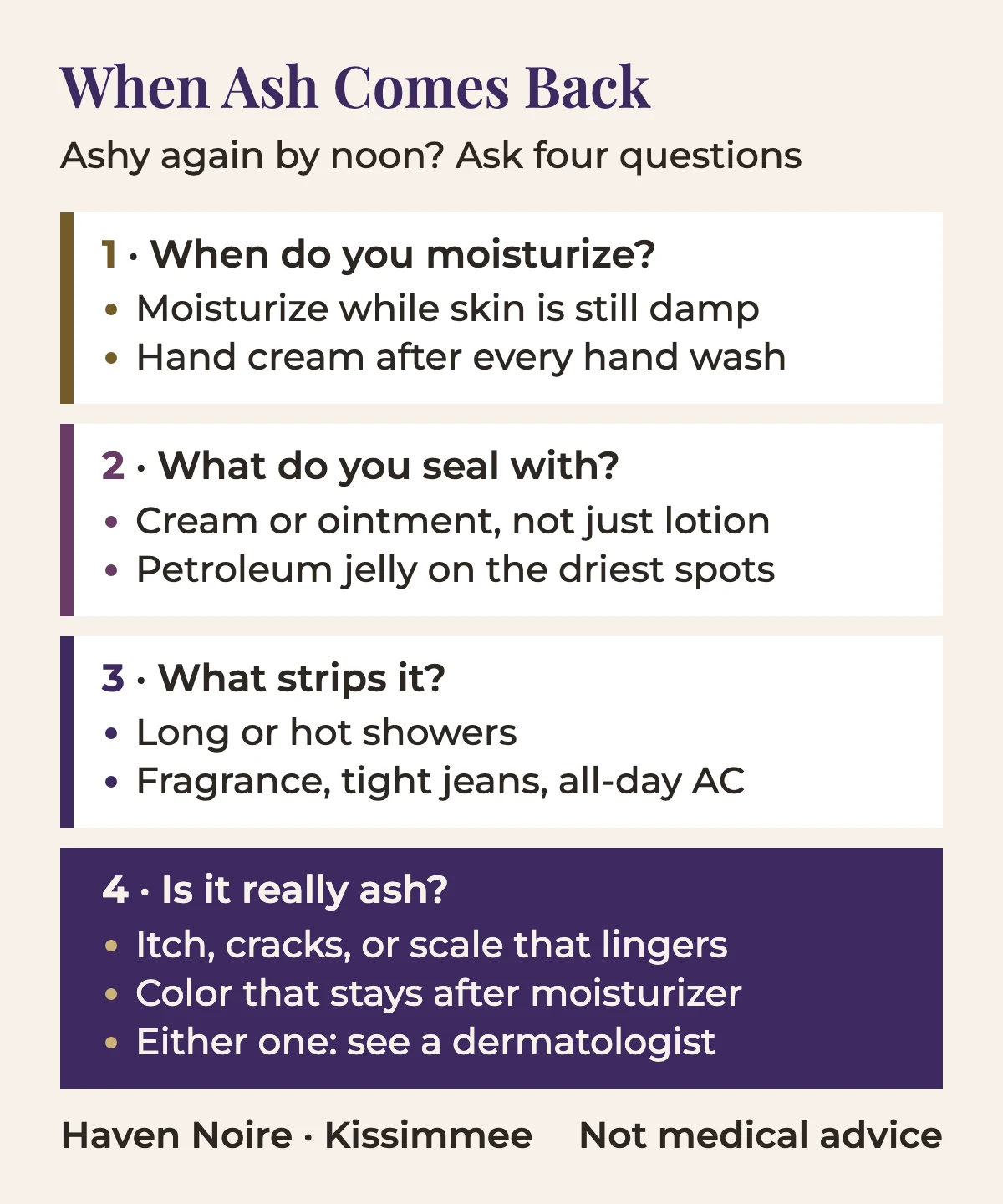
1. When do you moisturize?
Start here. The AAD's darker-skin guide says to pat (not scrub) your skin after a shower, leave it slightly damp, and apply a mild, fragrance-free moisturizer immediately after toweling off. The moisturizer seals in the water still on your skin. Wait until you're dressed and fully dry, and there's less water left to seal.
- After every shower or bath: moisturize before you leave the bathroom. Keep the jar there, not in the bedroom.
- During the day: the AAD's general tips say to moisturize several times a day and whenever skin feels dry.
2. What are you sealing it with?
Lotion isn't the strongest option. The AAD says creams and ointments tend to be more effective than lotions. For very dry skin, dermatologist Shani Francis, quoted in the AAD's darker-skin guide, recommends an ointment like petroleum jelly or a thick cream, and adds: "Butters and oils tend to liquefy on the skin, so they're less effective as moisturizers."
That cuts against what many of us grew up with. The AAD's general dry skin tips still list shea butter among ingredients to look for inside a cream, so the caution is about a butter or oil on its own. Our guide to shea butter for skin covers the rest.
| Texture | What the AAD says | Where we'd use it |
|---|---|---|
| Lotion | Less effective than creams and ointments | Light days and quick touch-ups |
| Cream | More effective than lotion; look for glycerin, hyaluronic acid, lactic acid, or shea butter | Your all-over layer after every shower |
| Ointment, such as petroleum jelly | Recommended for very dry skin; traps existing moisture | Elbows, knees, heels, and knuckles |
| A butter or oil on its own | Tends to liquefy, so less effective as a moisturizer | Over a cream, not instead of one |
Dermatologist Caroline Robinson, also quoted in that guide, says petroleum jelly works by trapping existing moisture, and suggests applying it to skin that's damp from bathing or on top of a lotion or cream. Thinking about doing that on your face? Read our guide to slugging first.
On your face and back
Kindred says a moisturizer with ceramides can reduce the whitish look of dry skin. Keep butters off breakout-prone skin: the AAD's acne tips for darker skin tones say products containing oils such as cocoa butter or shea butter can clog pores on your face, back, or chest.
3. What keeps stripping it?
If you moisturize at the right time with the right product and ash still returns, look at what's taking water out. From the AAD's dry skin tips:
- Long or hot showers. Keep them to 5 to 10 minutes in warm water.
- Too much cleanser. Use it only where you need it, such as your armpits and groin.
- Deodorant soaps and products with fragrance or alcohol. The AAD makes an exception for hand sanitizer.
- Retinoids. The AAD lists them among products to stop when skin is dry. If yours is a prescription, ask your prescriber first.
- Tight leggings and jeans that rub.
- Air-conditioned air, which MedlinePlus counts among causes of dry skin. The AAD suggests a humidifier in your bedroom at night, cleaned regularly to prevent mold.
Scrubbing harder isn't the answer. The AAD's exfoliation guide warns that aggressive exfoliation may lead to dark spots, especially in darker skin tones, and says to moisturize right after you exfoliate. Before you add a body scrub, count every exfoliant in your week.
4. Is it really ash?
Here's the question most guides never ask. Some gray, scaly, or darkened skin isn't simple dryness, and no lotion will fix it. Our rule of thumb: surface ash fades once moisturizer goes on. If a patch stays gray, purple, or brown after you moisturize, or it itches enough to wake you, it's a question for a dermatologist. Signs to watch for are below.
How to Get Rid of Ashy Skin: A Daily Routine
Here's the AAD's dry skin guidance in one order. Its darker-skin guide says that by following its tips, you should see some improvement within two weeks.
- Shower for 5 to 10 minutes in warm, not hot, water.
- Use a gentle, fragrance-free cleanser, and only where you need it.
- Pat your skin with a towel and leave it slightly damp.
- Apply a fragrance-free cream all over, right away.
- Add a thin layer of petroleum jelly to your driest spots, such as elbows, knees, and heels.
- Use hand cream after every hand wash, and reapply cream to dry spots during the day.
- At night, run a clean humidifier in your bedroom, and choose loose cotton clothes when you can.
Protect exposed skin from the sun, too. The AAD's dry skin tips include a broad-spectrum, water-resistant sunscreen with SPF 30 or higher. Our guide to sunscreen for dark skin helps you choose one that doesn't leave a gray cast of its own, and our companion post answers whether Black people can get sunburned.
What about exfoliating?
Flakes are dead skin cells, so gentle exfoliation may help, within limits. The AAD lists lactic acid among ingredients to look for in a dry skin cream, and MedlinePlus says a provider may suggest creams or lotions with urea and lactic acid. The AAD's exfoliation guide says people with dry skin may prefer just a washcloth and a mild chemical exfoliator, since scrubs and brushes may be too irritating, and that exfoliating while using a retinoid may worsen dry skin.
Pregnant, or using isotretinoin, tretinoin, or another prescription skin medicine? Ask your doctor or dermatologist before adding an acid. The same goes if you have eczema, rosacea, or keloid-prone skin.
Rough bumps aren't ash
If your upper arms or thighs feel like sandpaper with tiny bumps, that may be keratosis pilaris rather than ash, and a dermatologist can tell you for sure. The AAD notes that these rough bumps usually develop on the arms, thighs, and buttocks, and that many people get them. Our guide to textured skin sorts bumps from flakes.
Where Haven Noire Fits: Facials and Body Treatments in Kissimmee
Haven Noire is an esthetics spa, not a medical office. No facial or body treatment replaces the daily routine above, and our menu has no treatment built for dry, ashy arms and legs. What we can offer is a professional reset for your face and answers to your home-care questions.
For a dull or ashy face: the Signature Facial
Our menu lists the Signature Facial's benefits as balancing, hydrating, rejuvenating, and relaxing, for all skin types. It's $95 for 60 minutes (3 for $210) or $110 for 90 minutes (3 for $285). Every one starts with a double cleanse and a skin analysis, and finishes with serums, moisturizer, and SPF. See every step on our relaxing facials page.
Prefer monthly? The Ritual Membership ($94.99) covers the 90-minute Signature Facial and lists dry or dehydrated skin among what it's best for. Compare the tiers on our memberships page.
Firming Back + Booty: what it is, and what it isn't
Of our body treatments, Firming Back + Booty covers the back, the backs of the legs, and the booty with an enzyme polish and a peptide-rich firming mask: 60 minutes, $135. Our menu lists it for all skin types and as ideal for cellulite, aging, and hyperpigmentation. Dry skin isn't on that list, so it won't replace your routine. Unsure whether it suits your skin? Ask us at your consultation. Members get 10% off extra services.
Afterward, our body treatment aftercare asks you to avoid heat, friction, and sun for 24 to 48 hours, exfoliate gently after a few days, and keep your skin moisturized.
Not sure which cream to use at home? Ask at your visit, or browse the professional skincare lines we use before you come in.
When Ashy Skin Needs a Dermatologist, Not More Lotion
We're estheticians, not doctors, and we can't diagnose a skin condition. The AAD's darker-skin guide warns that some people with darker skin tones live for years with an undiagnosed condition, believing their skin is too dry for moisturizer to work. See a board-certified dermatologist, or your doctor where noted, if:
- Your skin is still dry after you've given the AAD's tips time to work. Its darker-skin guide names eczema, ichthyosis, and psoriasis as possible causes.
- Itchy patches stay dark brown, purple, or grayish after you moisturize, sometimes with small, rough bumps. The AAD's atopic dermatitis page lists these among eczema signs in darker skin tones.
- Scales look white, gray, or brown with curled edges, often on the fronts of the legs or backs of the arms. The AAD's ichthyosis vulgaris page says a mild case can be mistaken for dry skin.
- Flat gray patches appear that don't change with moisturizer. One possible cause is ashy dermatosis (erythema dyschromicum perstans), which a 2023 case report and mini-review in Acta Dermatovenerologica Croatica describes as acquired gray patches on the face, neck, trunk, and limbs. A 2023 consensus of dermatologists in India and Australia groups it with acquired pigment conditions, not dryness.
- Your skin cracks and bleeds, itches enough to wake you, or shows signs of infection the AAD lists: yellow crusts, pus or other fluid, swelling, and discoloration. Your doctor can check an infection, too.
- Your dry skin started with a new medicine or comes with other changes in your health: see your doctor. MedlinePlus lists diabetes, underactive thyroid, Sjögren syndrome, and certain medicines among causes of dry skin, and says a provider may order tests. Don't stop a prescribed medicine without asking.
If it's your child's skin
The AAD says children with darker skin tones who have atopic dermatitis tend to get patches on the fronts of the knees, the elbows, and the backs of the hands, the same places ash tends to show. It also says parents usually notice ichthyosis vulgaris between 3 months and 5 years of age. If a child's ash itches or doesn't clear with a good routine, ask their pediatrician or a dermatologist.
To find a dermatologist experienced with darker skin, the AAD suggests its Find a Dermatologist directory, filtered for a Skin of Color practice focus. Already seeing a doctor for reactive skin? See how we approach sensitive and redness-prone skin alongside a physician's care.
Frequently Asked Questions About Ashy Skin
Why is my skin still ashy after I put on lotion?
Usually it's timing or texture. Lotion on fully dry skin has little water left to seal in, and the American Academy of Dermatology says creams and ointments are more effective than lotions. Apply a fragrance-free cream right after you towel off, while your skin is still damp, and add petroleum jelly to the driest spots.
Is petroleum jelly or shea butter better for ash?
For very dry skin, a dermatologist quoted by the American Academy of Dermatology recommends petroleum jelly or a thick cream, and says butters and oils tend to liquefy on skin, so they're less effective as moisturizers. Shea butter still has a place as an ingredient inside a cream. Keep butters off an acne-prone face, back, or chest.
Can white people be ashy?
Yes. Dry skin happens on every skin tone. The American Academy of Dermatology says flaking, discoloration, and rough texture are more noticeable on darker skin, and a 2021 Vogue essay on ashiness points to the higher contrast between grayish dry patches and deeper skin. Same dryness, less contrast, so it's easier to miss on lighter skin.
Why are my knees and elbows always ashy?
They take a lot of friction, and they're easy to skip when you moisturize. The American Academy of Dermatology says tight clothes such as leggings and body-hugging jeans can worsen dry skin. Add a thin layer of petroleum jelly over your cream on these spots. In children with darker skin, itchy patches there can be eczema, so ask a pediatrician.
Is gray, dry skin ever a sign of something serious?
Often it's everyday dryness, which the American Academy of Dermatology says many people can treat at home. But MedlinePlus lists diabetes, underactive thyroid, and certain medicines among its causes, and the AAD says dryness nothing relieves may be eczema, ichthyosis, or psoriasis. If two weeks of care hasn't helped, or skin cracks and bleeds, see a doctor or dermatologist.
How do you get rid of ashy skin fast?
Smooth on a fragrance-free cream, then a thin layer of petroleum jelly. Our rule of thumb: surface ash fades once moisturizer goes on, and a patch that doesn't is a dermatologist question. To keep it gone, moisturize right after every shower and hand wash, keep showers short and warm, and run a clean humidifier at night.
Does a facial help an ashy face?
A facial can't treat a skin condition or replace daily moisturizer. Our Signature Facial, which our menu lists as hydrating, includes a double cleanse, skin analysis, exfoliation as needed, a mask and facial massage, then serums, moisturizer, and SPF. It's $95 for 60 minutes. Our guide to facials for Black skin explains more.
More from the Journal

About the author
Tiffany · Licensed Esthetician · Licensed PMU Artist
Tiffany is a Florida-licensed esthetician and permanent makeup artist and the founder of Haven Noire. She specializes in customized facials, corrective skincare, and waxing for melanin-rich and all skin types, and is known for a calm, education-first approach that puts first-time clients instantly at ease.
Meet Tiffany →