

Toner is a thin, watery liquid you put on after cleansing and before serum or moisturizer. What it does depends on what's in the bottle: some toners hydrate, some exfoliate with acids, and old-school astringents strip oil, often with alcohol.
Do you need one? Usually not: it's an optional step. In November 2026 we read the American Academy of Dermatology's (AAD) pages on face washing, oily skin, dry skin, acne, and rosacea. None lists toner as a step you need, and the AAD's rosacea tips are blunt: "Never use an astringent or toner."
Two things the toner guides we read skip: the popular pH claim rests on thin evidence, and on brown and Black skin, a toner that stings can leave a dark mark that takes months to fade.
What Does Toner Do?
A face toner leaves a light layer of its ingredients on clean skin. A hydrating toner adds moisturizing ingredients, an exfoliating toner dissolves dead skin cells with acids, and an astringent toner removes oil, which can leave skin dry.
So the honest answer to "what does toner do" is: whatever its ingredients do. A Cleveland Clinic article describes a toner as typically a water-based product used after cleansing and before moisturizing, and says modern toners are much more moisturizing and soothing than old-school, high-alcohol ones.
What toner can't do
- Replace washing. The AAD's face washing advice calls for a gentle cleanser morning and night and after sweating. If makeup lingers, a gentle double cleanse fixes it at the source.
- Change your pore size. The Cleveland Clinic article says pore size is largely genetic. Our guide to how to shrink pores covers what makes them look smaller.
- Stand in for moisturizer. The study in the pH section below explains why.
Hydrating, Exfoliating, or Astringent: The 3 Kinds of Toner
Toners look alike on a shelf. The ingredient list, not the name on the front, tells you which of three jobs a toner does.
Hydrating toners
These carry moisturizing ingredients such as glycerin and hyaluronic acid, both on the list the AAD's dry skin tips say to look for in a cream or ointment. This is the gentlest kind.
Exfoliating toners
These contain alpha hydroxy acids (AHAs) such as glycolic, lactic, or mandelic acid, or a beta hydroxy acid (BHA) such as salicylic acid. The AAD's exfoliation guide says chemical exfoliation uses acids like these to dissolve dead skin cells. So an acid toner counts toward the weekly tally in our guide to how often you should exfoliate.
Acids change your sun plan, too: the FDA says AHAs may increase your skin's sensitivity to the sun, and its recommended label says to use sunscreen, wear protective clothing, and limit sun exposure while using the product and for a week afterward. Weighing a specific acid? See our guides to lactic acid and mandelic acid.
Astringent toners
These are the old-school bottles built to strip oil. The AAD's acne tips advise gentle products labeled "alcohol-free" and name astringents, toners, and exfoliants among products that can irritate your skin, saying they "can dry your skin and make acne appear worse." The AAD's dry skin tips list alcohol (except hand sanitizer) among ingredients to stop using.
| Kind | What it does | Label words to look for | Be careful if |
|---|---|---|---|
| Hydrating | Adds a light moisturizing layer | Glycerin, hyaluronic acid | Fragrance bothers you; choose fragrance-free |
| Exfoliating | Dissolves dead skin cells | Glycolic, lactic, mandelic, salicylic; AHA, BHA | Darker skin tone, a retinoid or benzoyl peroxide, sun ahead |
| Astringent | Strips oil, often with alcohol | Alcohol, astringent, oil control | Your skin is acne-prone, dry, or rosacea-prone |
Does Toner Balance Your Skin's pH? What the Research Shows
One of the most repeated toner claims is that it restores your skin's pH after cleansing. A Cleveland Clinic article makes it for toners with mild acids, but neither it nor the brand guides we read in November 2026 cited a study. Here's what three small studies on PubMed show:
- Skin is naturally acidic and drifts back on its own. A 2006 study of forearm skin in 330 people estimated natural surface pH at about 4.7 on average; its authors note plain tap water can raise skin pH for up to 6 hours before it returns.
- Washing barely moved facial pH in one small study. A 2015 study of 22 Korean women tracked facial skin for 3 hours after washing with a cleanser. Hydration dipped and was back at 40 minutes; pH showed no significant difference at any point.
- Added acid faded fast in one pilot. In a 2019 study of 22 people, half with eczema, dilute apple cider vinegar soaks lowered forearm pH right afterward, but the effect wasn't sustained at 60 minutes, and 16 of the 22 reported mild side effects.
None of the three tested a toner. We searched PubMed in November 2026 for studies pairing toner with skin pH or the acid mantle and found none that tested whether toner after cleansing restores pH or improves skin by doing so. Our take: that's too little evidence to make pH a reason to buy a toner, and too little to say toners never change pH.
Our one clear rule: skip homemade toners made with lemon juice or vinegar. The evidence is thin, but it points one way. Most people in the vinegar pilot above reported mild side effects from forearm soaks, and a 2014 case report in the Australasian Journal of Dermatology is titled "Chemical leucoderma induced by homemade lemon toner." Leucoderma is a loss of skin color.
Does toner hydrate better than moisturizer?
Not on its own, in the one study we found. A 2016 study in the Journal of Cosmetic Science compared cream, toner, and spray water over eight hours. Every treatment beat untreated skin, and toner alone ranked last among them. On normal skin, cream topped up with toner every two hours gave the biggest gain. On dry skin, cream alone did as well: the study found no significant difference between it and the cream and toner combinations.
Our advice: if you buy one bottle, buy the moisturizer. Tight in the air conditioning but shiny outside? Our guide to dry vs. dehydrated skin helps you tell which you're treating.
Do You Need Toner?
Probably not, unless you like how one feels or it does a job nothing else does. The AAD's face washing tips build a routine from a gentle cleanser that doesn't contain alcohol, lukewarm water, your fingertips, and moisturizer if your skin is dry or itchy. Toner isn't on the list.
For some readers, the AAD says to skip it:
- Rosacea. Never use an astringent or toner, and avoid alcohol, fragrance, glycolic acid, and lactic acid. The AAD says cold can trigger rosacea too, so read our ice bath for face guide before you try one.
- Isotretinoin. The AAD's isotretinoin guide says toners can be too harsh while you're taking it, and lists AHAs and BHAs among exfoliants to avoid.
- Acne-prone skin. The acne tips name toners among irritants; if your dermatologist recommended an acid toner, follow that plan.
- Dry skin. Stop products that contain alcohol.
- Skin that stings right now. Pause the toner with your other actives; our skin barrier guide walks through a gentle reset.
Pregnant? The AAD's pregnancy skin care guide lists retinoids among ingredients to avoid and puts salicylic acid at high doses (greater than 2%) on its use-sparingly list. If your toner contains salicylic acid or a retinoid, ask your obstetrician or dermatologist before you keep using it. On tretinoin or another prescription skin medicine, or living with eczema or keloid-prone skin? Ask your doctor or dermatologist before adding any toner.
Who might enjoy one? We'd say dehydrated skin under moisturizer, or oily skin wanting a gentle acid. The AAD's oily skin tips say salicylic, glycolic, and lactic acid can help reduce oiliness but may be too harsh, so stop or cut back if skin gets irritated. Not sure which you have? See our guide to skin types.
Should You Keep Your Toner? Three Questions to Ask
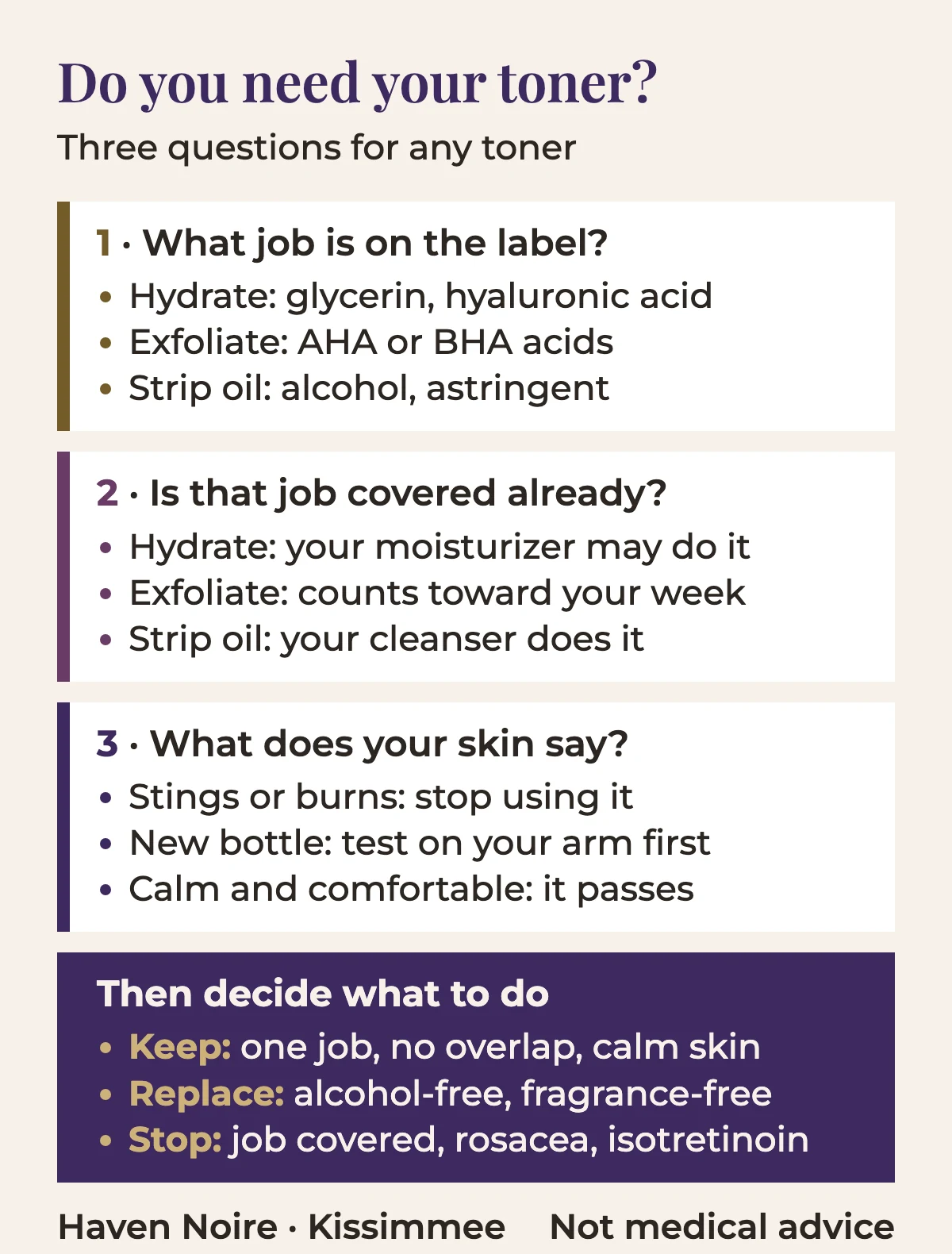
These three questions build on the AAD guidance cited here. They're a way to sort your shelf, not a diagnosis or a medical rule. Ask them about the toner you own, and "what does toner do?" becomes "what does my toner do for me?"
Question 1: What job is on the label?
Read the ingredient list, not the front. Glycerin or hyaluronic acid points to hydrating. Glycolic, lactic, mandelic, or salicylic acid, or the letters AHA or BHA, mean exfoliating. Alcohol, or the word astringent, points to oil stripping.
Question 2: Is that job already covered?
- Hydrating. If your moisturizer keeps skin comfortable, the toner is optional. Our guide to what a serum does shows where serums fit, too.
- Exfoliating. Count it with your scrubs and spa visits. The AAD says retinoids, retinol, and benzoyl peroxide may make skin more sensitive or peel, and exfoliating while using them "may worsen dry skin or even cause acne breakouts."
- Astringent. The AAD's first oily skin tip is cleansing up to twice daily and after sweating, and none of its oily skin tips mentions an astringent.
Question 3: What does your skin say?
Your skin casts the deciding vote. The AAD's anti-aging product guide says stinging, burning, or tingling means a product irritates your skin, and its guide to fading dark spots is direct: "If a product burns or stings when you apply it, stop using it." Trying a new toner? The AAD's product testing guide suggests a quarter-sized spot, such as the underside of your arm, twice daily for seven to 10 days, and stopping if it turns red, itchy, or swollen.
What to do with your toner
- Keep it if it has one clear job, nothing else is doing that job, and your skin stays calm.
- Replace it if the job is worth keeping but the formula isn't. Choose alcohol-free and fragrance-free; the AAD notes that "unscented" products can contain chemicals that hide other odors.
- Stop using it if the job is covered, your skin says no, or you're in a group the AAD warns away from toner.
How to Use Toner, Step by Step
Did yours get the job? Here's how to use toner. Lines that name the AAD follow its guidance; the rest is our own advice.
- Wash with a gentle cleanser, lukewarm water, and your fingertips, then pat dry with a soft towel, as the AAD advises.
- Shake a few drops into clean palms and press them over your face. A cotton pad works too; keep it light, since the AAD says scrubbing irritates the skin.
- Skip the skin right around your eyes and any broken or irritated patch.
- Apply any prescription treatment where your prescriber says, then serum if you use one.
- Moisturize while skin is still slightly damp, as the AAD's dry skin tips advise after bathing.
- In the morning, finish with sunscreen. Our guide to sunscreen for dark skin helps you choose one without a white cast.
How often to use toner
Our rule of thumb: a hydrating toner once or twice a day, if skin stays comfortable. An exfoliating toner is exfoliation, so start at once a week, at night. An astringent, if you keep one, sparingly, stopping at the first sting. Don't stack an acid toner on retinoid or benzoyl peroxide nights unless your prescriber says it's fine. For the full order, see our morning skincare routine.
Toner on Melanin-Rich Skin: Gentle Wins
If your skin is brown or Black, the sting check matters more. The AAD's dark spots guide says a skin care product that irritates your skin can cause dark spots. A spot a few shades darker than your natural color usually fades within 6 to 12 months, it says, and color deep in the skin can take years.
Its exfoliation guide adds: avoid strong chemical or mechanical exfoliation if you have a darker skin tone. Our advice for deeper skin: choose hydrating over astringent, keep any acid toner gentle and occasional, and treat a sting as a stop sign, not proof it's working.

Already have marks? Start with how to fade hyperpigmentation on melanin-rich skin, or read our guide to facials for Black skin.
Toner in Florida Heat: Sweat, Shine, and Cold Offices
On a Central Florida afternoon, use toner on purpose, not on reflex:
- After sweating, wash. The AAD says perspiration irritates the skin and to wash as soon as possible after sweating. In our view, a toner swipe is no substitute.
- For midday shine, blot. The AAD's oily skin tips say to press blotting paper gently on your face for a few seconds without rubbing, and warn that a too-harsh face wash can trigger increased oil production. We'd skip a stinging astringent for the same reason.
- In cold air conditioning, top up (our tip). In the 2016 study above, toner reapplied over cream gave normal skin its biggest hydration gain.
For a full hot-weather routine, see our glass skin guide.
Toner, Facials, and Your Skin Analysis in Kissimmee
A facial won't pick your toner, but it gives you a trained second look. Every Signature Facial begins with a double cleanse and a skin analysis, then exfoliation and extractions as needed, a custom mask and facial massage, and serums, moisturizer, and SPF.
Bring the bottle, or a photo of its label, and tell us what you use with it, prescriptions included. For home care, ask about the professional skincare lines we work with: Circadia by Dr. Pugliese, Dermalogica, and Skin Script. After a facial, skip harsh actives and heat for 24 hours; we'd count an acid toner as one.
| Option | Price |
|---|---|
| Signature Facial, 60 minutes | $95, or 3 for $210 |
| Signature Facial, 90 minutes | $110, or 3 for $285 |
| Glow Membership: one 60-minute Signature Facial a month | $74.99 a month |
| Ritual Membership: one 90-minute Signature Facial a month | $94.99 a month |
When to See a Dermatologist Instead of Switching Toners
Haven Noire is an esthetics spa, not a medical office; Tiffany, our founder, is a Florida-licensed esthetician, and we don't diagnose skin conditions. See a board-certified dermatologist, or your doctor, when:
- Your face feels warm most of the time, or skin care burns or stings. On darker skin, the AAD lists both among rosacea signs that call for a dermatology appointment; see our page on sensitive and redness-prone skin.
- A product reaction is severe and cool compresses or petroleum jelly don't relieve it; the AAD says you may need a dermatologist.
- A dark spot isn't fading. The AAD says that if your treatment fails to deliver, you may want to see a dermatologist.
- Acne isn't clearing, or you want to add an acid toner to prescription acne medicine.
- You take isotretinoin, use tretinoin or another prescription skin medicine, or you're pregnant or nursing.
- You have eczema, or skin that scars or forms keloids easily.
Not sure which professional fits your question? Read esthetician vs. dermatologist.
Frequently Asked Questions About Toner
Is toner necessary for a skincare routine?
No. The American Academy of Dermatology's face washing advice builds a routine from a gentle cleanser and moisturizer, and its rosacea, acne, and isotretinoin pages warn some people away from toner. A gentle hydrating toner is optional. Use one if your skin likes it and it does a job nothing else in your routine does.
Can I use toner every day?
A gentle hydrating toner, yes, if your skin stays comfortable; that's our advice. An exfoliating toner with glycolic, lactic, or salicylic acid is different. It counts as exfoliation, so start once a week at night and wear sunscreen daily. Stop any toner that burns or stings, as the AAD advises.
Do you put toner on before or after moisturizer?
Before. Our suggested order is cleanser, toner, serum or treatment, moisturizer, then sunscreen in the morning. A 2016 study found that when cream and toner were used together, the order made little difference to skin hydration, so don't stress over it. Prescription products go wherever your prescriber says.
Is toner good for acne-prone skin?
Often not. The American Academy of Dermatology's acne tips name astringents, toners, and exfoliants among products that can irritate your skin, and say they can make acne appear worse. Choose gentle products labeled alcohol-free. If your dermatologist recommends a specific acid toner, follow that plan and count it as exfoliation.
What is the difference between toner and astringent?
An astringent is a toner built to remove oil, usually with alcohol. A Cleveland Clinic article says astringents are usually alcohol-based and can be harsh and dry out your skin, while modern toners are much more moisturizing and soothing. Check the label: alcohol, or the word astringent, signals the stronger kind.
Does toner balance your skin's pH?
It's a common claim, and the evidence is thin. In a small 2015 study of 22 women, facial skin pH showed no significant change in the three hours after washing with a cleanser. We searched PubMed in November 2026 and found no study that tested whether toner restores pH after cleansing or improves skin that way.
Can toner replace washing your face?
No. The American Academy of Dermatology advises washing with a gentle cleanser that doesn't contain alcohol in the morning, at night, and after sweating heavily. Toner isn't part of that advice, and in our view it's no substitute for a real wash after a sweaty Florida afternoon or a full day of sunscreen.
More from the Journal

About the author
Tiffany · Licensed Esthetician · Licensed PMU Artist
Tiffany is a Florida-licensed esthetician and permanent makeup artist and the founder of Haven Noire. She specializes in customized facials, corrective skincare, and waxing for melanin-rich and all skin types, and is known for a calm, education-first approach that puts first-time clients instantly at ease.
Meet Tiffany →