

Pimple patches, the small clear stickers you press over a spot before bed, are still everywhere as of November 2026. In September 2026, The Conversation published a University of Queensland dermatologist's look at the science, and the American Academy of Dermatology (AAD) included patches in its 2025 roundup of viral at-home acne hacks.
So, do pimple patches work? Yes, within limits. A board-certified dermatologist quoted in the AAD's news release says pimple patches "do have science behind them": they help draw out fluid from pimples and stop you from picking, but they won't work on deep acne.
Most guides stop at "it depends on the pimple." We'd add: it depends on the day. A patch helps one pimple at one stage of its life, and does nothing for the one forming next to it. Below: a stage-by-stage guide to timing a patch, the evidence, the DIY hacks to skip, and when to see a dermatologist.
What Are Pimple Patches, and How Do They Work?
Pimple patches are small adhesive stickers, usually made of hydrocolloid, a gel-forming material borrowed from wound care. You press one over a pimple, and it soaks up fluid, covers the spot, and keeps your fingers off it.
The Conversation's explainer gives the mechanics. The hydrocolloid "absorbs moisture," drawing pus, oil, and dead skin cells out of a pimple with a visible head, which is why a used patch turns white or cloudy. The patch also acts as a physical barrier, so the pimple is harder to pick, squeeze, or touch.
That barrier matters. The AAD's guide to pimple popping says squeezing often pushes a pimple's contents deeper into the skin, which increases inflammation.
Three kinds of patches on the shelf
| Type | What it is | Best fit | What the evidence says |
|---|---|---|---|
| Plain hydrocolloid | An absorbent gel patch, nothing added | A pimple with a head, or one that has opened | The most studied kind, though mostly in wound care |
| Medicated | Hydrocolloid plus salicylic acid, benzoyl peroxide, tea tree oil, or niacinamide | Not established | Unclear whether the added ingredient helps; salicylic acid can irritate |
| Microneedle | Tiny dissolving points meant to carry an ingredient into the skin | Not established | Mostly lab and animal studies, plus two small trials in people |
A microneedle patch is a single-use sticker, not microneedling, and microneedling isn't on our menu at Haven Noire.
Not sure the bump is even a pimple? Our guide to textured skin helps you sort small bumps before you reach for a patch.
Do Pimple Patches Work? What the Studies Show
The research is younger than the hype. A 2025 review of hydrocolloids in dermatology found they've been studied mostly for chronic wounds, with only a few acne studies. Its authors wrote that few clinical studies definitively support their efficacy in acne, and that it's not clear whether adding medications to a patch helps.
The Conversation's author adds that many of the acne studies are small and industry-funded, test the brands' own patches, and often aren't blinded. Here's the evidence at a glance:
| Study | Size | What it reported | Funding and caveat |
|---|---|---|---|
| 2006 pilot trial, Journal of Cosmetic Science | 20 people, one week | A hydrocolloid acne dressing eased acne severity and inflammation more than plain skin tape | Small; the abstract names the dressing's maker, not a funder |
| Trial reported by The Conversation | 41 people | A patch improved the look of a popped pimple within a day | Small; manufacturer-funded |
| Study reported by The Conversation | 37 people, ten days | Patched pimples were 35% smaller at day two while untreated ones barely changed, and were less likely to leave dark marks by day ten | Small; industry-funded |
| 2022 microneedle trial, Journal of Cosmetic Dermatology | 30 people, 28 days | Daily dissolving microneedle patches with cosmetic anti-acne ingredients reduced acne volume; no comparison group was described | Small; authors from two companies; no funder named in the abstract |
| 2023 microneedle trial, Clinical, Cosmetic and Investigational Dermatology | 35 people, 28 days | One microneedle patch, with or without the prescription steroid triamcinolone, cleared pimples faster than no patch | Small; university-funded; one author holds a patent licensed to a microneedle company |
We searched PubMed in November 2026 for microneedle patch acne studies and found mostly lab and animal work, plus the two trials in people above.
The Conversation's verdict: early results are promising, but "the evidence for pimple patches is still limited."
The bigger limit: a patch treats one spot
Here's what most patch guides skip. A patch treats the pimple under it, not the breakout already forming nearby. The AAD lists applying acne medication only to your blemishes among the habits that can worsen acne: it makes sense to treat what you see, the AAD says, but that approach fails to prevent new breakouts. Its fix is a thin layer of medication over all your acne-prone skin, given 6 to 8 weeks to work.
A Cleveland Clinic dermatologist says the same of patches: they "cannot prevent acne from coming, nor can they clear clogged pores." So treat a patch as spot care, not acne care. Patching a new pimple every week? Start with our guide to closed comedones or how to start a retinoid like retinol.
When Pimple Patches Work in a Pimple's Life
Timing matters. Here's one pimple followed through four stages, each paired with what the AAD and the studies above say to do. It isn't a diagnosis, and the stage lines are our suggestions, not medical rules.
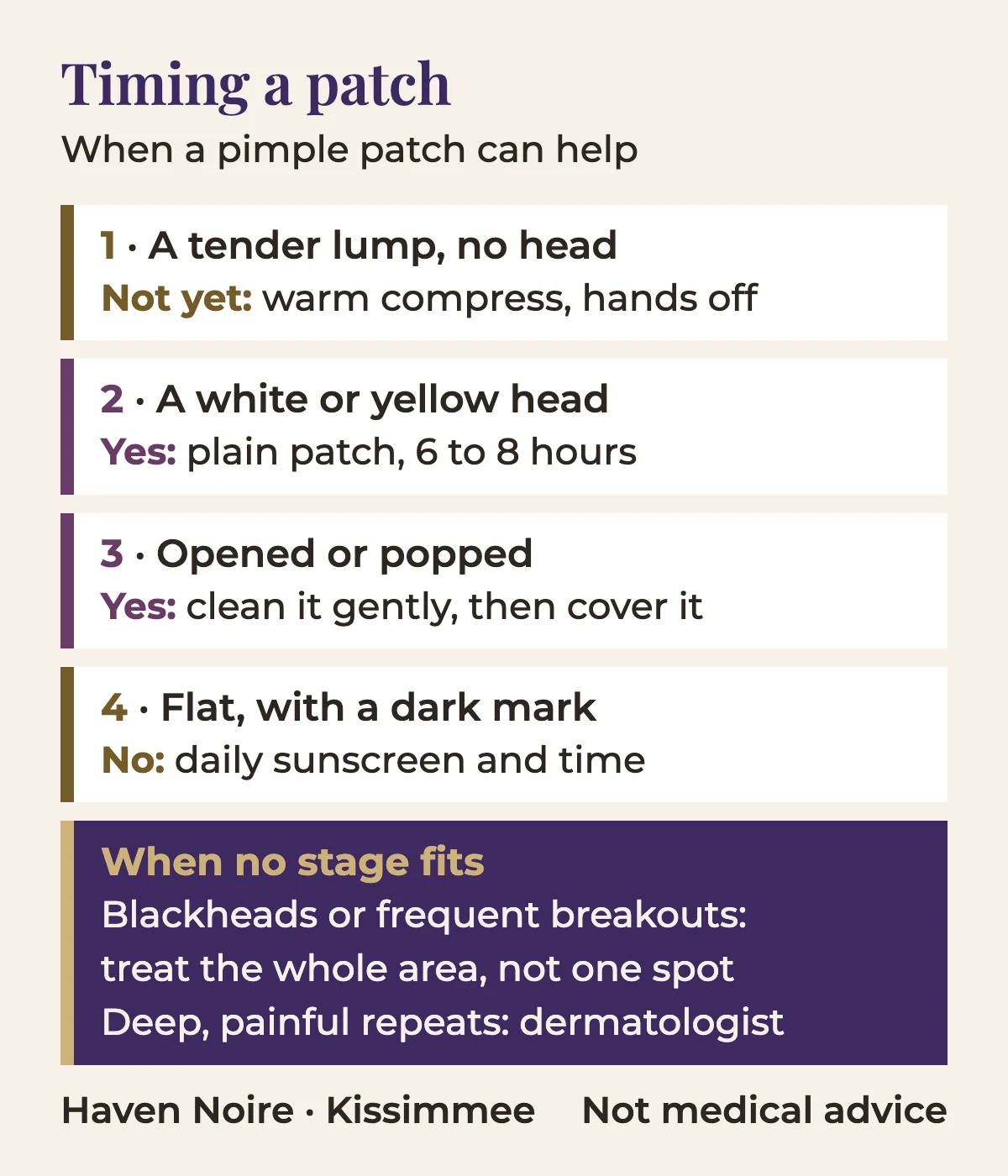
Stage 1: A tender lump with no head (not yet)
You feel a sore bump under the skin with nothing at the surface. Patches don't work well on deep, painful pimples, The Conversation explains, because they can't reach inflammation that sits deeper in the skin.
Keep your hands off. The AAD's guide to treating a deep, painful pimple suggests a clean, warm, damp washcloth for 10 to 15 minutes, three times a day, to help bring it toward the surface. Once it's there, the AAD says, topical treatments work better, and a hydrocolloid patch can protect your skin and improve healing.
Stage 2: A white or yellow head (patch it)
Patches "seem to work best on pimples that already have a visible white or yellow head," The Conversation says, because the pus has risen within reach of the gel. To use one:
- Wash gently with a mild cleanser and your fingertips, as the AAD advises for skin with breakouts.
- Pat dry. A patch needs clean, dry skin.
- Press on a plain patch that covers the head.
- Leave it on six to eight hours or overnight, per The Conversation and your package directions.
- Swap it once it turns cloudy and swollen, then throw it away.
Stage 3: It opened, or you popped it (cover it)
Once a pimple is open, a patch works like the wound dressing it was adapted from, absorbing fluid and keeping the spot covered. That's the case the small, manufacturer-funded 41-person trial tested, and a Cleveland Clinic dermatologist says that after a popped pimple, a patch "may help your skin recover and minimize damage." Clean the spot gently, cover it, and leave it alone.
Popping often? Our guide to facial extractions has a section on how to stop picking.
Stage 4: Flat, with a dark mark (too late for a patch)
A flat spot leaves a patch nothing to absorb, and on brown and Black skin a dark mark often remains. The AAD's guide to fading dark spots in darker skin tones says spots often appear when a pimple clears, and that a spot a few shades darker than your natural color usually fades within 6 to 12 months once the cause stops. Color that sits deep in the skin can take years.
Treatment, the AAD says, begins with sunscreen: a tinted one with iron oxide. Our guide to fading hyperpigmentation on melanin-rich skin has the full plan.
When no stage fits
- Blackheads and closed comedones. They're clogs, and patches can't clear clogged pores; see our guide to getting rid of blackheads.
- A new pimple every few days. That pattern needs whole-area treatment, not more stickers.
- Small bumps on your forehead, chest, or upper back that flare in heat. The AAD's release says so-called fungal acne, caused by yeast, looks like this and gets worse in hot, humid weather. See a dermatologist, and read our guide to sweat pimples.
- Deep, painful pimples that keep coming back. See the dermatologist section below.
Pimple Patches on Melanin-Rich Skin: Protecting Against Dark Marks
If your skin is brown or Black, one pimple can cost you more. The AAD's guide to acne in skin of color says acne is often accompanied by dark spots or patches called hyperpigmentation, and that if you pick, pop, or squeeze acne, you increase your risk of a scar.
So a patch earns its place as a shield. The Conversation flags a catch, though: irritation can raise the risk of dark marks after a pimple heals on darker skin tones, and medicated patches with salicylic acid can be irritating.
Our advice for melanin-rich skin:
- Choose plain over medicated if you mark easily.
- Treat the area, not just the spot. The AAD says a retinoid plus benzoyl peroxide works well in skin of color, and warns that benzoyl peroxide bleaches clothing, sheets, pillowcases, and towels.
- Treat early. The AAD says that if acne becomes moderate to severe before treatment begins, people with skin of color have a higher risk of dark spots and keloids, a type of raised scar.
- Wear sunscreen every day. Our guide to sunscreen for dark skin helps you choose one.
To keep a facial itself from leaving marks, see our guide to facials for Black skin.
Toothpaste on Pimples and Other DIY Spot Hacks to Skip
Toothpaste on pimples is the oldest hack here, and the AAD is blunt about it. Asked whether toothpaste is an effective at-home treatment for adult acne, one dermatologist in its adult acne guide answers "Absolutely not!" Another explains that toothpaste often contains abrasive ingredients, whitening agents, color, and flavor, and that "none of these ingredients fight acne, but they can irritate or harm your skin."
Why the myth? A Cleveland Clinic article on toothpaste and pimples says toothpaste once contained triclosan, an ingredient thought to help acne, and that as of 2019 no toothpaste sold in the U.S. used it. We searched PubMed in November 2026 for studies on toothpaste and acne and found none that tested toothpaste as a pimple treatment.
Other bathroom-cabinet fixes backfire too:
| Hack | What the AAD says | Try instead |
|---|---|---|
| Toothpaste | None of its usual ingredients fight acne, but they can irritate or harm your skin | Adapalene, benzoyl peroxide, or salicylic acid |
| Rubbing alcohol or a harsh astringent | Dry skin is irritated skin, and irritation risks more acne | A moisturizer made for acne-prone skin |
| A chamomile tea bag | A dermatologist advises against tea bags on skin because they could cause irritation | Skip it |
| Dandruff shampoo on your face | It isn't made for facial skin, and overuse can bring dryness, irritation, and more breakouts | A dermatologist, for bumps that may be yeast-related |
| A pin or needle | Popping at home risks infection and scars | A patch once a head shows |
What works is less exciting and better proven. The AAD's adult acne guide names adapalene, azelaic acid, benzoyl peroxide, and salicylic acid, and suggests starting benzoyl peroxide at 2.5% to avoid dry, irritated skin. Use one product for 6 to 8 weeks before adding another. Skin already stinging? Our skin barrier guide covers the repair.
When to See a Dermatologist Instead of Reaching for a Patch
We're estheticians, not doctors. Haven Noire is an esthetics spa, not a medical office, and a patch is no substitute for a dermatologist.
Check with your doctor or dermatologist first
- Pregnant or trying to get pregnant? A dermatologist in the AAD's adult acne guide says to consult a dermatologist before treating acne on your own, because some non-prescription acne treatments aren't safe during pregnancy. Ask before using a medicated patch.
- On isotretinoin, tretinoin, or another prescription skin medicine? Ask your dermatologist before adding a medicated patch, and tell us what you use when you book a facial.
- Eczema, rosacea, sensitive skin, or an adhesive allergy? The Conversation notes that patches can cause redness, itching, or a rash in people with sensitive skin or an adhesive allergy, and the 2025 review cites case reports of allergic reactions under hydrocolloid dressings. See how we approach sensitive and redness-prone skin.
- Keloid-prone, or scar easily? Raised scars are a dermatologist's call.
See a dermatologist if
- You have large, painful pimples deep in the skin, or acne that scars. The AAD says products you buy online or in a store are unlikely to treat these effectively.
- A deep, painful pimple won't go away with home care, or you develop several of them, per the AAD's deep-pimple guide.
- You're not getting results after weeks of using an acne treatment, the AAD's adult acne guide says.
- Dark spots appear after acne clears. The same guide says those marks signal significant inflammation.
Take a patch off if
Your skin turns red, itchy, or rashy under it. Our rule of thumb: let your skin settle, and see a doctor or dermatologist if the reaction doesn't clear.
Where Pimple Patches End and a Facial Begins
A patch, a facial, and a dermatologist each handle a different part of the job:
| Job | Pimple patch | Facial at Haven Noire | Dermatologist |
|---|---|---|---|
| Best for | One pimple with a head, or an opened one | Congestion, texture, and a skin analysis | Acne as a condition, deep pimples, scars, and lasting marks |
| What it does | Absorbs fluid and blocks picking | Exfoliation and extractions as needed, a custom mask, serums, moisturizer, and SPF | Diagnoses and prescribes treatment |
On our menu, the Signature Facial (60 minutes, $95, or 3 for $210) includes a double cleanse, a skin analysis, and extractions as needed. For breakouts and congestion, a Corrective Facial is $135, or $360 for a 3-pack. Its Acne Oxygen Rx option pairs oxygen therapy with a purifying charcoal mask. The Corrective Membership covers one corrective facial a month for $109.99.
Coming in with a pimple? Point it out at your consultation instead of squeezing it the night before. Tiffany, our founder, is a Florida-licensed esthetician. To match a facial to breakouts, read the best facial for acne in Kissimmee, or for a teen, our parents' guide to teen facials.
Frequently Asked Questions About Pimple Patches
How long should you leave a pimple patch on?
A University of Queensland dermatologist writing in The Conversation suggests six to eight hours or overnight, on clean, dry skin, then swapping the patch once it turns cloudy and swollen. Follow your package directions too. If the spot isn't changing after a night or two, it may sit deeper than a patch can reach.
Do pimple patches work on cystic acne?
Not well. A dermatologist quoted by the American Academy of Dermatology says patches won't work on deep acne, and The Conversation explains that a patch can't reach inflammation deep in the skin. For a deep, painful pimple, the AAD suggests hands off and a warm, damp washcloth, and a dermatologist if it won't go away.
Can you put a patch on a popped pimple?
Yes. Hydrocolloid comes from wound care, and a small, manufacturer-funded trial of 41 people found that a patch on a pimple that had come to a head and been popped improved its appearance within a day. Clean the spot gently, cover it, and try not to make popping a habit, because squeezing raises your risk of scars.
Does toothpaste get rid of pimples overnight?
No. In the AAD's adult acne guide, one dermatologist answers "Absolutely not!" Another notes that toothpaste often contains abrasives, whitening agents, color, and flavor, and that "none of these ingredients fight acne, but they can irritate or harm your skin." On melanin-rich skin, irritation can leave a dark spot. Try a plain patch instead.
Are microneedle patches the same as microneedling?
No. A microneedle patch is a single-use sticker dotted with tiny dissolving points meant to carry an ingredient into a pimple. Microneedling is a separate procedure, and it isn't on our menu. When we searched PubMed in November 2026, most microneedle patch research was lab or animal work, with two small trials in people.
Can acne patches irritate your skin?
They can. The Conversation's dermatology author says patches can cause redness, itching, or a rash in people with sensitive skin or an allergy to adhesives, and that medicated patches with salicylic acid can also irritate. If your skin reacts, take the patch off. If you have eczema or rosacea, ask your dermatologist before trying one.
Do pimple patches prevent dark spots?
They may help indirectly. Patches keep fingers off a pimple, and the AAD says picking, popping, or squeezing acne increases your risk of a scar. One small industry-funded study found patched pimples were less likely to leave dark marks by day ten. Daily tinted sunscreen and early acne treatment still do the heavy lifting.
More from the Journal

About the author
Tiffany · Licensed Esthetician · Licensed PMU Artist
Tiffany is a Florida-licensed esthetician and permanent makeup artist and the founder of Haven Noire. She specializes in customized facials, corrective skincare, and waxing for melanin-rich and all skin types, and is known for a calm, education-first approach that puts first-time clients instantly at ease.
Meet Tiffany →