

Face mapping is the idea that where you break out shows what's wrong inside your body: your forehead for digestion, your cheeks for your lungs, your chin for your hormones. As of November 2026, these zone charts still circulate as a skin trend on social media, and Healthline's medically reviewed explainer, updated November 4, 2026, says most versions "lack strong scientific support."
Here's the honest answer. We searched PubMed in November 2026 and found no study showing that a breakout's location points to a problem in a particular organ. Location still tells you something, though. Dermatology sources tie some zones to real causes: hair products along the hairline, helmet straps on the chin, hormonal flares along the jawline. Those clues point to what touches your skin and when it flares, not to an internal organ.
What Is Face Mapping?
Face mapping divides your face into zones and gives each zone a cause. Traditional charts tie zones to internal organs. Newer acne face maps tie them to habits and hormones. Some skincare brands also use the name for their own skin analysis.
- Traditional Chinese face mapping. Healthline describes it as a 3,000-year-old practice that views the face as a map, with each section connected to a different organ, and says "there's no real scientific basis" for those links.
- Acne face maps. These swap organs for causes such as stress, diet, phones, or hormones. Healthline notes there's "little research to prove that a specific factor can cause acne in a specific area."
- Branded skin analysis. The skincare brand Dermalogica uses the name Face Mapping for its own skin analysis tool.
We understand the appeal. Looking for a pattern is the right instinct. The trouble starts when the chart hands you the answer before you've looked. A skin analysis works the other way around, and our guide to the types of facials explains how one opens every facial we offer.
Does Face Mapping Work? What the Evidence Says
For organ charts, our search found no support. We searched PubMed in November 2026 for "face mapping" with acne, and for facial mapping studies of the skin. The first returned nothing. The second returned ten papers, on topics such as skin cancer locations and facial hydration, and none tested an organ link.
Your face does have real zones, just not organ zones. A 2019 review in the International Journal of Cosmetic Science describes instrument maps showing that hydration, water loss, skin pH, and oil change "within short distances across the face." In one small, industry-funded study it reviews, of 12 white women in Switzerland, oil ran highest on the central forehead and beside the nose, and lowest around the eyes, the outer cheeks, and the chin. Our guide to making pores look smaller covers what that oil means for your T-zone.
The everyday causes that acne face maps assign hold up only partly. The AAD says stress can't cause acne but may worsen it, and that more research is needed to know whether certain foods worsen acne. MedlinePlus says research doesn't show that chocolate, nuts, or greasy foods cause acne. None of these sources ties a food or a mood to one part of your face.
The Acne Face Map, Zone by Zone
Here's what dermatology sources connect to each area. Notice how often it's something that touches your skin.
Forehead, hairline, and temples
The AAD's page on hair care products and breakouts says shampoos, conditioners, and styling products can cause tiny bumps along your hairline and forehead, sometimes so subtle you can feel but not see them. When acne appears only on your forehead and temples, the AAD's tips for acne in darker skin tones say hair oil may be the cause, a pattern common enough to have a name: pomade acne.
Our guide to closed comedones walks through the AAD's hair oil fixes. After you stop a product that clogs pores, the AAD says the acne can take 4 to 6 weeks to clear. Small forehead bumps that flare in hot, humid weather may be "fungal acne," which the AAD links to yeast in hair follicles; our guide to sweat pimples explains how to tell it apart from a heat breakout.
Nose and the T-zone
Charts often assign the nose to the heart. Sources describe oil instead, the T-zone pattern in the review above. If your nose zone means blackheads, read our guide to getting rid of blackheads. Lasting redness with bumps across your nose and cheeks is a different story; see rosacea below.
Cheeks
Cheek charts point to the lungs or stomach. Dermatology sources point to the surface. The AAD's page on makeup and acne says acne cosmetica usually shows up as many tiny bumps on the cheeks, chin, or forehead, and can take a few days to 6 months to appear. MedlinePlus advises against touching your face with your hands. Our advice: anything that rests on the same patch daily, like your phone or a pillowcase, belongs on your list.

Around the mouth
The same AAD makeup page says that tiny breakouts around your lips may come from your lipstick or lip balm. A dry, flaky rash around the mouth is a different matter, covered below.
Chin and jawline
Here charts and dermatologists partly agree, though not about organs. In a May 2025 AAD news release on acne hacks, dermatologist Fatima Fahs says hormonal acne typically appears as cystic or inflammatory bumps along the jawline, chin, and lower cheeks, and that many patients notice flares just before their period begins.
Location alone still doesn't settle it. The AAD's page on sports equipment and acne describes acne mechanica, rough bumps where a chin strap or helmet rubs. The AAD also says men often see razor bumps on the beard area when they shave. Same zone, three different causes.
| Zone | Traditional chart link (per Healthline) | What dermatology sources point to |
|---|---|---|
| Forehead and temples | Digestion; kidneys and bladder | Hair oils and styling products, hats, "fungal acne" in humid heat |
| Nose | Heart | Oil in the T-zone; rosacea |
| Cheeks | Stomach, spleen, and respiratory system | Makeup and skin products, hands, rosacea |
| Around the mouth | Stomach and colon | Lipstick or lip balm; perioral dermatitis |
| Chin and jawline | Hormonal and reproductive systems | Hormonal flares, chin straps, razor bumps |
A Better Face Map: Three Questions About Your Breakouts
So here's our reframe: trade the organ chart for a contact chart. It's built on the AAD guidance above and on Dr. Fahs's point that "paying attention to what flares or improves your acne can be a helpful first step." It doesn't diagnose anything. Unless a source is named, its time frames are our suggestions, not medical rules.
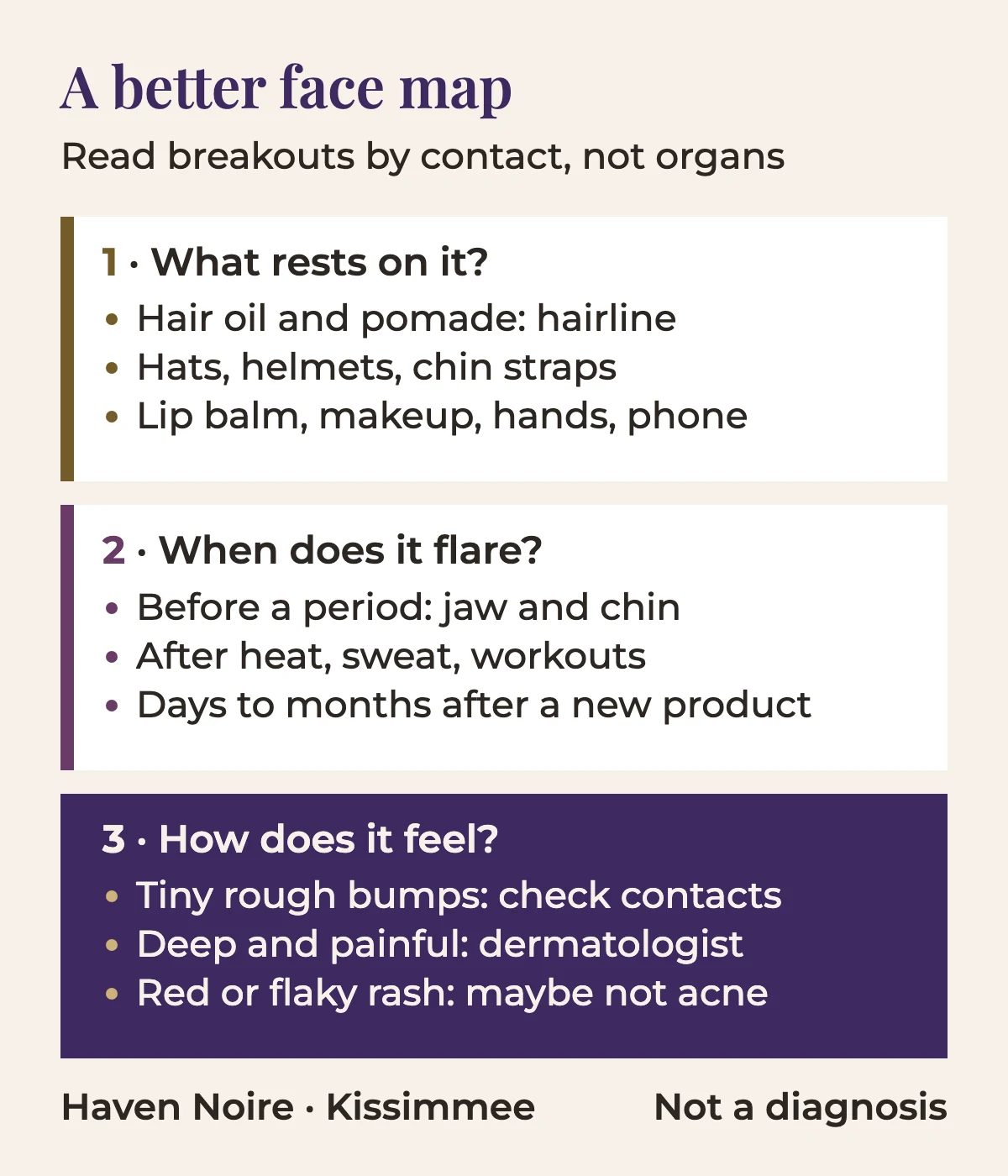
What rests on this zone?
- Hair oils, pomades, and gels: hairline, forehead, temples.
- Hats, headbands, helmets, and chin straps: wherever they rub.
- Makeup, sunscreen, and moisturizer: the AAD says to look for "non-comedogenic" or "won't clog pores" on the label.
- Lipstick and lip balm: around your lips.
- Hands, phones, and pillowcases: cheeks, chin, and jaw.
When does it flare?
- Just before your period, along your jaw and chin: the hormonal pattern the AAD describes.
- After heat, sweat, or a workout: MedlinePlus lists heavy sweating and humidity as triggers.
- Days to months after a new product. A new retinoid or acid is its own case; see skin purging.
- Within 6 months of a new medicine: keep taking it and talk with your prescriber, as the AAD advises.
What does it look and feel like?
- Tiny rough bumps you feel more than see: typical of hair product acne and early acne mechanica, per the AAD.
- Deep, painful bumps: the AAD says these need a dermatologist.
- Redness, warmth, or a dry, flaky rash: it may not be acne at all.
How to track your breakouts for two weeks
- Pick the one or two zones where breakouts keep coming back.
- Each evening, note any new bump: where it is and how it looks and feels.
- Write down what touched that zone that day.
- Note the timing: your cycle if you have periods, workouts, heat, and any new product or medicine.
- After two weeks, look for a repeat. Change one thing at a time, then give it 4 to 6 weeks, the time the AAD says hair product acne can take to clear.
- Bring your notes to your dermatologist, or to your skin analysis with us.
When Your Breakout Zone Isn't Acne at All
An acne face map assumes every bump is acne. Several lookalikes favor certain zones. We're estheticians, not doctors, so we can't diagnose them; each is worth a dermatologist's look.
| Lookalike | Where it tends to show | What the AAD describes |
|---|---|---|
| Rosacea | Nose and cheeks | Flushing, lasting redness or a brown or violet color, and acne-like bumps |
| Perioral dermatitis | Around the mouth, nose, or eyes | A rash that often looks like acne, red on lighter skin and skin colored on skin of color, often dry and flaky |
| "Fungal acne" | Forehead, chest, upper back | Small bumps from yeast in hair follicles that worsen in hot, humid weather |
| Folliculitis, including razor bumps | Beard area, after shaving | Bumps that usually look like a sudden acne breakout |
The AAD's page on rosacea signs notes that on darker skin, acne-like bumps may be the first sign you notice, and a warm feeling on your cheeks may be the only sign of flushing. Its page on perioral dermatitis says many people develop that rash after applying a corticosteroid to their skin for too long. If you use a prescription cream, the AAD says to check with the doctor who prescribed it before you stop.
See how we care for sensitive and redness-prone skin alongside your doctor. Tiny, hard white bumps around the eyes may be milia, not whiteheads.
Acne Zones on Melanin-Rich Skin: Watch the Mark
If your skin is brown or Black, the zone matters less than what a breakout leaves behind. The AAD's tips for darker skin tones say acne in skin of color often comes with dark spots, recommend treating the acne and the spots together, and urge treating acne early, before it becomes moderate to severe and raises the risk of dark patches and keloids.
That's why harsh zone hacks worry us more than the charts do. An AAD article on retinoids quotes a dermatologist: with skin of color, "irritation can trigger dark marks." The AAD's guide to fading dark spots says a spot a few shades darker than your skin usually fades within 6 to 12 months, and deeper color can take years.

The AAD also advises people with darkly pigmented skin to see a dermatologist before using a chemical peel, microdermabrasion, or laser therapy to treat acne, because even at-home versions can cause permanent dark marks and light spots. For marks that have formed, start with how to fade hyperpigmentation on melanin-rich skin, and see our guide to facials for Black skin.
After the Acne Face Map: Treat the Whole Area
A face map can tempt you to fight one zone at a time. The AAD's list of habits that can worsen acne says applying acne medication only to your blemishes fails to prevent new ones. Spread a thin layer over all your acne-prone skin instead: if you break out on your forehead, nose, and chin, treat all three.
Then give it time. The AAD says to use a product for 6 to 8 weeks before judging it, and complete clearing generally takes 3 to 4 months. The AAD release names retinoids, benzoyl peroxide, and salicylic acid as common acne treatments, and Dr. Fahs advises keeping the rest of your routine gentle.
Go deeper with how to use retinol and whether pimple patches work. Pregnant? The AAD says retinoids should not be used during pregnancy, so ask your doctor before starting any acne product. On isotretinoin, tretinoin, or another prescription skin medicine? Your dermatologist's plan comes first.
Where a Facial Fits: Skin Analysis, Not a Zone Chart
We don't read organs from your breakouts. Every Signature Facial begins with a consultation and double cleanse, then a skin analysis, where your esthetician examines your skin to customize every step that follows, from exfoliation and extractions as needed to serums, moisturizer, and SPF.
Tiffany, our founder, is a Florida-licensed esthetician. We're estheticians, not doctors: we can't diagnose a skin condition, and a facial isn't a treatment for one. A skin analysis adds a trained second look at your pattern, so bring your breakout notes, and you'll leave with home-care recommendations. Extractions are a cosmetic step, as our guide to facial extractions explains.
A 60-minute Signature Facial is $95 (3 for $210); 90 minutes is $110 (3 for $285). For congestion, the Acne Oxygen Rx option in our Corrective Facial ($135, or $360 for a 3-pack) pairs oxygen therapy with a purifying charcoal mask. See our acne facials page, or read what to expect at your first facial.
When to See a Dermatologist or Doctor Instead
Book a dermatologist or your doctor first, not a facial, if any of these fit:
- Deep, painful bumps or cysts. The AAD's release warns that untreated cystic acne can scar.
- Jawline breakouts that track your period, especially with irregular periods or extra hair on your face or chin. The AAD's retinoid article says people whose acne is tied to their periods or to hormonal changes such as hair growth should see a board-certified dermatologist before trying a retinoid. The Office on Women's Health lists acne, irregular periods, and too much hair on the face or chin among symptoms of polycystic ovary syndrome (PCOS). These signs don't diagnose anything on their own; it takes a doctor to diagnose PCOS and rule out other causes.
- Breakouts that began within 6 months of starting a new medicine.
- Redness, flushing, or a rash around your mouth, nose, or eyes.
- Small bumps on your forehead, chest, or upper back that flare in humid heat.
- Scars or dark spots appearing as your acne clears.
- Self-care and over-the-counter products that haven't helped after several months, MedlinePlus's line for contacting a provider.
- Back or chest breakouts that won't clear even after your face does, a question on the AAD's checklist for seeing a dermatologist. Our back acne guide covers that zone.
Once a dermatologist has a plan for your skin, ask whether facials fit it, and tell us what they recommend.
Frequently Asked Questions About Face Mapping
Is face mapping accurate?
For organ charts, we found no evidence. We searched PubMed in November 2026 and found no study linking a breakout's location to a specific internal organ. Location can still hint at a cause, such as hair oil along the hairline or a hormonal pattern along the jaw, so treat your map as a clue, not a diagnosis.
What does acne on your chin and jawline mean?
It can mean several things. An AAD dermatologist says hormonal acne typically appears as cystic or inflammatory bumps along the jawline, chin, and lower cheeks, and many patients notice flares just before a period. Chin straps, helmets, and shaving can cause bumps there too. If flares are deep, painful, or come with irregular periods, see a dermatologist or doctor.
What does forehead acne mean?
Traditional charts tie the forehead to digestion, but we found no dermatology source that does. The AAD points to the surface: shampoos, conditioners, and styling products can cause tiny bumps along the hairline and forehead, and acne only on the forehead and temples may be pomade acne from hair oil. Hats and headbands can play a part too.
Does cheek acne mean something is wrong with your lungs or stomach?
Not according to any dermatology source we found. The AAD links cheek breakouts to makeup and skin products, which can take up to 6 months to cause acne cosmetica. Your hands, phone, and pillowcase are worth checking too. Lasting redness with acne-like bumps across your nose and cheeks may be rosacea, which needs a dermatologist.
Can certain foods cause breakouts in one area of your face?
We found no source that ties a food to a facial zone. The AAD reports that small studies suggest a low-glycemic diet may reduce acne, though other studies found no connection, and that some studies link cow's milk to breakouts. MedlinePlus says research doesn't show that chocolate, nuts, or greasy foods cause acne. For the season of sweets, see holiday eating and breakouts.
Can an esthetician tell what your breakouts mean?
An esthetician can look at your skin and your pattern, but can't diagnose. At Haven Noire, every facial begins with a skin analysis at no extra charge, and a 60-minute Signature Facial is $95. We're estheticians, not doctors, so a pattern that points to a medical cause belongs with a dermatologist.
How long should you test a change before deciding it worked?
Longer than most people expect. The AAD says acne from hair products can take 4 to 6 weeks to clear after you stop the product, and that an acne treatment needs 6 to 8 weeks before you judge it. Change one thing at a time, so you know which change made the difference.
More from the Journal

About the author
Tiffany · Licensed Esthetician · Licensed PMU Artist
Tiffany is a Florida-licensed esthetician and permanent makeup artist and the founder of Haven Noire. She specializes in customized facials, corrective skincare, and waxing for melanin-rich and all skin types, and is known for a calm, education-first approach that puts first-time clients instantly at ease.
Meet Tiffany →