

Closed comedones are the tiny, skin-colored bumps you can feel more than see, usually across your forehead and chin. Each one is a pore plugged with oil and dead skin under a sealed surface.
Here's how to get rid of closed comedones, in short: stop using what clogs your pores, treat the whole area with one pore-unclogging product, and leave the bumps alone for six to eight weeks. The American Academy of Dermatology (AAD) says dermatologists recommend a retinoid to unclog pores, and that you can buy one, adapalene, without a prescription.
Pregnant, or using isotretinoin, tretinoin, or another prescription? Ask your doctor or dermatologist before you start.
Most guides start by adding products. With these bumps, the first fix is often taking one away. And on melanin-rich skin, the heavy cover-up many of us use to hide dark marks can feed the next crop.
What Are Closed Comedones?
Closed comedones are pores plugged with oil and dead skin cells under a closed surface. They look like small, raised bumps, white or the same color as your skin, and they're one type of acne, often called whiteheads.
MedlinePlus, from the U.S. National Library of Medicine, lists the term as another name for whiteheads, which it says form when oil and skin collect in the pores. DermNet, a dermatology reference from New Zealand, says the follicle is completely blocked, and calls the pattern where most of your bumps are comedones "comedonal acne." A Cleveland Clinic article on comedonal acne adds that these plugged follicles are covered with skin, and that this type of acne usually appears on your forehead and chin.
Closed vs. open comedones
Open comedones are blackheads: the same kind of plug in a pore that stays open, and both the AAD and DermNet say the dark top isn't dirt. Seeing dark dots instead of skin-colored bumps? Start with how to get rid of blackheads.
Is it a whitehead or a look-alike?
- Tiny white bumps whose middle stays white may be milia, which MedlinePlus says aren't a true form of acne. See what milia are and how they're removed.
- Small bumps on your forehead, chest, and upper back that worsen in hot, humid weather may be "fungal acne." A May 27, 2025 AAD news release describes that pattern and says it's caused by an overgrowth of yeast in hair follicles. A dermatologist can tell you which one you have.
- Sore, swollen, or pus-filled pimples are a different kind of breakout. The AAD's advice for them is the same: don't pop or squeeze.
- Rough patches rather than bumps? Our guide to textured skin sorts the other causes.
What Causes Whiteheads, and What Keeps Them Coming Back
Every one starts with oil and dead skin cells collecting in a pore. The useful question is what keeps topping it up. DermNet's list of contributing factors includes:
- Oily pomades, and cosmetic ingredients such as isopropyl myristate, propylene glycol, and some dyes.
- Skin overhydrated by moisturizers, before a period, or in humid conditions.
- Injury to the follicle, such as squeezing pimples or abrasive washing.
- Smoking: DermNet says comedonal acne is more common in smokers.
MedlinePlus's acne guide adds hormonal changes that make skin oilier, greasy or oily cosmetic and hair products, heavy sweating and humidity, and touching or rubbing the skin. The AAD names one that's close to home for many of our clients: cocoa butter or shea butter on your face can clog your pores. For where shea still earns its place, see where shea butter helps and where it clogs.
Why humidity shows up on both lists
Humidity is on both lists, and Central Florida has plenty of it. Our take: if your bumps arrived with a move to Kissimmee or with the summer, look at how much you layer on, not only at what. And if you've seen charts that tie each zone of your face to an organ, our face mapping guide looks at what holds up.
What about diet?
DermNet says milk products and high glycemic index foods may contribute. MedlinePlus calls the link with refined sugars or dairy controversial, and says research doesn't show that chocolate, nuts, or greasy foods cause acne. So the evidence on diet is mixed. In our view, your products are the easier place to start. Heading into the holidays? See holiday eating and breakouts.
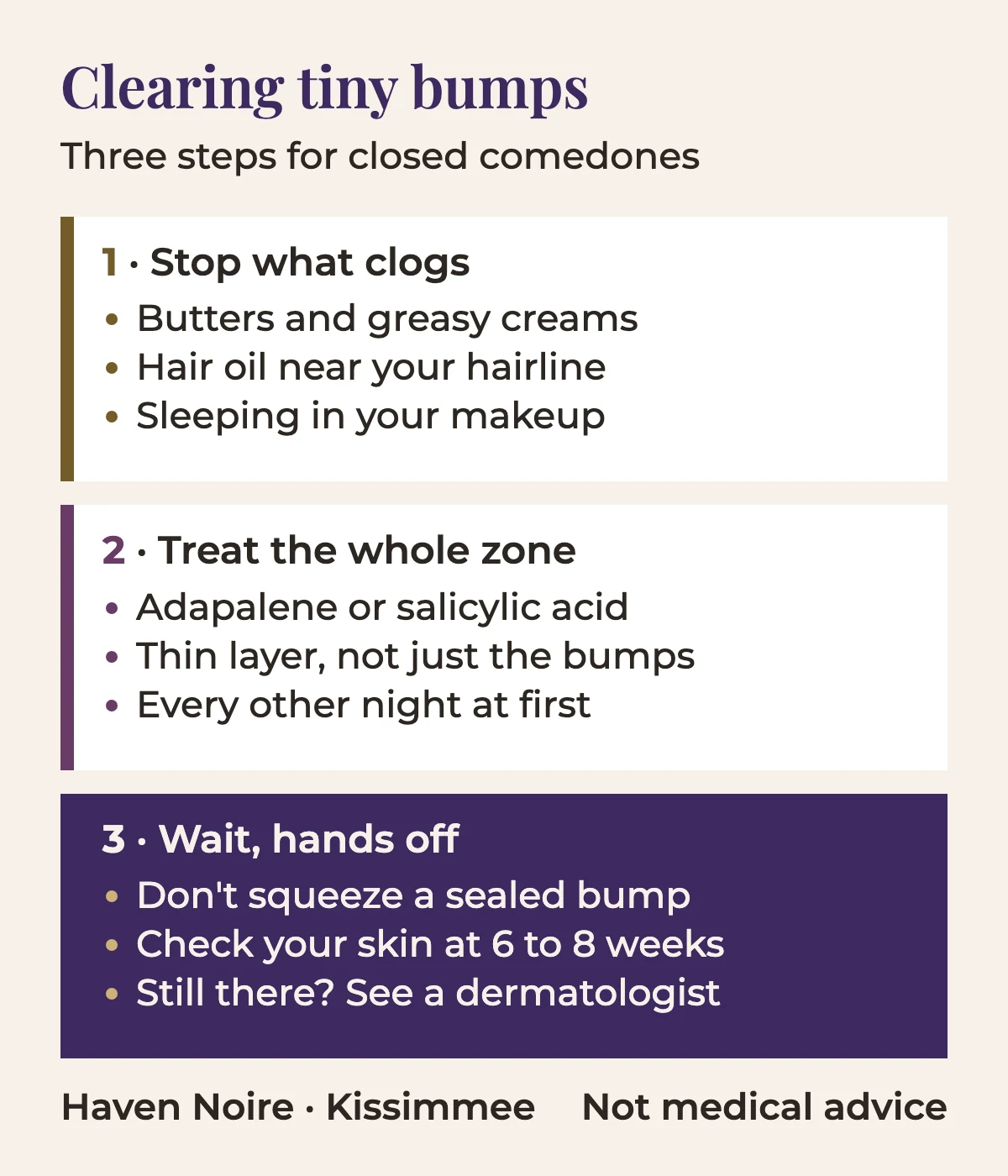
How to Get Rid of Closed Comedones in 3 Steps
These three steps are built on AAD, MedlinePlus, and DermNet guidance. They're our suggestions, not medical rules, and they don't replace a dermatologist.
The order is the point. The AAD's page on makeup and acne describes acne cosmetica as many tiny bumps on the cheeks, chin, or forehead, often whiteheads that rise slightly above the skin. It says this acne will often clear when you stop using the makeup and hair and skin care products that clog your pores, but if anything else is causing your acne, you'll still see acne. So you take things away first, then treat, not one instead of the other.
Step 1: Stop using what clogs your pores
Audit everything that touches your forehead, cheeks, and chin, and look back further than last week. The same AAD makeup page says acne cosmetica can take anywhere from a few days to 6 months to appear, so the culprit may not be your newest product.
| Check | What the source says | What to try |
|---|---|---|
| Moisturizer, sunscreen, makeup | AAD: look for oil-free, won't clog pores, or non-comedogenic. MedlinePlus: non-comedogenic products were tested not to clog pores in most people | Read every label and swap the greasy ones |
| Cocoa or shea butter | AAD: on your face, back, or chest, it can clog your pores | Keep butters for the rest of your body |
| Hair oil or pomade | AAD: acne only on the forehead and temples may be pomade acne | Keep oil off your hairline |
| Sleeping in makeup | AAD: even non-comedogenic makeup can cause acne if you sleep in it | Take it all off every night |
| Scrubs and extra washing | AAD: scrubbing can irritate your skin, causing acne to flare | Wash twice a day with your fingertips |
Our tip: change your face products first, then hold them steady while you treat, so you can tell what's working. Our guide to double cleansing covers taking makeup and sunscreen off properly.
Step 2: Treat the whole zone with one active
Pick one pore-unclogging product. DermNet calls these comedolytic treatments, applied as a thin smear to the entire affected area, and notes that microcomedones are too small to see. The AAD says to spread acne medication on all acne-prone skin, not just your blemishes.
| Active | What the source says | Good to know |
|---|---|---|
| Adapalene, a retinoid | AAD: dermatologists recommend a retinoid to unclog pores, and adapalene is sold without a prescription | AAD: retinoids should not be used during pregnancy |
| Salicylic acid | AAD: works best on whiteheads and blackheads because it unclogs pores and exfoliates | It already exfoliates, so skip scrubs alongside it |
| Benzoyl peroxide | AAD: paired with a retinoid, it works well in skin of color | AAD: start with 2.5%; it bleaches towels and sheets |
| Azelaic or glycolic acid | DermNet lists both among topical treatments for comedonal acne | Ask your dermatologist how to fit them in |
- Choose one. The AAD's adult acne guide says to use it as directed for 6 to 8 weeks without adding another product.
- Start slowly. In the AAD's guide to retinoids and retinol, a dermatologist advises the least-intense formula you can find, every other night at first.
- Smooth a thin layer over the whole zone, not just the bumps. Use a retinoid only at night, as the same guide advises.
- Wear sunscreen by day. The same guide says retinoids can make skin more sensitive to sun.
New to retinoids? See how to use retinol. More bumps in the first weeks? Read about skin purging before you quit. Stinging or tightness? Slow down and see how to repair your skin barrier.
The AAD says retinoids should not be used during pregnancy, and that anyone pregnant or trying should consult a dermatologist before treating acne on their own. On isotretinoin, tretinoin, or another prescription, or living with eczema or rosacea? Ask your dermatologist before adding anything.
Step 3: Wait, and leave the bumps alone
Each bump is sealed under skin, with no open pore for the plug to leave through. The AAD's page on pimple popping says pushing contents deeper often happens and increases inflammation. Its acne symptoms guide adds that picking at these bumps can lead to more whiteheads and acne scars.
- Weeks 4 to 6: the AAD's tips for acne that won't clear say a treatment that works should show some improvement.
- Weeks 6 to 8: your checkpoint. The AAD's guide to acne types says to give treatment six to eight weeks, then consider a dermatologist if you still see blemishes.
- Weeks 8 to 12: a Cleveland Clinic article on comedonal acne says you may start to notice a difference with persistent care.
- After that: the AAD's won't-clear tips say clearing can take two to three months or longer, and to keep using the treatment even once you clear.
If your hands keep drifting to your face while you wait, our guide to pimple patches looks at what they can and can't do.
Clogged Pores on Melanin-Rich Skin: When Cover-Up Causes Breakouts
If your skin is brown or Black, a breakout can cost more than the bump itself. The AAD's tips for clearing acne in darker skin tones say many people seek a dermatologist's help for the dark spots, which can last much longer than the acne. Its dark spot guide says a spot a few shades darker than your natural color usually fades within 6 to 12 months, and color that lies deep in the skin can take years.
Two AAD pages describe the same trap. The makeup page warns that you may treat acne, then cover it with acne-causing makeup, and that continuing to use it leads to a never-ending cycle of breakouts. The darker skin page adds that heavy, oily makeup used to hide dark marks can also cause new blemishes, and that mineral or non-comedogenic makeup is okay.
Three ways to break that cycle:
- Cover with mineral or non-comedogenic makeup, and take it off every night. Getting ready for an event? Here's skin prep for makeup that won't clog pores.
- Go slowly with actives. In the AAD's retinoid guide, a dermatologist warns that with skin of color, irritation can trigger dark marks, and says starting slowly and using moisturizer helps.
- Wear tinted sunscreen. The AAD's dark spot guide recommends one with iron oxide, SPF 30 or higher. Our guide to sunscreen for dark skin shows how to choose.
Pomade acne along your hairline
If your bumps sit only on your forehead and temples, the AAD says hair oil may be the cause, common enough to have a name: pomade acne. Its suggestions include a hair product made with water or glycerin instead of oil, and using oil only in the middle of your scalp and on the ends of your hair. The same page says to wash caps and hats often. Oiling your edges with castor oil? See what castor oil means for acne-prone skin.
Peels and microdermabrasion: see a dermatologist first
The AAD advises seeing a dermatologist before any chemical peel, microdermabrasion, or laser therapy to treat acne, because on darkly pigmented skin even at-home versions can cause permanent dark marks and light spots. In our reading, that includes spa resurfacing, ours too, when acne is why you're booking. For the bigger picture, read facials for Black skin. If marks have already formed, start with how to fade hyperpigmentation on melanin-rich skin.
Where a Facial Fits in Your Plan
A facial can support your plan for how to get rid of closed comedones, but it isn't an acne treatment. The AAD's pimple popping page describes acne extraction with sterile instruments as a dermatologist's technique, usually offered when other acne treatment fails to clear the skin.
Extraction in a facial is a cosmetic step for congestion. Our Signature Facial lists exfoliation and extractions as needed, to refine texture and clear congestion, after a double cleanse and a skin analysis that tailors the treatment to your skin that day. Our guide to facial extractions explains which bumps that step suits.
For congestion that keeps coming back, our corrective facials include options our menu lists for congested skin, among them the Acne Oxygen Rx, built around oxygen therapy and a purifying charcoal mask, and the Hydrofacial, a gentle, water-based hydrodermabrasion treatment. Read what the evidence says about oxygen facials, or see our acne facials page for our wider approach to breakouts.
- Tell us your routine when you book, including adapalene, acids, and any prescription.
- Leave your bumps alone in the days before, so we see your skin as it is.
- Monthly visits? The Glow Membership is $74.99 a month for a 60-minute Signature Facial, and the Corrective Membership is $109.99 a month for any corrective facial, each with a three-month minimum. Compare them on our memberships page.
Between visits, ask us about home care from the professional skincare lines we use.
When to See a Dermatologist or Doctor
Haven Noire is an esthetics spa, not a medical office. We don't diagnose acne or treat it medically. See a board-certified dermatologist or your doctor if:
- Your bumps remain after six to eight weeks of treatment. The AAD says comedo extraction or prescription-strength treatment may help.
- They're stubborn. DermNet lists procedures such as cryotherapy and electrosurgery for persistent comedones, which are medical procedures.
- Small bumps on your forehead, chest, and upper back flare in the heat. That can be fungal acne, which the AAD says needs different treatment from hormonal acne. Our guide to sweat pimples covers heat-season breakouts.
- Breakouts follow your period or come with hormonal changes such as new hair growth. The AAD's retinoid guide says to see a dermatologist before trying a retinoid.
- You have deep or painful acne. The AAD says seeing a dermatologist is necessary.
- You're pregnant or trying, take isotretinoin, use a prescription on your skin, or have eczema or rosacea.
- Acne is getting worse, which MedlinePlus lists as a reason to contact a provider, or it's affecting your mental health, which the NHS lists as a reason to see a doctor.
- Breakouts are leaving dark spots or raised scars. The AAD says that when acne becomes moderate to severe before treatment, people with skin of color have a higher risk of dark patches and keloids, a type of raised scar.
Frequently Asked Questions About Closed Comedones
How long does it take to get rid of closed comedones?
Plan on weeks, not days. The American Academy of Dermatology's guide to acne types says to give treatment six to eight weeks to work, and its tips for stubborn acne say clearing can take two to three months or longer. A Cleveland Clinic article on comedonal acne says you may notice a difference in 8 to 12 weeks.
Is it safe to pop a whitehead?
No. It sits under a layer of skin, so there's no open path out. The American Academy of Dermatology says squeezing often pushes contents deeper and increases inflammation, and that picking at these bumps can lead to more whiteheads and scars. On brown and Black skin, it adds, the dark spots acne leaves can outlast the acne itself.
Are closed comedones the same as whiteheads?
Yes, they're two names for the same bump, according to MedlinePlus. DermNet describes them as whiteheads in which the follicle is completely blocked. They can look white or the same color as your skin. Open comedones are blackheads: the same kind of plug, in a pore that stays open at the surface.
Why do I keep getting tiny bumps on my forehead?
A Cleveland Clinic article says comedonal acne usually appears on your forehead and chin. If they sit only along your forehead and temples, the American Academy of Dermatology says hair oil may be the cause, which it calls pomade acne. Small bumps on the forehead, chest, and upper back that worsen in humid heat may be fungal acne instead.
Can moisturizer clog your pores?
It can contribute. DermNet lists skin overhydrated by moisturizers or humid conditions among the factors behind comedonal acne, and MedlinePlus names greasy or oily cosmetics. Choose products labeled non-comedogenic, which MedlinePlus says were tested not to clog pores in most people, and keep cocoa or shea butter off your face, as the AAD advises.
What is the best treatment for whiteheads?
The American Academy of Dermatology says dermatologists recommend a retinoid to unclog pores, and adapalene is sold without a prescription. It also says salicylic acid works best on whiteheads and blackheads. Choose one, apply a thin layer over the whole area, and give it six to eight weeks. Pregnant? Skip retinoids and ask your doctor.
Can a facial clear whiteheads?
A facial can clear some of the clogs you can see, but it doesn't treat acne. Our 60-minute Signature Facial ($95) includes exfoliation and extractions as needed. The American Academy of Dermatology says whiteheads can return, so keep your home routine going. For full pricing, see what a facial costs in Kissimmee.
More from the Journal

About the author
Tiffany · Licensed Esthetician · Licensed PMU Artist
Tiffany is a Florida-licensed esthetician and permanent makeup artist and the founder of Haven Noire. She specializes in customized facials, corrective skincare, and waxing for melanin-rich and all skin types, and is known for a calm, education-first approach that puts first-time clients instantly at ease.
Meet Tiffany →