
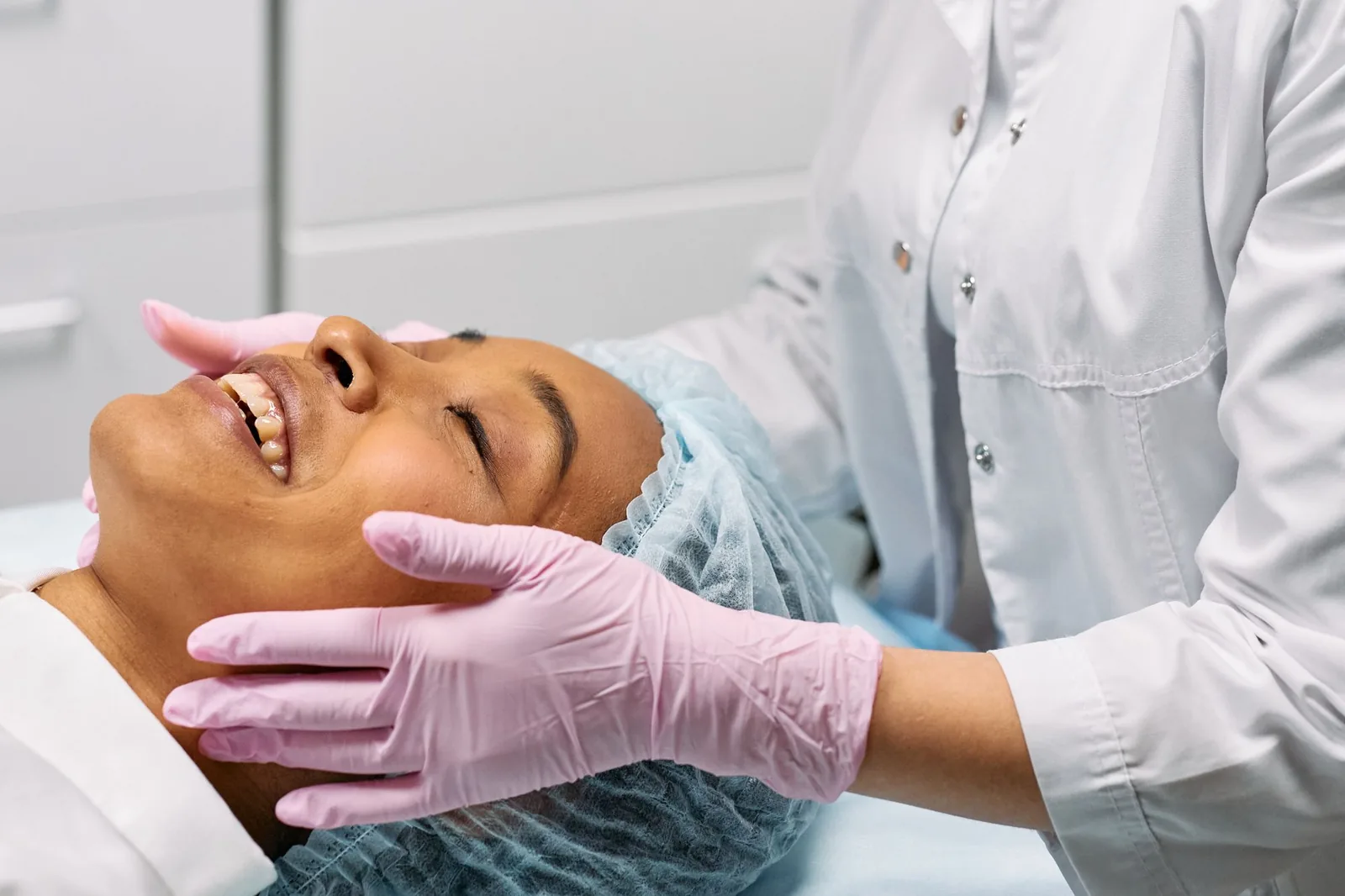
Facial extractions are the step in a facial where an esthetician clears clogged pores, mainly blackheads and whiteheads. They help when the problem is a clog. They aren't the answer for a sore pimple or a deep, painful lump, and squeezing either one at home can leave a scar or a dark mark.
At Haven Noire in downtown Kissimmee, extractions are part of our 60-minute Signature Facial ($95) as needed, after a double cleanse and a skin analysis. So the honest answer to "are extractions good or bad?" is this: it depends on the bump.
Most guides stop at the benefits. Below, you'll learn to sort a bump before you touch it, what a deep cleansing facial is, how to protect melanin-rich skin, and how to stop picking.
What Are Facial Extractions?
Facial extractions clear clogged pores during a facial. An esthetician removes the plug of oil and dead skin cells that forms a blackhead or whitehead. On a spa menu, it's a cosmetic step to clear congestion, not a medical treatment for acne. Tiny, hard, pearly white bumps may be milia instead, which aren't a job for the extraction step.
Those plugs have names. The American Academy of Dermatology (AAD) explains that both form when excess oil and dead skin cells build up in a pore. A whitehead plugs the opening. A blackhead widens it, and its color isn't dirt. The AAD says the black color appears when the buildup reacts with oxygen in the air.
That changes what you do at home. If blackheads aren't dirt, scrubbing harder won't wash them away. MedlinePlus, from the U.S. National Library of Medicine, advises cleaning your skin gently with a mild, nondrying soap and avoiding scrubbing or repeated washing.
Are facial extractions good or bad for your skin?
Both answers are half true. Here's what the sources say:
- Squeezing at home backfires. The AAD's guide to pimple popping says pushing a pimple's contents deeper into the skin, which often happens, increases inflammation, and bacteria on your hands can cause an infection.
- Blackheads aren't an exception. The AAD says squeezing a blackhead can cause an infection or a permanent scar.
- As an acne treatment, extraction is a dermatologist's job. The same AAD page is titled "Why only a dermatologist should do it." It describes acne extraction, using sterile instruments to remove blackheads and whiteheads, as a dermatologist's technique, usually offered when other acne treatment fails to clear the skin.
Our view: the extraction step in a facial is not that acne treatment. Our Signature Facial lists "exfoliation and extractions as needed, to refine texture and clear congestion." That makes it a tool for a clog, not for inflamed, deep, or stubborn acne, which belong with a dermatologist. It isn't a pore-size fix either. If large pores are your real concern, read how to make pores look smaller.
Which Bumps Facial Extractions Can Help
Before your hands get involved, look in the mirror and sort the bump into one of three groups. The groups match acne types the AAD and the NHS describe, and each one ends in a next step: a facial, hands off, or a dermatologist.
The next steps are our advice, not theirs. Sorting helps you decide what to do next. It isn't a diagnosis, and it doesn't replace a dermatologist's exam. If you aren't sure a bump is acne at all, that's a question for a dermatologist too.
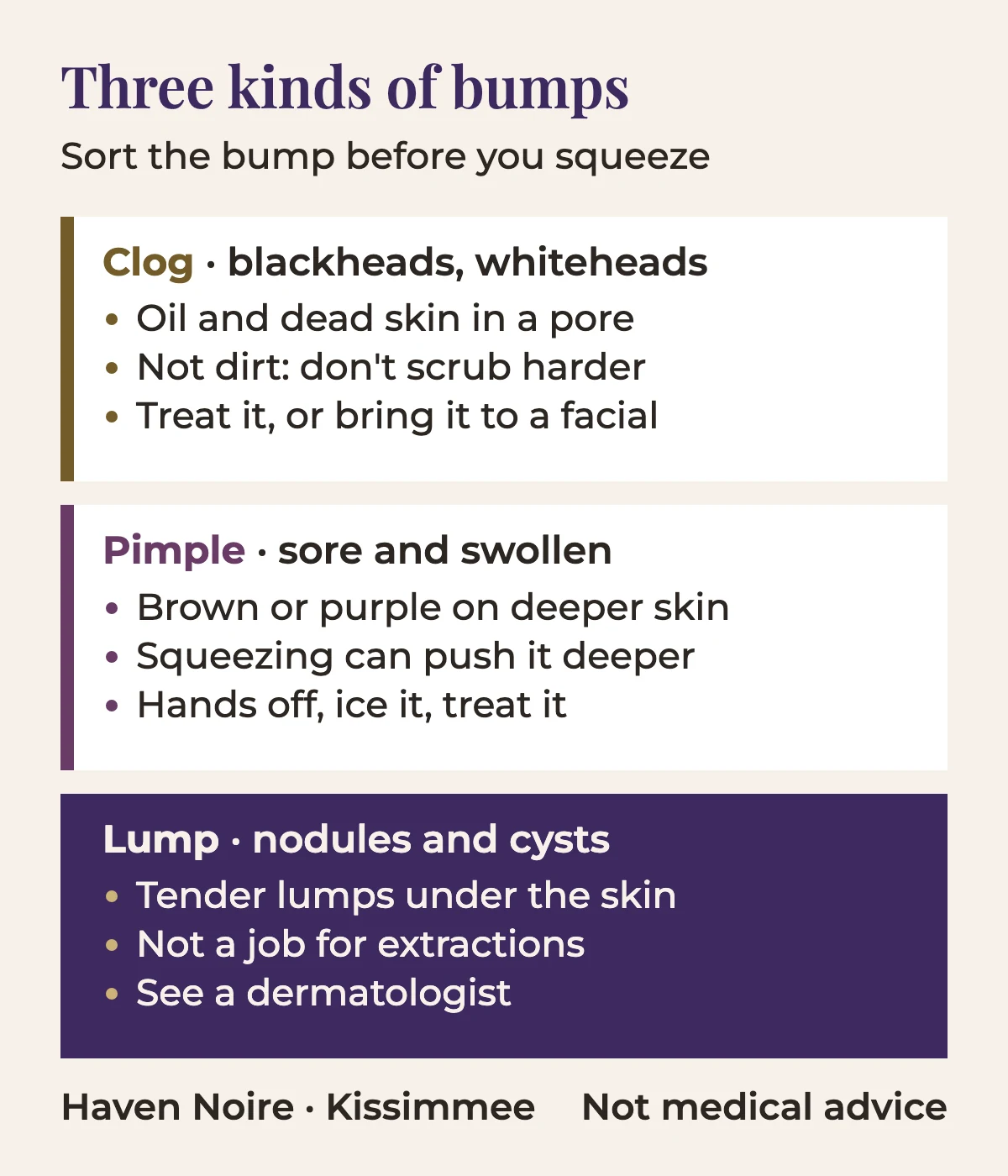
Blackheads and whiteheads
What it looks like: the NHS acne guide describes whiteheads as small bumps the same color as your skin, and blackheads as black and brown spots that are usually flat but may be raised.
What to do: don't squeeze. At home, the AAD recommends treating clogs rather than picking: an acne treatment for whiteheads and a retinoid for blackheads. Our guide to getting rid of blackheads at home lays out that routine week by week. It notes that picking at whiteheads can lead to more whiteheads and acne scars. Clogs are also what a facial's extraction step is for, so save them for your appointment instead of the bathroom mirror. Using a retinoid? Tell us before your facial. Pregnant or trying to get pregnant? Ask your doctor before you start one.
- Choose makeup and creams labeled noncomedogenic. MedlinePlus says these have been tested and proven not to clog pores and cause acne in most people.
- Feel tiny, skin-colored bumps that make your skin rough? Our guide to textured skin helps you tell clogs from other causes.
Sore, swollen pimples
What it looks like: a raised bump, sometimes with a pus-filled head. The AAD calls a pimple with pus a pustule and one without pus a papule. Watch the color. The NHS says papules look pink or red on white skin, but on brown and black skin they may look brown or purple. If you're waiting for redness as your signal, you can miss it.
What to do: hands off. A sore pimple isn't a clog waiting to be emptied. It's inflammation. The AAD lists three things to do while you wait:
- Keep your hands away from your face. The AAD says touching, picking, and popping can worsen acne. Once a pimple has a head, a hydrocolloid patch can act as a shield.
- Relieve pain with ice, which the AAD says reduces the inflammation. Wrap it in a thin cloth first; our guide to icing your face safely explains why.
- Treat your acne. The AAD says many people can clear acne with treatment they buy online or at a drugstore, and that a dermatologist can help if you don't see results in 4 to 6 weeks.
Coming in for a facial with one? Point it out at your consultation instead of squeezing it the night before. If breakouts are the main reason you book, start with our acne facials page and the best facial for acne in Kissimmee.
Nodules and cysts
What it looks like: a larger lump under the skin. The AAD says these breakouts go deep into the skin and can feel tender or painful, and the NHS adds that they may join together. A cyst contains pus. A nodule doesn't, so it feels harder.
What to do: see a dermatologist. The AAD says that if you have deep or painful acne, seeing a dermatologist is necessary to help clear it, and it warns that squeezing is likely to push what's inside deeper into your skin.
| Bump | What you see | What the sources say | Your next step |
|---|---|---|---|
| Clog | Blackheads, or whiteheads the color of your skin | Oil and dead skin in a pore; picking whiteheads can lead to more whiteheads and scars | Treat it, don't squeeze it, and save it for a facial with extractions |
| Sore pimple | A raised pimple: red, brown, or purple, sometimes with pus | Squeezing often pushes contents deeper, which increases inflammation | Hands off, ice it, treat it, and point it out at your consultation |
| Deep lump | A tender or painful lump under the skin | Deep or painful acne needs a dermatologist | Book a dermatologist, not an extraction |
What Is a Deep Cleansing Facial?
A deep cleansing facial is a spa menu name, not a medical term. It usually means a facial built around congestion: cleansing, exfoliation, and extractions where a pore needs them. Steps differ from spa to spa, so ask what's included before you book.
Our menu doesn't use that name. Here's where the same work lives at Haven Noire:
| Service | Time | Price | What our menu lists |
|---|---|---|---|
| Signature Facial | 60 minutes | $95, or 3 for $210 | Double cleanse, skin analysis, exfoliation and extractions as needed, custom mask and facial massage, then serums, moisturizer, and SPF |
| Signature Facial | 90 minutes | $110, or 3 for $285 | The same steps, plus a hand and arm massage and an eye treatment |
| Corrective Facial: Acne Oxygen Rx | 60 minutes | $135, or a 3-pack for $360 | Oxygen therapy and a purifying charcoal mask; listed for acne, sensitive, and congested skin |
| Corrective Facial: Hydrofacial | 60 minutes | $135, or a 3-pack for $360 | Gentle, water-based hydrodermabrasion; listed for skin types including congested |
Our Signature Facials are the closest match to what most spas call a deep cleansing facial. For congested skin, the Acne Oxygen Rx and the Hydrofacial sit on our corrective facials menu. Curious about the first one? Read what the evidence says about oxygen facials before you choose it.
Booking for a man? Our facials for men page lists a deep-cleansing corrective facial with thorough decongestion and extractions. Comparing every option? See our guide to types of facials.

What happens during a facial with extractions
In our Signature Facial, exfoliation and extractions are step three of five. They follow the consultation, double cleanse, and skin analysis, and come before the custom mask, facial massage, serums, moisturizer, and SPF.
Every facial begins with a skin analysis, and we tailor the treatment to your skin that day. So "as needed" is literal: some visits call for extractions and some don't. For a walk-through of a whole first visit, read what to expect at your first facial.
Want fewer extractions, or none?
You can ask for less pressure, skip extractions or any other step, or ask to stop, and you don't need to give a reason. It helps to tell us at your consultation, especially if extractions have left marks on you before or make you nervous.
Facial Extractions on Melanin-Rich Skin: Keeping Dark Marks Away
If your skin is brown or Black, a squeezed pimple costs more. The AAD's page on acne in skin of color says acne is often accompanied by dark spots or patches called hyperpigmentation, and that if you pick, pop, or squeeze acne, you increase your risk of a scar.
A 2010 review in the Journal of Clinical and Aesthetic Dermatology says post-inflammatory hyperpigmentation, the dark mark left after skin is inflamed or injured, tends to affect darker skin more often and more severely. It calls the condition particularly common after acne in dark-skinned patients, and it lists cosmetic procedures, along with irritants and burns, among the skin injuries that can cause it.
That last point is the honest part: a facial that injures your skin can leave a mark too. On our menu, extractions are listed "as needed," and you can skip them. Ignoring clogs isn't the answer either. MedlinePlus explains that when bacteria get trapped in a plug, the immune system may react, causing pimples, so keep treating clogs at home the way the AAD recommends. Our guide to facials for Black skin shows how heat, pressure, and exfoliation add up on deeper skin.
Time is the other cost. The AAD's guide to fading dark spots in darker skin tones says dark spots often appear when a pimple clears, and that a spot a few shades darker than your natural color usually fades within 6 to 12 months. If the color lies deep in the skin, fading can take years. That's a long time to wear a few seconds of squeezing.
Three habits that protect melanin-rich skin:
- Don't pre-squeeze. Leave sore pimples alone in the days before a facial.
- Tell us if you mark easily. Dark spots left by breakouts, bug bites, or earlier facials are worth mentioning before we start.
- Wear tinted sunscreen every day. The AAD recommends a tinted sunscreen with iron oxide, SPF 30 or higher, with broad-spectrum protection. Our guide to sunscreen for dark skin shows you how to choose one.
If a mark has already formed, start with how to fade hyperpigmentation on melanin-rich skin.
Between Facials: How to Stop Picking at Home
A facial with extractions clears today's clogs. The urge to squeeze tomorrow's is still yours to manage, and it's the part most extraction guides skip.
The NHS notes that most people pick at their skin from time to time. For some, it goes further. The NHS describes skin picking disorder, also called dermatillomania or excoriation disorder, as being unable to stop picking at your skin. Its signs include picking spots or scars to try to "smooth" or "perfect" them, not always realizing you're doing it, and picking when you feel anxious or stressed.
What to do instead of squeezing
These come from the NHS's own self-help list. The mirror example and the last tip are our own additions:
- Keep your hands busy. Try squeezing a soft ball or putting on gloves.
- Find your triggers. Notice when and where you pick most, then avoid those moments. If it's a magnifying mirror, put it away.
- Make it harder. Keep your nails trimmed, and keep tweezers and pins out of easy reach.
- Care for your skin instead. When the urge hits, apply moisturizer.
- Put your next facial on the calendar. Our tip: a clog is easier to leave alone when you know the day it gets handled.

After a facial with extractions
Our aftercare for a Signature Facial is short: keep skin hydrated, skip harsh actives and heat for 24 hours, and wear SPF daily. After a corrective facial, avoid sun exposure and active exfoliants for a few days. If a small bump appears afterward, treat it like a sore pimple: leave it alone.
How often to book
Clogs come back. The AAD says blackheads and whiteheads can return, so you'll need a skin-care plan to prevent new ones. Most skin does best with a facial about every four weeks; for the full answer, read how often you should get a facial.
If monthly is your rhythm, the Glow Membership covers one 60-minute Signature Facial every month for $74.99, with a three-month minimum.
When to See a Dermatologist Instead of Booking Facial Extractions
We're licensed estheticians, not a medical clinic. We don't diagnose acne or treat it medically, and extractions don't replace a dermatologist. Here's when to see one first.
See a dermatologist or your doctor about your skin
- Deep or painful acne, meaning nodules or cysts. The AAD says seeing a dermatologist is necessary.
- Acne that isn't clearing. The AAD says a dermatologist can help if you don't see results in 4 to 6 weeks.
- Lots of spots, spots that are deep, painful, or scarring, or acne that's affecting your mental health. The NHS lists each as a reason to see a doctor.
- Hot, swollen, red skin, a sign of infection. The NHS notes that redness can be harder to see on brown and black skin.
- A dark mark that isn't fading. The AAD says a dermatologist can help when the treatment you're using fails to deliver.
- Raised scars. The AAD says people with skin of color whose acne becomes moderate to severe before treatment have a higher risk of keloids.
See a doctor about picking
The NHS advises seeing a doctor if:
- You can't stop picking your skin.
- Picking causes serious damage, like cuts that don't heal within a few days.
- Picking causes you emotional distress or affects your daily life.
This is general information, not medical advice. If you take isotretinoin or another acne prescription, ask your dermatologist whether a facial with extractions fits your treatment, and tell us what you use when you book. Not sure what kind of bump you have? Contact us before you book, and we'll talk it through.
Frequently Asked Questions About Facial Extractions
Are facial extractions good for your skin?
It depends on the bump. In a facial, extractions are a cosmetic step for clogged pores, meaning blackheads and whiteheads, not a medical acne treatment. They're the wrong tool for sore, swollen pimples, which do better left alone, and for deep, painful lumps, which the American Academy of Dermatology says need a dermatologist. Sort the bump first, then decide.
Is it safe to do extractions at home?
The American Academy of Dermatology advises against it. Squeezing can push a pimple's contents deeper and increase inflammation, and bacteria on your hands can cause an infection. The AAD also says squeezing a blackhead can cause an infection or a permanent scar. Treat clogs with an acne product instead, and save extractions for a facial.
Are blackheads just dirt?
No. The American Academy of Dermatology says a blackhead forms when oil and dead skin cells build up inside a pore, and the black color appears when that buildup reacts with oxygen in the air. That's why scrubbing harder doesn't clear them, and why MedlinePlus advises against scrubbing or repeated washing.
Should I pop a pimple before my facial?
No. The American Academy of Dermatology says squeezing often pushes a pimple's contents deeper, which increases inflammation, and on brown or Black skin, acne often comes with dark spots. Leave it alone, ice it if it's sore, and point it out at your consultation so we can tailor the facial to your skin that day.
Do facial extractions cause dark spots on Black skin?
They can if skin is injured. A 2010 dermatology review lists cosmetic procedures among the skin injuries that can cause post-inflammatory hyperpigmentation, which affects darker skin more often and more severely. Tell us if you mark easily; you can also skip extractions. Squeezing at home can leave marks too, so leave spots alone and wear tinted sunscreen daily.
How often should you get a facial with extractions?
Most skin does best with a facial about every four weeks, and active concerns may call for a shorter series to start. The American Academy of Dermatology says blackheads and whiteheads can return, so a steady home routine matters too. We'll recommend a cadence for your skin during your visit.
What's the difference between a deep cleansing facial and a regular facial?
A deep cleansing facial is a menu name for a facial focused on congestion, usually with exfoliation and extractions. A relaxing facial puts more weight on hydration and massage. At Haven Noire, our Signature Facial includes both sides: exfoliation and extractions as needed, plus a custom mask and facial massage.
How much is a facial with extractions in Kissimmee?
At Haven Noire in downtown Kissimmee, the 60-minute Signature Facial, which includes extractions as needed, is $95, or 3 for $210. The 90-minute version is $110, or 3 for $285. A Corrective Facial is $135. For the full price picture, see what a facial costs in Kissimmee.
More from the Journal

About the author
Tiffany · Licensed Esthetician · Licensed PMU Artist
Tiffany is a Florida-licensed esthetician and permanent makeup artist and the founder of Haven Noire. She specializes in customized facials, corrective skincare, and waxing for melanin-rich and all skin types, and is known for a calm, education-first approach that puts first-time clients instantly at ease.
Meet Tiffany →