

A morning skincare routine does four jobs in this order: cleanse, treat, moisturize, and protect with sunscreen, then makeup if you wear it. A night skincare routine keeps the first three jobs and drops the sunscreen: wash off the day, apply any medicine or treatment, then moisturize. That order comes from the American Academy of Dermatology's (AAD) guide to applying skin care products.
Here's what most routine guides leave out. The popular rule of layering from thinnest to thickest isn't how the AAD sorts your products. It sorts them by job. And its guide to skin care on a budget recommends a simple, three-step approach: cleansing, moisturizing, and protecting your skin. It also warns that using several different products can irritate your skin. A longer routine isn't a better one, especially on melanin-rich skin, where irritation can leave dark spots.
Below: the morning and night steps, a simple way to layer, a Central Florida sunscreen plan, and when your dermatologist's instructions come first. Where a rule is ours and not the AAD's, we say so: it's our judgment, not a medical rule.
Morning Skincare Routine Steps, in Order
A morning skincare routine gets your skin ready for the day. You clean it, add any treatment, moisturize, and finish with sunscreen, the one step a night routine doesn't have.
Here are the skin care routine steps in the AAD's order, with details from its other guides:
- Cleanse. The AAD's budget guide says water or a gentle cleanser is fine in the morning. Use lukewarm water and your fingertips, then gently pat dry.
- Treat, if you use a treatment. The AAD says medicine or other treatment goes on right after cleansing. Around your eyes, use your ring finger, the weakest finger, so you don't pull on delicate skin.
- Moisturize. Apply it while your skin is still slightly damp; the AAD says moisturizer traps water in your skin, and that you should moisturize even if your skin is oily.
- Protect. Use a broad-spectrum, water-resistant sunscreen with SPF 30 or higher, at least a teaspoon for your face. The AAD's guide to applying sunscreen says it takes about 15 minutes to protect you, so put it on before you head out. Take it down to your collarbone, too; here's why neck lines can show up early.
- Makeup, if you wear it. It goes last in the AAD's order.
Where toner and serum fit
Neither one is on the AAD's order list, so think of both as optional treatments. A serum is typically applied after cleansing but before moisturizing, according to Harvard Health's article on skin serums; see what a serum does. A toner, if you use one, goes on right after cleansing, in our judgment; see what toner does.
Do you need to wash your face in the morning?
A gentle wash or a rinse, yes. The AAD's tips for healthier skin say washing when you wake up removes the dirt and bacteria that settle on your face while you sleep, and its budget guide says water or a gentle cleanser will do. If a morning cleanser leaves your face tight, try lukewarm water alone. Tightness is one of the signs in our guide to dry vs. dehydrated skin.
Night Skincare Routine Steps, in Order
A night skincare routine removes the day's sunscreen, makeup, and sweat, then applies any treatment and moisturizer before bed. It's the morning order minus the sunscreen.
- Cleanse. Take off sunscreen and makeup first; the AAD's oily skin tips say to always remove all makeup before you go to sleep. Water-resistant sunscreen and long-wear makeup may need two steps, which our double cleansing guide walks through.
- Treat. Apply any medicine or treatment right after cleansing, just as in the morning. Retinoids belong here.
- Moisturize. In our view, night is the easier time for a richer cream if your skin runs dry, since nothing goes on top of it.
Why retinoids go at night
Retinoids can make skin more sensitive to the sun. In the AAD's guide to retinoids and retinol, a dermatologist advises using them only at night and always using sun protection during the day. The same dermatologist advises starting with the least-intense formula you can find and using it every other night at first.
Keep strong actives apart, too. Harvard Health cautions that your skin may get irritated if you use a vitamin C serum along with a retinol cream. In our view, the simplest fix is a split: vitamin C, if you use it, in the morning, and a retinoid at night.
Exfoliating acids and scrubs run on their own schedule; see how often you should exfoliate. Overnight masks and patches, part of the trend called the morning shed, sit on top of this routine, not in place of it.
| Step | Morning | Night |
|---|---|---|
| 1. Cleanse | Water or a gentle cleanser | Remove sunscreen and makeup, then a gentle cleanser |
| 2. Treat | Optional: a serum or treatment, such as vitamin C | Medicine or treatment; a retinoid goes here |
| 3. Moisturize | On slightly damp skin | A richer cream if your skin is dry |
| 4. Protect | Broad spectrum, SPF 30 or higher, water resistant | None |
| Last | Makeup, if you wear it | Nothing more |
How to Layer Skincare by Job, Not Texture
Most layering advice starts with texture: thinnest to thickest, water before oil. The AAD's order guide doesn't mention texture at all. We searched PubMed in November 2026 for studies on the order of applying skin care products and found none that tested a full routine or the thinnest-to-thickest rule. The closest studies tested pairs of products, such as a moisturizer and a prescription steroid cream. So we treat thinnest to thickest as a handy convention, not a rule.
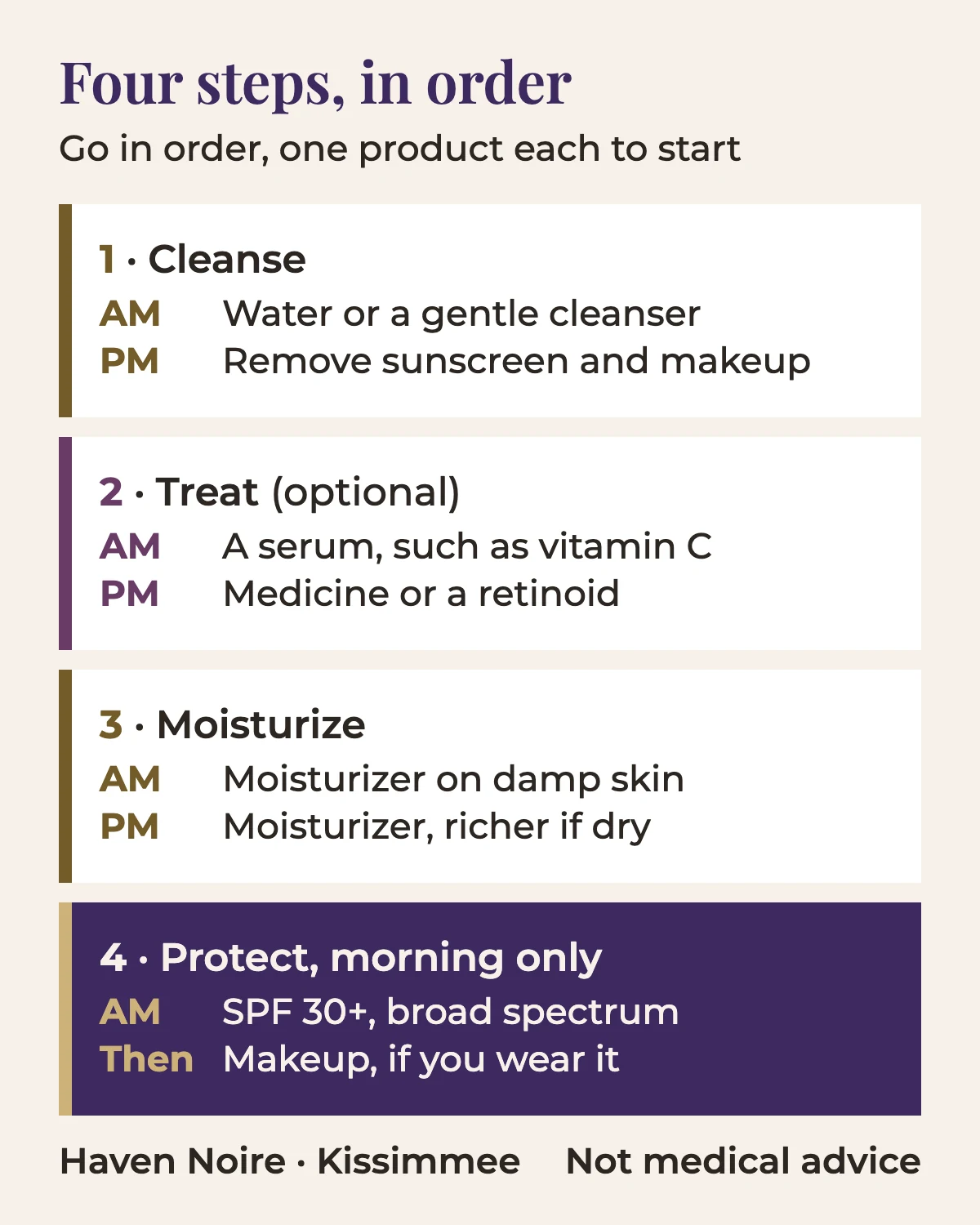
Our approach builds on the AAD's job order, and the rules below are our suggestions. Give every product one of four jobs, and apply them in order.
Step 1: Cleanse
Water or a gentle cleanser in the morning. Sunscreen and makeup removal at night. Everything else goes on clean skin.
Step 2: Treat
Medicine, a retinoid, a serum, or a toner. It goes on right after cleansing, as the AAD advises. It's the only step that's optional morning and night.
Step 3: Moisturize
Moisturizer, morning and night, even on oily skin. If your face feels tight in air conditioning, adjust this step before you add more products. Layering several hydrating products on damp skin has its own trend name; see skin flooding.
Step 4: Protect
Sunscreen, morning only. The AAD lists moisturizer and sunscreen together, so the order between them isn't set. Its budget guide says moisturizer works best on damp skin, while its sunscreen FAQ says to apply sunscreen to dry skin 15 minutes before going outdoors. We'd put moisturizer first, then sunscreen on top once your skin is dry.
Makeup goes over the sunscreen. In a 2021 lab study from a cosmetics company's research center, sunscreen and makeup with SPF each measured far below their label SPF when applied in the thin amounts people typically use; layered, they measured higher than either one alone. That's one industry-run lab measurement, and it doesn't make makeup a substitute for sunscreen. Wear sunscreen under your makeup, and outdoors, reapply it every two hours, as the AAD advises.
Three rules for adding products
- Start with one product per step. The AAD's tips for getting results from skin care products say to start with one product, because using several anti-aging products at the same time can irritate your skin.
- Split, don't stack. If two treatments could irritate together, give one the morning and one the night, as with vitamin C and a retinoid.
- Add one new product at a time, and give it time. The AAD says most products take at least six weeks to work, sometimes up to three months. That matches the pace in our glass skin guide.
If one of your products is a prescription
Your dermatologist's order wins. The research on order is thin and mixed. In a small 2016 trial in Pediatric Dermatology, 46 young children with eczema used a moisturizer and a steroid cream, and which went first made no statistically significant difference in severity. A 2026 review in Skin Pharmacology and Physiology, though, found that applying medicines one after another can change how much the skin absorbs, and that the effect can't be predicted from the type of formula alone. So follow your prescriber's order.
Your Morning Skincare Routine in Central Florida Heat
In Central Florida, sunscreen does the most work, and it isn't seasonal. The AAD says your skin is exposed to the sun's harmful UV rays every time you go outside, even on cloudy days and in the winter. A Kissimmee November still calls for sunscreen. Doubting what's in the bottle? See what the evidence says about sunscreen safety.
Four habits for humid days:
- Use fewer layers. In our view, sticky weather is a good reason to combine steps. If your skin runs oily, the AAD's oily skin tips suggest a moisturizer with broad-spectrum SPF 30 or higher to save time, and products labeled oil free and noncomedogenic.
- Reapply on schedule. Outdoors, the AAD says to reapply sunscreen every two hours, and right after swimming or sweating.
- Blot at midday. The same oily skin tips suggest pressing a blotting paper against your face for a few seconds instead of rubbing.
- Wash after a sweaty stretch. The AAD's face-washing tips say perspiration irritates skin, especially under a hat or helmet, and to wash as soon as possible after sweating. Then put sunscreen back on before you head out again.
Choosing the bottle is its own topic. Our guide to sunscreen for dark skin covers the label checks, water resistance, and how to avoid a white cast.
Morning and Night Skincare Routine for Melanin-Rich Skin
On brown and Black skin, the case for a short morning skincare routine gets stronger. The AAD's guide to fading dark spots says that when a skin or hair care product irritates your skin, it can cause dark spots. It suggests gentler products, often labeled "for sensitive skin" or "fragrance-free." Every extra layer, as we see it, is one more chance for irritation. Our skin care routine for Black skin is built the same way: short, gentle, and planned around dark marks.
Three adjustments:
- In the treatment step, go slowly with retinoids. On the AAD's retinoid page, a dermatologist cautions that with skin of color, irritation can trigger dark marks, and that starting slowly and using moisturizer helps.
- For moisturizer, keep butters off a breakout-prone face. The AAD's tips for acne in skin of color say a product with oil, such as cocoa butter or shea butter, can clog your pores when you apply it to your face.
- For sunscreen, choose tinted. The AAD's dark-spot guide recommends a tinted sunscreen with iron oxide, which helps protect your skin from the sun's visible light, a cause of dark spots.
Skin tone and skin type aren't the same thing; our guide to skin types helps you match products to oily, dry, or combination skin. For the bigger picture, read our guide to facials for Black skin. If marks are already there, start with how to fade hyperpigmentation on melanin-rich skin.
When to See a Dermatologist Before You Change Your Routine
Haven Noire is an esthetics spa, not a medical office. We don't diagnose, and no skin care routine treats a skin condition. Ask your doctor or dermatologist first if:
- You're pregnant, trying to get pregnant, or breastfeeding. The AAD's pregnancy skin care guide says to avoid retinoids while you're pregnant, including prescription isotretinoin and tretinoin and over-the-counter retinol. If you're pregnant or trying to become pregnant, it says to tell your obstetrician and dermatologist about every medicine and prescription skin product you use, so they can update your plan for pregnancy and breastfeeding. Its basic pregnancy routine is three steps: cleanse, moisturize, and protect.
- You take isotretinoin or use tretinoin or another prescription skin medicine. Your dermatologist's order and schedule come before any guide, this one included.
- You have eczema, rosacea, or a lot of redness. The AAD's retinoid page quotes a dermatologist who says people with a lot of redness or inflammation should avoid retinoids and ask their dermatologist about other therapies.
Signs it's time to book a dermatologist
- You're not sure of your skin type. The AAD's budget guide says to talk with a board-certified dermatologist before starting any skin care routine.
- A product stings, burns, or tingles. The AAD says to stop it. If it's a prescription, ask your dermatologist whether that should be happening before you stop.
- Six weeks to three months haven't helped. The AAD says that if you don't see the results you want, you may want to see a board-certified dermatologist.
- Your acne has left moderate or severe scarring, or it flares with your periods or other hormonal changes. The AAD's retinoid page says to see a dermatologist before you try a retinoid in either case.
- Dark spots aren't fading. The AAD says some need prescription-strength treatment.
Not sure which professional to call? Our guide to esthetician vs. dermatologist sorts it out. Already working with a physician on redness? See how we approach sensitive and redness-prone skin.
How a Haven Noire Facial Follows the Same Steps
Our Signature Facial in Kissimmee runs the same skin care routine steps you'll use at home, with more time in the middle. These are the five steps on our menu:
- Consultation and double cleanse: we discuss your skin and gently remove makeup.
- Skin analysis, so every step is customized to your skin.
- Exfoliation and extractions as needed.
- Custom mask and facial massage.
- Serums, moisturizer, and SPF, sealing in hydration and protection.
Notice the ending: treatment, moisturizer, and sunscreen, the same order as at home. If it helps, jot down your morning skincare routine, step by step, and bring the list with you. After your facial, your esthetician will recommend home-care products, and you can see the professional skincare lines we work with, Circadia by Dr. Pugliese, Dermalogica, and Skin Script, before you come in.
The night after a facial
Our aftercare is short: keep skin hydrated, skip harsh actives and heat for 24 hours, and wear SPF daily. So leave harsh actives out of your treatment step that first night; if it holds a prescription, ask your dermatologist. After a Corrective Facial, avoid sun exposure and active exfoliants for a few days.
| Service | What's included | Price |
|---|---|---|
| Signature Facial, 60 minutes | The five steps above | $95, or 3 for $210 |
| Signature Facial, 90 minutes | Adds a hand and arm massage and an eye treatment | $110, or 3 for $285 |
| Corrective Facial, 60 minutes | A targeted option, such as Radiance Brightening or our Hydrofacial | $135, or a 3-pack for $360 |
| Glow Membership | One 60-minute Signature Facial every month | $74.99 a month |
Members also get 10% off extra services and in-spa products; see the terms on our memberships page. New to facials? Here's what to expect at your first facial.
Frequently Asked Questions About Morning and Night Skincare Routines
What is the correct order for a morning skincare routine?
Cleanse, treat, moisturize, then sunscreen, then makeup. That follows the American Academy of Dermatology's order: wash with a gentle cleanser, apply any medicine or treatment right after cleansing, then moisturizer and sunscreen, and makeup last. Serums and toners, if you use them, go in the treatment spot, before your moisturizer.
Should I wash my face in the morning if I washed it at night?
Yes, gently. The American Academy of Dermatology advises washing once in the morning and once at night, plus after heavy sweating, and its budget guide says water or a gentle cleanser is fine in the morning. If a morning cleanser leaves your face feeling tight, try lukewarm water on its own instead.
Does moisturizer or sunscreen go first?
The AAD lists them together, and a moisturizer with broad-spectrum SPF 30 or higher can do both jobs. If you use two products, our advice is moisturizer first, on slightly damp skin, then sunscreen once your skin is dry, about 15 minutes before you go outside, with any makeup on top.
Does makeup with SPF count as sunscreen?
Not on its own, in our view. In a 2021 lab study run by a cosmetics company's research center, makeup with SPF and sunscreen each measured far below their label SPF at the thin amounts people typically apply. Wear sunscreen first and makeup on top, and outdoors, reapply sunscreen every two hours, as the AAD advises.
How long should I wait between skincare layers?
The AAD guides we checked don't set a wait time between most layers. Sunscreen is the exception: the AAD says it takes about 15 minutes to protect you, so apply it before you head outside. Our tip: if products pill or slide around, use less, or let each layer settle first.
How many skincare products do I really need?
Fewer than most routines suggest. The AAD's budget guide recommends a simple, three-step approach: cleansing, moisturizing, and protecting your skin. It warns that using several different products can irritate your skin and cause contact dermatitis. Add treatments one at a time, and give each one at least six weeks to work.
Do I need a night routine if I don't wear makeup?
Yes. The AAD's tips for healthier skin say to wash before bed to remove makeup and grime, such as smog, smoke, or dirt, and the same wash takes off the day's sunscreen and sweat. For many people, a gentle cleanse and a moisturizer are enough. Add a treatment only if your skin needs one.
More from the Journal

About the author
Tiffany · Licensed Esthetician · Licensed PMU Artist
Tiffany is a Florida-licensed esthetician and permanent makeup artist and the founder of Haven Noire. She specializes in customized facials, corrective skincare, and waxing for melanin-rich and all skin types, and is known for a calm, education-first approach that puts first-time clients instantly at ease.
Meet Tiffany →