

The American Academy of Dermatology (AAD) describes five skin types: oily, dry, combination, normal, and sensitive. To find yours, wash with a gentle cleanser, leave your face bare for about 30 minutes, then look: shine all over is oily, tightness or flakes is dry, a shiny forehead, nose, and chin with comfortable cheeks is combination, and comfortable, even skin is normal. Stinging or burning after products points to sensitive.
Here's what most guides skip: that one word answers only one of three questions your routine depends on. Sensitive skin can also be oily or dry, and none of the five labels says anything about your skin tone or whether irritation leaves a mark. Below: a simple at-home test, how to read all three, combination skin in Florida humidity, and when "sensitive" is a dermatologist's question.
What Are the Main Skin Types?
Your skin type is how your skin behaves on an ordinary day: how much oil it makes and how easily products bother it. The AAD defines each one in its guide to exfoliating safely at home:
- Oily skin is shiny and greasy.
- Dry skin is flaky, itchy, or rough.
- Combination skin is dry in some areas and oily in others.
- Normal skin is clear and not sensitive.
- Sensitive skin may sting or burn after product use.
Each one points to a different moisturizer texture:
| Skin type | What the AAD suggests | Our suggestion |
|---|---|---|
| Oily | A lighter gel, in products labeled oil free and noncomedogenic | Light layers; blotting papers for shine |
| Dry | A cream or ointment, skipping lotions | Your richest layer at night |
| Combination | Moisturize the dry spots, skip the oily areas | Two textures, one per zone |
| Normal | Lotion, for most younger people with seasonal dryness | Keep it simple |
| Sensitive | For dry, sensitive skin, gentle products labeled fragrance-free, since "unscented" ones can contain chemicals that hide odors (AAD dry skin tips) | Fewer products, added one at a time |
Dry and dehydrated aren't the same label. If your face is tight in the air conditioning but shiny by noon, read dry vs. dehydrated skin. If shine and visible pores bother you most, see how to shrink pores.
How to Find Your Skin Type at Home
The simplest way to find your skin type is to wash, wait, and look, so you see how bare skin behaves before any product changes it.
- Wash with lukewarm water, your fingertips, and a gentle cleanser that doesn't contain alcohol, as the AAD's face washing tips advise.
- Pat dry with a soft towel. Apply nothing after: no toner, serum, moisturizer, or sunscreen.
- Wait before you look. Guides disagree on how long: a Cleveland Clinic article checks after about 30 minutes, while a Medical News Today guide watches how skin changes over the next few hours.
- Look in daylight and touch lightly. Where does it shine, and where does it feel tight or look flaky?
- Press a blotting paper to your forehead, nose, chin, and each cheek, then hold each one up to the light.
- Repeat on two or three ordinary days, and compare (our suggestion).
Reading your results
- Oil on every sheet and shine all over: oily.
- No oil, and skin feels tight or looks flaky: dry.
- Oil from the forehead, nose, and chin, but not the cheeks: combination.
- Little oil and no tightness: normal.
- Stinging, burning, or itching at any point: low tolerance, whatever your oil result.
How reliable is the at-home test?
Close enough to start with, in our view, though the evidence is indirect. We searched PubMed in November 2026 for a study testing the wash-and-wait or blotting-paper method itself and found none. The closest studies compared women's own ratings with instrument readings, and both had industry authors and studied only Chinese women. A 2007 study in Skin Research and Technology, led by a L'Oréal researcher, surveyed 1,787 women in five Chinese cities and found self-evaluation quite consistent with measured forehead oil and a dermatologist's assessment. A 2020 study in the Journal of Cosmetic Dermatology, mostly by staff of a Shanghai biotechnology company, found self-reported and measured types matched in about 60% of 2,173 oil samples; most mismatches came from the broad criteria for combination skin. Neither study included men or women outside China, so read them as a hint, not proof.
Our advice: don't test right after a workout, or for a few days after a new active, a sunburn, or a facial. Once you have an answer, build your morning and night routine around it.
Beyond Your Skin Type: Tolerance and Tone
A one-word label can't cover everything your routine asks. Ask three separate questions instead, each deciding something different. It's a home check, not a diagnosis, and the rules below are our suggestions.
This borrows an idea from dermatology research. A 2020 review in the Journal of Cosmetic Dermatology describes the Baumann Skin Type Indicator, a skin typing system built on four separate measures: oily or dry, resistant or sensitive, pigmented or nonpigmented, and wrinkled or tight. Cleveland Clinic puts it plainly: you can have sensitive skin that's also dry, oily, or combination.
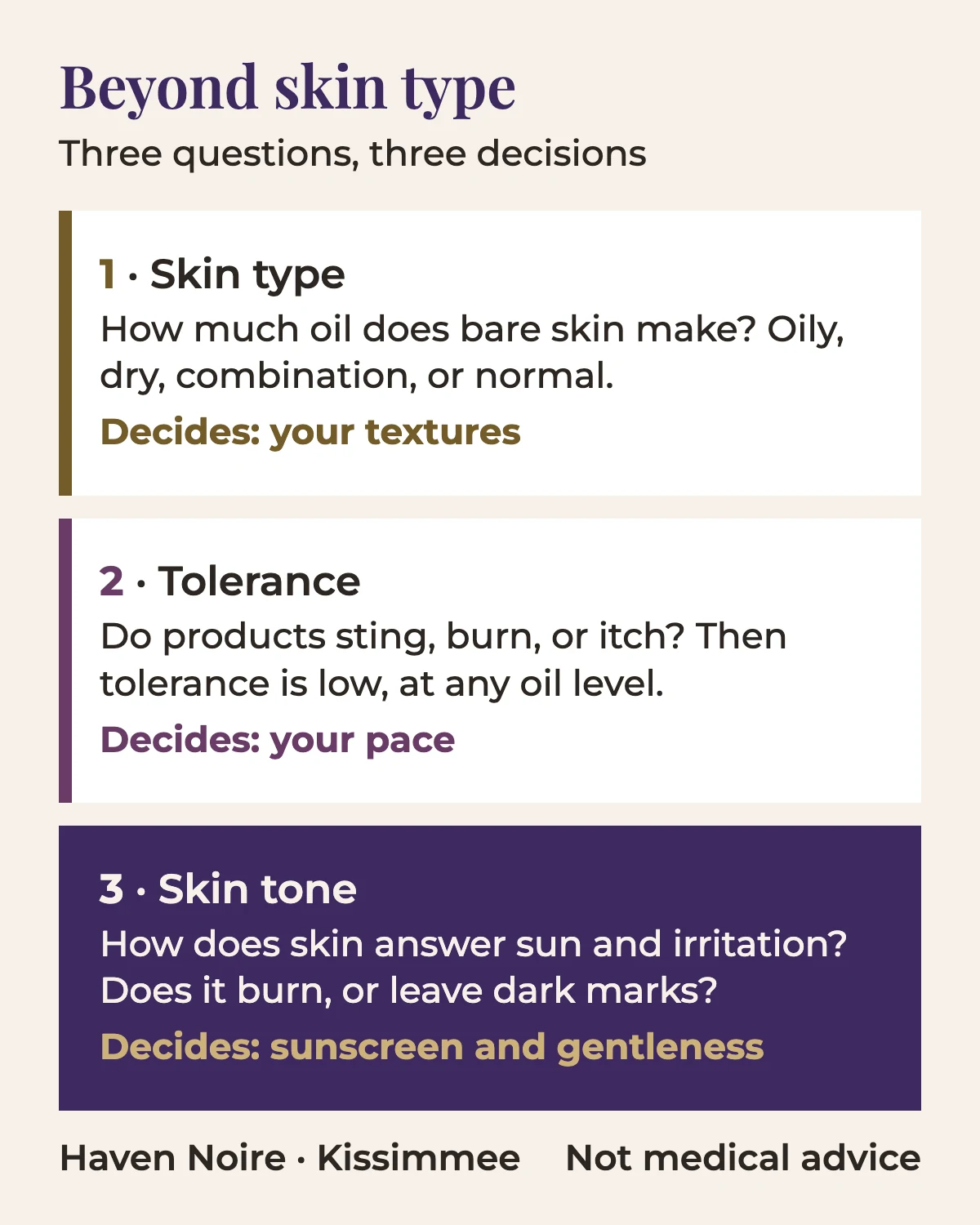
How much oil does your skin make?
That's your skin type, the wash-and-wait answer. It decides textures: your cleanser, your moisturizer's weight, and whether you need two products for two zones.
How fast does your skin react?
This is where "sensitive" belongs. If products sting, burn, or itch, your tolerance is low, oily or dry. Tolerance decides pace. Our advice: with low tolerance, add one new product at a time and give each a week or two. If things already sting, our skin barrier guide walks through a slower reset.
How does your skin answer sun and irritation?
This question is about tone: how your skin reacts to the sun and whether irritation leaves a mark. On darker skin tones, the AAD lists a skin or hair care product that irritates your skin among the causes of dark spots, and says a spot a few shades darker than your skin usually fades within 6 to 12 months once its cause stops. Tone decides protection: your sunscreen and how gently you exfoliate.
| Trait | The question | Possible answers | What it decides |
|---|---|---|---|
| Skin type | How much oil does bare skin make? | Oily, dry, combination, normal | Cleanser and moisturizer texture |
| Tolerance | How quickly do products bother it? | High, medium, low | How fast you add products |
| Skin tone | How does it react to sun and irritation? | Burns easily, rarely burns, marks easily | Sunscreen and exfoliation |
Together, the answers read like "combination, low tolerance, marks easily." That says far more than "combination" alone: light textures on the T-zone, a slow pace with anything new, gentle exfoliation, and daily sunscreen.
Combination Skin: Why It's the Hardest Type to Read
Combination skin is dry in some spots and oily in others, as the AAD's guide to picking a moisturizer puts it. The oily part is often the T-zone, meaning your forehead, nose, and chin.
It's also the type with the fuzziest edges. In a 2005 study from Seoul National University, published in Skin Research and Technology, researchers measured facial oil at five sites on the same volunteers each season for a year. The authors called combination the most common type, with a vaguer definition than the others. The forehead, nose, and chin made more oil than the cheeks, and summer was the oiliest season. They proposed a seasonal definition: the T-zone and the cheeks (the study's U-zone) don't match in more than two seasons.
That fits the 2020 study above. Our take: if your result changes from test to test, combination is often the honest answer.
How to care for combination skin
- Treat it as two faces. An AAD dermatologist advises people with combination skin to moisturize the dry spots and skip the oily areas.
- Keep the T-zone light. The AAD's oily skin tips suggest products labeled oil free and noncomedogenic, plus blotting papers through the day.
- Don't scrub the shine away. The same page warns that a face wash that's too harsh can irritate your skin and trigger more oil.
- Adjust by season (our suggestion). In a Central Florida summer your cheeks may need less; in a cold office they may need more.
Wondering whether toner earns a place on your T-zone? See what toner does. Dark dots on your nose? Our guide to getting rid of blackheads sorts them from sebaceous filaments.
Skin Type vs. Skin Tone: Two Different Readings
Skin type describes oil and reactivity. Skin tone is your color. Skin phototype, often called Fitzpatrick type, describes how your skin reacts to the sun. Any tone can be oily, dry, combination, normal, or sensitive. For a routine planned around how melanin-rich skin reacts, see skin care for Black skin.
DermNet, a dermatology reference site from New Zealand, describes the Fitzpatrick skin type as a way to classify skin by its reaction to sunlight, from type I, which always burns and doesn't tan, to type VI, which never burns and always tans darkly. It calls phototype a constitutional characteristic present at birth.
The scale often gets stretched beyond that job. A 2020 paper in Cutis notes it was developed to assess the skin's tendency to burn during phototherapy, yet providers commonly use it to describe skin color and ethnicity. A 2024 dermatologist panel review in the Journal of the American Academy of Dermatology called it the most widely used and validated skin classification, but listed its conflation with race, ethnicity, and skin color among numerous limitations.

Why tone still changes your routine
Tone won't tell you how oily you are, but it shapes two choices:
- How gently you exfoliate. The AAD's exfoliation guide says to avoid strong chemical or mechanical exfoliation if you have a darker skin tone or notice dark spots after burns, bug bites, or acne breakouts.
- Which sunscreen you wear. The AAD's guide to fading dark spots in darker skin tones recommends a tinted sunscreen with iron oxide, SPF 30 or higher, and broad-spectrum protection. Our guide to sunscreen for dark skin helps you choose one.
Already have marks? Start with how to fade hyperpigmentation on melanin-rich skin. For tone and treatment choices, see our guide to facials for Black skin, including where the Fitzpatrick scale falls short.
Where Fitzpatrick shows up on our menu
Our chemical peels carry Fitzpatrick ratings: the Lactic Peel is listed for types I to VI, and the MandeliClear Peel for types I to V. Every peel requires a skin consultation first, so a peel is never a first-visit service. Curious about the acid in the Lactic Peel? Read about lactic acid for skin.
Can Your Skin Type Change?
Yes. Cleveland Clinic notes that your skin type can change over the course of your life, and even at certain times of the year.
- Hormones. Cleveland Clinic names puberty, pregnancy, and breastfeeding.
- Age. MedlinePlus says sebaceous glands produce less oil as you age. Women gradually produce less oil beginning after menopause; men see a minimal decrease, most often after age 80. An AAD dermatologist says perimenopausal people and everyone 50 and older should use a cream-based moisturizer.
- Season. In the 2005 Seoul study, summer was the oiliest season of the year.
- Stress, diet, and certain medicines. Cleveland Clinic says these can affect your skin too.
Our advice: rerun all three checks each spring and fall, and whenever your routine stops feeling right. Men can start from the same checks with a simple men's skincare routine. Shopping for a tween? See what tween skin actually needs.
Sensitive Skin or a Skin Condition? When to See a Dermatologist
"Sensitive" is a skin care label, not a diagnosis. Stinging and redness can come from an overworked routine or from a condition that needs a doctor. Haven Noire is an esthetics spa, not a medical office, so we don't diagnose skin conditions. See a board-certified dermatologist if you notice:
- Signs the AAD lists for rosacea in darker skin tones: a warm feeling most of the time, a dusky brown discoloration, burning or stinging when you apply skin care products, or acne-like breakouts that acne treatment won't clear.
- Intense itch, which the AAD calls typical of atopic dermatitis, or the dark brown, purple, or grayish patches it lists as a sign in darker skin tones.
- Stinging or flaking that keeps coming back after you've simplified your routine (our advice).
- Breakouts, dark spots, or texture that months of home care haven't changed. Our esthetician vs. dermatologist guide sorts who to see for what.
Pregnant, or using isotretinoin, tretinoin, or another prescription skin medicine? Talk to your doctor or dermatologist before you change your routine or book a treatment; the AAD says retinoids should not be used during pregnancy. The same goes if you have eczema, rosacea, or skin that forms keloids.
Already working with a doctor? Our page on sensitive and redness-prone skin explains how we approach reactive skin alongside your physician's care.
What a Skin Analysis Adds at Haven Noire
An at-home test shows what your skin does in your bathroom. A skin analysis adds a trained second look. Every Signature Facial begins with a double cleanse and a customized skin analysis, so each product and technique is chosen for your skin that day. Then come exfoliation and extractions as needed, a custom mask and facial massage, and serums, moisturizer, and SPF.
Bring your answers to the three questions and a list of every product you use, prescriptions included. For sensitive or reactive skin, our facial page notes gentle options chosen for your skin that day. Tiffany, our founder, is a Florida-licensed esthetician known for a calm, education-first approach that puts first-time clients at ease.
What our menu says each facial suits
| Service | Listed for | Time | Price |
|---|---|---|---|
| Signature Facial | All skin types | 60 or 90 minutes | $95 (3 for $210) or $110 (3 for $285) |
| Hydrofacial (Corrective Facial) | All skin types, dull, dehydrated, congested, uneven | 60 minutes | $135, or a 3-pack for $360 |
| Dermaplane + Nano Infusion (Corrective Facial) | All skin types, congested, dull, dehydrated, hyperpigmented, sensitive | 60 minutes | $135, or a 3-pack for $360 |
Both corrective options are on our corrective facials page. Prefer a monthly rhythm? The Glow Membership covers one 60-minute Signature Facial a month for $74.99; compare tiers on our memberships page. Between visits, ask about the professional skincare lines we use.
Frequently Asked Questions About Skin Types
What are the 5 skin types?
The American Academy of Dermatology describes five: oily (shiny and greasy), dry (flaky, itchy, or rough), combination (dry in some areas, oily in others), normal (clear and not sensitive), and sensitive (may sting or burn after product use). Sensitive can overlap with any of the other four, which is why we read it as a separate question.
How long should I wait after washing to check my skin type?
Guides disagree. A Cleveland Clinic article checks after about 30 minutes, while a Medical News Today guide watches how skin changes over the next few hours. Whichever you choose, apply nothing in between, test on an ordinary day, and repeat on two or three days, since heat, a workout, or a new product can throw off a single reading.
Can oily skin also be sensitive?
Yes. Cleveland Clinic says you can have sensitive skin that's also dry, oily, or combination, and a 2020 dermatology review describes oily sensitive skin as a pairing that causes significant discomfort. If oily skin stings or reddens with products, choose gentle, oil-free textures and add new products one at a time.
Is combination skin oily or dry?
Both, in different places. The AAD describes combination skin as dry in some spots and oily in others, often with an oily forehead, nose, and chin. An AAD dermatologist suggests moisturizing the dry spots and skipping the oily areas. If your test results change from day to day, combination is often the answer.
Does skin get less oily with age?
Often, yes. MedlinePlus says sebaceous glands produce less oil as you age: women gradually produce less oil beginning after menopause, while men see a minimal decrease, most often after 80. Cleveland Clinic adds that puberty, pregnancy, breastfeeding, and the time of year can change your skin too, so rerun the wash-and-wait test each spring and fall.
Is Fitzpatrick type the same as skin type?
No. Fitzpatrick type, or phototype, classifies skin by how it reacts to sunlight, from type I, which always burns, to type VI, which never burns. Your everyday skin type describes oil and sensitivity. Deep skin can be oily, dry, combination, normal, or sensitive, just like light skin.
Can an esthetician tell me my skin type?
An esthetician can give you a trained second look, not a diagnosis. At Haven Noire, every Signature Facial begins with a double cleanse and a customized skin analysis, at $95 for 60 minutes or $110 for 90. If you notice signs of rosacea or eczema, see a dermatologist before you book.
More from the Journal

About the author
Tiffany · Licensed Esthetician · Licensed PMU Artist
Tiffany is a Florida-licensed esthetician and permanent makeup artist and the founder of Haven Noire. She specializes in customized facials, corrective skincare, and waxing for melanin-rich and all skin types, and is known for a calm, education-first approach that puts first-time clients instantly at ease.
Meet Tiffany →